Stitching the Path: Connecting Disjointed Walk & Cycle Routes 1

A mission objective of the rECOnnect Dengie project is to improve the active travel infrastructure on the Dengie and get a safe network of routes connecting all the settlements. As I’ve noted previously, there are lots of good words about achieving this sort of thing in the strategy documents produced from the national level down to the parish – but what happens next? How does it happen?

This in the first in a series of posts where I’ll look at where there are opportunities on the Dengie to connect up existing routes and how we might turn document objectives into objective fact. I’m starting close to home in Burnham-on-Crouch.

The Burnham-on-Crouch Neighbourhood Development Plan [pdf](2017) expressed a clear desire for better active travel infrastructure:

5.3 Make Burnham-on-Crouch a More Pedestrian and Cycle Friendly Place to Live

The Town should have a friendlier environment for cycling and walking. Its main and secondary roads are dominated by vehicles. New pedestrian and cycle routes should be provided that link the town centre with existing and new neighbourhoods, schools and recreation areas via quieter roads.’

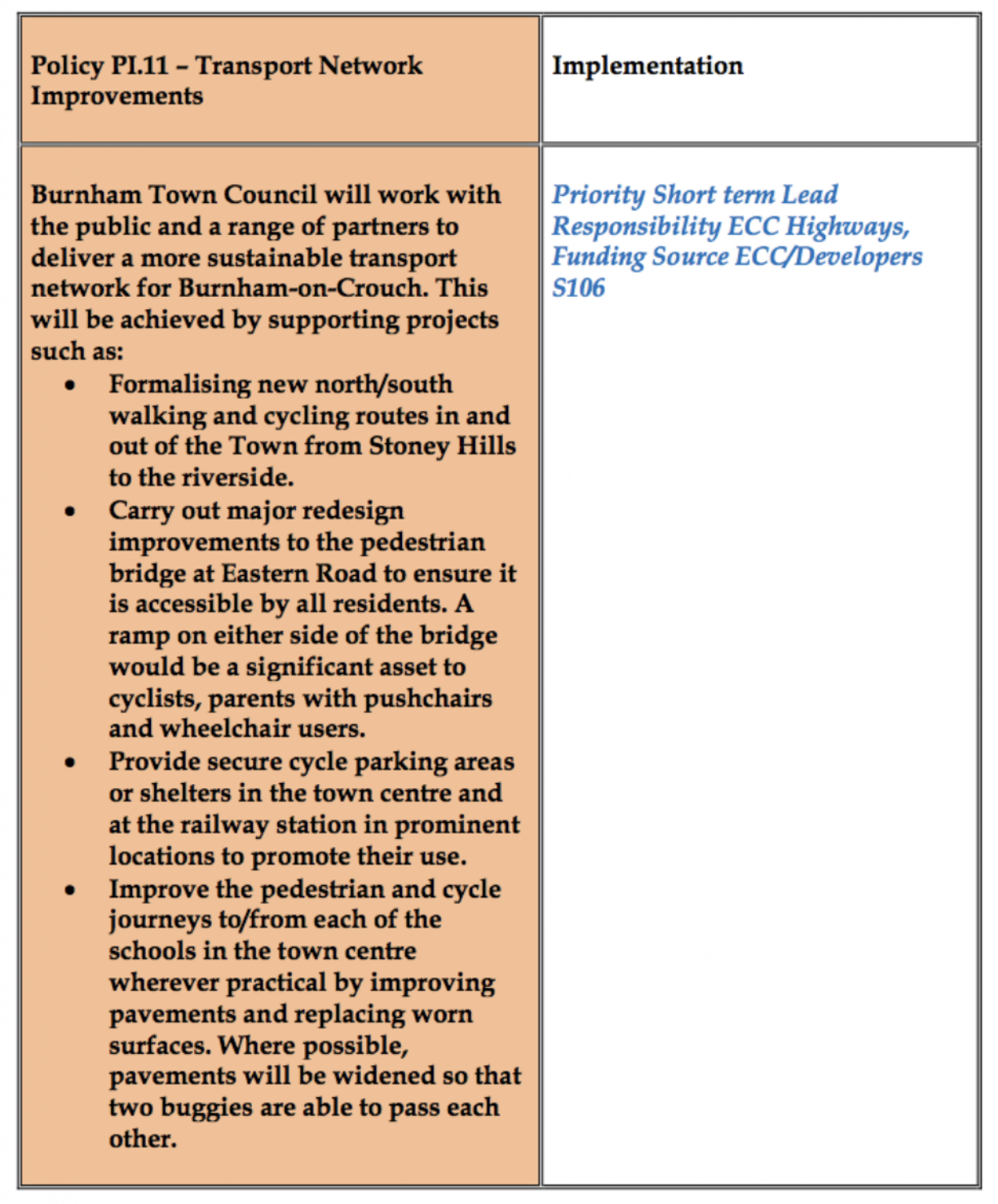
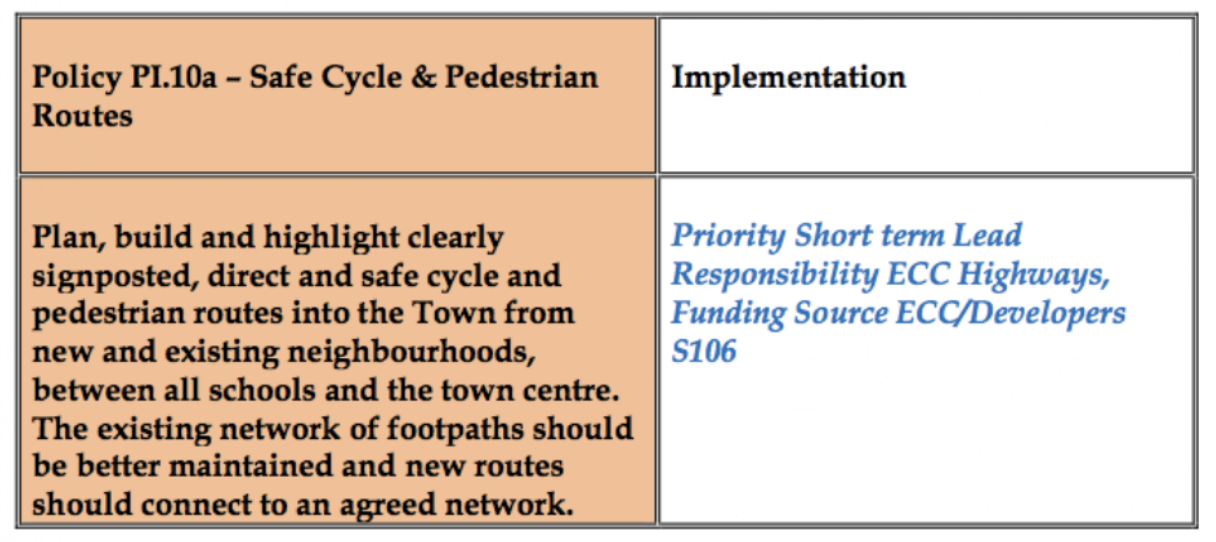
It substantiates this objective with policies including:
One of the first new neighbourhoods created after the NDP is the Grangewood Park estate which was built on agricultural land allocated for new housing as Site S2 (j) in the Maldon District Local Development Plan [pdf]. A site with a long southern boundary to the town’s Secondary School, the Ormiston Rivers Academy.
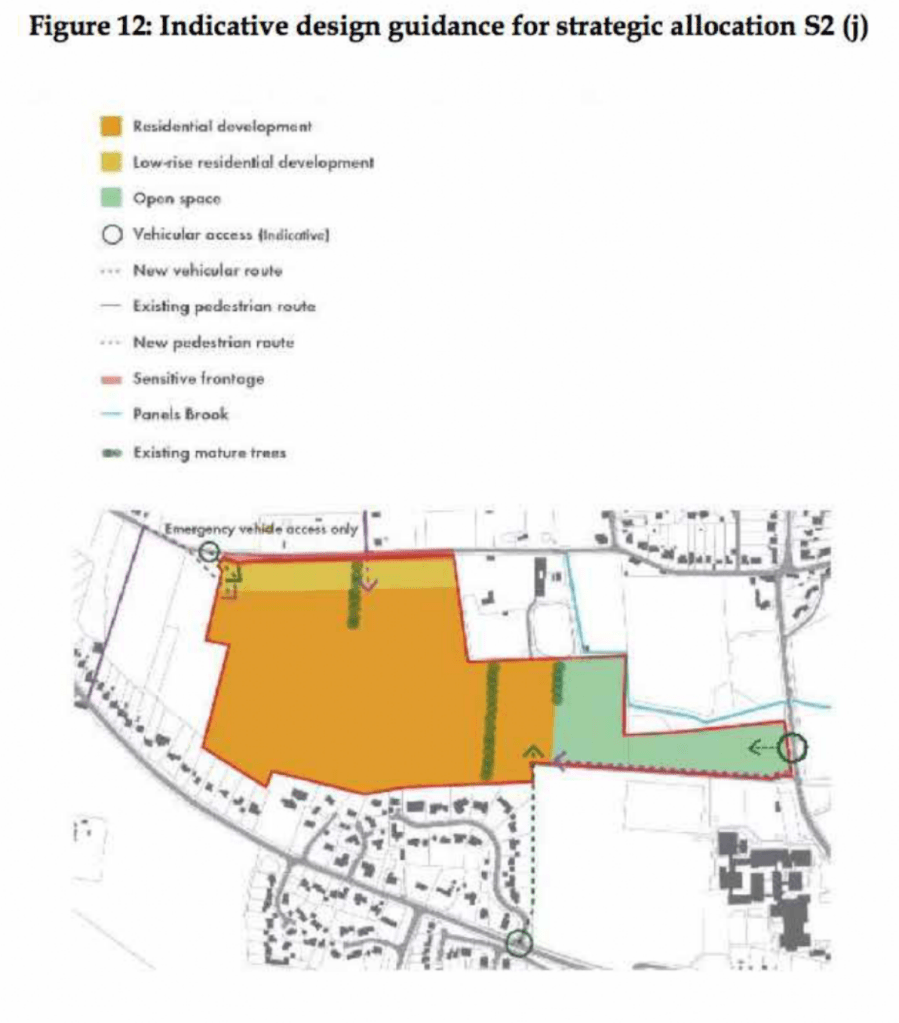
Figure 12 in the Burnham NDP (Apologies for poor image quality, this is as it appears online)

The masterplan [pdf] presented by developers Charles Church in their planning application included a new off-road foot/cycle path running through the green space on the estate and providing a connection from Southminster Road in the east to Green Lane in the north.

Their document notes that the Maldon LDP includes:

T2 Transport Infrastructure in New Developments The layout of new developments should provide for safe access to and from the highway including… links to adjacent or nearby foot/cycle path network’

and that it states that amongst the criteria any proposed development must satisfy is:

‘Safe pedestrian and cycle linkages are provided from the development to the town centre, other public service facilities and the existing urban area’.

(The Residential Travel Plan [pdf] supplied in the developer’s application noted that ‘[t]here are no dedicated cycle facilities in the vicinity of the development site’)

Later the planning application notes that ‘[t]he Burnham Neighbourhood Plan shows proposed cycle links that the Town would like to see progressed; within this diagram a possible link is shown into the site subject to this application. The provision of this link would rely on third party land and therefore cannot be provided by Charles Church, however the scheme has been developed to facilitate future connectivity.’

It’s unclear exactly what this is referring to, as the Burnham NDP includes text references to possible cycle routes but no maps showing these. The diagram with ‘a possible link’ is perhaps the green dotted line ‘new pedestrian route’ shown in the NDP’s ‘Figure 12’ (copied above) connecting the site to Maldon Road in the south, and running along the western boundary of Ormiston Rivers’s playing fields. This would have been a convenient addition to Burnham’s walk/wheel/cycle routes but it never materialised and it illustrates succinctly a key unaddressed problem in getting better active travel infrastructure.

i.e A government strategy proposes active travel infrastructure as an essential part of new developments, a developer provides infrastructure within the development – but the value of such infrastructure is largely produced by a larger connectivity that neither government nor developer is providing.

The National Planning Policy Framework (NPPF) make enough noises about pedestrian and cycle routes that applications for new housing tend to include vague promises about including them. On the ground this tends to result in intra-estate pathways that have genuine utility but terminate at the estates’ boundaries with no clear sense of how onward travel on foot, mobility device or bicycle might proceed.
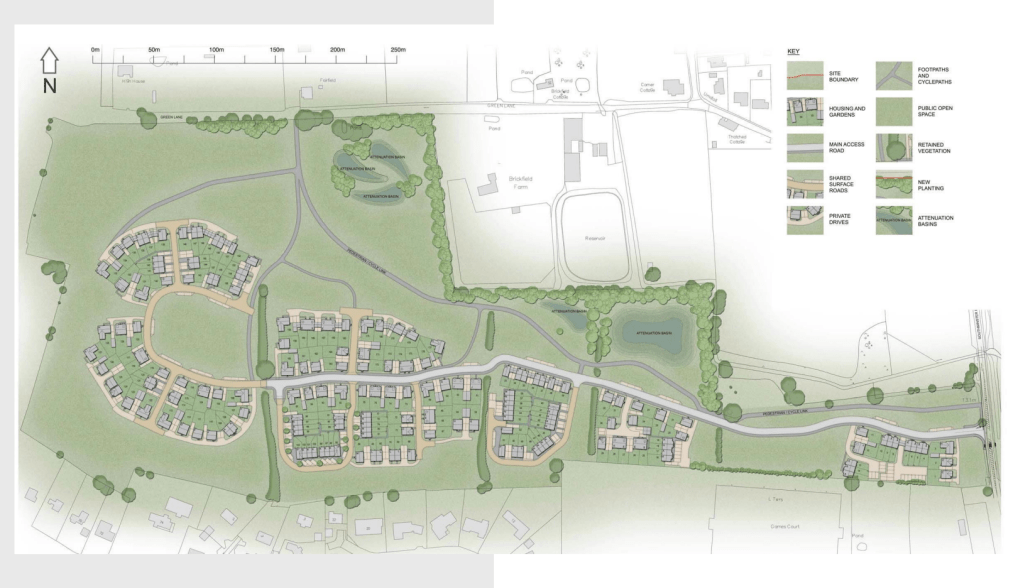
Foot/cycle paths shown in grey to the north of the housing on Grangewood Park estate

True to their promise, the developers of Grangewood Park delivered the walk/cycle path on their masterplan and the estate includes what is, currently, the best example of active travel infrastructure in the town with an off-road path that connects Southminster Road with Green Lane – but what happens when you get to Southminster Road or Green Lane? What contribution does it make to a safe, active travel network?
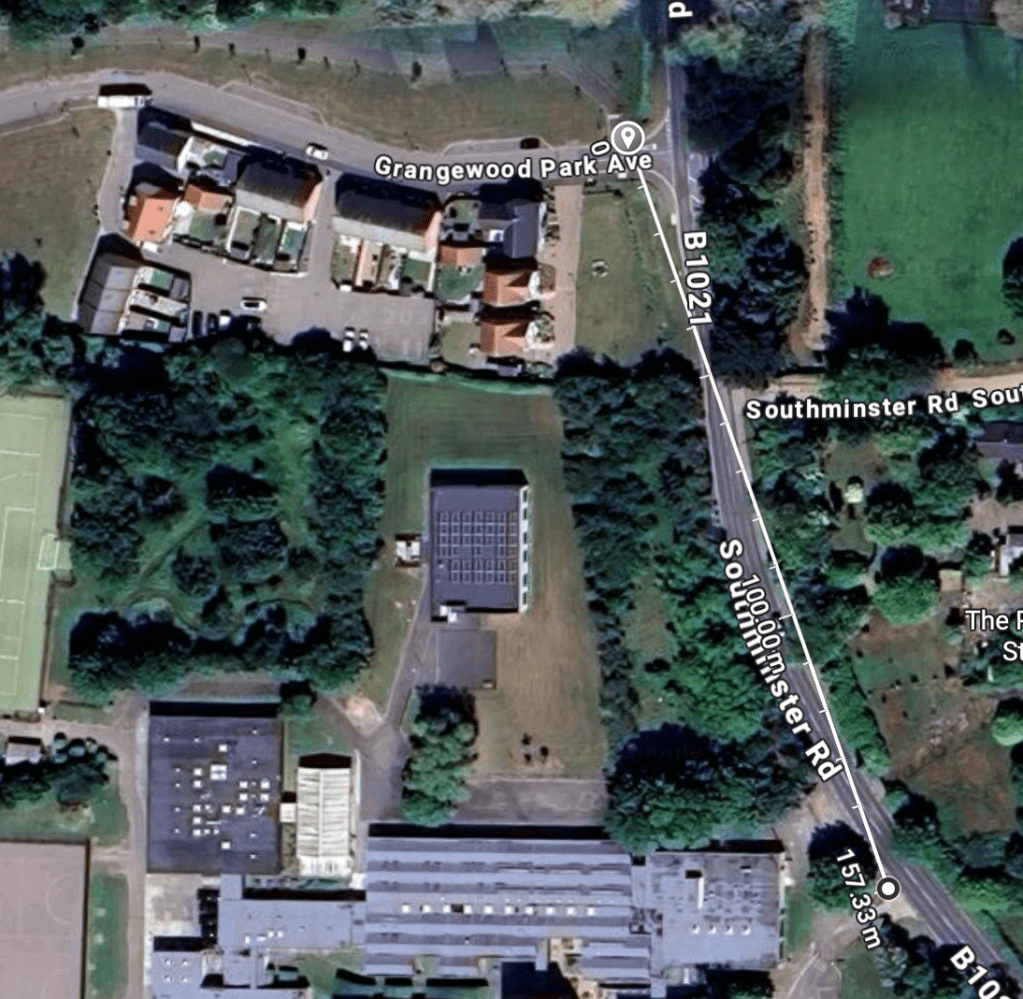
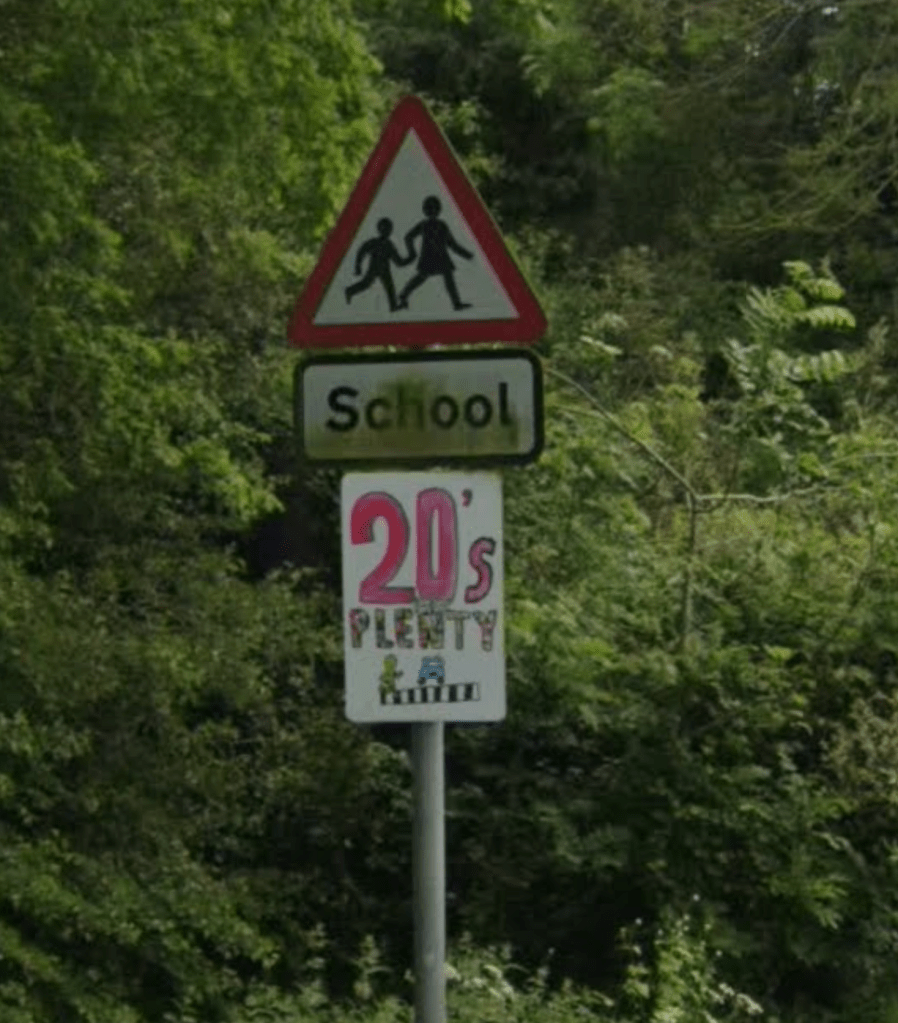
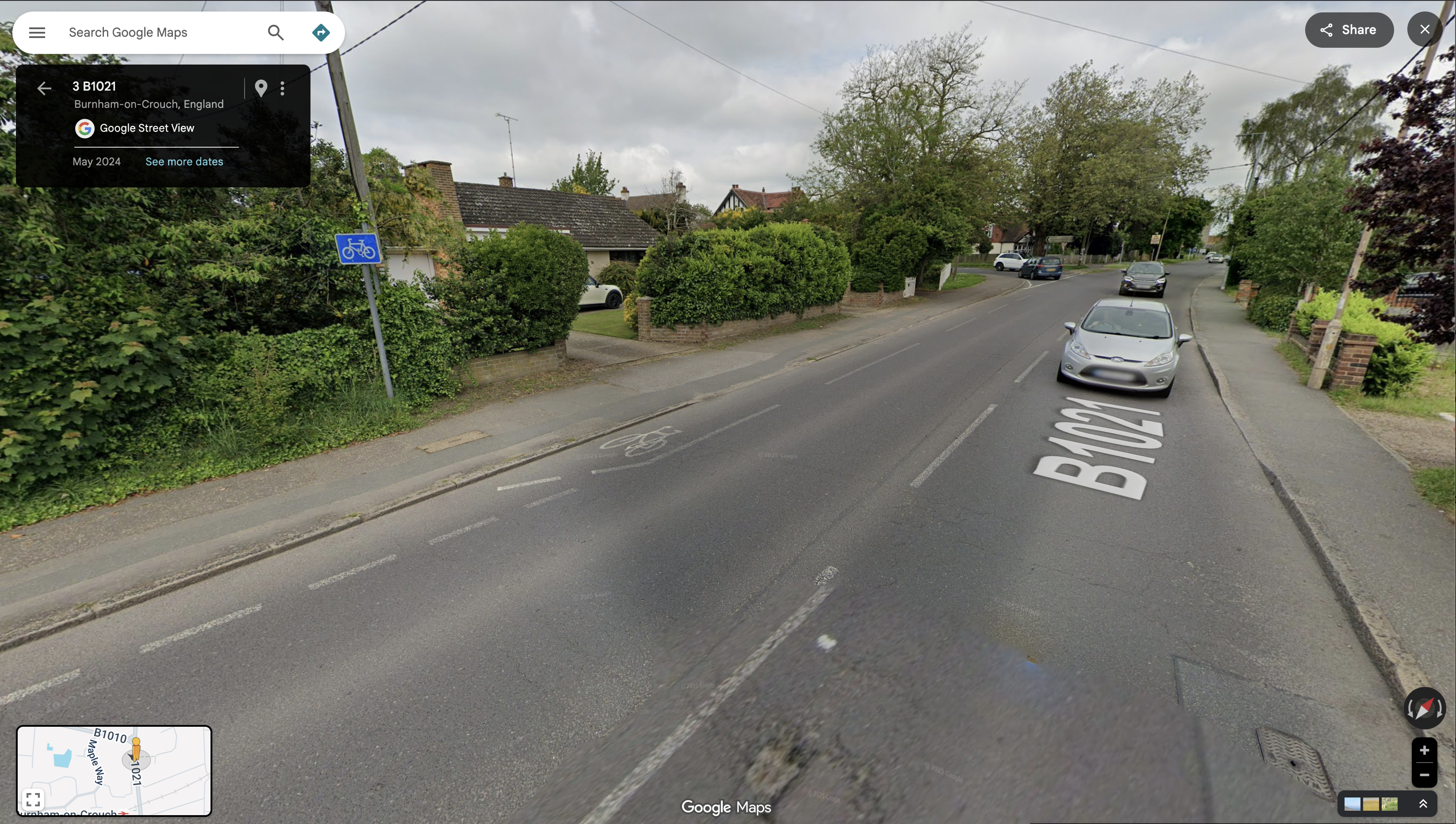
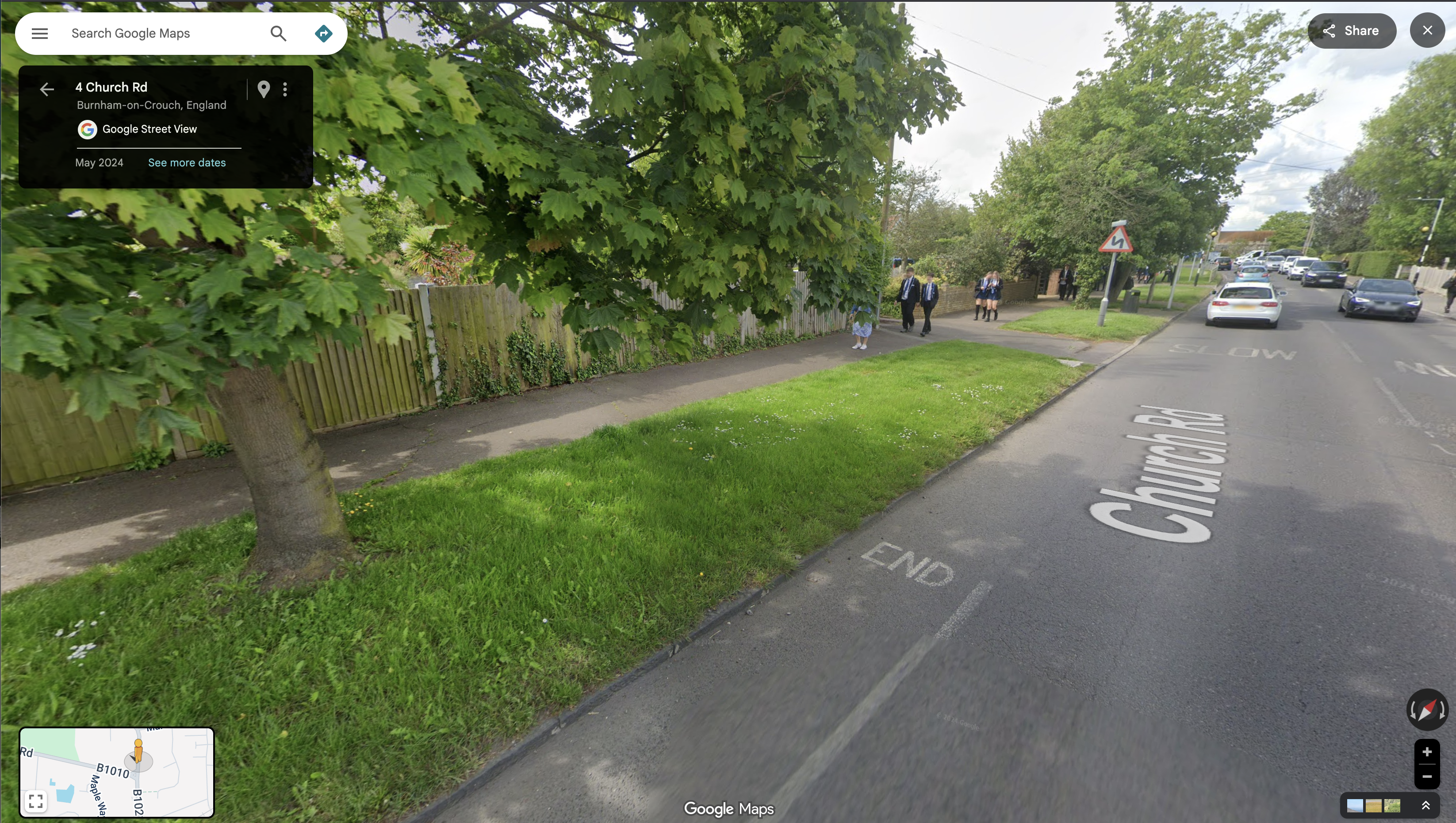
At Southminster Road (B1021) the pathway ends 160 metres north of the entrance to Ormiston Rivers school. A child on a bicycle coming through Grangewood Park must now leave the off-road cycle path, cross a lane of northbound traffic leaving town on the B1021, and join the southbound lane – before turning across the path of northbound traffic again to complete their journey to school. Opposite the Grangewood junction there’s a road sign with the red triangle warning of a school ahead and, beneath it, one of those advisory-only ’20’s Plenty’ signs – but the B1021 has a 30mph speed limit at this point and has limited direct access along this section, a form that tends to encourage vehicle speeds in excess of the legal limit. The common experience of cyclists, of all ages, using this road is driver impatience and an aggressive eagerness to pass.
Meanwhile, pedestrians leaving the off-road path at Southminster Road find there is no footway providing an onward walking route north or south. There is a narrow pavement on the east side of Southminster Road but there is no controlled crossing to reach it (a small traffic island provides some pedestrian refuge).
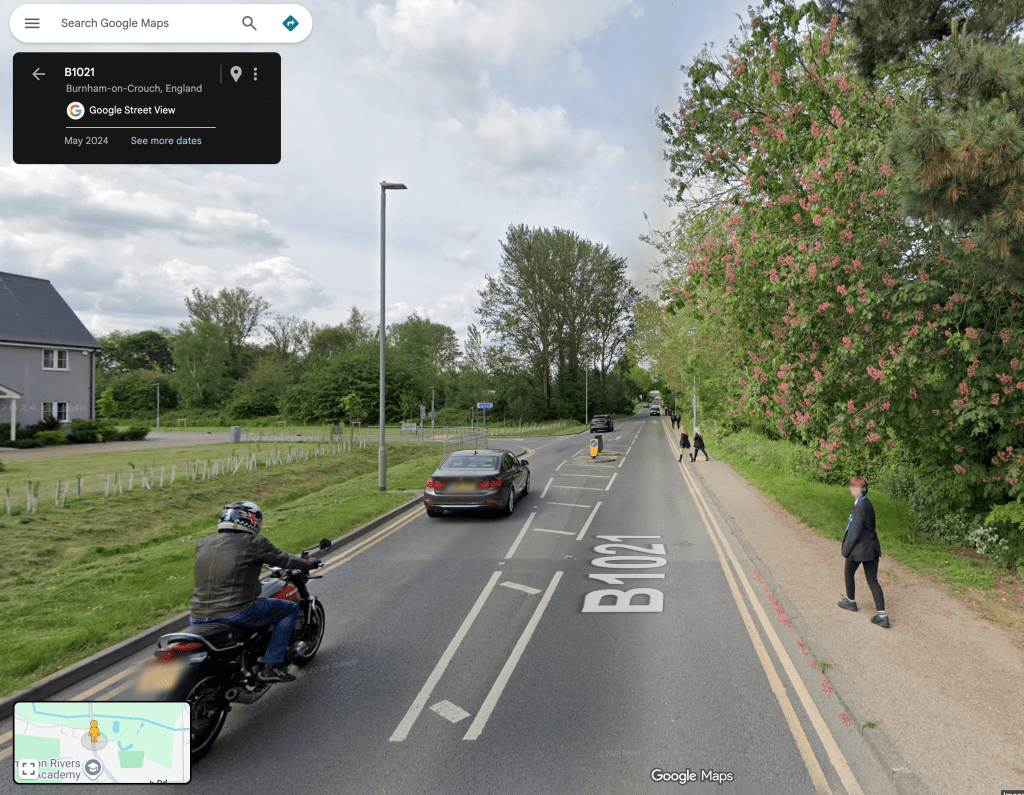
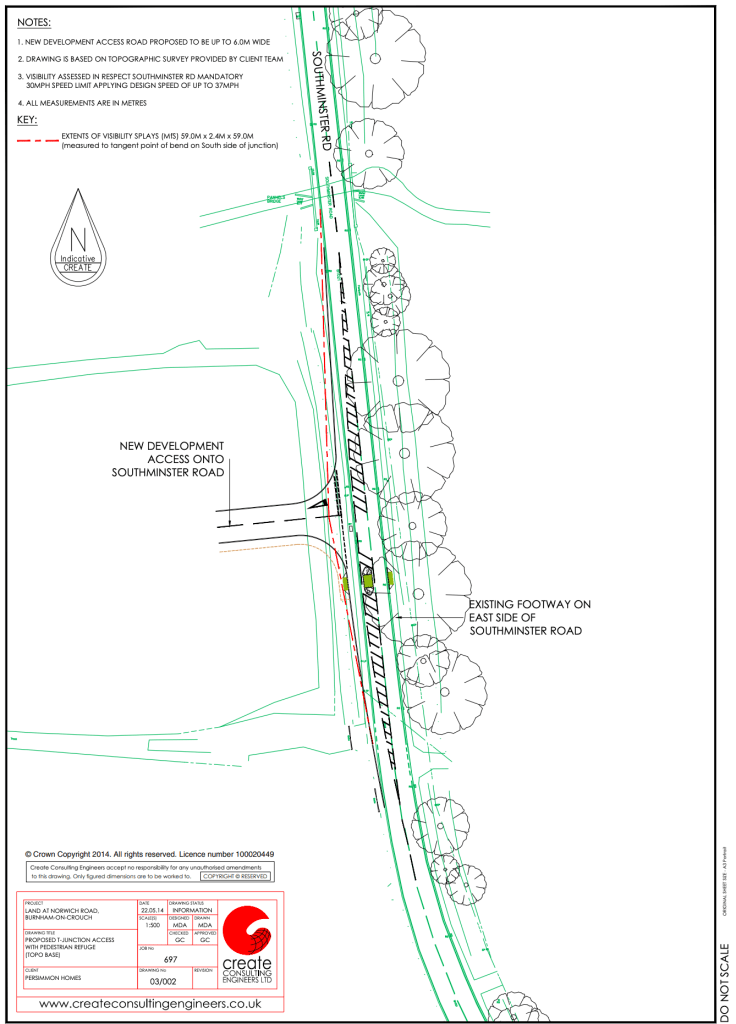
School children cross the B1021 to reach the Grangewood Park Estate.
The junction of Grangewood Park Avenue and Southminster Road, where the foot/cycle path ends

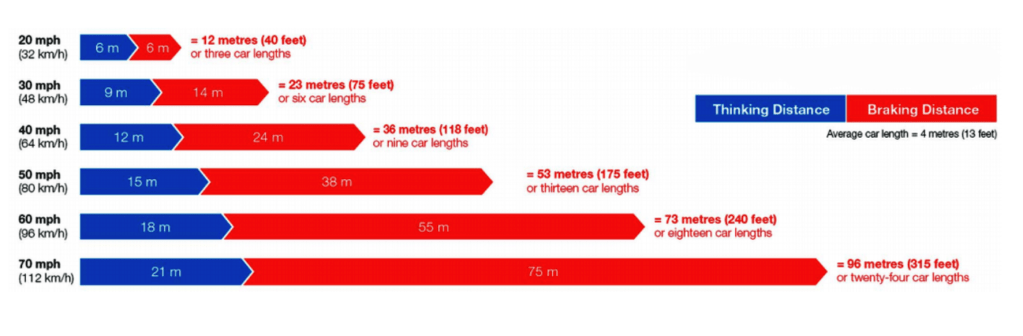
Once the road is crossed, a pedestrian can proceed south on pavement into Burnham. If it’s a child walking to the school they can pass the school entrance on the other side of the road and carry on further south around a bend to cross the road at a zebra crossing, then walk north again up the opposite pavement to reach the school entrance – a distance of 450m. Will they do that though? Of course not!, once they are opposite the school entrance our cyclist used – 160m down, they’ll do what she did and cross the road there. The curve of the road means that drivers travelling south will be blind to a child crossing the road there until they are quite close. The Highway Code calculates the stopping distance of an average car at 30mph in dry conditions to be 23 metres.
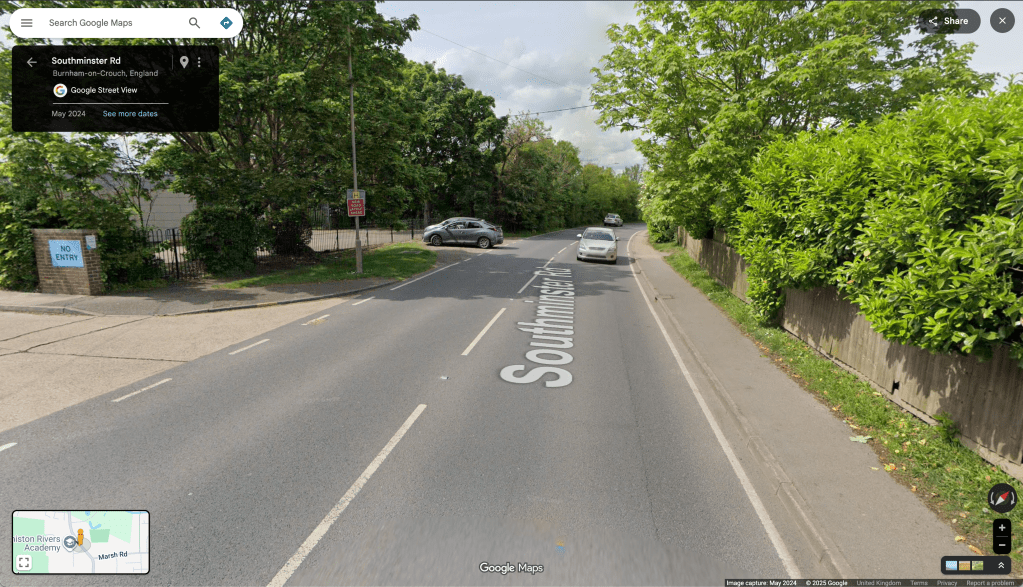
Looking north up Southminster Road where a child is liable to cross to reach the school
Car stopping distances in the Highway Code

‘But there’s no alternative!’ I hear you cry, ‘you just have to make do with what you’ve got’.

‘I know this estate is right next to the secondary school and we agreed in the neighbourhood plan to “plan, build and highlight clearly signposted, direct and safe cycle and pedestrian routes into the Town from new and existing neighbourhoods, between all schools and the town centre” and we agreed that we would “improve the pedestrian and cycle journeys to/from each of the schools” – but really what else could we have done?

Let me tell you!

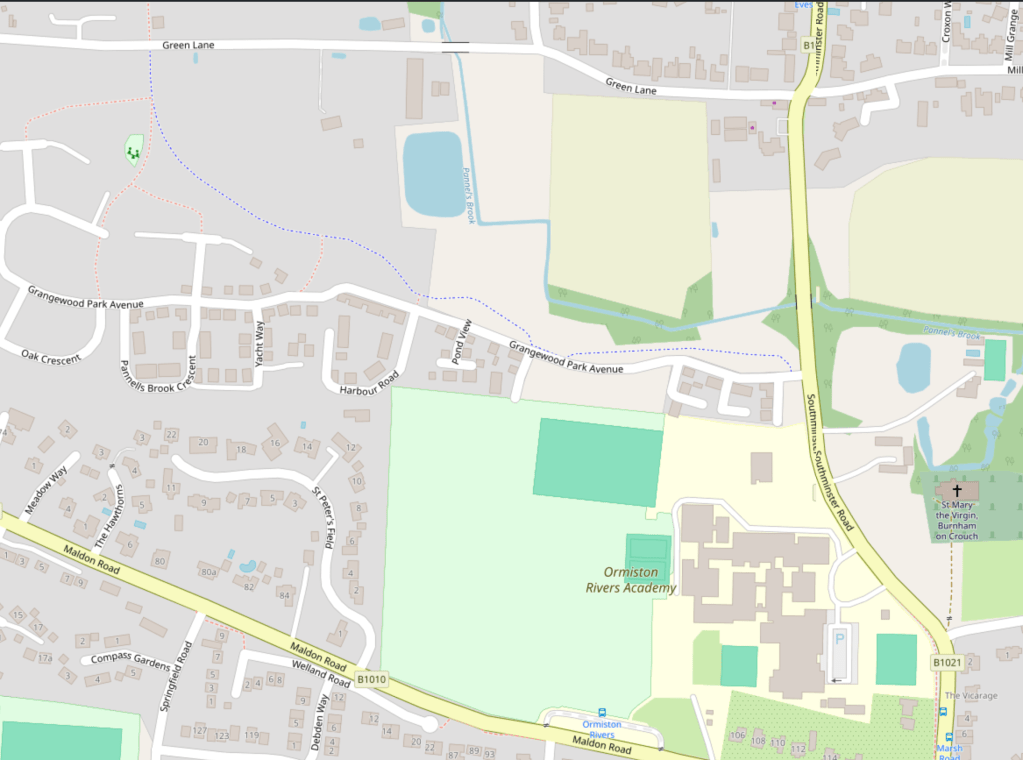
Grangewood Park shares a border with Ormiston Rivers school, their frontage to Southminster Road is contiguous. The foot/cycle path could have gone over Grangewood Park Avenue and continued south over amenity land to the boundary of the school and through the small woodland which separates it from the paved area of the school grounds.
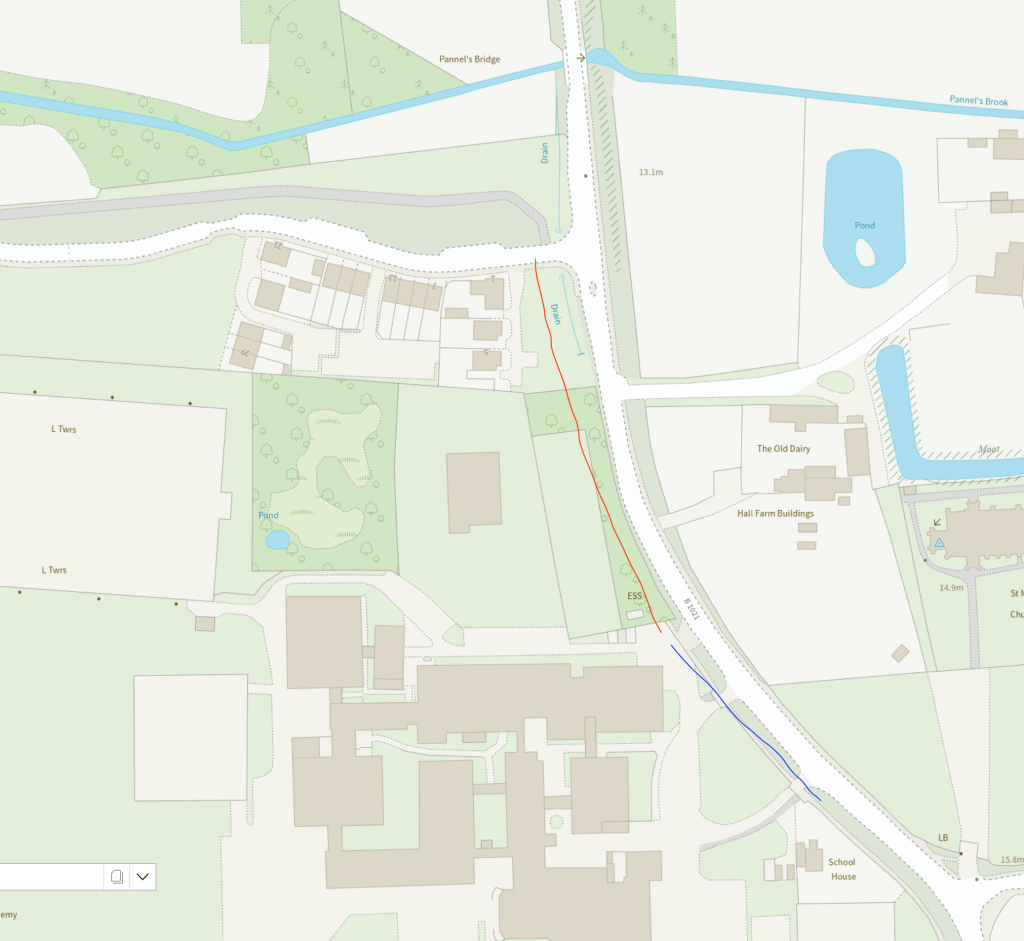
The red line indicates where the Grangewood path could be connected to Ormiston school, the blue line how that could continue to the existing footway

All the land involved either belongs to the developer or to Essex County Council. The developer was on-board with facilitating connectivity, the Town and District Councils wanted connectivity, Essex County Council/Essex Highways wants kids to cycle to school. It should have happened… and it still can!

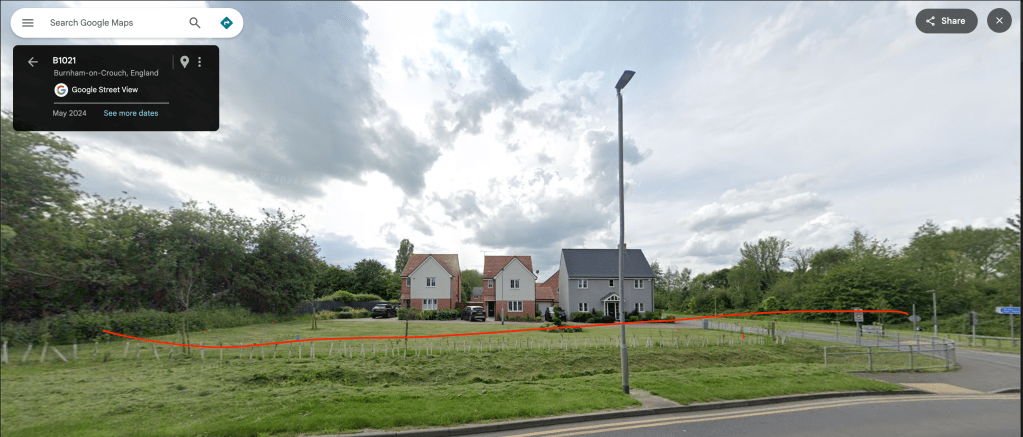
The current residents of the three houses on Grangewood Park estate facing Southminster Road might prefer the current area of mown grass and small flower bed, but they’d benefit from a walk/cycle/wheel route through it. Improving active travel routes is beneficial for everyone, not just children.
This missing link would facilitate footway access from Burnham’s riverside, urban centre and railway station through to Green Lane by reducing the number of necessary road crossings. It would complete a safe cycle route from the Grangewood Park estate to Ormiston school.

EXTRA CREDIT: The pavement going south from Ormiston School has an area of verge and is wide enough to allow a shared foot/cycle way to the junction with Maldon Road (B1010). Across the B1010 junction, in the northbound lane, there is also Burnham’s oldest piece of cycling infrastructure – a painted cycle lane that begins just south of it and finishes quickly north of it – it’s of spurious utility but nevertheless could easily merge into a cycleway on the west of Southminster Road and gain a connectivity it has never had before!
What happens at the other end of the Grangewood Park estate foot/cycle path though? Can we get anywhere from there? Look out for Stitching the Path: Connecting Disjointed Walk & Cycle Routes 2 – where I will address these very questions!
Weeknotes 02025 Q1 W8

DCAP

Monday. I feared devolution in Essex would derail strategic planning on climate issues

That seems to be proving true with the new Transport Strategy for Essex (LTP4) which was set to reflect county and national policy commitments to transport decarbonisation and better provision of sustainable transport and active travel infrastructure.

Public consultation on the draft Transport Strategy for Essex (LTP4) & the programme of planned investment in different parts of Essex was scheduled for Winter 24/25 – with adoption of the new strategy in Spring 2025.

I recently sought confirmation of calendar dates for the Essex Transport Strategy and received the dispiriting reply that devolution was causing the timetable to be revised….

Today I have written to ECC Cllrs Fleming and Stamp who represent the Dengie, and to cabinet member and ‘climate czar’ Peter Schweir seeking answers to these questions:

  • When will the decision regarding further public consultation and timelines be made?
  • Can they confirm that Essex County Council remains committed to formally adopting LTP4 in 2025?

Tuesday – Cllr Schweir replied first but just said he would ask the officers – not very satisfactory as I had already forwarded him my reply from officers which noted that it was a member’s decision… . Cllr Fleming sent a reply saying she would try to find out. No reply fro Cllr Stamp


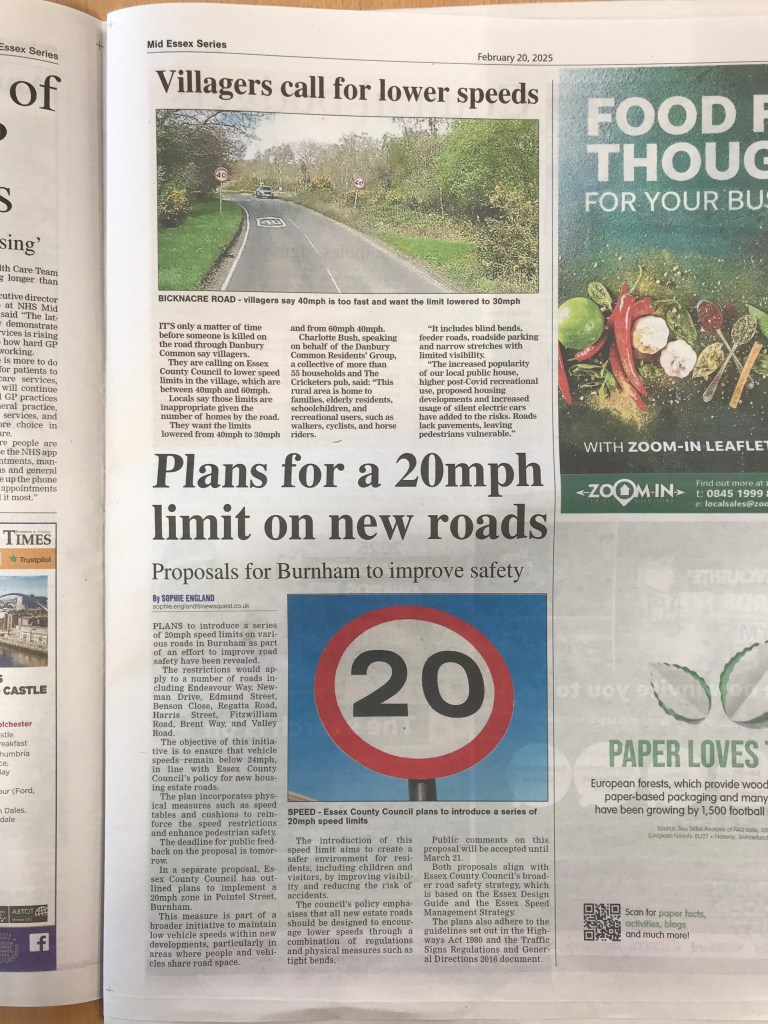
The Maldon & Burnham Standard featured a news story about 20mph speed limits for the new estates in Burnham-on-Crouch. I’d already heard it mentioned at the last council meeting, but there and on FB there were many comments on how it would be policed – the same way all speed limits are policed, I presume?

Thursday. I published the first promo for next week’s monthly meet and the associated River Watch talk.


Tree distribution, some of the saplings went to St Andrews’ Althorne. They are planning a wildlife-friendly church ground with Essex Wildlife Trust

Thursday. There was too much interest in DCAP, again, from Burnham Town Council – and it is difficult not to sense malicious intent. Parish/town councils are a strange level of government. They have very little power or influence and they are the easiest positions to get (many join them through co-option or uncontested elections). Yet, post-holders can sometimes seem possessed by a sense of status and authority far removed from their actual position as unpaid servants of the people with very little clout. It should be a noble role, but easily descend into busy-bodydom.

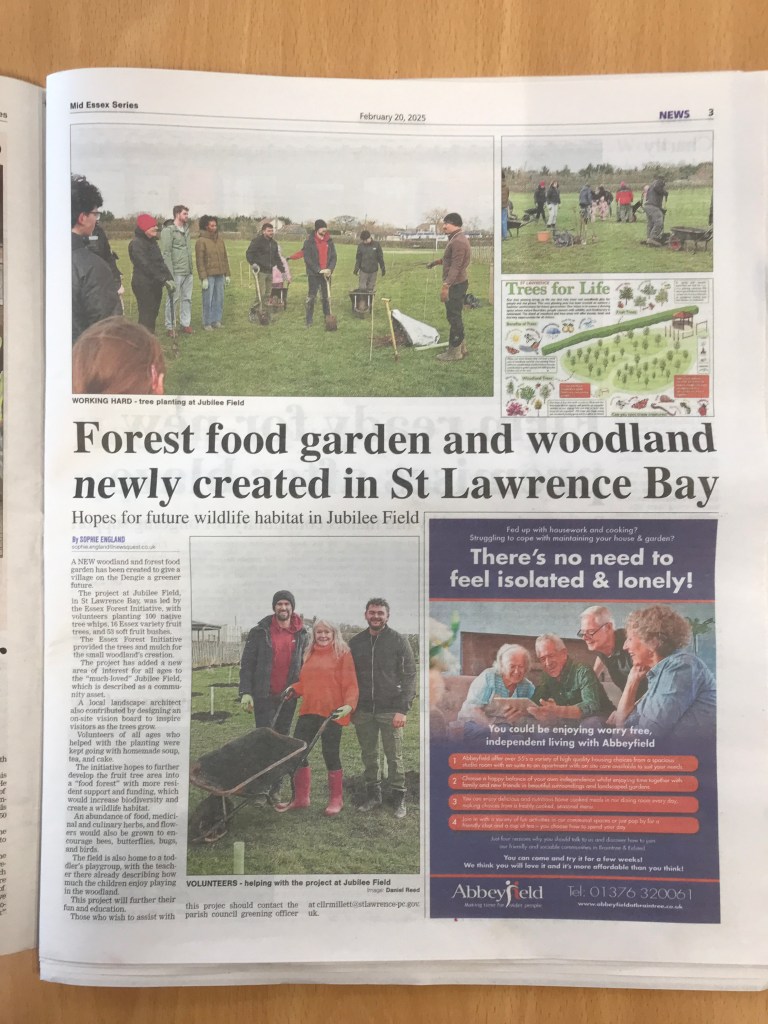
Friday. The new woodland and food forest in St Lawrence made the local paper.

Day Job

1to1 with my line manager – all is good there for now.

Friday – the weekly corporate missive informs staff that we now have a balanced budget for 2025/26 but that the UK Government’s Spending Review Phase 2 for 2026+ is ongoing and “until concluded we still have uncertainty for beyond 2025/26”. It doesn’t look like we got a good slice of the Arts Everywhere Fund. So, along with the uncertainty comes some fear and doubt. The UK finances and Rachel Reeves’s fiscal rules already look set for a collision course before Starmer started pledging billions for Ukraine. We’re still dependent on a government grant coming through an unprotected department, so when April 2026 comes around I imagine some cutbacks will swiftly follow. HR are already asking if folk want to buy some more leave days.

Everyday Life

At some point this week I went under the 600 days threshold on the plan that cannot be named.

Tuesday. The sound of a chainsaw outside this morning, another local tree taken. Our borrowed landscape has declined a lot over the last few years – soft organic form replaced by the hard lines of fencing, brickwork and concrete. In the evening though, just after sunset, I saw a large dog fox leap over a nearby fence and wander around the gardens – all while one of my neighbours practiced playing ‘Wild Thing’ on electric guitar.

Wednesday. Dental hygienist – this is my only interface with private healthcare, and the bill is sufficient to warrant full communism.


Wednesday. I went to a talk by Michael Head at the Royal Corinthian Yacht Club on the last 125 years of Dengie Hundred Farming. These local history talks are frequently very different from the type of academic presentation I’m more used to – and this was one of those – a slideshow of re-photographed old postcards and personal snaps presented alongside anecdotes, jokes and lists of things you might not know about cows. The room was full to the gunwales. Many in the audience were clearly from the farming community and some were referenced or specifically called out to; others were quick to shout out corrections and clarifications: “That’s a pea-spreader!!”

The room was hot from the crowd and the chairs were placed tight against one another which added to the discomfort when laughter accompanied mentions of immigrants or gypsies and cheers were raised at the sight of huntsmen in their finery with accompanying calls to ‘bring it back’.

Many of the photos were great, but I didn’t learn much about the last 125 years of Dengie Hundred Farming – the audience was assumed to know the details, and to recognise the names of people and farms mentioned in passing. I wanted to hear about things like: how the world wars had changed agricultural practice on the Dengie, about local mechanisation and the introduction of chemical Ag, about how the land was altered about the ’53 floods and how the old creeks were filled in and replaced with new straight ditches, about the amalgamation of small farms into fewer larger holdings, about the formation of the Dengie Crops co-operative. I didn’t get any of that, but there were little stories and references you wouldn’t get elsewhere which made it worthwhile nonetheless. I was acutely aware that the talk wasn’t being recorded and that a lot of what was heard but not retained will probably die with the tale teller.

Friday

Saturday. We had our Home Energy Assessment and we now await the report (mid-March was mentioned for delivery). From things the pair of assesors said while they were here I’m not optimistic I’m going to learn much, if anything, I don’t know already – despite the pre-visit written survey I filled in it was apparently news to them that the house was Grade II listed – and there didn’t seem to be in expertise in crafting solutions particular to that need. We won this assessment in a competition, apparently it would normally cost £500 – frankly I’d expect more for that money, but let’s see the report I suppose.

I have larger concerns about the national programme of transitioning the UK housing stock to sustainability. At every level: data collection, analysis, proposed changes – information seems to be drawn from off-the-shelf lists rather than from any understanding of the particularities of the nation’s varied housing stock. If your house was built in the last 40 years and has an EPC certificate, they can easily tickbox through – increase loft insulation to 300mm, solar PV and battery, air-source heat pump, smart thermostat, TRV’s on the rads etc. But the UK’s housing stock is among the oldest in Europe. Our home is among the 15% of houses in England built before 1900 and 78% of homes in the UK were built before 1980. As ONS analysis shows that the age of a property is the most significant factor associated with energy efficiency (ahead of both fuel type and property type), finding bespoke solutions for the housing stock we actually have is more important than blanket applying some set of heuristics.

Saturday. C and I went to the Beecroft Gallery in Southend for the opening of 2 exhibitions – the interim TOMA show and ‘Into the Zone’. Apparently the Southend mayor, Ron Woodley, was in the building but he remained unseen, which was disappointing for those hoping for a face-to-face encounter between him and artist/TOMA leader Emma Edmondson. Woodley has been an eager voice in local philistinism and apparently once threatened to drive into one of Edmondson’s public sculptures

Into the Zone with its Estuary focus resonated with many of my interests and concerns. I was frustrated with the explicit referencing of the Zone from Tarkovsky’s Stalker, though which felt like borrowed glory. Stalker is now one of those overdone culture reference points like the ‘the liminal’, folk horror, standing stones, Sebald’s Rings of Saturn, psychogeography, fungal networks – that have become bland touchstones fully drained of their magick by the Arts and Humanities departments.

Media

TV

White Lotus S03E01
Severance S02E06

Music

Online

‘You can rattle the bars of the cage as fiercely as you like but you will never actually escape the comfort of the zoo’ – James Marriott in The Times, ‘Conspiracists are about to get a dose of reality

‘from here on out, for any player smaller than a state or a multinational, adaptation is pretty much the only game in town worth playing, because it’s the only one that people on the ground are actually gonna notice.’ Paul Graham Raven Drill, Baby, Drill

Future Thinking and Dreaming

You Say You Want a Devolution

This week, the Greater Essex devolution consultation opened – part of the fast-track reorganisation of local governance. The consultation concerns the proposal to form a Mayoral Combined County Authority for the local government areas of Essex County Council, Thurrock Council and Southend-on-Sea City Council. An area it calls ‘Greater Essex’ but once was just called Essex. The first election for a Mayor is scheduled to take place in May 2026 – in 15 months.

The consultation does not concern the proposals for new unitary local government replacing the existing two-tier system, where services are split between a county and district council. This seems like replacing one two-tier system with another one: county & districts replaced with mayoralty & unitary authorities. Suffice it to say, they are not taking a bioregional approach.

Continue reading “You Say You Want a Devolution”

Weeknotes 02025 Q1 W5

DCAP

We had our monthly meeting on Thursday and tried to do some Thermal Imaging of 4 homes at the same time – which was ambitious. The only way to make it work was to split the group in two and I wasn’t really happy with things working out that way. Earlier in the week I spent some time looking through Parish Plans and Neighbourhood Development Plans from across the Dengie looking for opportunities and commitments.

Jo Coombes and I have been working on an idea I’m tentatively calling ‘Looking out for Nature’ inspired by the work that Wild Justice did identifying that ‘Nearly half of the nature-friendly enhancements promised by developers building new homes have failed to materialise’. I shared this report on local social media and suggested that because Maldon District Council has no professional ecologists on staff it was in high peril of developers not fulfilling their legal biodiversity commitments. I got a comment that ‘MDC Planning employs Planning Enforcement Officers who are responsible for investigating developments where planning has not been granted and checking that planning conditions attached to planning approvals have actually been carried out. Where a condition regarding trees or bird box has been inserted then they would check the compliance’ with a link to the Planning Enforcement. If you actually look at the Planning Enforcement site though it doesn’t support the claim that Planning Enforcement are proactive and makes checks. ‘ Their own overview description of their work simply states: ‘The planning enforcement team has responsibility for investigating complaints [my emphasis] principally where unauthorised development has taken place and aims to resolve these using the most appropriate means.’ i.e. they are reactive. It’s impossible to see how planning authorities like Maldon will be able to assess whether developments meet the 10% biodiversity gain

This places the responsibility to identify breaches with concerned citizens, hence the project. Do we really have the capacity to do it though?

Continue reading “Weeknotes 02025 Q1 W5”

Planetary

Here’s a piece I submitted to the upcoming Long Now London newsletter on the ‘planetary’

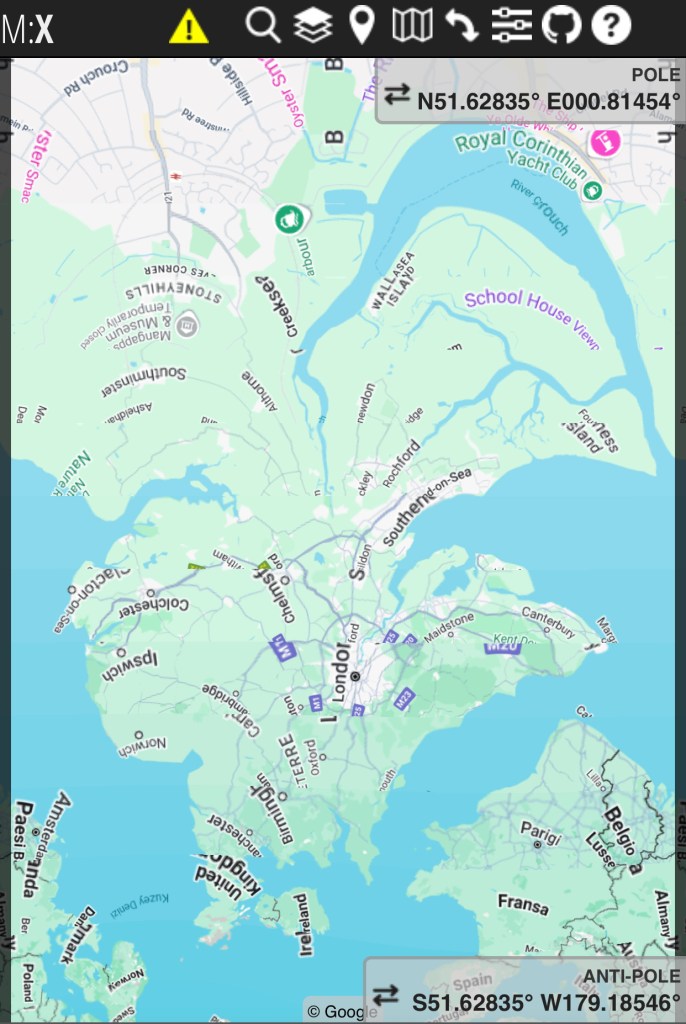
Mercator projection of the Earth centred on Burnham-on-Crouch (or is it London?)

‘Think Globally: Act Locally ‘has been a familiar refrain of the Green movement for decades now. It poses the problematique at the planetary level but advocates for action at a smaller ‘here’. The scale of this here is never entirely clear but the bioregionalist Raymond Dassman confronting the ecological crisis in the 1970s made a distinction between “biosphere people,” who exploit resources from the entire planet and “ecosystem people,” who can achieve a high-quality of life within their local bioregions. The bioregionalists encouraged us to provision ourselves primarily from our local watershed and to reinhabit this more discrete bio-geo-ecological unit as other species do. “The world”, poet Gary Snyder wrote is “places.”

Continue reading “Planetary”

The Reformation

Thursday 5th December was the deadline for electors to request a ballot to fill the empty seats on Burnham-on-Crouch Town Council (BTC). I’ve seen a couple of people online saying they would be requesting one for the sake of democracy and to avoid the remaining councillors co-opting whoever they please. There’s still no news about the result and whether elections will be forthcoming. I suspect enough folk will have asked for an election to get one, but not enough people will stand for there to be a contest—certainly in the North Ward.

Continue reading “The Reformation”

Get on the Magic Bus

Today was supposed to be day one of the new 45 bus service on the Dengie. This would replace the D4 and Dart 5 with a much-reduced timetable combining those two buses. The scheduled services would be reduced to two a day in either direction, Monday to Friday, with the Saturday service lost entirely. The Dengie Hundred Bus Users Group (DHBUG) had intervened to tweak the timetable in Essex County Council [ECC]’s tender as the original proposal gave little time at the route’s destination before returning. As many users depended on the bus to do their weekly shop they would have found themselves with less than an hour to do so. At the DHBUG AGM on 7 June, many attendees were furious about the changes and reduction in service – but ECC didn’t send anyone to the meeting and Arrow Taxis who had won the tender sent a message saying that it wasn’t worth them coming as they didn’t know anything about what was going on past what had been published already.

Continue reading “Get on the Magic Bus”

We shall encounter, counting, face to face

Thoughts on the General Election and Reform UK in Maldon constituency.

Last Thursday, I stayed up all night for the first time in years. It was the UK General election of course and despite the perils of displaced slumber I was minded to burn the midnight oil and watch the disgraced fall. I didn’t have the comforts of home and TV to assuage the sleep deprivation, however, because I had a formal role to play as a ‘counting agent’ invigilating the manual tallying in my constituency. We got the last bus to Maldon, had a drink in the Queen’s Head and walked down to the Blackwater Leisure Centre as the sunlight disappeared.

Continue reading “We shall encounter, counting, face to face”

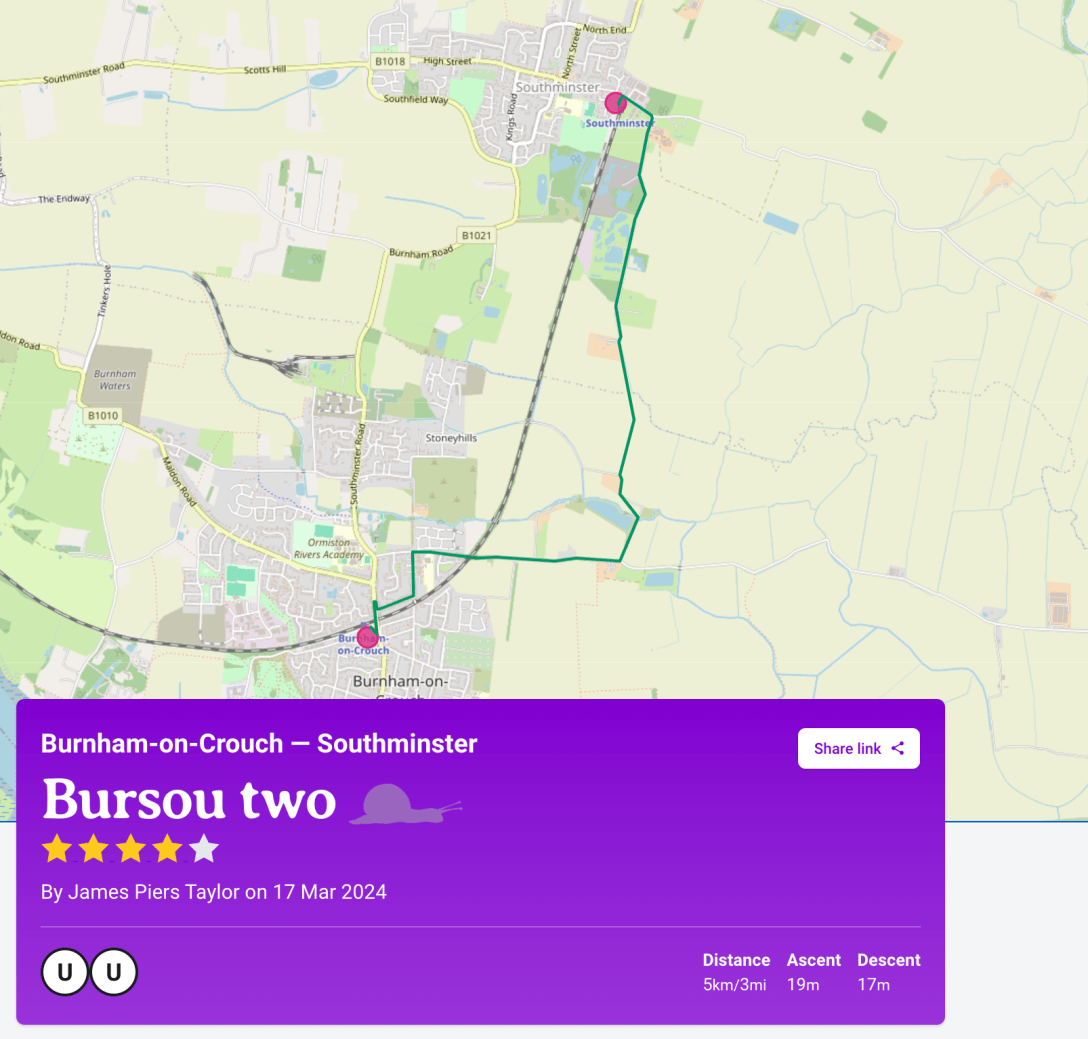
Bursou Two

In the previous post, I mentioned that the Slow Ways route Bursou One is one of three footpath-orientated ways between Burnham and Southminster. I committed to adding my preferred walking route between the two as an additional Slow Way. It’s now been added as Bursou Two. Below, I have appended my route description from the site, plus a review of walking it on Sunday 17th March.

Continue reading “Bursou Two”

Zeroing In

I am grateful to Tony Fittock (District Councillor for Althorne ) for letting me know that the process of creating a new Local Development Plan for Maldon District has begun. So my previous post on the matter revealed my own ignorance of the Maldon District Local Development Plan (LDP) Review: Issues and Options Consultation, which ran from 17 January to 14 March 2022.

Mr Fittock also shared a link to the report ‘Growth Options for the Review of the Local Development Plan’ [p.33 onwards] provided to the meeting of Maldon District councillors on 14 September 2023.

From this, I learned that ‘the Plan Period for the review of the LDP Review is going to be 20 years.’ As the current plan runs until 2029, this indicates that its successor will cover the period up to 2050. As noted previously, the UK government is committed by law to reduce greenhouse gas emissions by at least 100% of 1990 levels (net zero) by 2050. The next Local Development Plan will therefore set out a vision and a framework for the future development of Maldon District that must include complete decarbonisation.

Continue reading “Zeroing In”