Let a Thousand Knepps Bloom

Yesterday, Maldon District Council (MDC) shared on social media that they would be working in partnership with a property consultancy company that has launched a Biodiversity Net Gain (BNG) scheme with the Braxted Park estate.
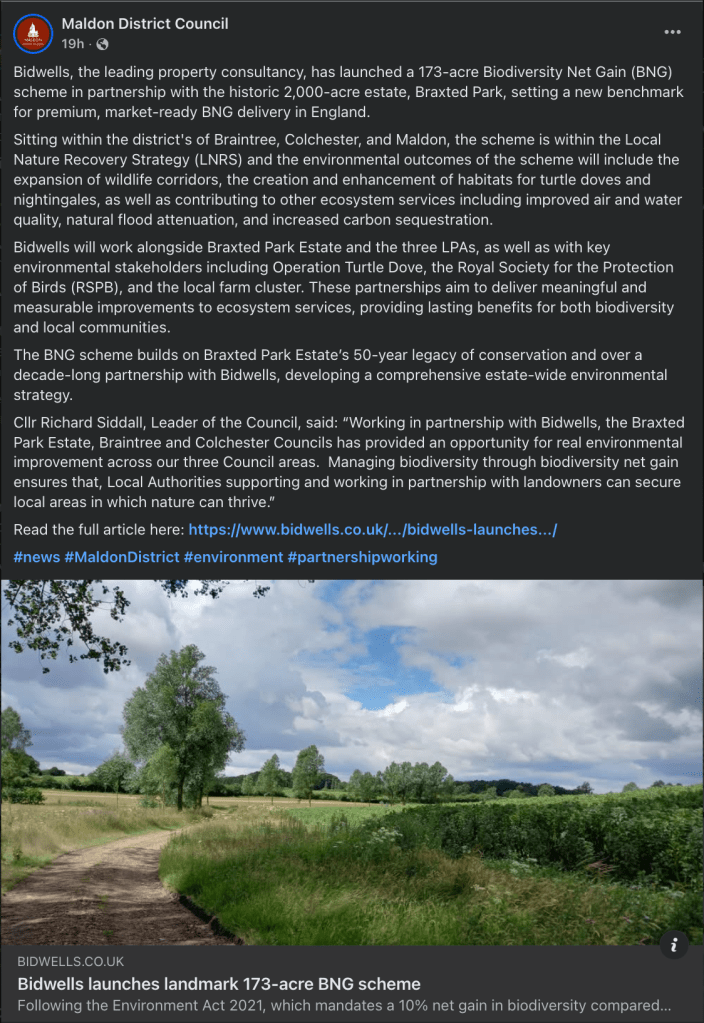

The post and linked article are light on detail, and there’s nothing about it on the MDC website, but this looks like MDC shaping up to allow developers to meet their ‘increase biodiversity’ requirements by paying someone else to do the nature recovery off-site.

Read more: Let a Thousand Knepps Bloom

Local District Councillor Wendy Stamp informs me that this scheme has not been discussed by Councillors and is seeking further detail.
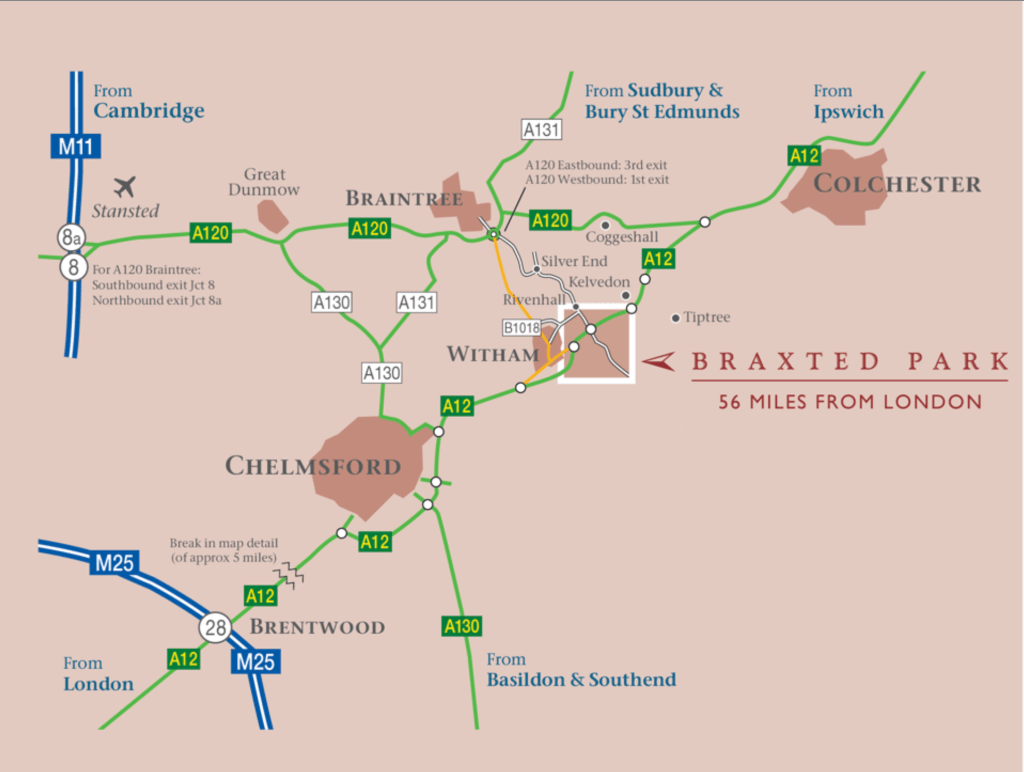
Map on the Braxted Park website illustrating that it is ‘well connected’ shows no connection to locations in Maldon District


I can see some advantages in consolidating nature recovery activities in the best sited locations and that working at a landscape scale can have environmental outcomes not available to smaller sites

but…


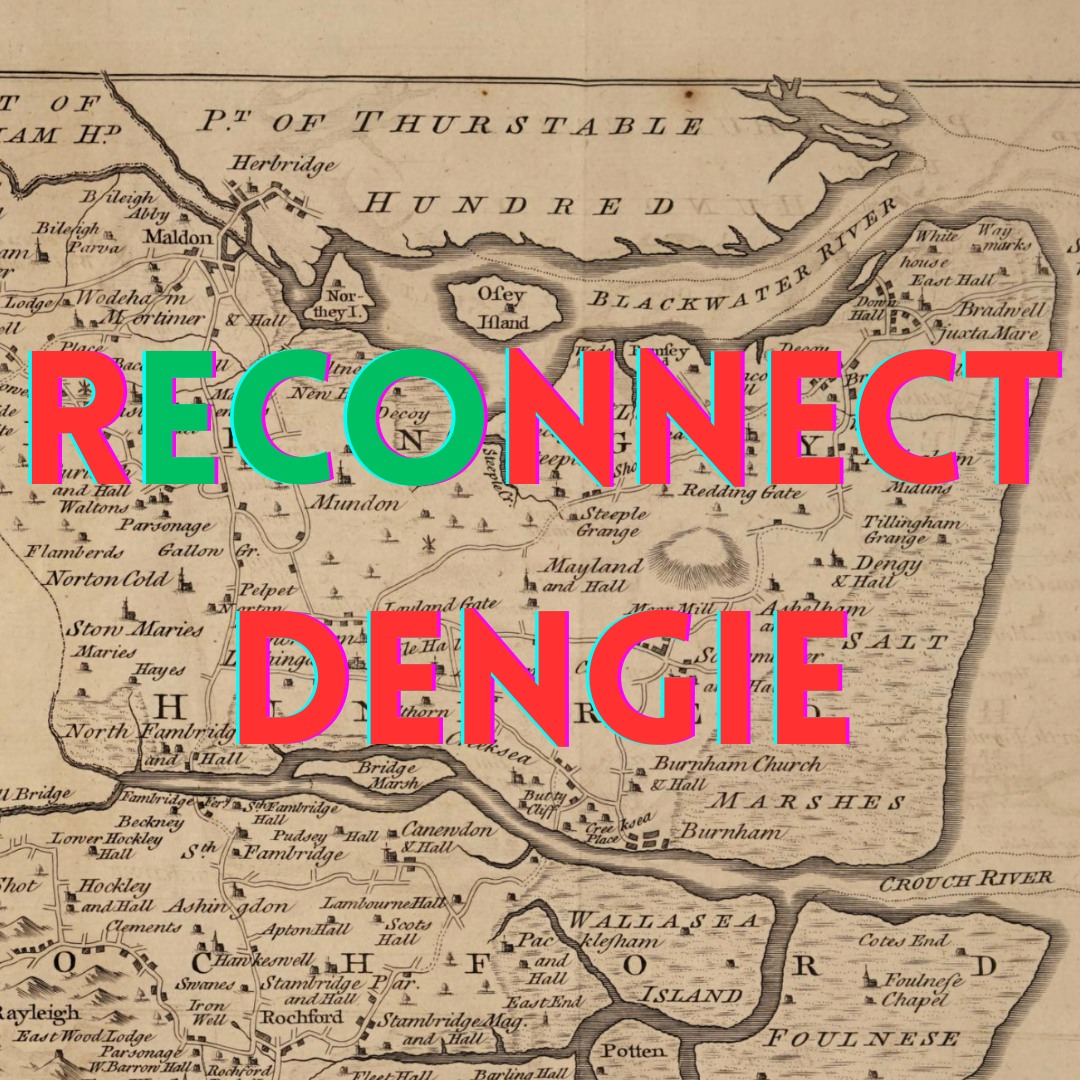
Braxted Park is barely in Maldon district (it’s on the North-west border with Braintree District, near to Witham) and it’s a long way from the Dengie peninsula. (It’s over 20km as the turtle dove flies from Braxted Park to the proposed Romans Farm development in Burnham on Crouch for example)
It’s hard to see how the environmental outcomes of the scheme will improve nature recovery out here.
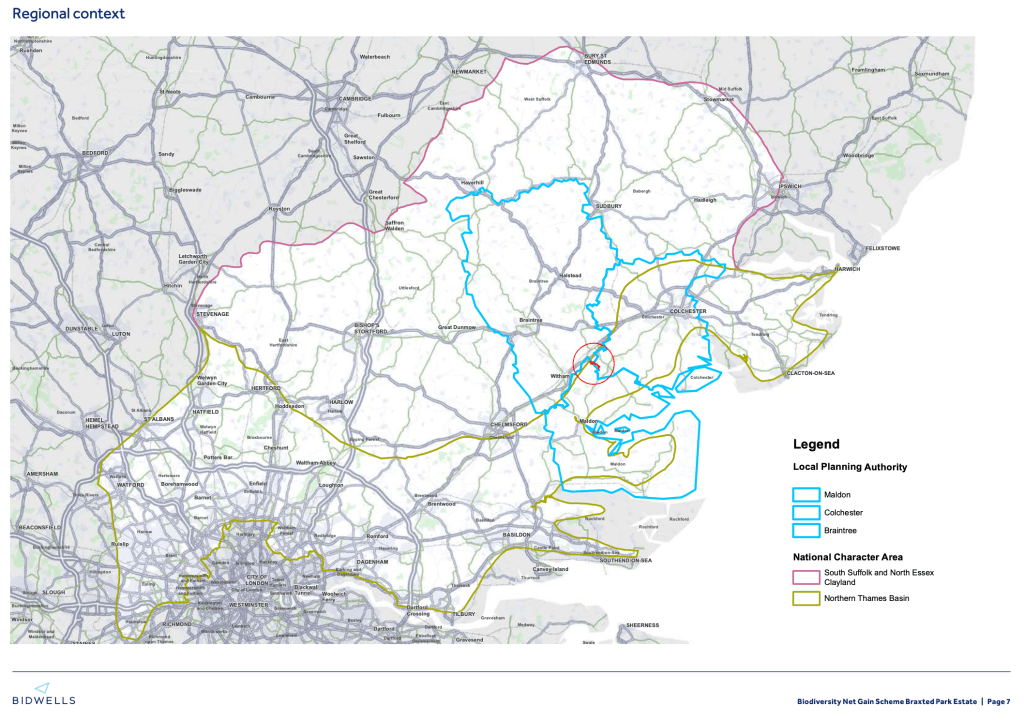
Location map in the Bidwells document Biodiversity Net Gain Scheme Braxted Park Estate [pdf]

We must demand that nature recovery schemes happen locally to us, no biodiversity offsetting in distant locations!


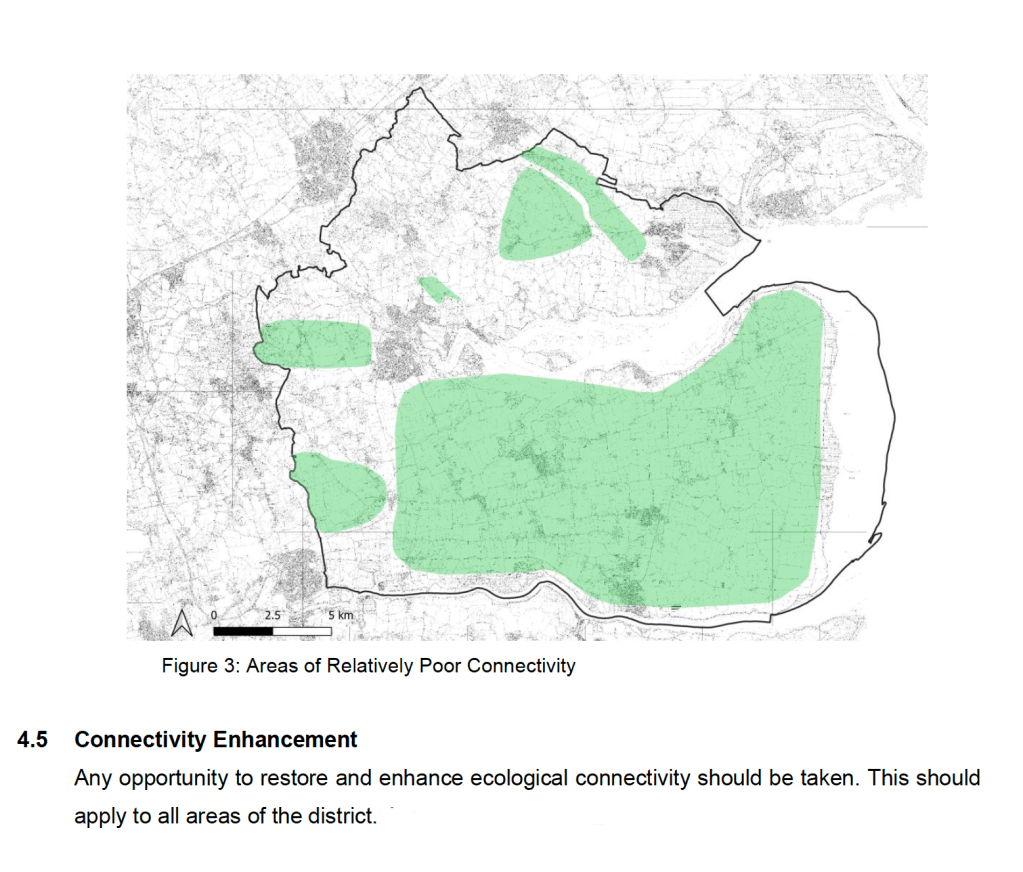
The Maldon Nature Conservation Study (February 2023) produced by Essex Ecology Services (EECOS) for MDC spoke of the importance of wildlife corridors in the district and stated that ‘[t]he taking of measures to enhance connectivity would be worthwhile anywhere in the district… Certain areas suggest themselves as potential priority targets… Any part of the Dengie peninsula

Map from the ‘Maldon Nature Conservation Study 2022′ (February 2023) [pdf]


The whole peninsula was mentioned because the Study notes that ‘[t]he Dengie peninsula has few [local wildlife] sites and many of these are isolated in a landscape dominated by intensively managed farmland, with few areas of natural or semi-natural habitats aside from the coast’


It notes that ‘[t]he woodlands of Maldon are heavily concentrated in the north west of the district [where Braxted Park is located] and are virtually absent to the east of Northey Island, both north and south of the Blackwater estuary. The Dengie peninsula, in particular, is virtually devoid of woodland.’


Elsewhere in the document the Dengie is described as an ‘impoverished landscape dominated by large arable fields with few hedgerows’ and that ‘[t]he planting of new hedges and appropriate management of these features would be of great benefit to wildlife, including breeding birds, and any measures that can be taken to encourage this should be considered. The establishment of a well-connected network of hedgerows would represent a major landscape-scale enhancement.’


MDC knows where, and what, nature recovery interventions on the Dengie would be effective because the Study they commissioned informs them.
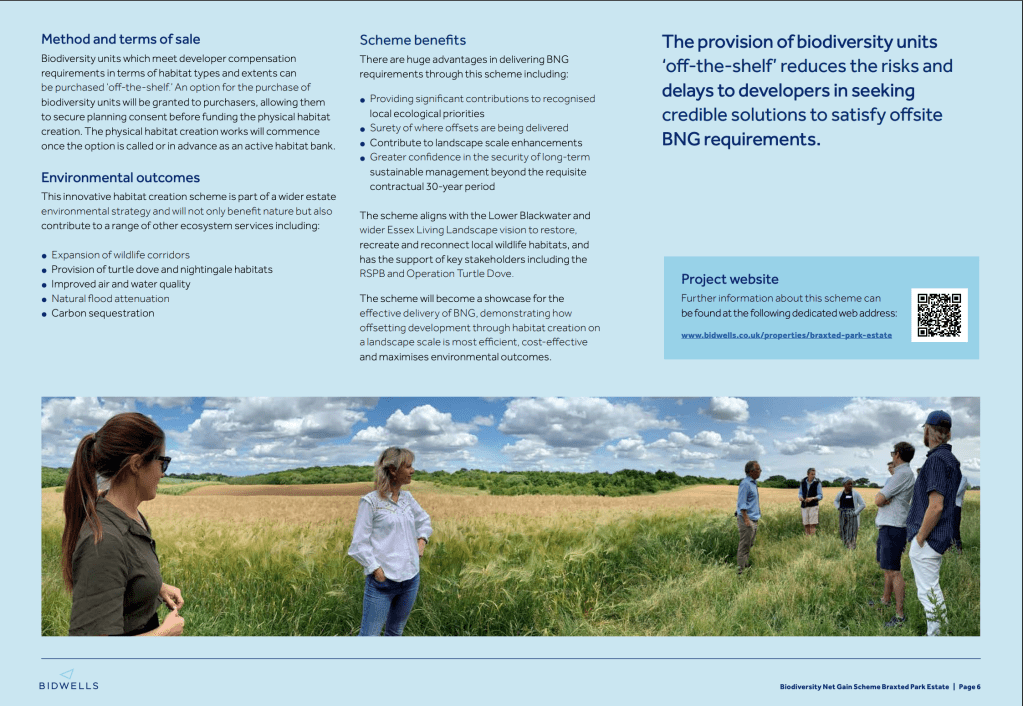
The pitch to developers in the Bidwells document Biodiversity Net Gain Scheme Braxted Park Estate [pdf]


This new scheme looks like a way for developers to avoid caring for and improving the natural world where they build by just paying a fee for someone else, to do something, somewhere else.

It should not be ignored that replacing an intensively managed, chemically dosed, arable monoculture field in our ‘impoverished landscape’ with houses and gardens will in itself create new niches for wildlife. Housing developments don’t in themselves, however, create a well-connected network of hedgerows, they don’t establish new woodlands, areas of natural or semi-natural habitats, or wildlife corridors between existing sites of biodiversity. Construction of these developments too often begins with violently making their site a tabula rasa, removing mature trees, bushes and hedgerows, blocking access to fauna, filling in scrapes, stripping topsoil, compressing the earth. It concludes with establishing neat show homes, where the ‘messiness’ of the wild is manicured away – no care to share the territory with what came before – no hedgehog holes or bee bricks, no bird and bat boxes, no quarter given to burrowing badgers and foxes, insects starved of fodder. In the amenity spaces, sapling trees are planted and then neglected to dry out and die. A councillor once told me that developers are generally contracted to support these trees for 5 years, but that it’s cheaper for them to replace those that die at the end of their period of responsibility than to maintain them for the intervening period. Any survey of the new estates in Burnham swiftly finds the desiccated evidence

BNG seemed to me from the get-go to be ‘biodiversity off-setting’ in the disgraced mode of carbon off-setting before it. So, it comes as no surprise that we are immediately seeing nature commodified and traded by third-party intermediaries.

When a developer grubs out a 300 year old oak tree near me, and the squirrels who ate the flowers disappear, the moths that relied on it don’t return, the oak-mining bee loses its pollen, the badger and wood mouse find no acorns, the jay has nothing to bury, and the caterpillar doesn’t come that the blue tit might consume, when the bat doesn’t roost, the fungus doesn’t feed, the lichen don’t spot the bark, the mushroom doesn’t fruit from its subterranean romance with roots – then I guess I can take solace in the knowledge that a seven hour walk from where I live, on the country estate of a retired banker, that an ‘off-the-shelf’ purchase by the developer will have financially contributed to the ‘creation of high-quality biodiverse habitats targeting ‘good’ condition as defined by the DEFRA Statutory Metric’. Call me a romantic if you will, but I prefer stewardship to the spreadsheet.
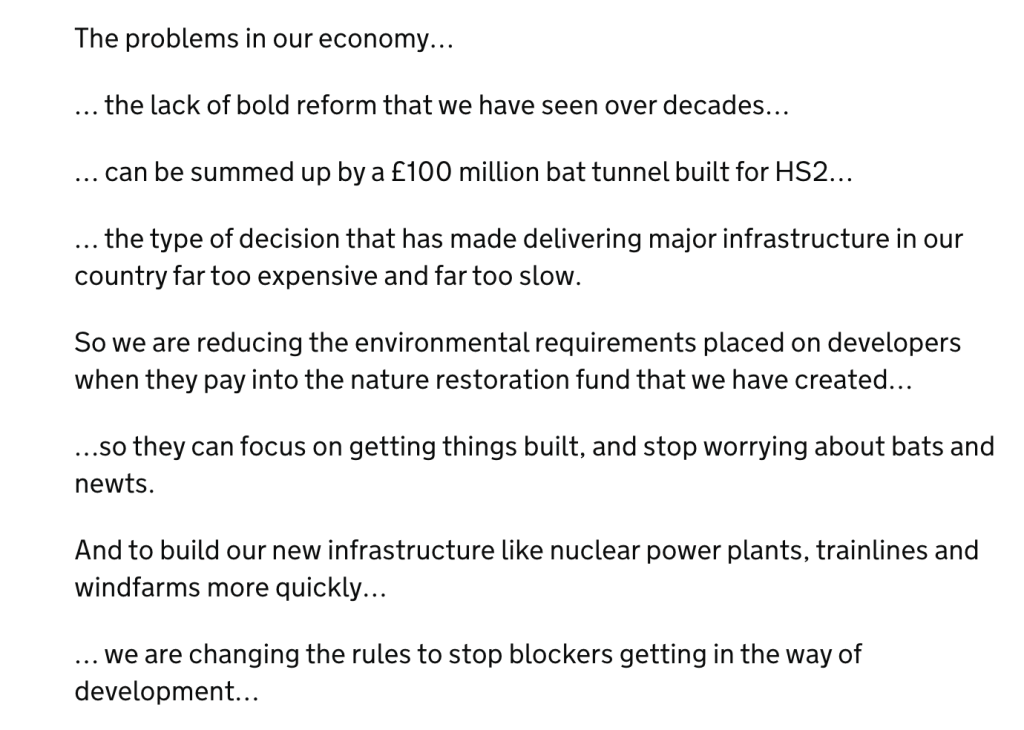
Chancellor vows to go further and faster to kickstart economic growth’ Rachel Reeves at Siemens Healthineers in Oxfordshire on 29 January 2025.

An ‘abundance’ YIMBYism is on the rise, an attitude on both the left and right of politics, and on both side of the Atlantic, that the future has been cancelled out of a gratuitous consideration for ‘bats and newts’, that we must just BUILD. Increasingly often this comes with a sanctimonious sneer that pits mitigating climate change against nature conservation “we could accelerate the construction of renewable energy infrastructure and energy efficient homes if you would just leave it out with bat tunnels and newt-counting delays”.

But why can’t we have both things? Because there’s a missing third part of this iron triangle
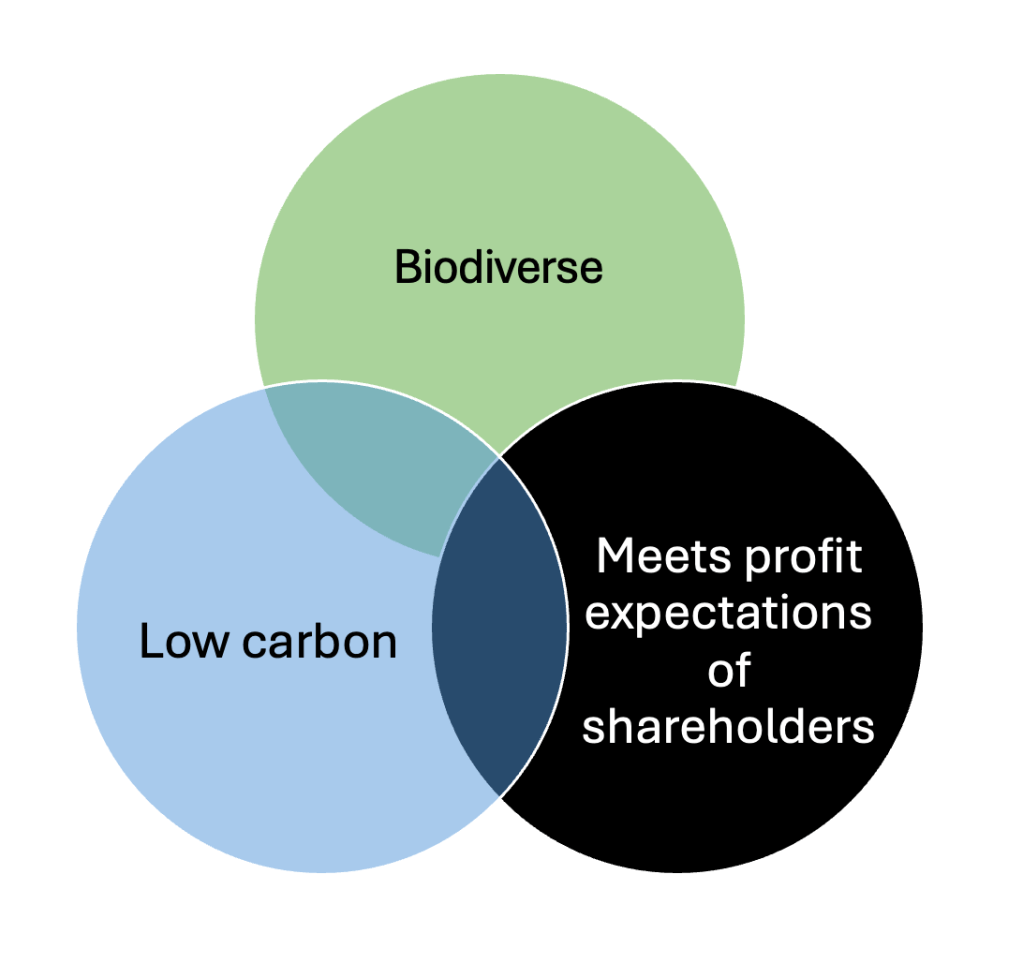
The great shapers of places in the UK, of our land and homes, are six volume housebuilders (Barratt/Redrow, Vistry, Taylor Wimpey, Bellway, Berkeley Group, Persimmon) and they are driven by profit, excessive profit. A 2023 report from the UK Collaborative Centre for Housing Evidence, Why have the volume housebuilders’ been so profitable? notes that

‘Since 2014, the largest housebuilders, and in particular the three largest housebuilders by
volume (Taylor Wimpey, Barratt and Persimmon – herein, the ‘big three’) have consistently reported supernormal levels of profitability, with gross profit margins reaching 32% and never falling below 17%’

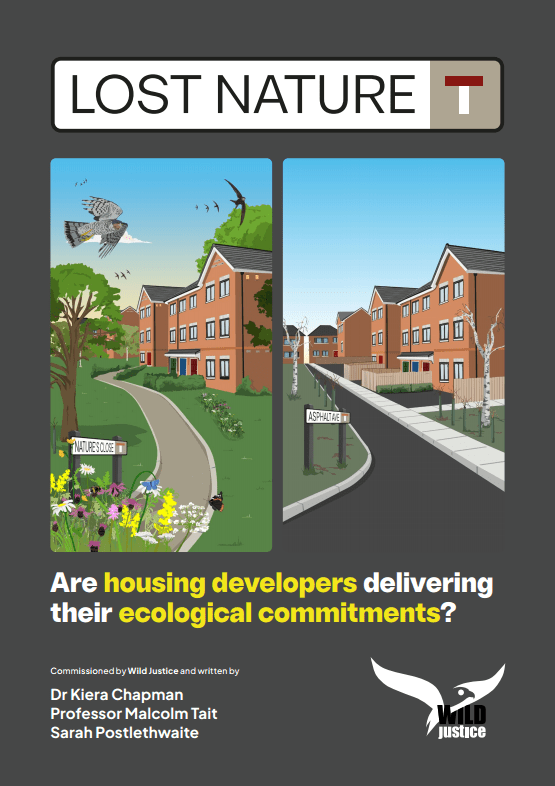
So, obviously, these companies are not interested in the business of stewardship, of long-term commitments to places, or indeed any commitments past the point when contracts are exchanged. A survey by University of Sheffield academics for the wildlife campaigning group Wild Justice discovered that nearly half of the nature-friendly enhancements promised by developers building new homes have failed to materialise.
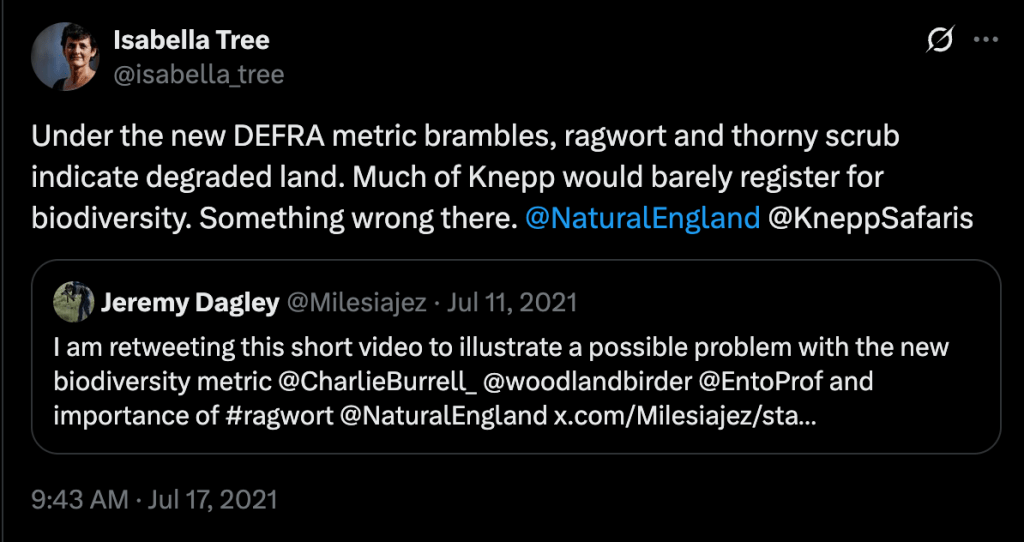
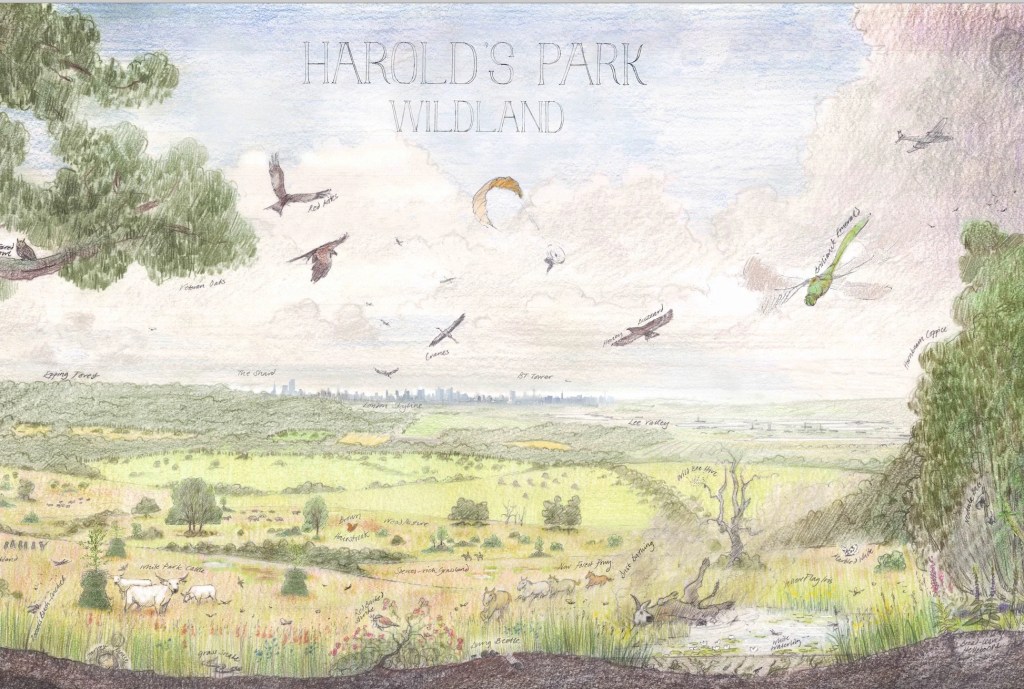
Instead of enforcing these commitments and penalising developers who fail to adhere, the BNG system surrenders and turns this all into a one-off transaction. Developers pay some ecologists to do a baseline survey before development, a wonk does some sums to account for 10% BNG, they pay a one-off fee to a mediator like Bidway and they’re done – on to the next one. The mediator creams some agency fees and passes on the remainder to a land owner adding BNG to their diversifed income streams. It could be a conference and wedding venue like Braxted Park, it could be elsewhere in Essex like the farm turned rewilderness Harold’s Park – 45km as the turtle dove flies from Braxted Park. (Recently purchased by ‘natural capital and rewilding company’ Nattergal.) These Essex projects stand in the shadow of the Knepp estate in Sussex -the poster child for UK rewilding – although Knepp’s owner Isabella Tree says it wouldn’t meet the DEFRA metrics.
All this is an approach to nature recovery that seems to depend on special places that are protected, another form of nature reserve, rather than forging a new symbiosis with nature and accepting that humans are completely embedded within a more-than-human world. Essex county council has a target of transforming 30% of Essex into wild and nature areas. Every place should be special, distinct among others of a kind. Nature recovery here, and there, and everywhere. Let a Thousand Knepps Bloom.
Stitching the Path: Connecting Disjointed Walk & Cycle Routes 1

A mission objective of the rECOnnect Dengie project is to improve the active travel infrastructure on the Dengie and get a safe network of routes connecting all the settlements. As I’ve noted previously, there are lots of good words about achieving this sort of thing in the strategy documents produced from the national level down to the parish – but what happens next? How does it happen?

This in the first in a series of posts where I’ll look at where there are opportunities on the Dengie to connect up existing routes and how we might turn document objectives into objective fact. I’m starting close to home in Burnham-on-Crouch.

The Burnham-on-Crouch Neighbourhood Development Plan [pdf](2017) expressed a clear desire for better active travel infrastructure:

5.3 Make Burnham-on-Crouch a More Pedestrian and Cycle Friendly Place to Live

The Town should have a friendlier environment for cycling and walking. Its main and secondary roads are dominated by vehicles. New pedestrian and cycle routes should be provided that link the town centre with existing and new neighbourhoods, schools and recreation areas via quieter roads.’

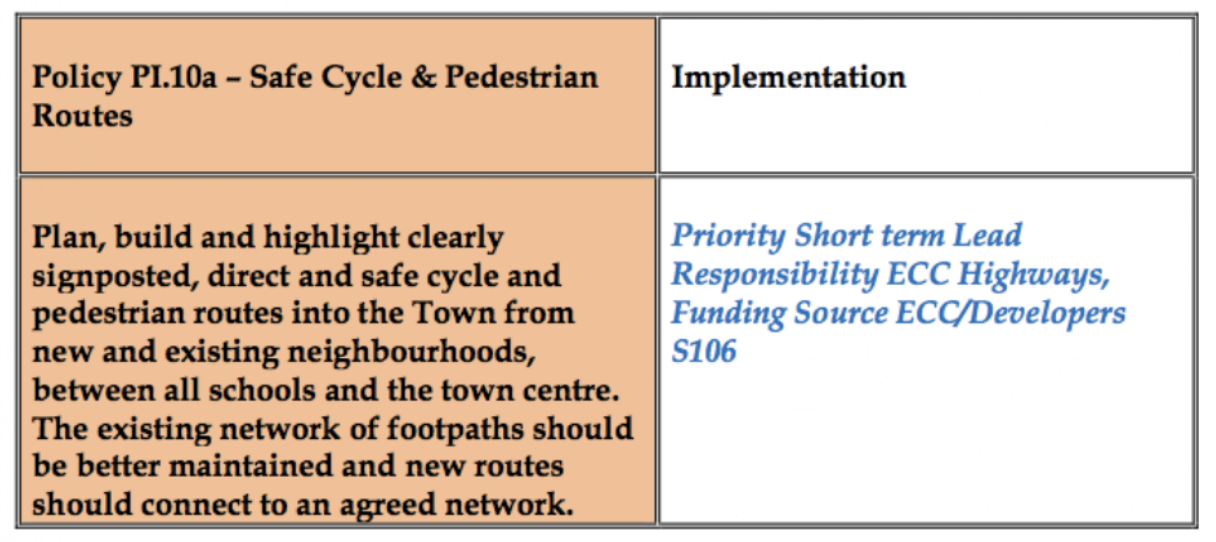
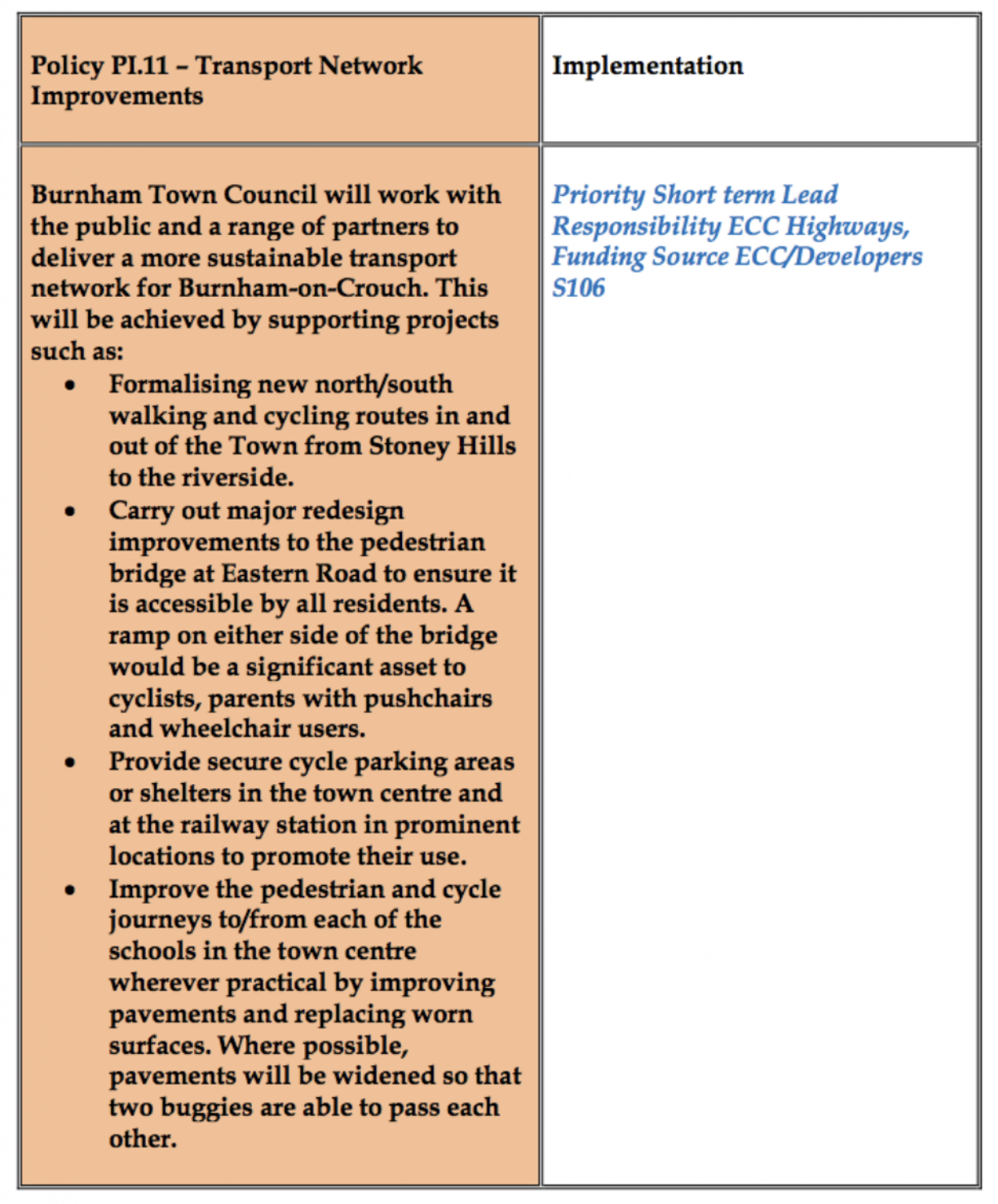
It substantiates this objective with policies including:

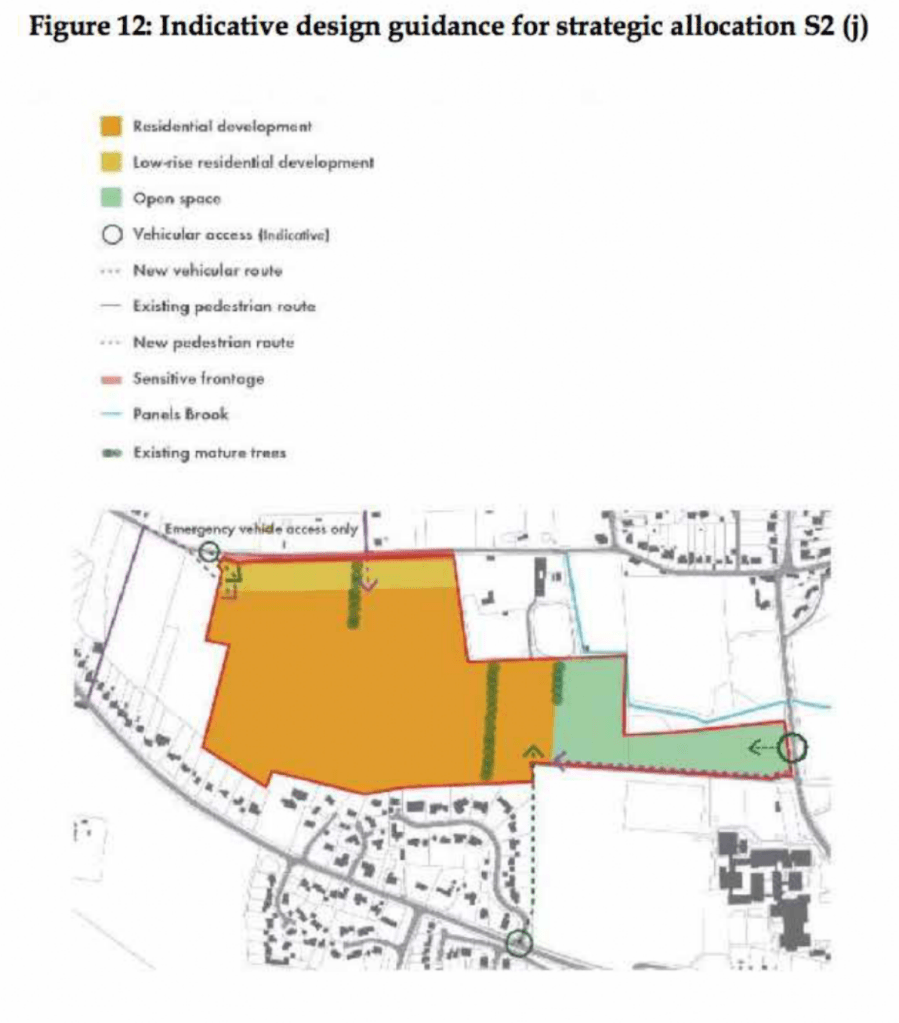
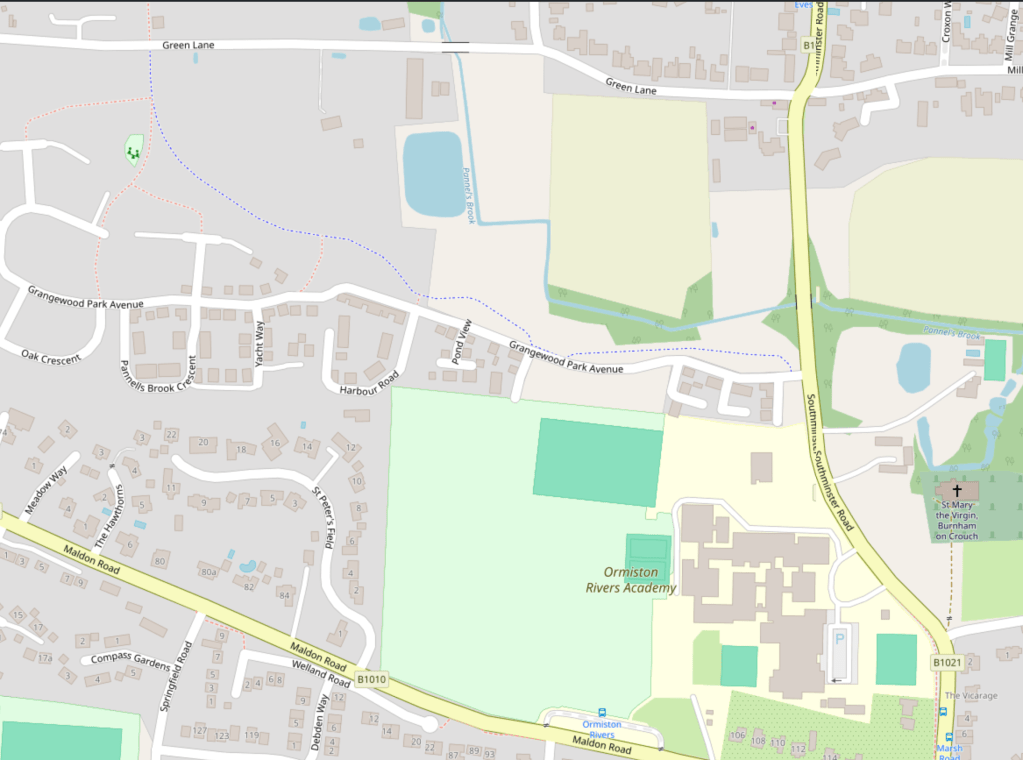
One of the first new neighbourhoods created after the NDP is the Grangewood Park estate which was built on agricultural land allocated for new housing as Site S2 (j) in the Maldon District Local Development Plan [pdf]. A site with a long southern boundary to the town’s Secondary School, the Ormiston Rivers Academy.

Figure 12 in the Burnham NDP (Apologies for poor image quality, this is as it appears online)

The masterplan [pdf] presented by developers Charles Church in their planning application included a new off-road foot/cycle path running through the green space on the estate and providing a connection from Southminster Road in the east to Green Lane in the north.

Their document notes that the Maldon LDP includes:

T2 Transport Infrastructure in New Developments The layout of new developments should provide for safe access to and from the highway including… links to adjacent or nearby foot/cycle path network’

and that it states that amongst the criteria any proposed development must satisfy is:

‘Safe pedestrian and cycle linkages are provided from the development to the town centre, other public service facilities and the existing urban area’.

(The Residential Travel Plan [pdf] supplied in the developer’s application noted that ‘[t]here are no dedicated cycle facilities in the vicinity of the development site’)

Later the planning application notes that ‘[t]he Burnham Neighbourhood Plan shows proposed cycle links that the Town would like to see progressed; within this diagram a possible link is shown into the site subject to this application. The provision of this link would rely on third party land and therefore cannot be provided by Charles Church, however the scheme has been developed to facilitate future connectivity.’

It’s unclear exactly what this is referring to, as the Burnham NDP includes text references to possible cycle routes but no maps showing these. The diagram with ‘a possible link’ is perhaps the green dotted line ‘new pedestrian route’ shown in the NDP’s ‘Figure 12’ (copied above) connecting the site to Maldon Road in the south, and running along the western boundary of Ormiston Rivers’s playing fields. This would have been a convenient addition to Burnham’s walk/wheel/cycle routes but it never materialised and it illustrates succinctly a key unaddressed problem in getting better active travel infrastructure.

i.e A government strategy proposes active travel infrastructure as an essential part of new developments, a developer provides infrastructure within the development – but the value of such infrastructure is largely produced by a larger connectivity that neither government nor developer is providing.

The National Planning Policy Framework (NPPF) make enough noises about pedestrian and cycle routes that applications for new housing tend to include vague promises about including them. On the ground this tends to result in intra-estate pathways that have genuine utility but terminate at the estates’ boundaries with no clear sense of how onward travel on foot, mobility device or bicycle might proceed.

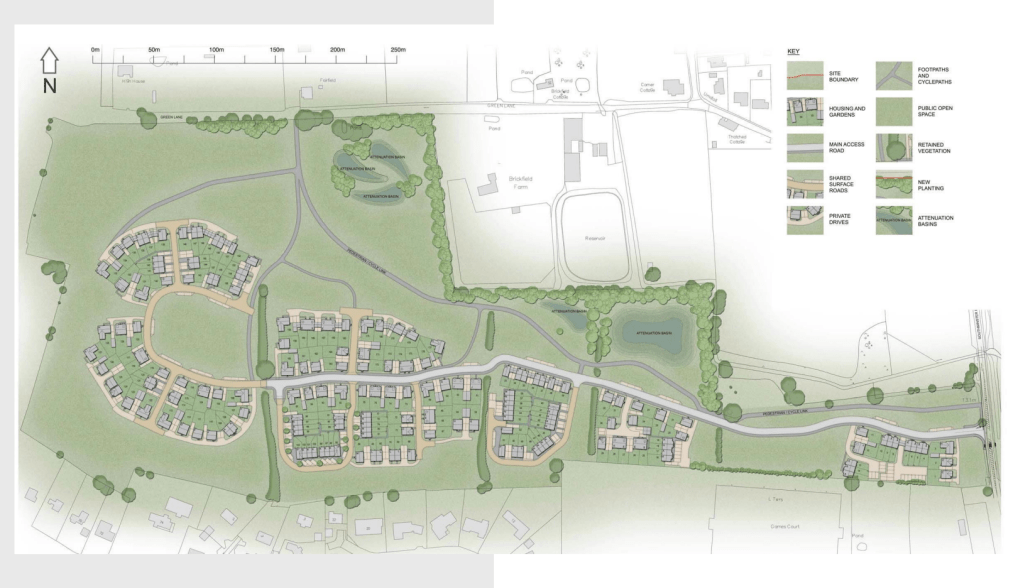
Foot/cycle paths shown in grey to the north of the housing on Grangewood Park estate

True to their promise, the developers of Grangewood Park delivered the walk/cycle path on their masterplan and the estate includes what is, currently, the best example of active travel infrastructure in the town with an off-road path that connects Southminster Road with Green Lane – but what happens when you get to Southminster Road or Green Lane? What contribution does it make to a safe, active travel network?

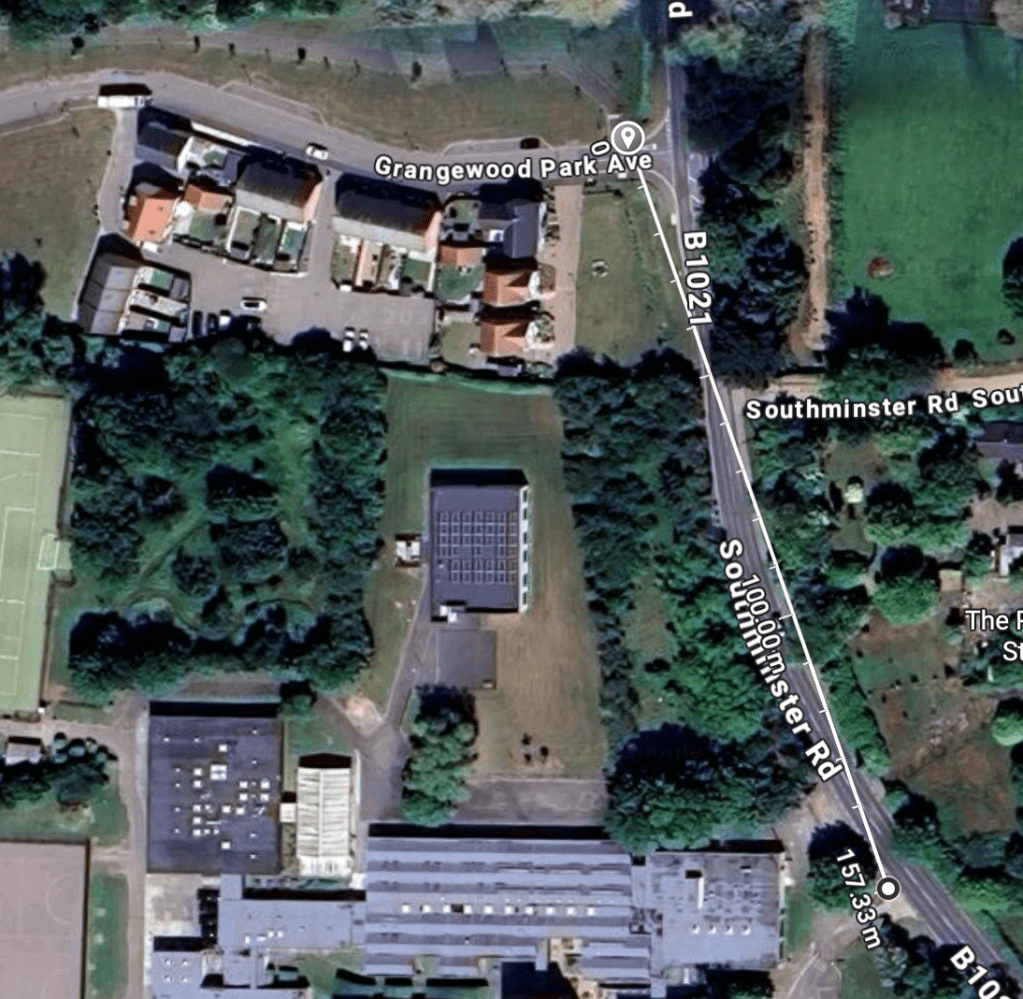
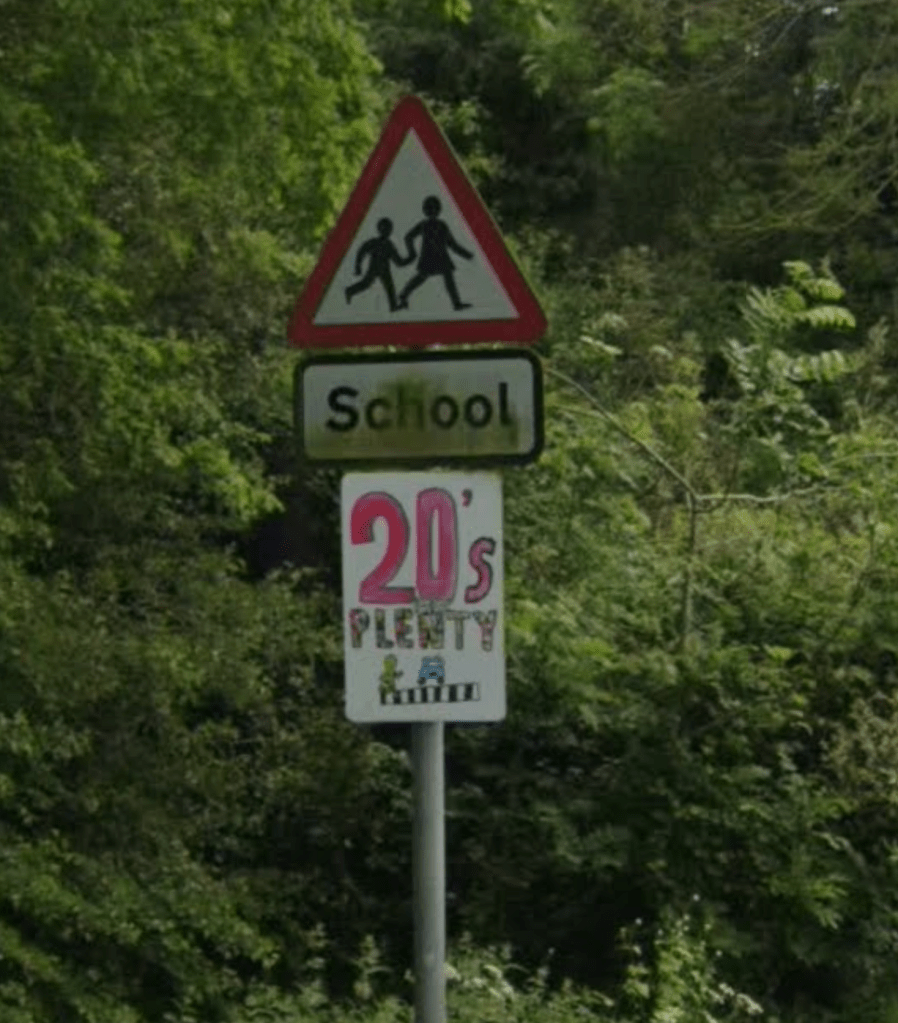
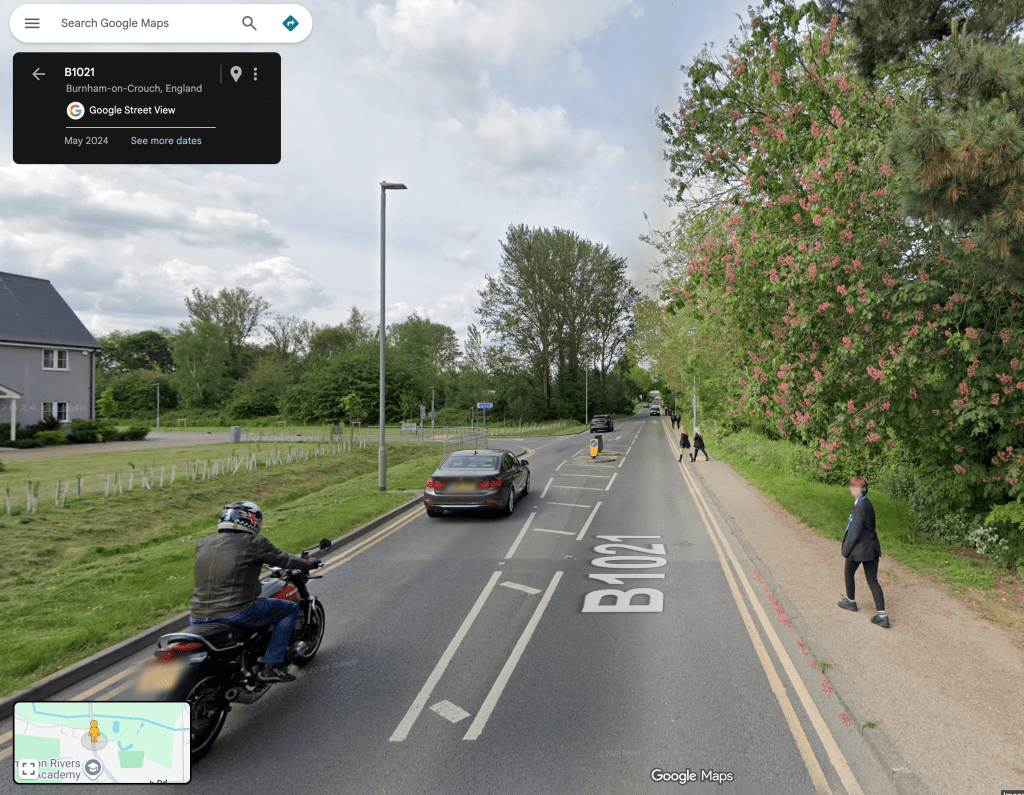
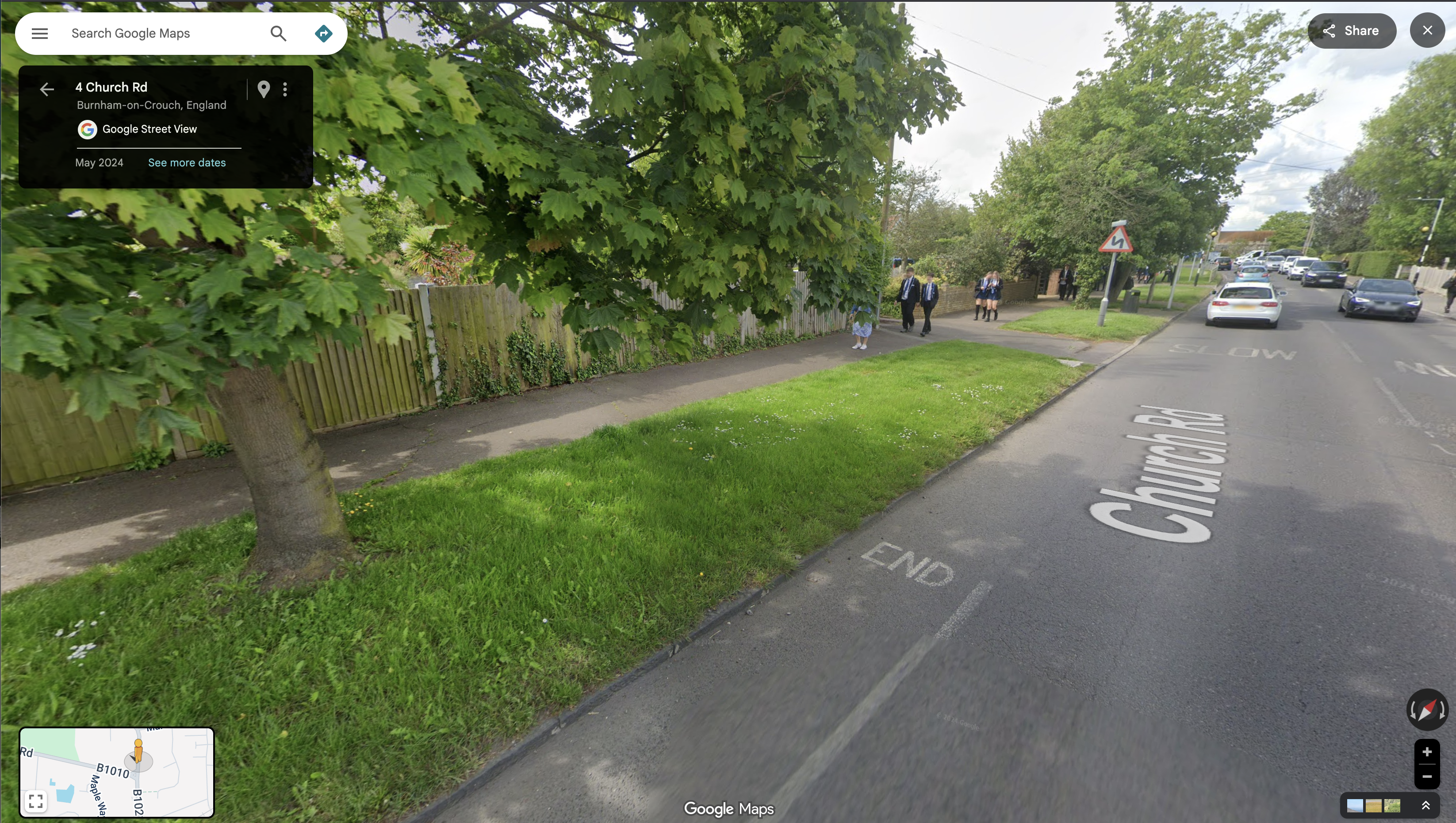
At Southminster Road (B1021) the pathway ends 160 metres north of the entrance to Ormiston Rivers school. A child on a bicycle coming through Grangewood Park must now leave the off-road cycle path, cross a lane of northbound traffic leaving town on the B1021, and join the southbound lane – before turning across the path of northbound traffic again to complete their journey to school. Opposite the Grangewood junction there’s a road sign with the red triangle warning of a school ahead and, beneath it, one of those advisory-only ’20’s Plenty’ signs – but the B1021 has a 30mph speed limit at this point and has limited direct access along this section, a form that tends to encourage vehicle speeds in excess of the legal limit. The common experience of cyclists, of all ages, using this road is driver impatience and an aggressive eagerness to pass.

Meanwhile, pedestrians leaving the off-road path at Southminster Road find there is no footway providing an onward walking route north or south. There is a narrow pavement on the east side of Southminster Road but there is no controlled crossing to reach it (a small traffic island provides some pedestrian refuge).

School children cross the B1021 to reach the Grangewood Park Estate.
The junction of Grangewood Park Avenue and Southminster Road, where the foot/cycle path ends

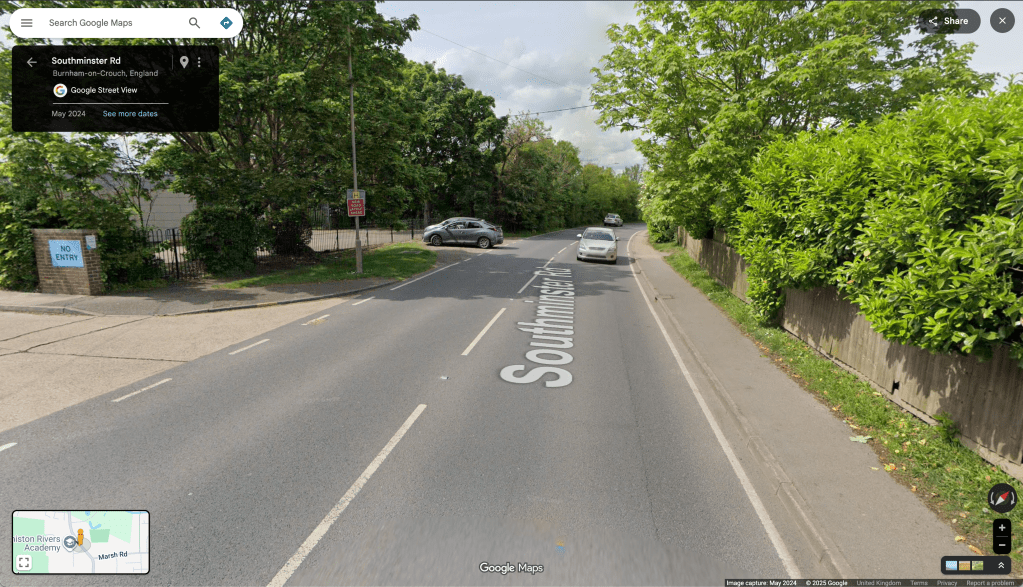
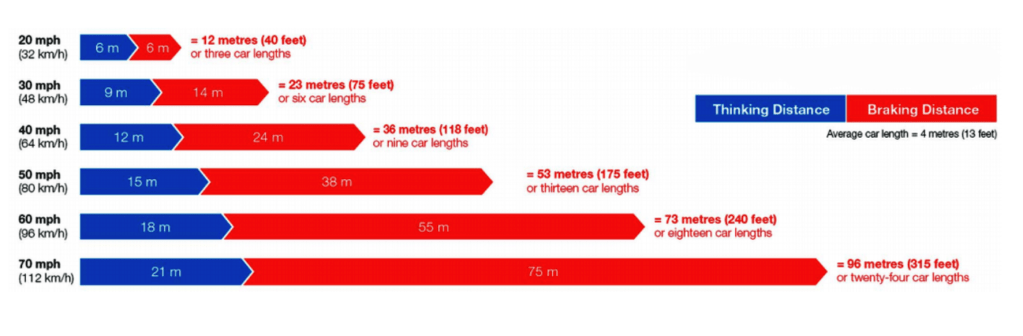
Once the road is crossed, a pedestrian can proceed south on pavement into Burnham. If it’s a child walking to the school they can pass the school entrance on the other side of the road and carry on further south around a bend to cross the road at a zebra crossing, then walk north again up the opposite pavement to reach the school entrance – a distance of 450m. Will they do that though? Of course not!, once they are opposite the school entrance our cyclist used – 160m down, they’ll do what she did and cross the road there. The curve of the road means that drivers travelling south will be blind to a child crossing the road there until they are quite close. The Highway Code calculates the stopping distance of an average car at 30mph in dry conditions to be 23 metres.

Looking north up Southminster Road where a child is liable to cross to reach the school
Car stopping distances in the Highway Code

‘But there’s no alternative!’ I hear you cry, ‘you just have to make do with what you’ve got’.

‘I know this estate is right next to the secondary school and we agreed in the neighbourhood plan to “plan, build and highlight clearly signposted, direct and safe cycle and pedestrian routes into the Town from new and existing neighbourhoods, between all schools and the town centre” and we agreed that we would “improve the pedestrian and cycle journeys to/from each of the schools” – but really what else could we have done?

Let me tell you!

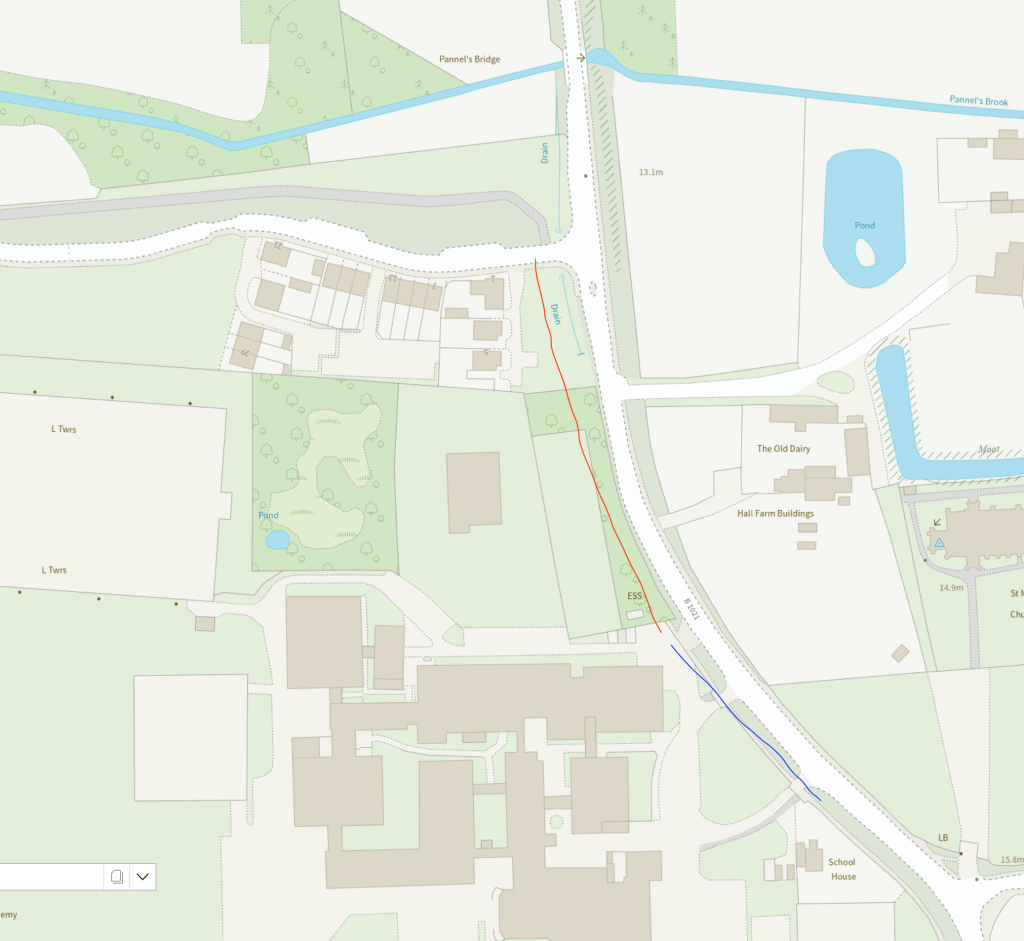
Grangewood Park shares a border with Ormiston Rivers school, their frontage to Southminster Road is contiguous. The foot/cycle path could have gone over Grangewood Park Avenue and continued south over amenity land to the boundary of the school and through the small woodland which separates it from the paved area of the school grounds.

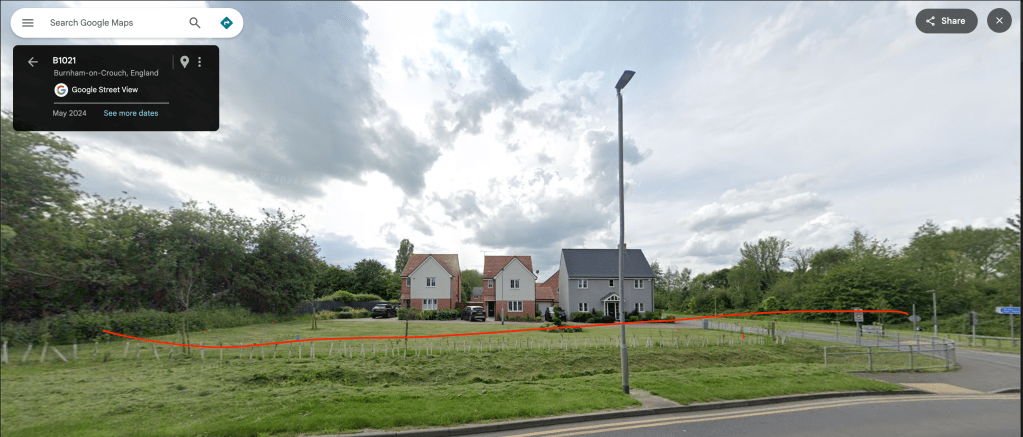
The red line indicates where the Grangewood path could be connected to Ormiston school, the blue line how that could continue to the existing footway

All the land involved either belongs to the developer or to Essex County Council. The developer was on-board with facilitating connectivity, the Town and District Councils wanted connectivity, Essex County Council/Essex Highways wants kids to cycle to school. It should have happened… and it still can!

The current residents of the three houses on Grangewood Park estate facing Southminster Road might prefer the current area of mown grass and small flower bed, but they’d benefit from a walk/cycle/wheel route through it. Improving active travel routes is beneficial for everyone, not just children.

This missing link would facilitate footway access from Burnham’s riverside, urban centre and railway station through to Green Lane by reducing the number of necessary road crossings. It would complete a safe cycle route from the Grangewood Park estate to Ormiston school.

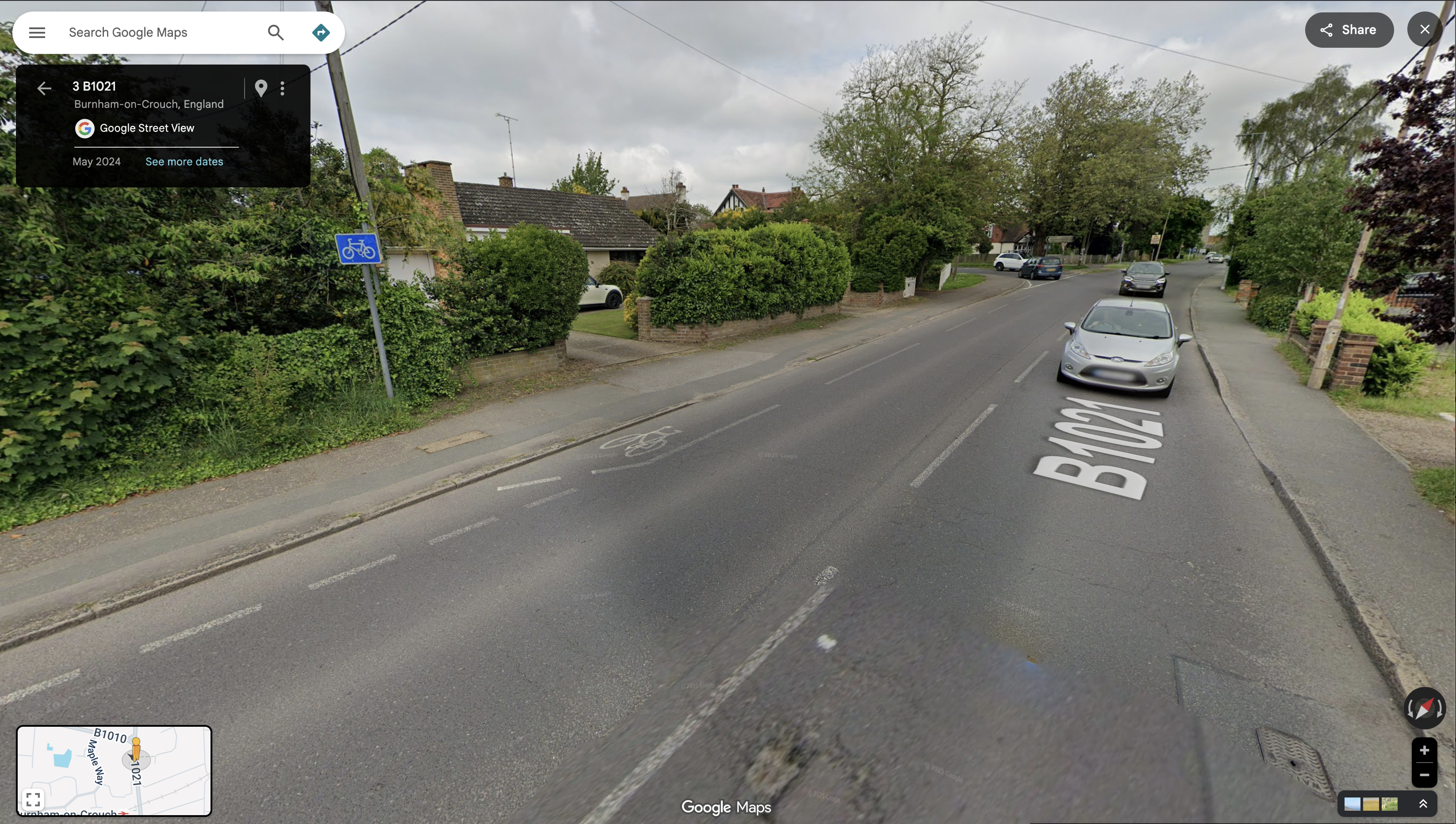
EXTRA CREDIT: The pavement going south from Ormiston School has an area of verge and is wide enough to allow a shared foot/cycle way to the junction with Maldon Road (B1010). Across the B1010 junction, in the northbound lane, there is also Burnham’s oldest piece of cycling infrastructure – a painted cycle lane that begins just south of it and finishes quickly north of it – it’s of spurious utility but nevertheless could easily merge into a cycleway on the west of Southminster Road and gain a connectivity it has never had before!

What happens at the other end of the Grangewood Park estate foot/cycle path though? Can we get anywhere from there? Look out for Stitching the Path: Connecting Disjointed Walk & Cycle Routes 2 – where I will address these very questions!

Why Don’t We Do It in the Road?

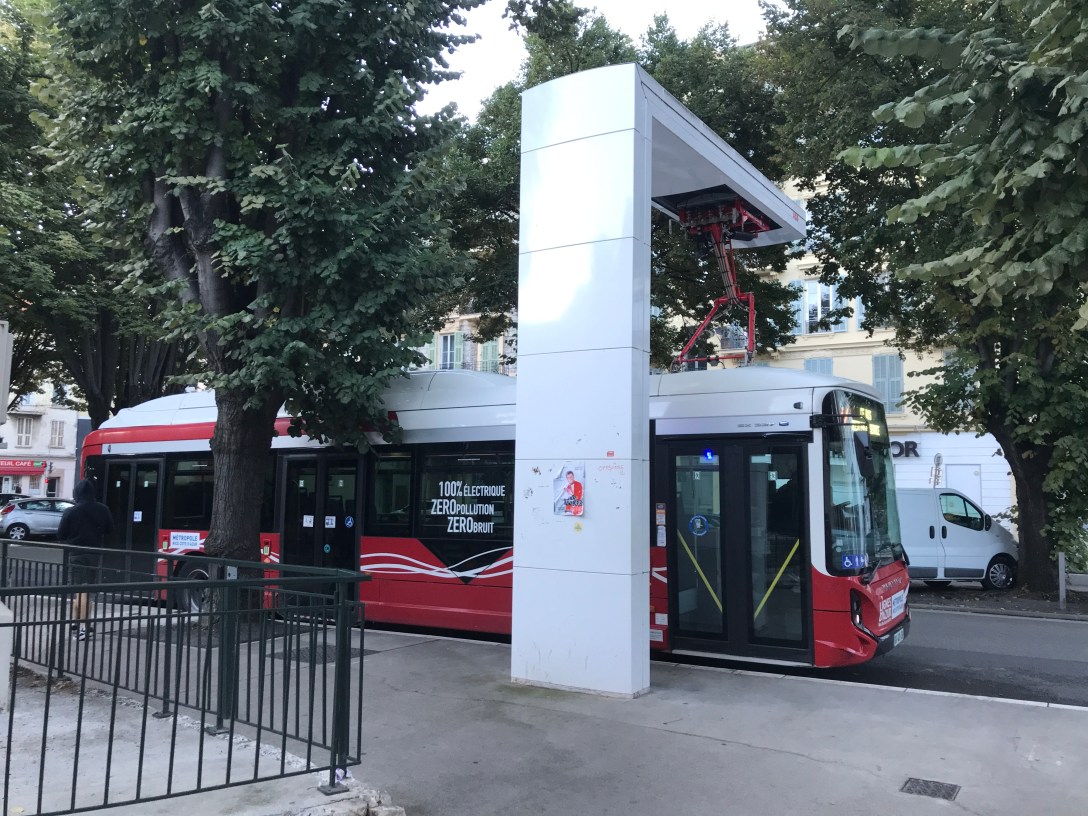
A couple of days ago, Essex Highways released a press release about their plans for rolling out electric vehicle charging in the county, and used the opportunity to ask people where they thought the chargers should go. Their survey is pretty minimal, but there was enough in it to raise my concern.

I’ve long been frustrated by the pavement parking of cars and how temporary road signs are placed on the footway rather than on the road they relate to. Cars already dominate urban space. In the rural town where I live, especially in the older parts built before the automobile, the streets are cluttered with private vehicles. The nearest pavement to my house is unusable – cars park on its full width to allow free access to vehicles on the road, so pedestrians have to walk on the road too. One of my neighbours has an EV, and the charging cable stretches from his boundary wall across the street to his car.

There’s a sci-fi saw, often attributed to Frederik Pohl, that ‘a good science fiction story should be able to predict not the automobile but the traffic jam’. You don’t have to be a futurist to see the trip hazard in the electric car rollout. Motornormativity —the assumption that car-centric infrastructure is the default—demands that any new space requirements for the automobile be carved from the realm beyond the car. When Essex Highways asked ‘where should the chargers go?’, the assumption is clearly that the person being asked is a motorist, an EV owner seeking on-street charging for their machine. The ‘where’ is not ‘where in the public realm, if anywhere, should we put this new chunk of motorcar infrastructure’, but ‘which streets shall we impose this pile of gubbins in?

Continue reading “Why Don’t We Do It in the Road?”

Better Walk/Wheel/Cycle Routes

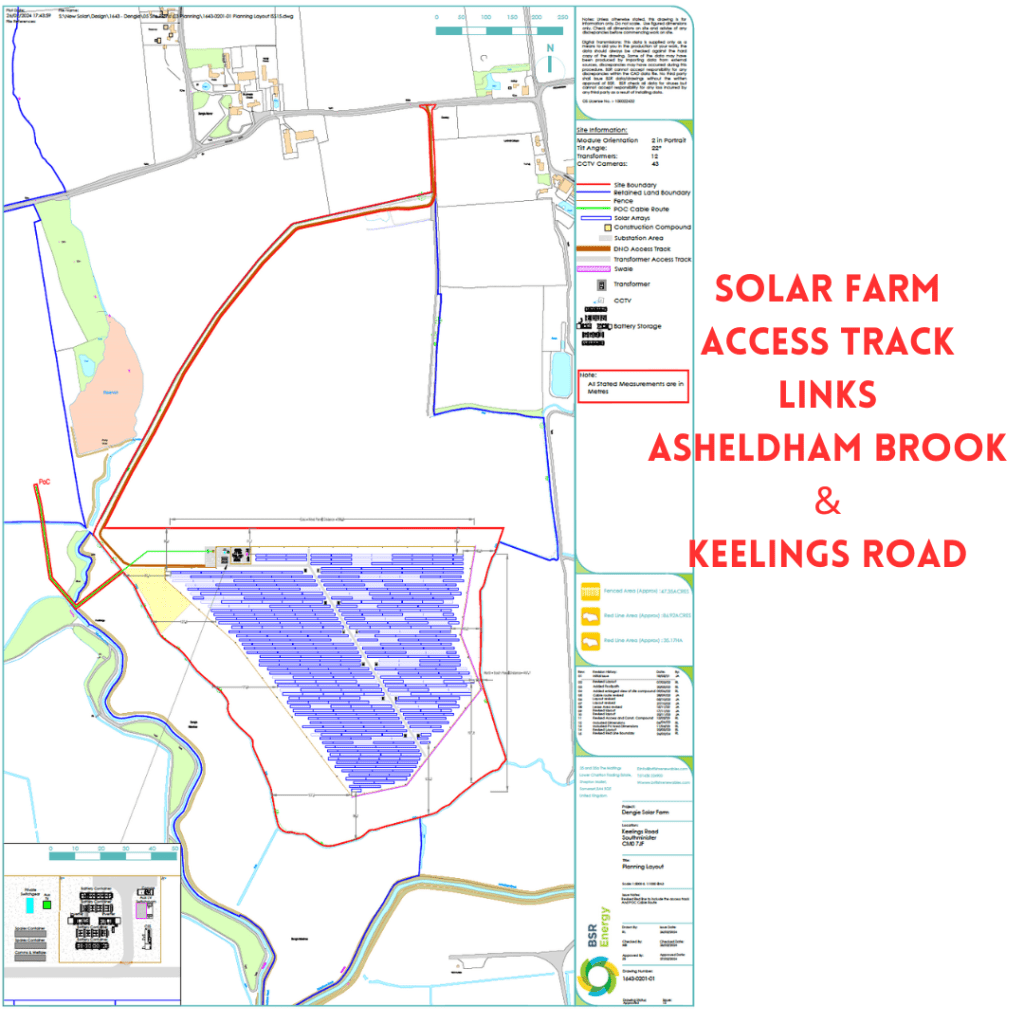
Next week, work commences on a solar farm south of Keelings Road, Dengie.

This will involve constructing an access road from Keelings Road to Asheldham Brook, which could be made suitable for cycle access.

From Asheldham Brook it’s only 2km to The Marshes, Southminster through land (Northwycke Farm) with a single owner: Lincoln College, Oxford.

Continue reading “Better Walk/Wheel/Cycle Routes”

Weeknotes 02025 Q1 W8

DCAP

Monday. I feared devolution in Essex would derail strategic planning on climate issues

That seems to be proving true with the new Transport Strategy for Essex (LTP4) which was set to reflect county and national policy commitments to transport decarbonisation and better provision of sustainable transport and active travel infrastructure.

Public consultation on the draft Transport Strategy for Essex (LTP4) & the programme of planned investment in different parts of Essex was scheduled for Winter 24/25 – with adoption of the new strategy in Spring 2025.

I recently sought confirmation of calendar dates for the Essex Transport Strategy and received the dispiriting reply that devolution was causing the timetable to be revised….

Today I have written to ECC Cllrs Fleming and Stamp who represent the Dengie, and to cabinet member and ‘climate czar’ Peter Schweir seeking answers to these questions:

  • When will the decision regarding further public consultation and timelines be made?
  • Can they confirm that Essex County Council remains committed to formally adopting LTP4 in 2025?

Tuesday – Cllr Schweir replied first but just said he would ask the officers – not very satisfactory as I had already forwarded him my reply from officers which noted that it was a member’s decision… . Cllr Fleming sent a reply saying she would try to find out. No reply fro Cllr Stamp


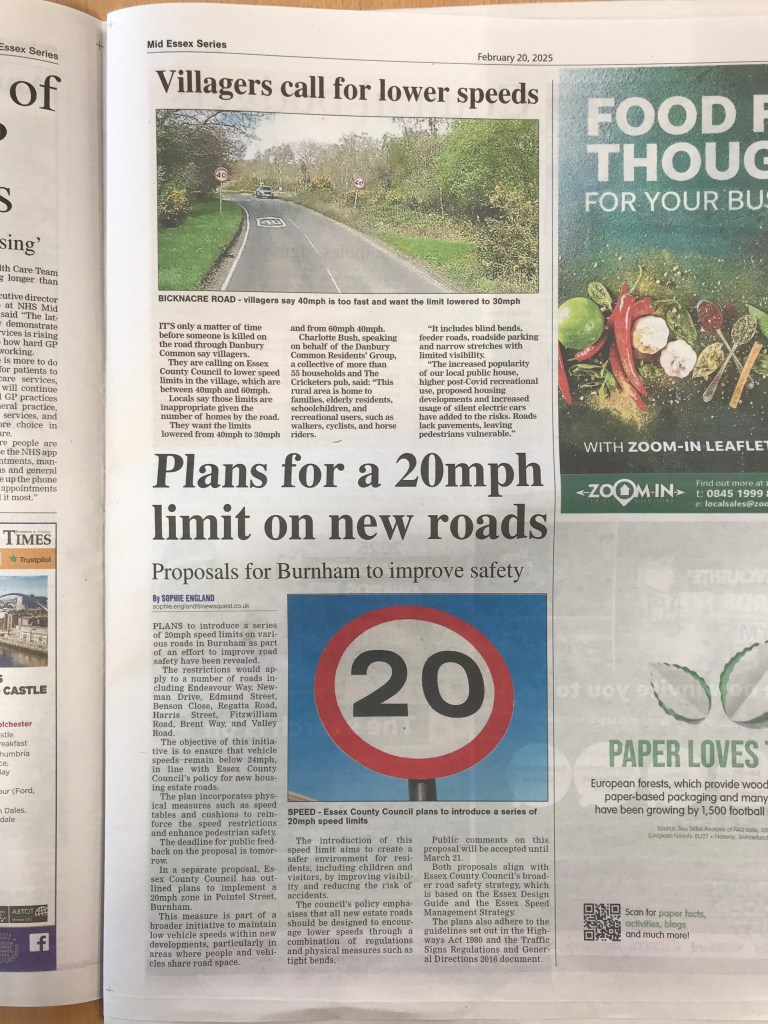
The Maldon & Burnham Standard featured a news story about 20mph speed limits for the new estates in Burnham-on-Crouch. I’d already heard it mentioned at the last council meeting, but there and on FB there were many comments on how it would be policed – the same way all speed limits are policed, I presume?

Thursday. I published the first promo for next week’s monthly meet and the associated River Watch talk.


Tree distribution, some of the saplings went to St Andrews’ Althorne. They are planning a wildlife-friendly church ground with Essex Wildlife Trust

Thursday. There was too much interest in DCAP, again, from Burnham Town Council – and it is difficult not to sense malicious intent. Parish/town councils are a strange level of government. They have very little power or influence and they are the easiest positions to get (many join them through co-option or uncontested elections). Yet, post-holders can sometimes seem possessed by a sense of status and authority far removed from their actual position as unpaid servants of the people with very little clout. It should be a noble role, but easily descend into busy-bodydom.

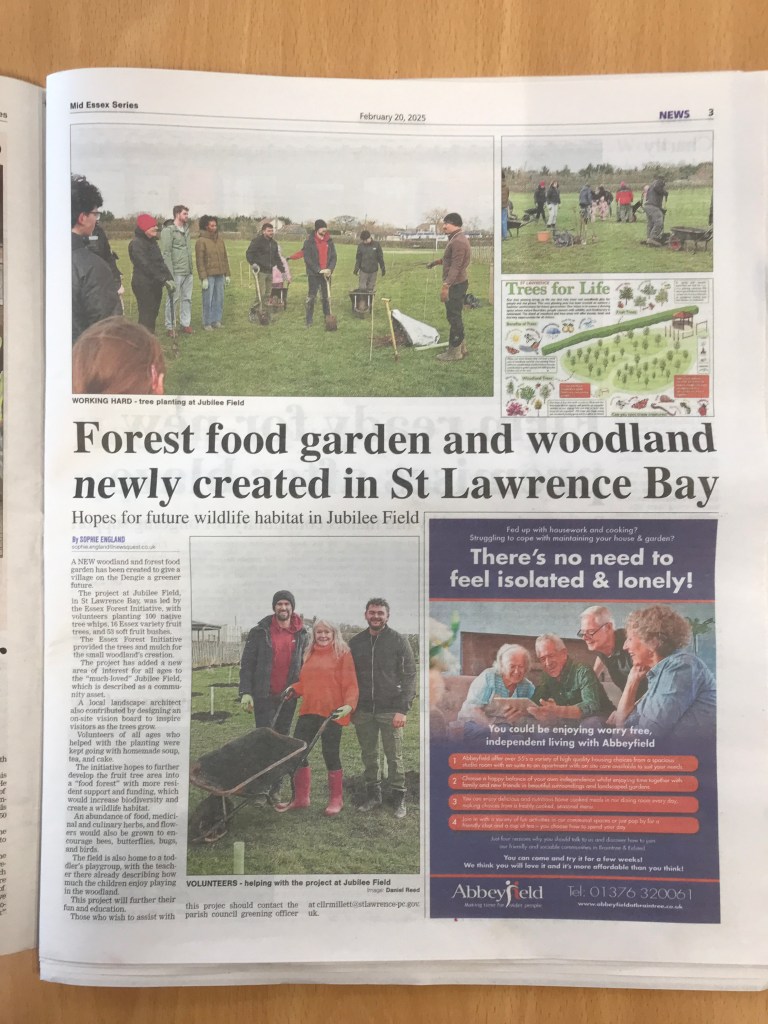
Friday. The new woodland and food forest in St Lawrence made the local paper.

Day Job

1to1 with my line manager – all is good there for now.

Friday – the weekly corporate missive informs staff that we now have a balanced budget for 2025/26 but that the UK Government’s Spending Review Phase 2 for 2026+ is ongoing and “until concluded we still have uncertainty for beyond 2025/26”. It doesn’t look like we got a good slice of the Arts Everywhere Fund. So, along with the uncertainty comes some fear and doubt. The UK finances and Rachel Reeves’s fiscal rules already look set for a collision course before Starmer started pledging billions for Ukraine. We’re still dependent on a government grant coming through an unprotected department, so when April 2026 comes around I imagine some cutbacks will swiftly follow. HR are already asking if folk want to buy some more leave days.

Everyday Life

At some point this week I went under the 600 days threshold on the plan that cannot be named.

Tuesday. The sound of a chainsaw outside this morning, another local tree taken. Our borrowed landscape has declined a lot over the last few years – soft organic form replaced by the hard lines of fencing, brickwork and concrete. In the evening though, just after sunset, I saw a large dog fox leap over a nearby fence and wander around the gardens – all while one of my neighbours practiced playing ‘Wild Thing’ on electric guitar.

Wednesday. Dental hygienist – this is my only interface with private healthcare, and the bill is sufficient to warrant full communism.

Wednesday. I went to a talk by Michael Head at the Royal Corinthian Yacht Club on the last 125 years of Dengie Hundred Farming. These local history talks are frequently very different from the type of academic presentation I’m more used to – and this was one of those – a slideshow of re-photographed old postcards and personal snaps presented alongside anecdotes, jokes and lists of things you might not know about cows. The room was full to the gunwales. Many in the audience were clearly from the farming community and some were referenced or specifically called out to; others were quick to shout out corrections and clarifications: “That’s a pea-spreader!!”
The room was hot from the crowd and the chairs were placed tight against one another which added to the discomfort when laughter accompanied mentions of immigrants or gypsies and cheers were raised at the sight of huntsmen in their finery with accompanying calls to ‘bring it back’.

Many of the photos were great, but I didn’t learn much about the last 125 years of Dengie Hundred Farming – the audience was assumed to know the details, and to recognise the names of people and farms mentioned in passing. I wanted to hear about things like: how the world wars had changed agricultural practice on the Dengie, about local mechanisation and the introduction of chemical Ag, about how the land was altered about the ’53 floods and how the old creeks were filled in and replaced with new straight ditches, about the amalgamation of small farms into fewer larger holdings, about the formation of the Dengie Crops co-operative. I didn’t get any of that, but there were little stories and references you wouldn’t get elsewhere which made it worthwhile nonetheless. I was acutely aware that the talk wasn’t being recorded and that a lot of what was heard but not retained will probably die with the tale teller.

Friday

Saturday. We had our Home Energy Assessment and we now await the report (mid-March was mentioned for delivery). From things the pair of assesors said while they were here I’m not optimistic I’m going to learn much, if anything, I don’t know already – despite the pre-visit written survey I filled in it was apparently news to them that the house was Grade II listed – and there didn’t seem to be in expertise in crafting solutions particular to that need. We won this assessment in a competition, apparently it would normally cost £500 – frankly I’d expect more for that money, but let’s see the report I suppose.

I have larger concerns about the national programme of transitioning the UK housing stock to sustainability. At every level: data collection, analysis, proposed changes – information seems to be drawn from off-the-shelf lists rather than from any understanding of the particularities of the nation’s varied housing stock. If your house was built in the last 40 years and has an EPC certificate, they can easily tickbox through – increase loft insulation to 300mm, solar PV and battery, air-source heat pump, smart thermostat, TRV’s on the rads etc. But the UK’s housing stock is among the oldest in Europe. Our home is among the 15% of houses in England built before 1900 and 78% of homes in the UK were built before 1980. As ONS analysis shows that the age of a property is the most significant factor associated with energy efficiency (ahead of both fuel type and property type), finding bespoke solutions for the housing stock we actually have is more important than blanket applying some set of heuristics.

Saturday. C and I went to the Beecroft Gallery in Southend for the opening of 2 exhibitions – the interim TOMA show and ‘Into the Zone’. Apparently the Southend mayor, Ron Woodley, was in the building but he remained unseen, which was disappointing for those hoping for a face-to-face encounter between him and artist/TOMA leader Emma Edmondson. Woodley has been an eager voice in local philistinism and apparently once threatened to drive into one of Edmondson’s public sculptures

Into the Zone with its Estuary focus resonated with many of my interests and concerns. I was frustrated with the explicit referencing of the Zone from Tarkovsky’s Stalker, though which felt like borrowed glory. Stalker is now one of those overdone culture reference points like the ‘the liminal’, folk horror, standing stones, Sebald’s Rings of Saturn, psychogeography, fungal networks – that have become bland touchstones fully drained of their magick by the Arts and Humanities departments.

Media

TV

White Lotus S03E01
Severance S02E06

Music

Online

‘You can rattle the bars of the cage as fiercely as you like but you will never actually escape the comfort of the zoo’ – James Marriott in The Times, ‘Conspiracists are about to get a dose of reality

‘from here on out, for any player smaller than a state or a multinational, adaptation is pretty much the only game in town worth playing, because it’s the only one that people on the ground are actually gonna notice.’ Paul Graham Raven Drill, Baby, Drill

Future Thinking and Dreaming

You Say You Want a Devolution

This week, the Greater Essex devolution consultation opened – part of the fast-track reorganisation of local governance. The consultation concerns the proposal to form a Mayoral Combined County Authority for the local government areas of Essex County Council, Thurrock Council and Southend-on-Sea City Council. An area it calls ‘Greater Essex’ but once was just called Essex. The first election for a Mayor is scheduled to take place in May 2026 – in 15 months.

The consultation does not concern the proposals for new unitary local government replacing the existing two-tier system, where services are split between a county and district council. This seems like replacing one two-tier system with another one: county & districts replaced with mayoralty & unitary authorities. Suffice it to say, they are not taking a bioregional approach.

Continue reading “You Say You Want a Devolution”

Weeknotes 02025 Q1 W7

DCAP

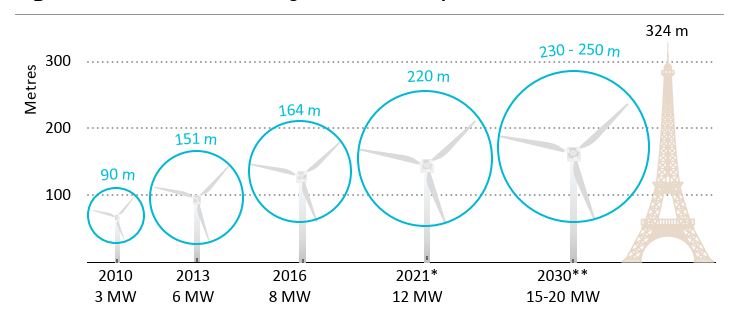
Monday. Community Led Energy Planning Teams call with ECC and Joolz. Also discussed the Dengie Marshes Wind Farm and the possibility of a community asset stake. The more I think about it the more concerned I am about the work necessary if eMpower got involved – especially as I was the only eMpower person on the call – maybe planning around the £600k pa community benefit fund would be a better approach. I saw some anti-wind posting in a local FB group where the poster was saying they would be as tall as the Eiffel Tower – a bit of an exaggeration I thought but I looked up a comparison graphic and (at up to 225m) they would be a significant fraction of the height – plus there could be 17 of them. I find them aesthetically pleasing but 17 two-thirds Eiffel Tower scale turbines would be a dramatic change to the skyline. *Having gone up the Eiffel Tower last month, this was actually a useful comparator).

Monday. C is distributing tree whips to people across the Dengie, she hasn’t had any photos/locations back yet though to map this little forest initiative.

Tuesday. Sorting out details for Riverwatch attendance at the February DCAP meet. Arranging time to talk with Gilly St Lawrence about the March meeting there.

Tuesday. Chasing ECC about dates of LTP4 consultation part 2. Some emails with Mary-Ann Munford and John McCarthy about putting in a bid to Essex Cycle Grant for a feasibility study on the Burnham-on-Crouch – Southminster cycle route. I sent a speculative email to Sustrans to see if they could do one and what the costs would be.

Tuesday. I read the updates from Sarah Green’s Organics that come in the vegbox – the recent rain has allowed them to draw on Bradwell Brook and fill their reservoir. The asynchronous water capture of winter rain is essential with the increasingly dry summers out here

Thursday. Teams call with Gilly re : St Lawrence DCAP meet in March. There’s a possibility that Andy Wright from Essex Wildlife Trust will come to speak about the seagrass restoration project and what else is happening in this part of Essex

Friday- Climate Action Partnerships catch-up call. Heybridge & Maldon Climate Action Partnership are thinking about changing its name to reach a wider audience that isn’t attracted by the current framing. The name HUMAN4NATURE was posited. It made me think about the Burnham Town Council meeting earlier in the week where I had heard some audience guffawing when ‘Net-zero’ was mentioned (they guffawed at the mention of a Covid-19 victim’s remembrance day as well). It also made me think about some recent interactions in a local Facebook group where the idea of the UK taking any climate mitigation action was roundly dismissed and wrapped up with culture war issues and the evils of foreign aid. Climate action is clearly now understood to be in the Woke area of the political spectrum and another nonsense to be dismissed by RUK fans. Later in the day, I watched a Nate Hagens video where he posited that ‘facts and values will not overcome traits and human behaviour and structures’ and spoke about the differences between ‘how the world ought to be and how it is’ – ‘facts and values are important but not sufficient for the times we are living in’ ‘facts and values are no longer sufficient to steer humanity away from the more dystopian outcomes’. He also mentioned, concerning communicating about some topics, that there are things he won’t say publicly because he doesn’t ‘want the Eye of Sauron focussing on Red Wing, Minnesota’ [where he lives]. I’m feeling the Eye of Sauron on me a bit lately.

Friday. I reflected on Heybridge Cllr Paul Spencely’s comments about Heybridge population size after new developments are completed – while she says ‘Heybridge is not a town’ – the imminent population increases will take it over 10k and therefore make it an ‘urban’ place in the UK government terminology.

Friday- I represented the Dengie Hundred Bus Users Group again on a Teams call about the Love Your Bus grant application. There was low attendance though – just the convenor from BTC, Mayowa from Mayland and me – so the meeting was cut short, which suited me – on too many calls lately.

Sunday – Zoom call with Mary-Ann and John about my contact with Sustrans, the questions Sustrans threw back at us, what do we mean by feasibility study? etc.

Day Job

Someone from Digital did the weekly internal editorial blog and wrote about Conway’s Law

Everyday Life

Tuesday. dentists – all good, but booked hygienist for next week.
Tuesday eve. BTC meeting – the first with all the new councillors. There was an agenda item question regarding community groups making free use of the council chamber – it felt rather pointed, as DCAP was singled out as being a group with no BTC representative on it and Cllr Stamp challenged its right to free use of the space. In other news, the EV chargers are finally going to be completed in Providence car park.; there will be no renewal of the Station House lease; there was no clear answer on whether tey are going to do No Mow May or not. New councillors Les Macdonald and Tory guy were jointly appointed to the Environment role on the council. One of the new RUK guys didn’t turn up and didn’t send an apology (turns out he’s quite active on TikTok though) – one of the shy Tories sent an apology – it was the first meeting in which they could participate and they were no-shows. In the public forum section, I didn’t make friends when I raised concerns about some loose communications regarding the recent elections. The secret squirrel section closed to the public was about devolution – the implication from earlier chatter is that the end of District Councils in Essex means local assets (eg. Riverside Park, car parks etc.) and possibly extra responsibilities will devolve to town/parish councils – assume some budget comes with – wait to see on this one.

Wednesday troubled sleep. I had a vivid dream in which I went lucid and had cause to pull myself out. On FB I posted something about reinsurance companies saying that the UK needs to spend £31 billion a year on flood defences – a pertinent subject for a flood risk area that got inundated in 1953 – and presented it as an example of what RUK’s ‘we just have to adapt’ agenda means in practice – it stirred up the standard responses from the standard men – mainly Nige can do no wrong types trying to talk about foreign aid or some other confection. Where factual errors were being presented I countered, and I tried to take a couple of commentators down the logical path of their statements. It gives me no pleasure to relay that straight-up climate denial is alive and well in Burnham-on-Crouch.

Last night’s council nonsense and this FB melee – both set against the latest Trump and Musk drivel, the situation in Gaza, the general rise of the Fash, and Rafael Behr’s Guardian article – boiled my brain. I went out for a walk, musing on whether there was value in saying anything about anything these days and whether protecting my own mental health needed to be prioritised. C and I talk about a lot of this but there’s only so much stuff your partner can take and I miss some larger group of affinity I could talk this shit out with.

Saturday: C and I took the bus to Danbury and then walked to Maldon through ‘The Wilderness’ (got some Shinrin-yoku) and via The Cats public house. The Cats isn’t open much, only takes cash and this was the first time the stars aligned for us – it was open and we had cash. It’s a wonderfully eccentric country pub that you don’t see the like of much anymore. Afterwards, cold rain that wanted to be sleet accompanied us for the last stretch past Beeleigh Abbey and we stopped for another at The Carpenter’s Arms in Maldon before catching the bus home.

Sunday: Blood donation in the morning in South Woodham, #59. They were running late which meant that I had to launch and chair the Zoom call I was hosting on my phone while I was still laid up pumping claret.

Media

Films

Elevation – Amazon post-apocalypse fare. More of the same that we’ve seen before. This one is only 18 months after the event, so I gave them a break on the cars – but it’s amazing/appropriate that in American post-apocalypses the essentials of society remain automobiles, firearms and packaged foods. You generally get a few nods to foraging and periculture but the dish of the day tends to be pulled from an abandoned kitchen cupboard, a defunct vending machine or a supermarket shelf – ‘Mac n’ cheese’ (Elevation), a can of coke (The Road), canned food (Walking Dead) etc. Americans were always already eating like the world had fallen.

TV

Severance S02E05 Trojans Horse – lots of elements point away from my ‘their consciousnesses are inside the computer’ hypothesis but I’m holding on to it. Folk who think that Lumon is doing cloning will find more to support that idea.

Yellowjackets S03E01 and S03E02 Cristina Ricci is still great but I’m not feeling this series yet.

Books

Finding it hard to sit down and read.

Music

On the Yellowjackets trip

Online

I loved the mega library in the latest Srsly Wrong podcast: Morning in Utopia

Les bibliothèques ou la barbarie!

Future Thinking and Dreaming

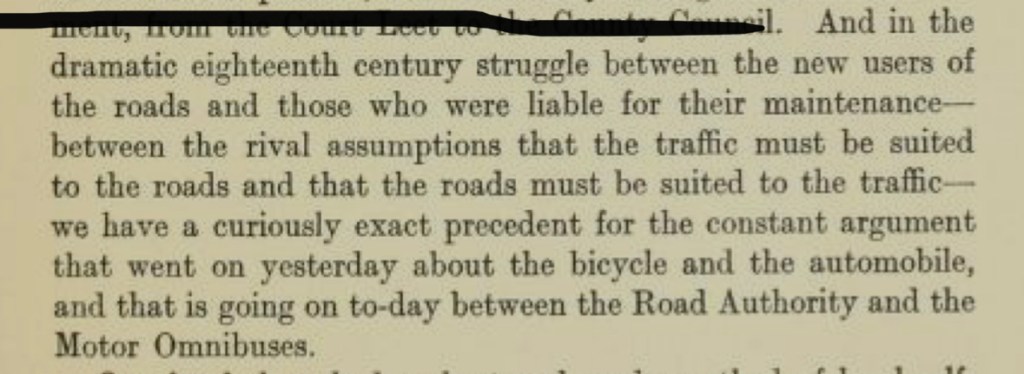
  • Found this paragraph early on in the Webb’s book The King’s Highway (1913)
  • I posed a question on the microblog sites: ‘Creative trespass and wild camping are the most well-known techniques of Tactical ruralism, what else is the toolbox?’

    I don’t think it’s helpful to just list a bunch of things with the prefix wild appended though – wild camping, wild swimming, wild foods etc. I’m trying to imagine something other than that – but what? Some tactical urbanism techniques apply equally, but what are the rural opportunities. Guerilla grafting? guerilla rewilding?
  • I thought that the rich countries going for ‘net zero’ by 2050 was analogous to elite athletic teams having the goal of an as yet unborn competitor winning a bronze medal in six Olympics time while secretly just hoping that they qualify for the Games.
  • I pondered what the Faragist Project 2029 looks like
  • the existence of the Veluwemeer Aqueduct gives me hope for the world – but make that road a railway!
Aquaduct Veluwemeer in the Veluwe lake near Harderwijk

Weeknotes 02025 Q1 W6

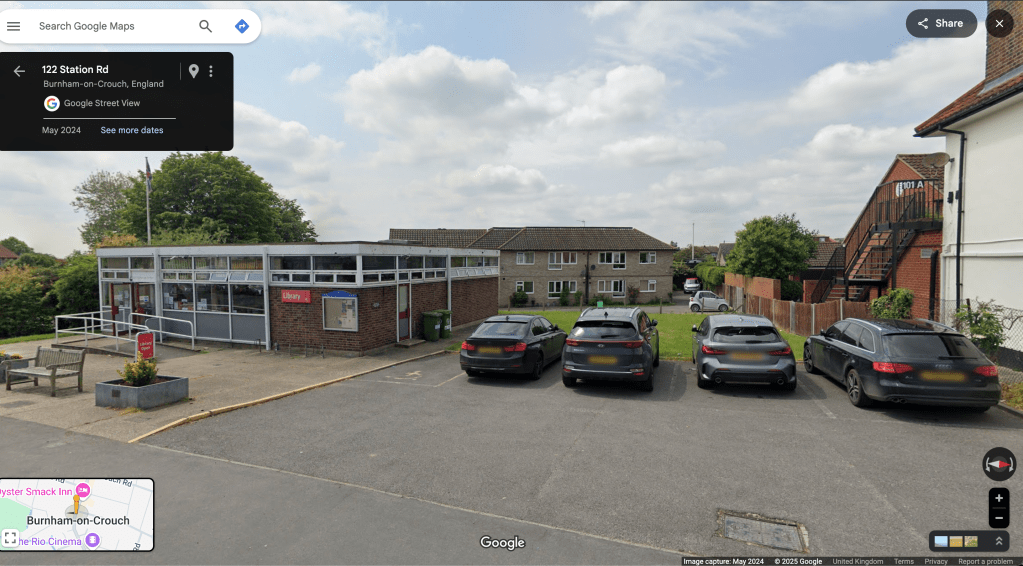
Over the weekend we received the disappointing news from Essex County Council that they were unwilling to let the Burnham Library Orchard project go ahead, with some not very detailed reasons about ‘infrastructure’ which seem to pertain to the library building itself which would have been unaffected by the proposal.

Burnham-on-Crouch Library

Tuesday. The Dengie Hundred Bus Users Group (DHBUG) monthly meeting. Hints that the D1 bus might be under threat of being withdrawn now, another hit to Dengie services.

Wednesday – I signed some documents as part of the process of formally registering eMpower Maldon as a Community Benefit Society. John Philpot’s done most of the admin work getting us to this point. We should be registered before the Community Led Energy Planning meeting in Maldon town in March.

Continue reading “Weeknotes 02025 Q1 W6”

Dengie Marshes Wind Farm

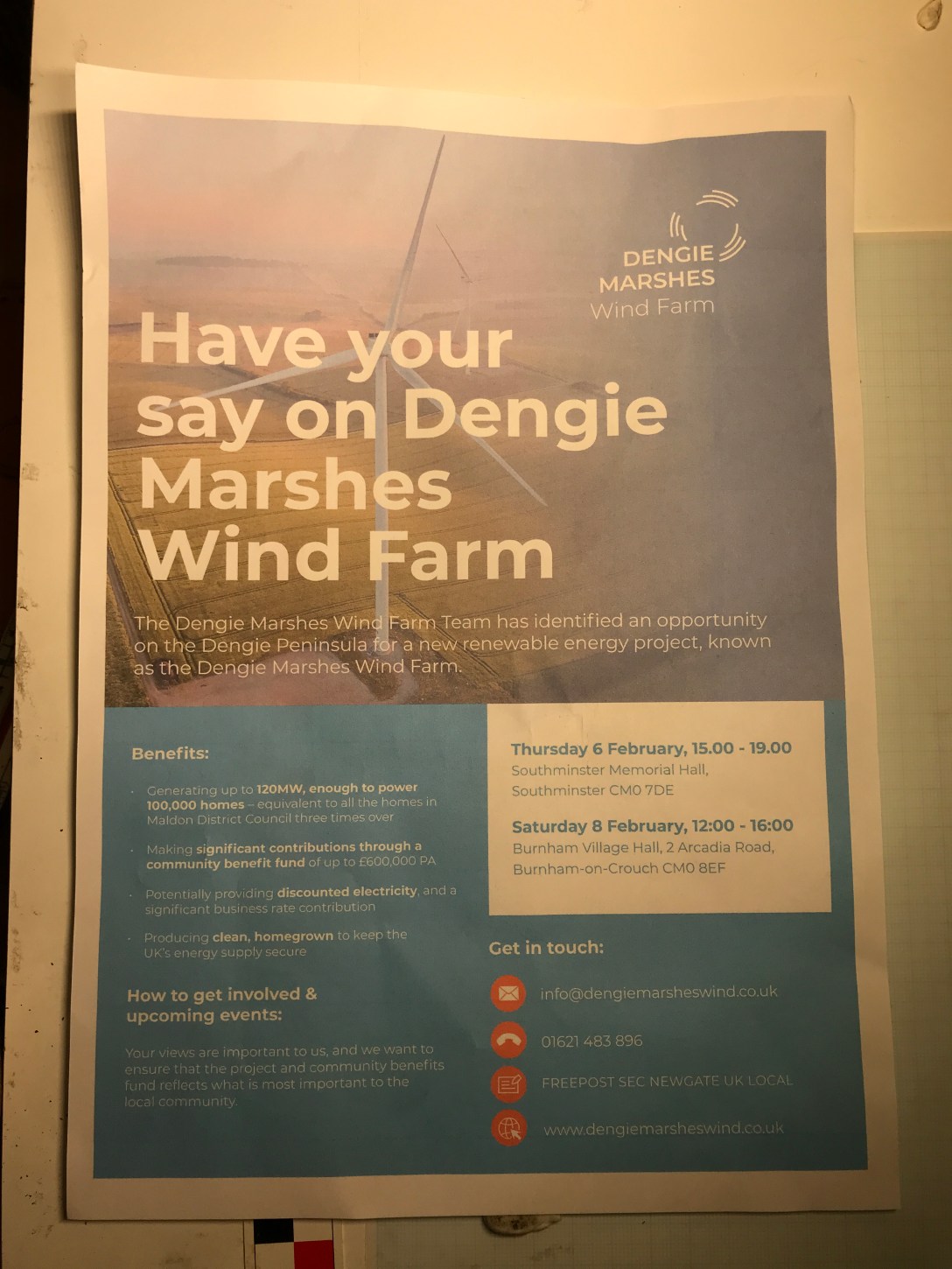
The proposed Dengie Marshes Wind Farm is moving forward into a phase of public survey and persuasion. (A company called Dengie Marshes Wind Farm Limited was incorporated on 18 October 2024 and shares directors with Blenheim Renewables, the company which initiated the project.)

The project has a website and is holding a series of consultation events with two scheduled for this week:


Thursday 6th February 15:00 – 19:00
Southminster Memorial Hall, Southminster, CM0 7DE


Saturday 8th February 12:00 – 16:00
Burnham Village Hall, 2 Arcadia Road, Burnham-on-Crouch CM0 8EF


They aim to submit a planning application this ‘summer’.

Continue reading “Dengie Marshes Wind Farm”

Weeknotes 02025 Q1 W5

DCAP

We had our monthly meeting on Thursday and tried to do some Thermal Imaging of 4 homes at the same time – which was ambitious. The only way to make it work was to split the group in two and I wasn’t really happy with things working out that way. Earlier in the week I spent some time looking through Parish Plans and Neighbourhood Development Plans from across the Dengie looking for opportunities and commitments.

Jo Coombes and I have been working on an idea I’m tentatively calling ‘Looking out for Nature’ inspired by the work that Wild Justice did identifying that ‘Nearly half of the nature-friendly enhancements promised by developers building new homes have failed to materialise’. I shared this report on local social media and suggested that because Maldon District Council has no professional ecologists on staff it was in high peril of developers not fulfilling their legal biodiversity commitments. I got a comment that ‘MDC Planning employs Planning Enforcement Officers who are responsible for investigating developments where planning has not been granted and checking that planning conditions attached to planning approvals have actually been carried out. Where a condition regarding trees or bird box has been inserted then they would check the compliance’ with a link to the Planning Enforcement. If you actually look at the Planning Enforcement site though it doesn’t support the claim that Planning Enforcement are proactive and makes checks. ‘ Their own overview description of their work simply states: ‘The planning enforcement team has responsibility for investigating complaints [my emphasis] principally where unauthorised development has taken place and aims to resolve these using the most appropriate means.’ i.e. they are reactive. It’s impossible to see how planning authorities like Maldon will be able to assess whether developments meet the 10% biodiversity gain

This places the responsibility to identify breaches with concerned citizens, hence the project. Do we really have the capacity to do it though?

Continue reading “Weeknotes 02025 Q1 W5”