‘I want to believe in it. I want to go on believing in it. But
I cannot quite yet. Because we haven’t yet arrived. We are still undeniably at the bridge. The liminal chaos clings to our garments and clouds our vision. We must move. We must create this future. We must create it before we can believe it. One windward tack at a time.’
- Tim Jackson, ‘Shooting the Bridge: Liminality and the End of Capitalism’ in Economic Science Fictions (Repeater Books, 2018)
1. Future Rural
If you were to go into a bookshop and found your eye caught by a book called Rural Futures; Imagining Tomorrow’s Countryside (Little Toller, 2026) you might reasonably assume that the book would be about that subject. But there’s surprisingly little about the future in this anthology, a sparse accounting of, to paraphrase Karen Lloyd herein, what they want next. Across 35 entries, only a handful seem to engage with the title. At the London launch, I heard one author say that those commissioned to produce them weren’t given much restriction on what they could write, nor guidance either perhaps.
The entries by Sue Pritchard, Jake Fiennes, and Fiona Reynolds offer something close to what I was expecting – but each reads rather like the introduction to a book on the subject, a teaser for the content to come. Content which is absent. Many of the entries throw in a line about the future in their final paragraphs but it doesn’t drive the pieces themselves.
It’s rather telling that three of the more focussed entries (those by James Shorten, Jez Ralph and Kim Squirrell) are reprints of content from a previous Little Toller anthology on the future of rural communities that came out late last year, Common Treasures Vol 1 & 2 (2025). Another previously appeared in Little Toller’s online journal The Clearing in 2023. Is the editor shoring up what else he got for this one?
Read more: Rural FuturingThe majority of the texts in this book seem backward rather forward looking, presenting potted histories of the rural either social or personal. The first half of the book is full of autoethnography and memoir. There is, also, a certain amount of apposite content on varieties of the rural-present – not least in the Common Treasures repeats – and I suppose we are to read these as potentials for wider future application. It’s not enough to just give a roll-call of rural issues though. You need to do some conjunctural analysis, say something about the interplay between these issues – make proposals about how we might navigate their contradictions, explore the forces and factors that will influence how they will change and develop. There’s too much on now and then, and not enough on later. What is the ‘call to action’ promised in the blurb on the Little Toller website?
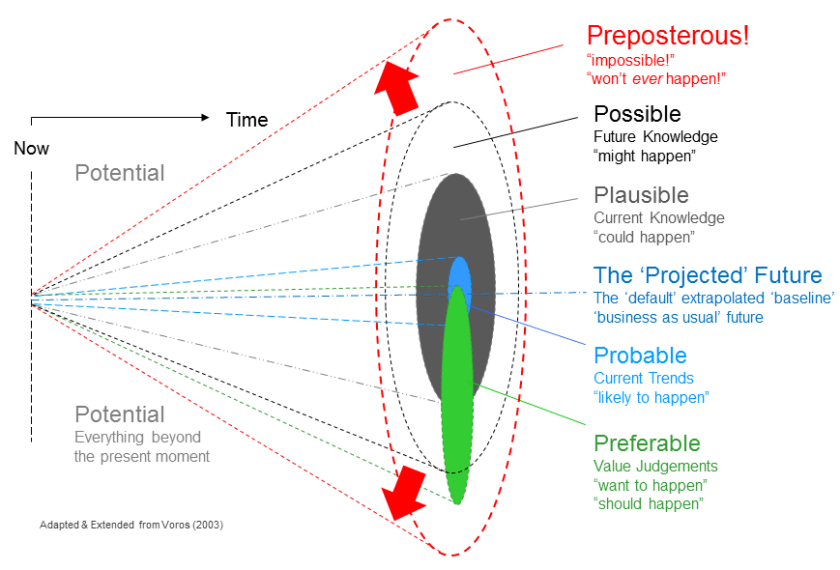
I guess I was hoping for a little design fiction or some scenario thinking, efforts at visioning and speculation. It didn’t have to be baler-twined up in future cone diagrams, but I think it would have benefited from foraging in that fruitful place of the preposterous, the possible, the plausible, the projected, the probable and the preferable.
There’s a rich seam of recent British futuring that could have been threaded through the collection here – works like The Land Workers’ Alliance A Manifesto for Food, Farming & Forestry; the alternate and conflicting visions of land-use in George Monbiot’s Regenesis and Chris Smaje’s Small Farm Future; Rob Hopkins’s work on From What Is to What If:Unleashing the Power of Imagination to Create the Future We Want and Shaun Chamberlain’s The Transition Timeline; the Roger Scruton legacy manifest through figures like self-styled “rural dissident” Jamie Blackett.
Earlier in the year, I read Ruth Rendell’s and Colin Wards’ book Undermining the Central Line (1989) a criticism of how centralist policies, affect rural areas (specifically their part of Suffolk). That book began with a speculative fiction on tomorrow’s countryside and Future Rural might have benefited from some of that spirit too.
I think that the value of an anthology on this topic (rather than a monograph) should also come from the diverse perspectives it contains, the dialogue created between the included texts and by how the editor shapes our understanding through their selection. It doesn’t succeed at this. In fact, there’s no editorial piece from Adrian Cooper that sets out the book’s purpose(s) and the selection criteria applied to either authors or texts, nor is there any summary or afterword.
If a reader were presented with this book without its title, I’m sure they would pick up it was about the countryside but I doubt they would guess it was explicitly about ‘imagining tomorrow’s countryside’.
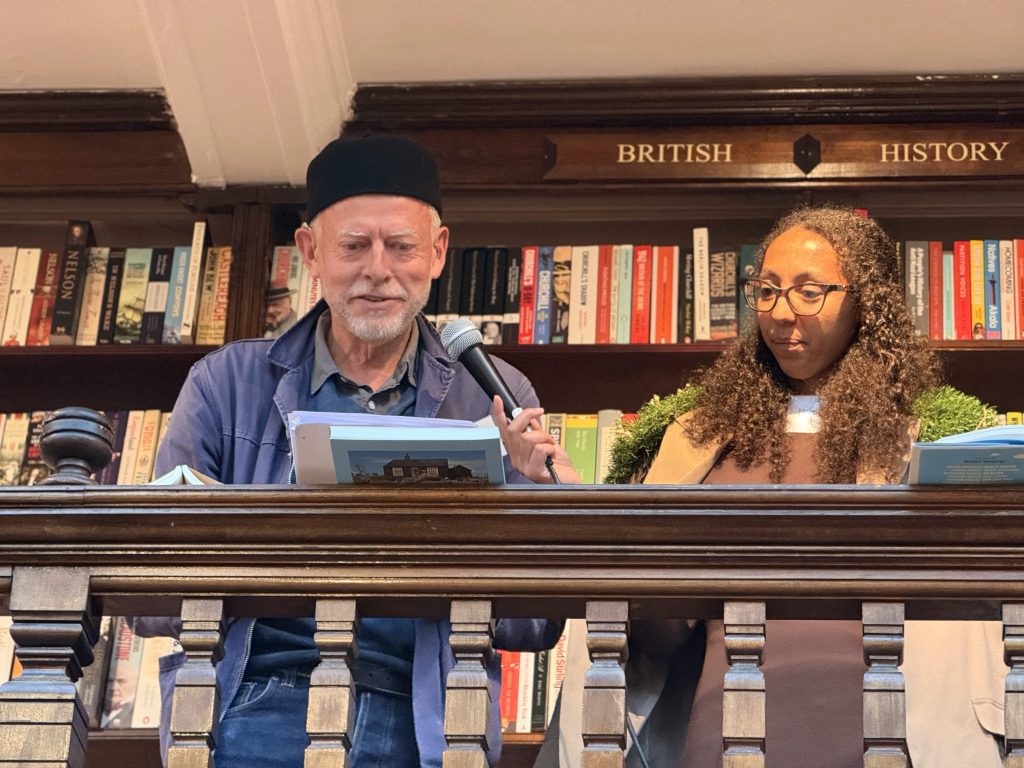
There is some very good writing in this book (Tim Dee’s piece is the standout entry) and I don’t mean to disparage it. It seems I just wanted a different book to the one sold. The anthology has the explicit purpose of marking the centenary of the CPRE, and it does capture something of this particular moment and of the various current demands on the countryside. The ongoing relevance of the CPRE in conversations about those demands remains an open question however.
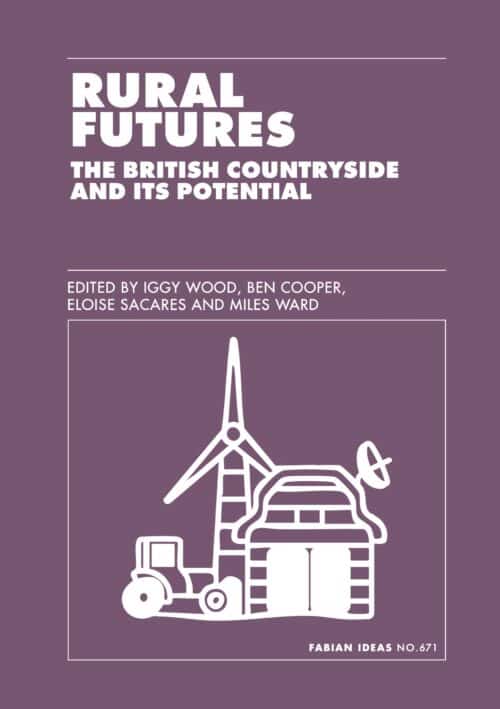
This book has an elder sister: Rural Futures; The British Countryside and its Potential [pdf](Fabian Ideas 671, September 2025) a pamphlet aimed at the new Labour Government. In it, the CPRE CEO Roger Mortlock writes that the CPRE’s ‘work now is focused on how we deliver a just transition to climate change, build the right homes in the right places and make the best use of land on our small island’. Unfortunately, the pamphlet is not much better than Future Rural at the conjunctural analysis, the task of imagining the future, nor in developing a route to contributor Jenny Riddell-Carpenter’s concept of a ‘countryside [which] is not a zero-sum landscape of competing demands, but a place where multiple priorities can be reconciled’ or of Future Rural contributor Fiona Reynolds’s call for ‘a coherent vision for the countryside as a whole‘.
2. Dengie in Drought
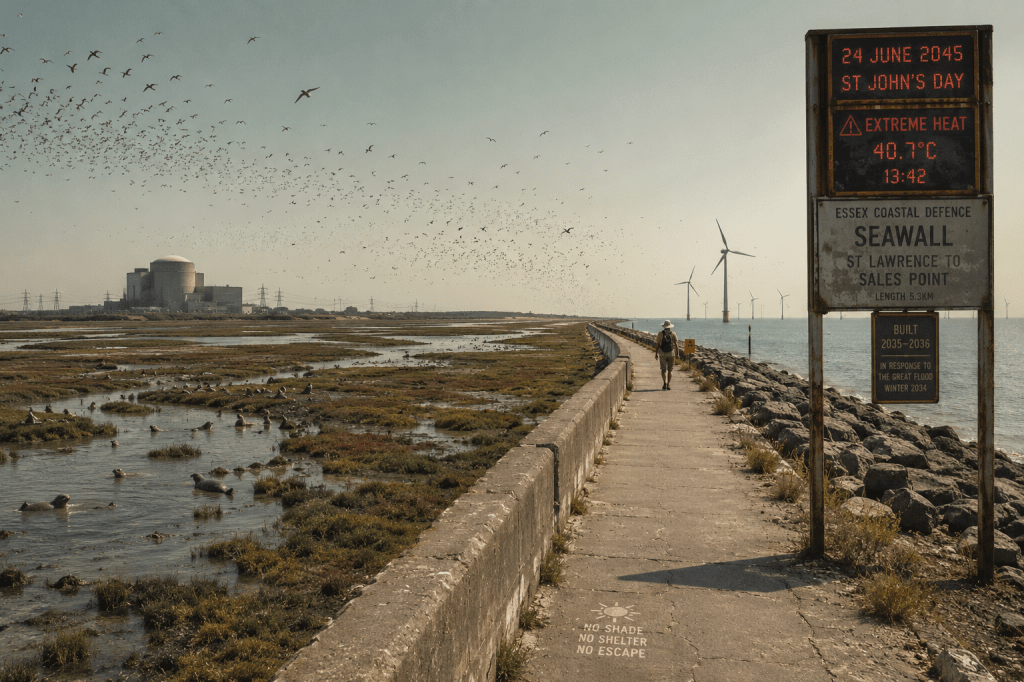
St John’s Day, 24th June 2045. It’s the eighth day in a row over 40°C, but the breakfast briefing from your AMi said Britain needs to prepare for -20°C winters. You’re walking the seawall between Sales Point and St Lawrence and there’s no shade – but someone’s got to fix the wires in that rad sensor! This path wasn’t here 20 years ago. In the winter of 2034, a deep, intense Atlantic depression tracked south-eastwards down the North Sea, reaching the Essex coast during a high spring tide, and a breach took out a section of wall west of the old nuclear station. All the effort went into keeping the atomic carcass dry and the old alignment wasn’t repaired. South of St Peter’s Chapel, other rifts mean there’s no decent route at all now. When the tide comes in it goes a quarter of a mile inland. The fields inward of the breaches are brackish and strange, there’s hints of saltmarsh returning behind where the walls stood, the seasonal birds come in sky-darkening flocks and seals swim up the creeks, but it remains a broken, brittle landscape still in the process of becoming something else. The wind farm’s back online, remodelled to something closer to its offshore kin now the tides tickles it’s towers. The mud walk out to service the turbines is worse than the mission you’re on now though, so small mercies and all that.
Some farmers took the government resettlement grants and walked away. Some reduced their landholding, stayed and changed what they grew. Bits of deserted land and a handful of the smaller holdings have become something harder to name: not rewilded, not agricultural, not abandoned. Regenerative market gardens, open mosaic habitats, orchards with a soft fruit understorey and messy edges, subtropicals in insulated greenhouses, olive groves, xeriscapes, alley cropping, halophytic edibles, mushroom sheds, hazel coppice, aquaculture, free-range hens, Ronaldsay sheep, holistic grazing. Nobody’s sure what climate resilience means anymore. They’re worked by enthusiastic new entrants to farming, unable to afford anywhere else, and by former white collar workers who moved out from cities to telecommute and then lost their jobs to automation. Insurance costs have made their homes unsellable, the old ‘thermodynamic constraints’ mean running an automobile has become too expensive and, with varying degrees of resignation, they make their lives here now. They grow food for themselves and their neighbours and surplus is sold at the gate or delivered to the care home syndicate by cargo bikes and wagon.
Burnham is still Burnham. Some unfinished edge estates were squatted and bricolaged into off-grid homes by kids avoiding National Service and some other walkaways. The high street has turned over several times. The Fiveways building that was the supermarket lay empty for a while but is now a provisioning hub run by the Dengie Foods Co-op, whose members include growers, two of the peninsula’s vineyards, a brewery, a bakery, waterkeepers, a micro-greens lab, five community kitchens and the church halls that kept people fed in the hungry years of the late twenties.
The rail service still runs, and freight cars attached to the the passenger carriages bring in packaged goods and raw materials, the post and parcels too – all of which are unloaded to the goods depot on Station Approach and the yard behind. Folk are concerned about the branch’s future though. High tides are undermining the ballast around Stow Creek, and the Stoke’s Hall defences have had their ‘hold the line’ status revoked by the Agency, threatening the track between Burnham and Althorne. It’s not on the StratInf list and there’s no repair budget. A cargo boat doing the east coast cabotage-run docks at the quay once a month and there’s always some trade with the Rochford Co-op going back and forth on the Crouch cable ferry.
None of this was designed. Some of it was argued for (or against), for years, in council chambers, village halls, public houses and holding cells. There were rarified conversations about common sense and a lot of energy went into blaming others that could have been spent softening the blows and building resilience. Most of it arrived sideways, through crises that forced choices that policy had deferred. Local plans went out of date before they got uploaded. The peninsula didn’t get a coherent vision for its future. It got a future anyway, the way places do: unevenly, partially, with loss built into every gain.
The bioplastic cover on the rad sensor has deformed in the heat and wedged shut, you brought the saw right?
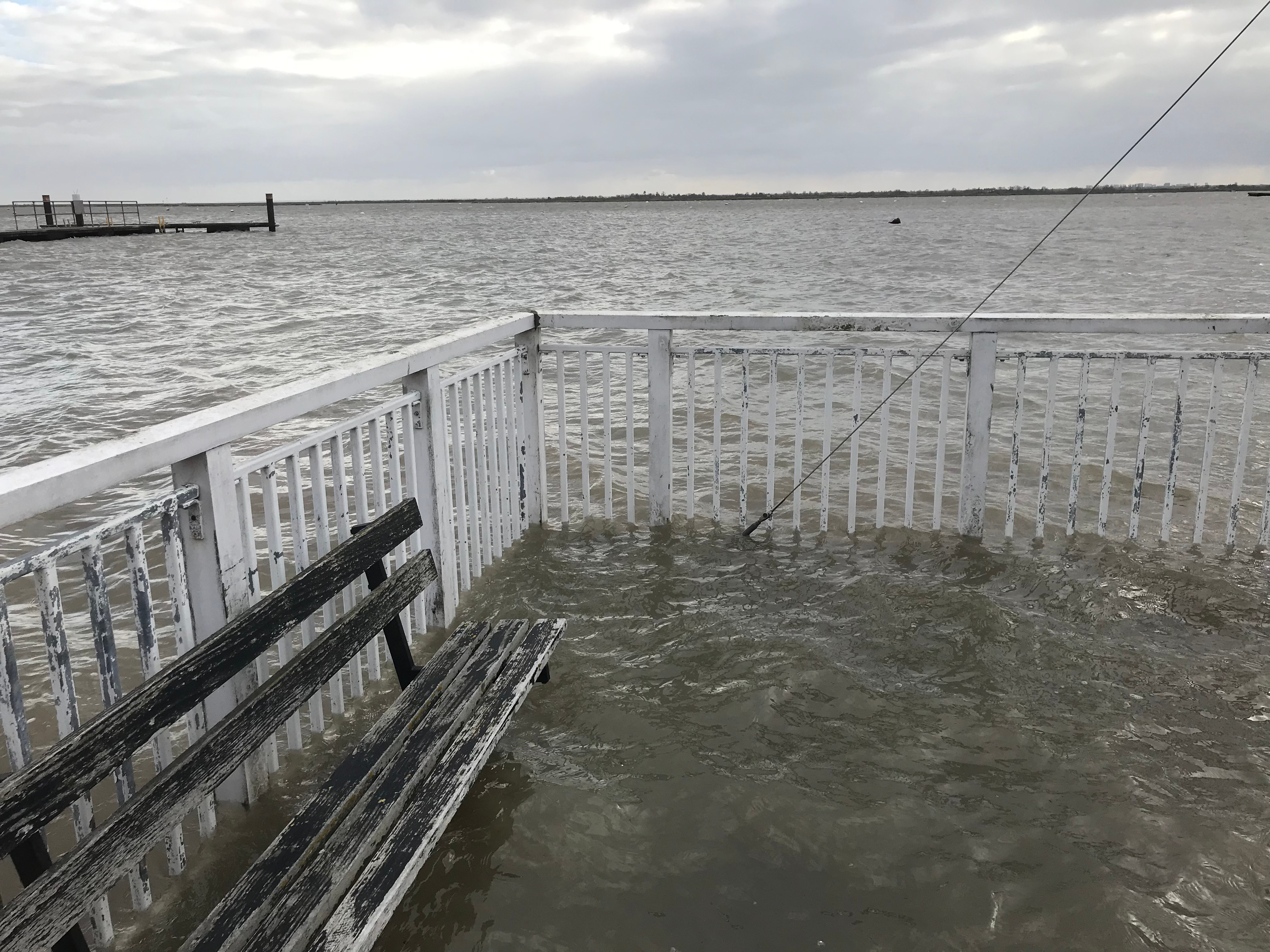
Out on the Dengie, I think about rural and coastal futures a lot, pondering what type of accord might be made here and whether we have the time to argue over the details. The land is sinking, the sea is rising. The temperature is going up, the rainfall is going down and sometimes the fields are on fire.
The land is in play from multiple directions. What once was woodland or marsh, then rough pasture, then better grazing, then arable, is now filled with the hope value of something else more profitable. What was once a patchwork of small land-holdings, a network of hedged fields – vegetables here, market gardens and orchards there, then consolidated into larger farms, an open landscape intensively farmed for rape, flax and horse feed – is now potential sites for housing estates, vineyards, fields of solar panels, and wind turbine installations.
If you list the 296 districts of England by order of population density from 1, most dense (Tower Hamlets), to least (West Devon), then Maldon District ranks 249. Yet Maldon District is just 50km from Tower Hamlets and Canary Wharf, and the Crouch Valley railway line has direct commuter rail services from Dengie towns into the City of London. It’s an obvious target for housebuilders and none of the local campaign groups against (over)development of our villages can reason past the cold logic of: location, location, location.
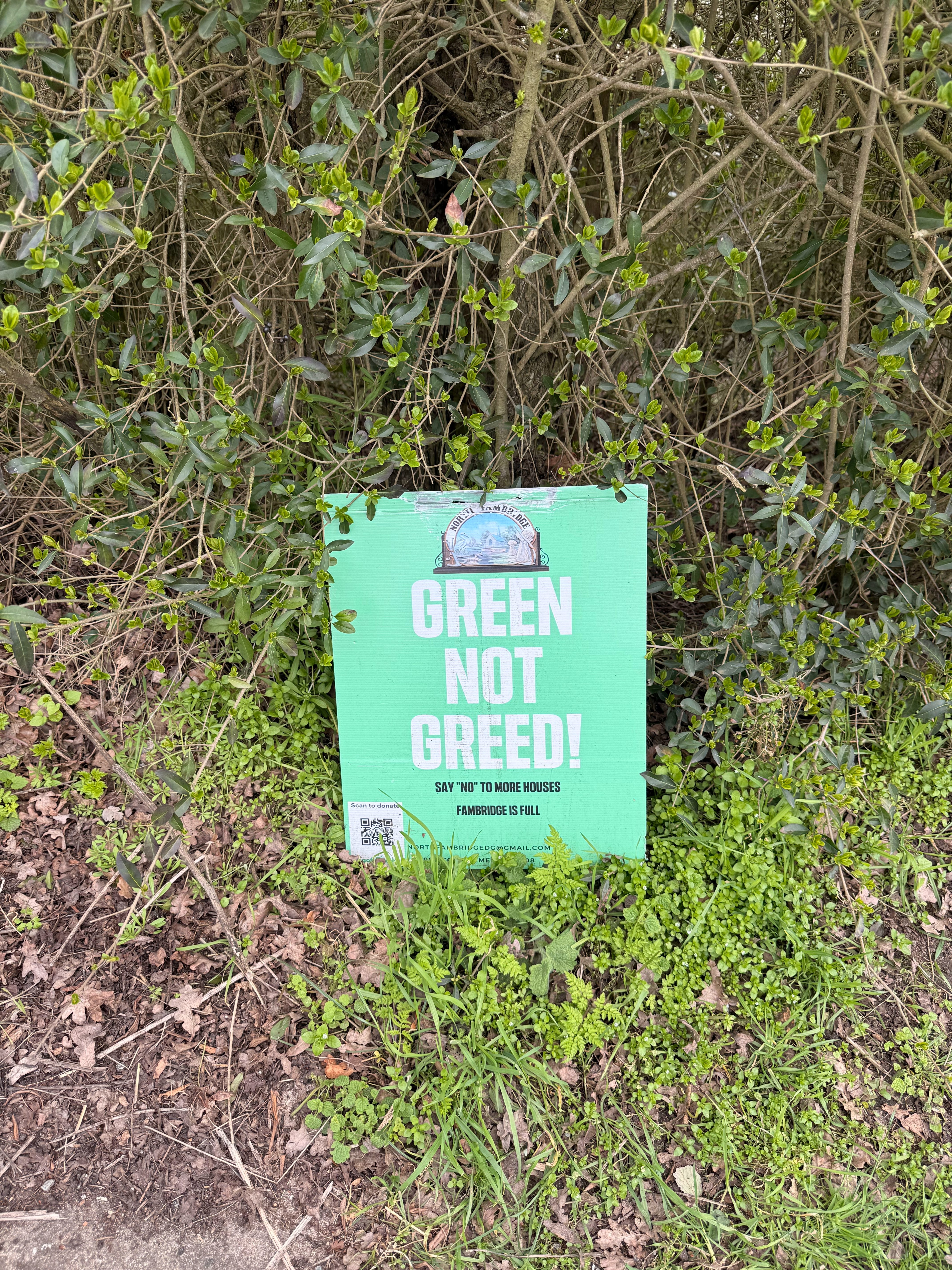
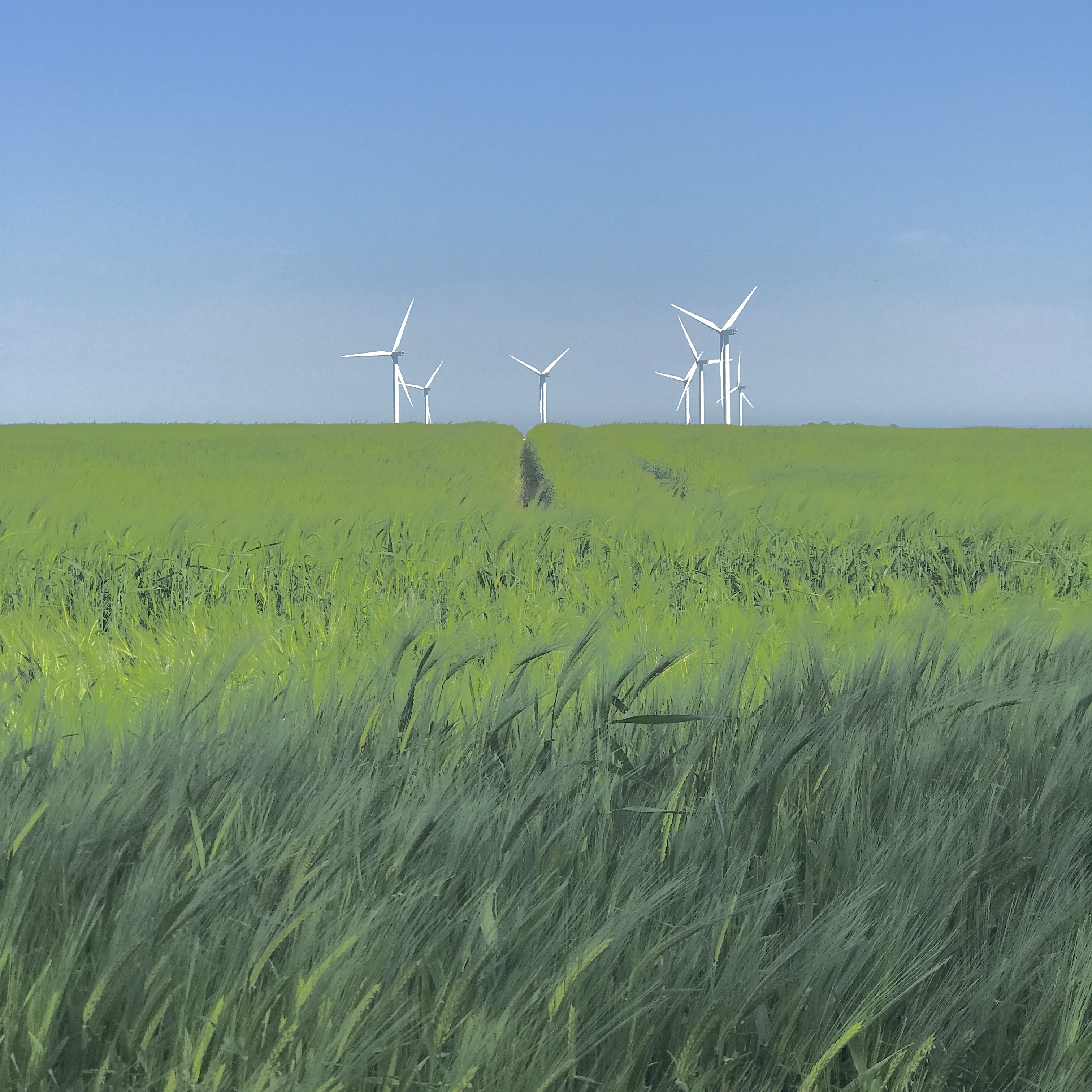
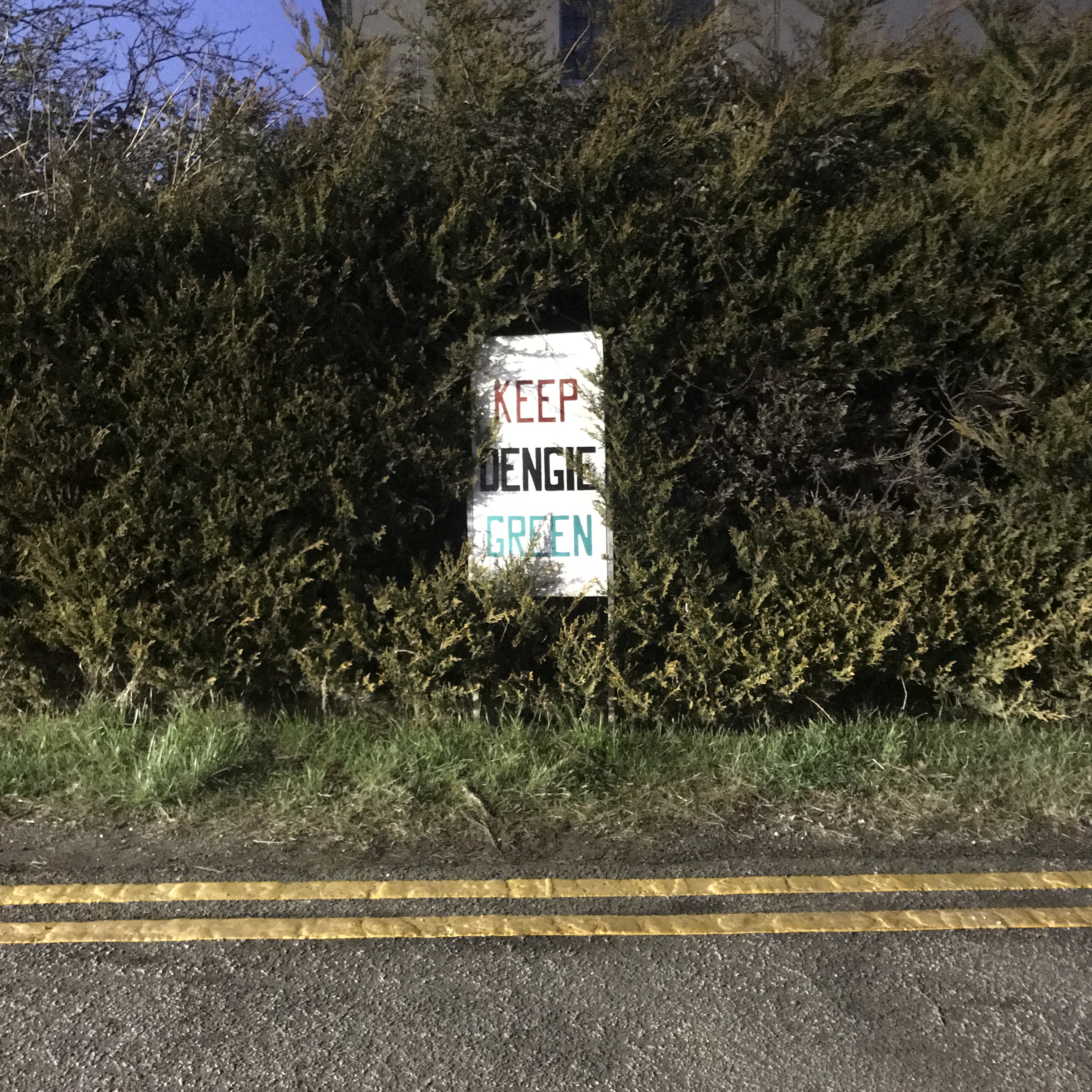
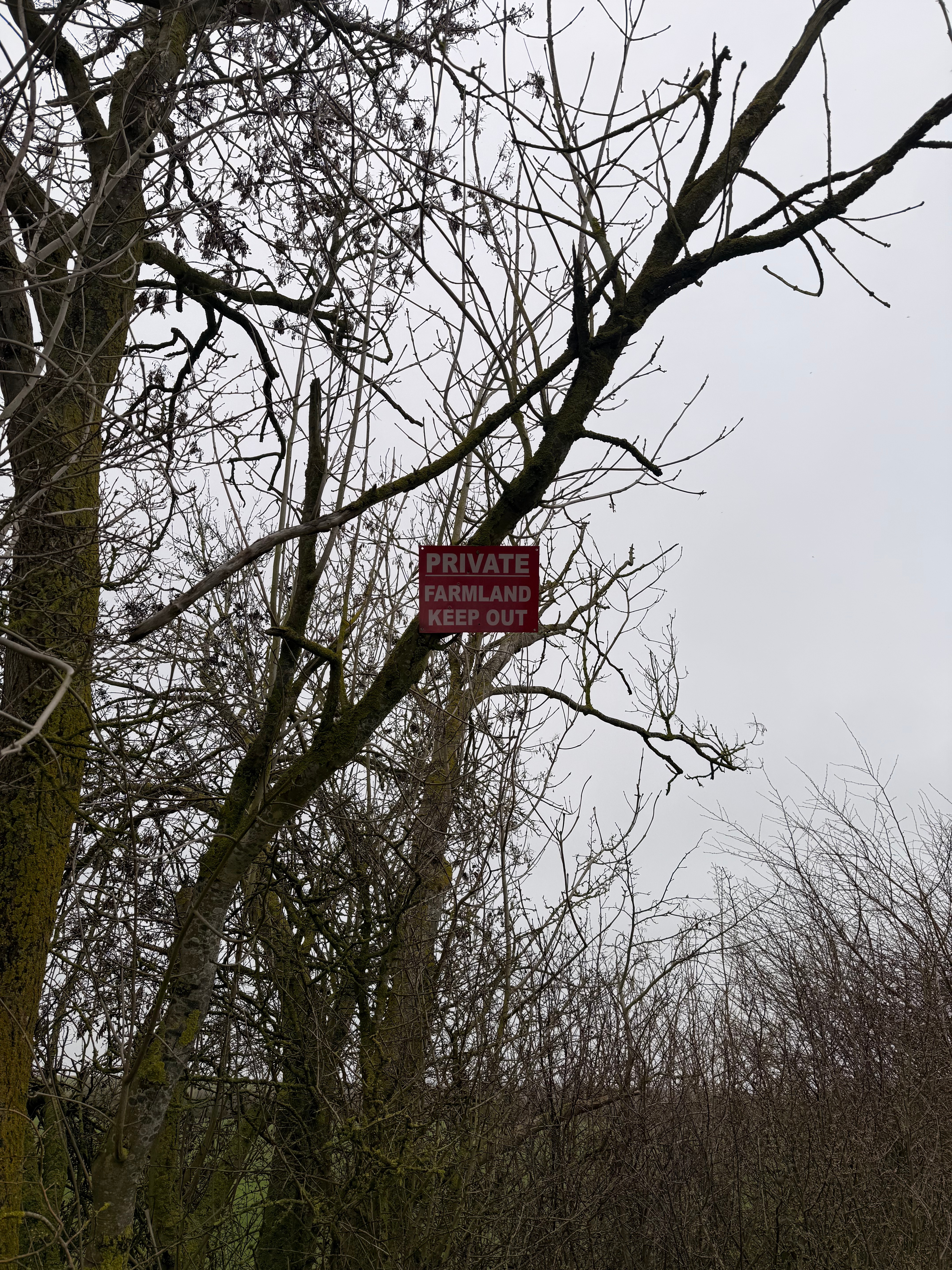
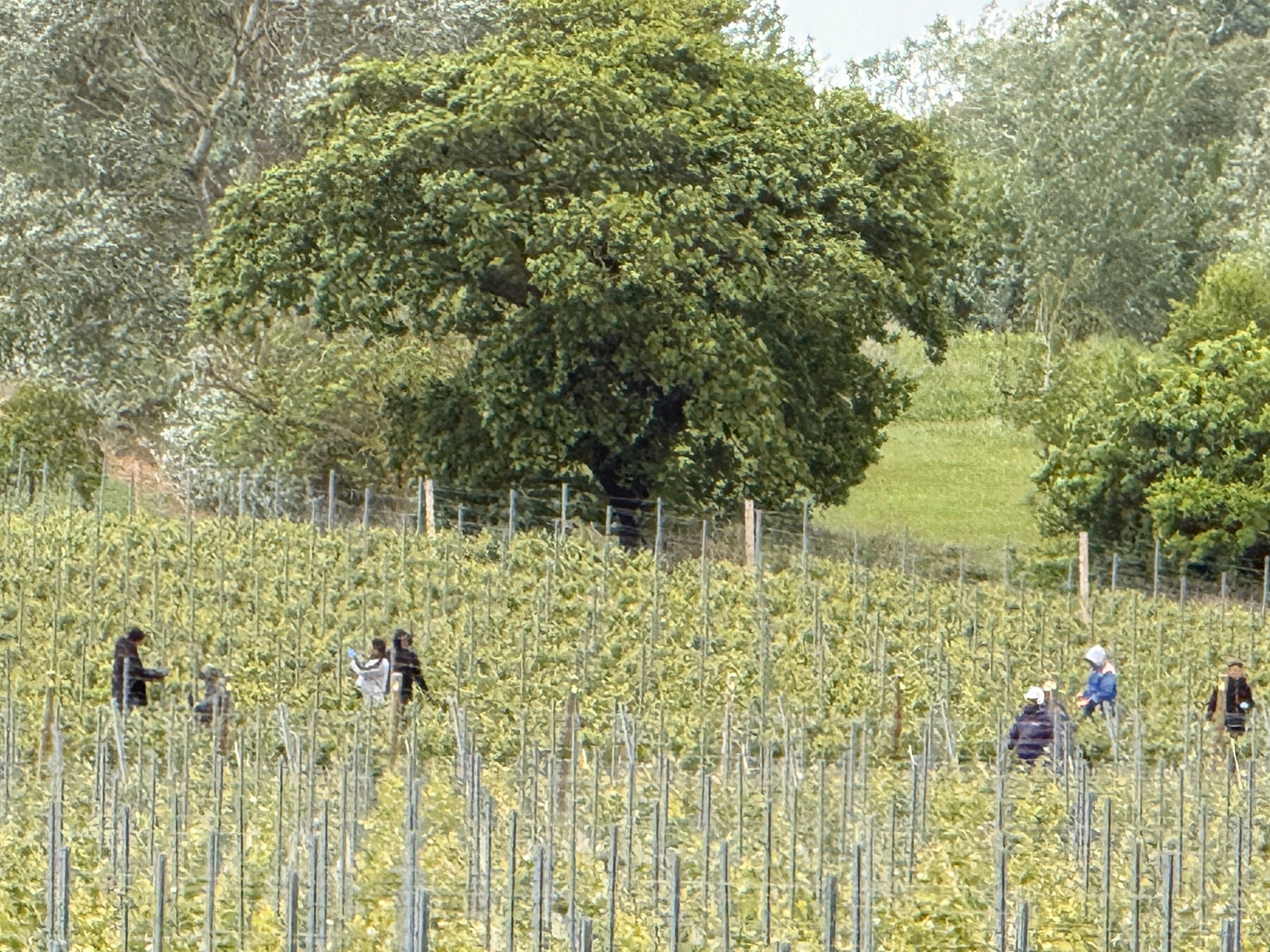
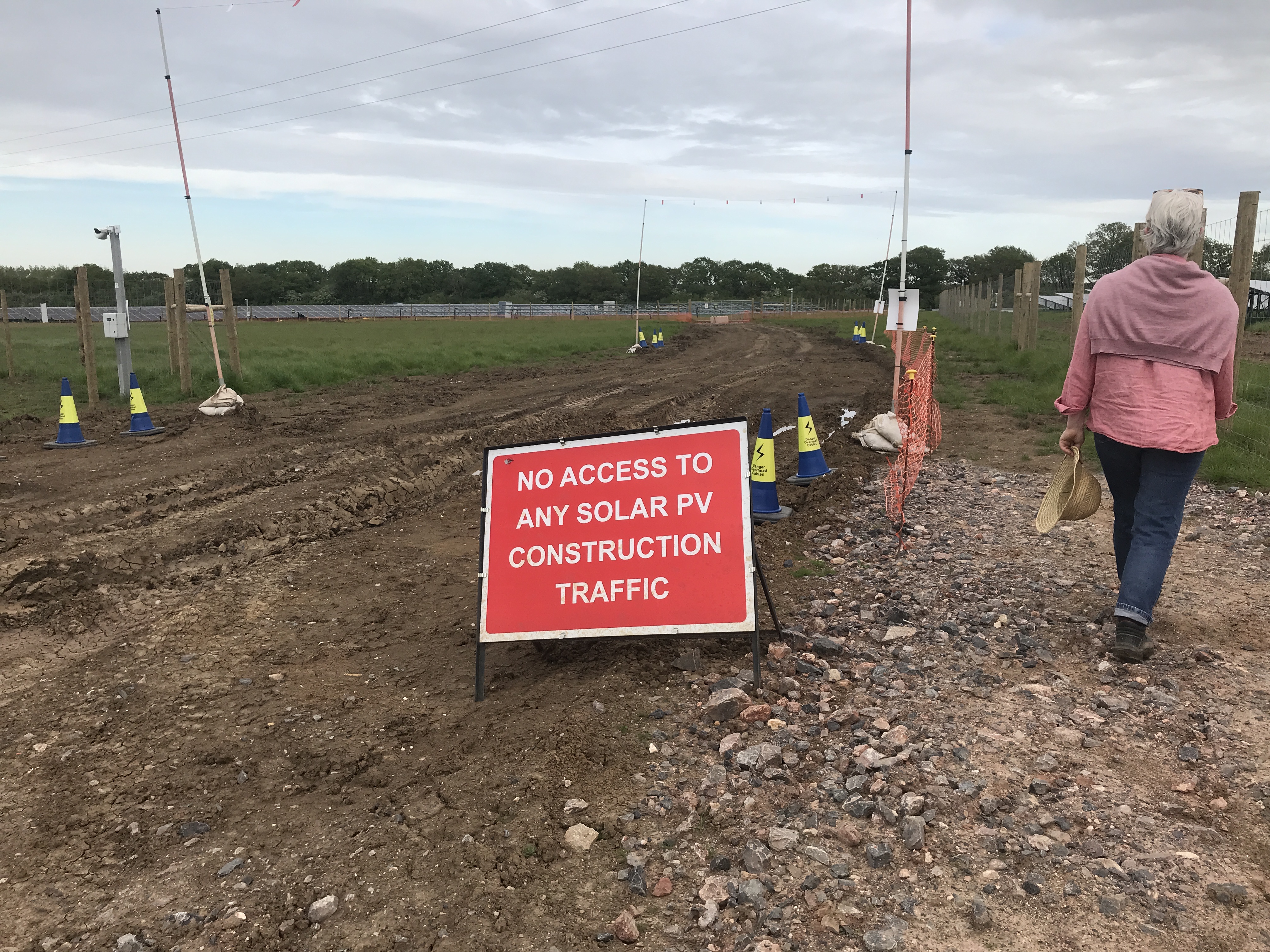
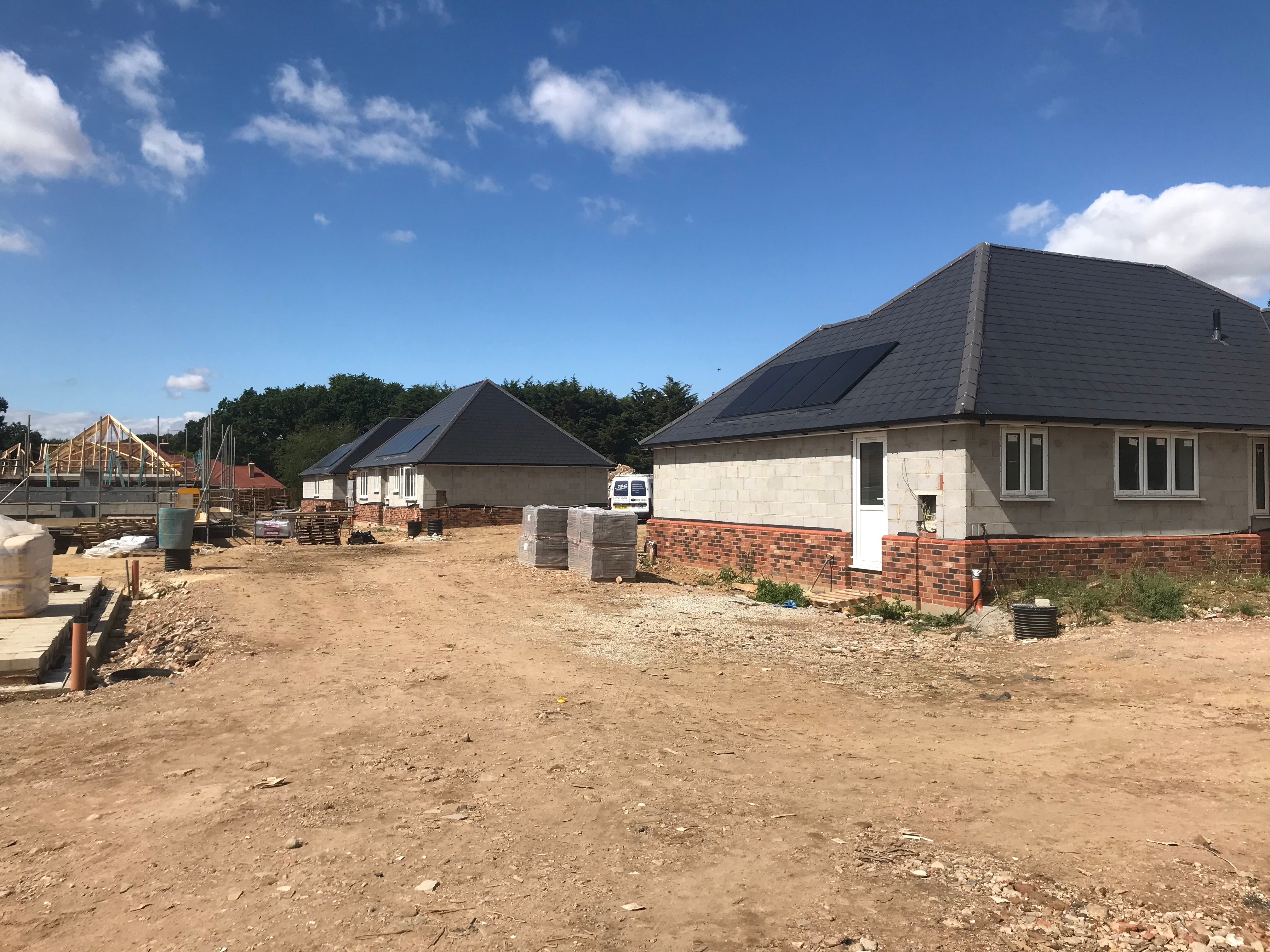
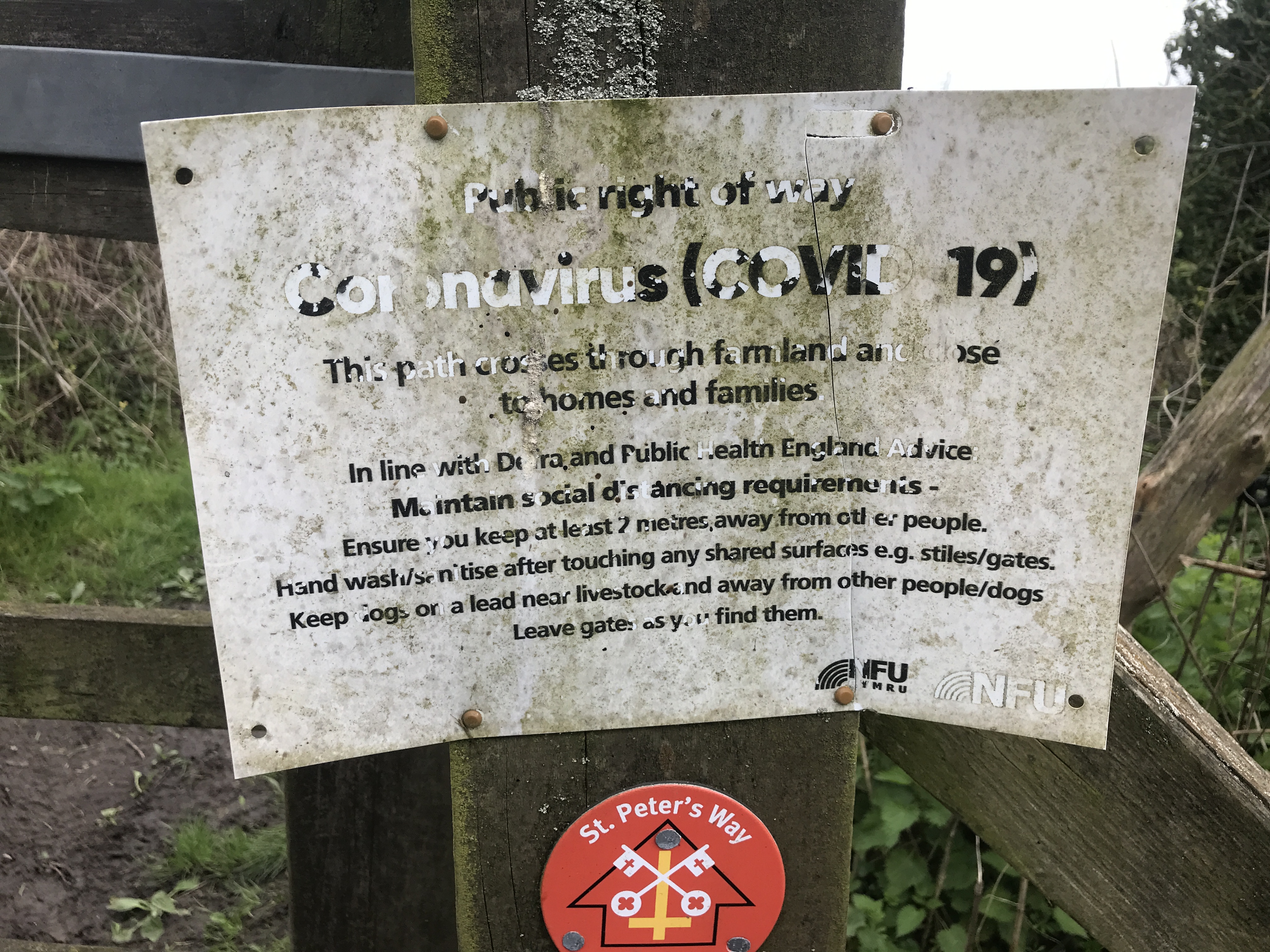
On social media, the bar-side stools and the protest placards, all this is happening on “productive farmland” and it’s evidence for the prosecution against a government that cares nothing for farmers and rural life. It’s part of a package with the banners on farm gates reading ‘Starmer the Farmer Harmer’ and ‘Stop the Family Farm Tax’.
There’s little reflection on the fact that none of these changes of land use occur without a sale or permit from the existing landowners, most of these farmers themselves. The land owning farmers take both the pity and the profit while they shape rural futures. Hope value and determined speculation inflate land prices higher than their base agricultural worth and push estates over tax thresholds. Securing planning permission on a field for development can raise its existing use value by 2000%.
This inevitably has an effect on wider land values and creates a positive feedback loop: now, even the farmer with neither intention to sell, nor planning permission, finds themselves capital rich and IHT liable while remaining revenue poor. The incentive is to seek planning permission, where at all possible, and to sell. It’s a tragedy of enclosure and private property. Despite its unpopularity, one wonders if more radical approaches need to be taken, like the usufruct tenure discussed by Chris Smaje or the brute action of nationalising farmland and giving farming families 1000 year leases under a compact that the land is used for food production.
In fact, small farms have already been consolidated into larger concerns, and those large farms are being acquired as investment vehicles by corporate bodies as has happened with the patchwork of Dengie farms absorbed into Strutt & Parker Farms and subsequently sold off in 2019 to asset management companies Robigus/Belport, with finance provided by European investors – collective ownership.
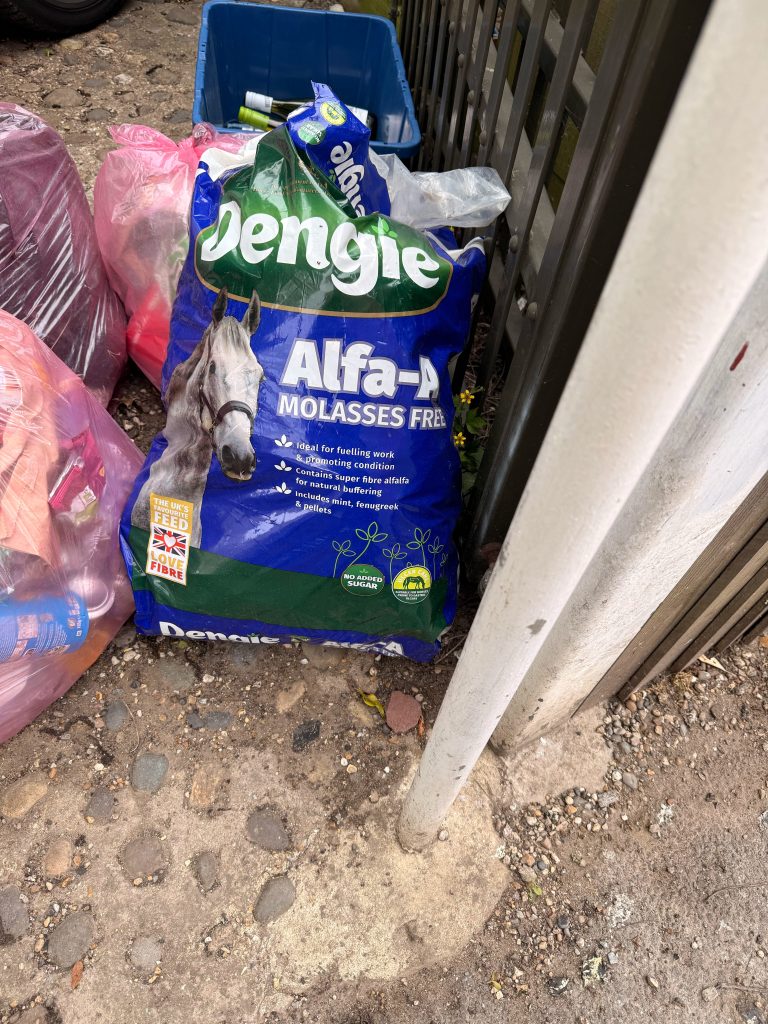
But on the Dengie now, this “productive farmland” is often producing feeds not foods, fodder for horses not human fare. Very little grown on local fields ends up on local forks. The loudest voices against new housing are regularly the newest arrivals on the newest estates. The paeans to productive farmland are actually appeals for the preservation of the open views from their houses, the dream they left some more urban locale to enjoy. They came for a future in a rural past, not for tomorrow’s countryside. Ask a fellow what is actually growing in that open view and disappointment often follows. Farmland is a vibe not a subject for consideration and reimagining.
It’s not that they moved from Barking, Basildon, Bromley-by-Bow or the London Borough of Havering. There’s people who were born here who can’t do much better. Burnham-on-Crouch, the largest settlement on the Dengie, doesn’t meet the 10k population threshold that would designate it “urban” by the current measure. It’s a built-up area nevertheless and not the only one on the peninsula.
Barely anyone that lives out here has an agricultural job. Folk commute for work, to the cities of London, Chelmsford, Southend; or WFH in front of fibre-optically connected screens. The aging demographic means that more every year are post-work: golfers, day drinkers, ladies who lunch, Sunday drivers, members of the U3A. Either way, they do the big shop at out of town hypermarkets or summon one of the delivery vans: Tesco, Sainsbury’s, Asda, Morrisons, Ocado – and are provisioned by the produce of the entire world. They are an urban population not a rural one. They are biosphere people not ecosystem people. Wants and needs alike are met by global suppliers not local growers. Some of the same people who decry our dependence on foreign food imports would both baulk at sustaining themselves solely on food that was in season and have no idea what is.
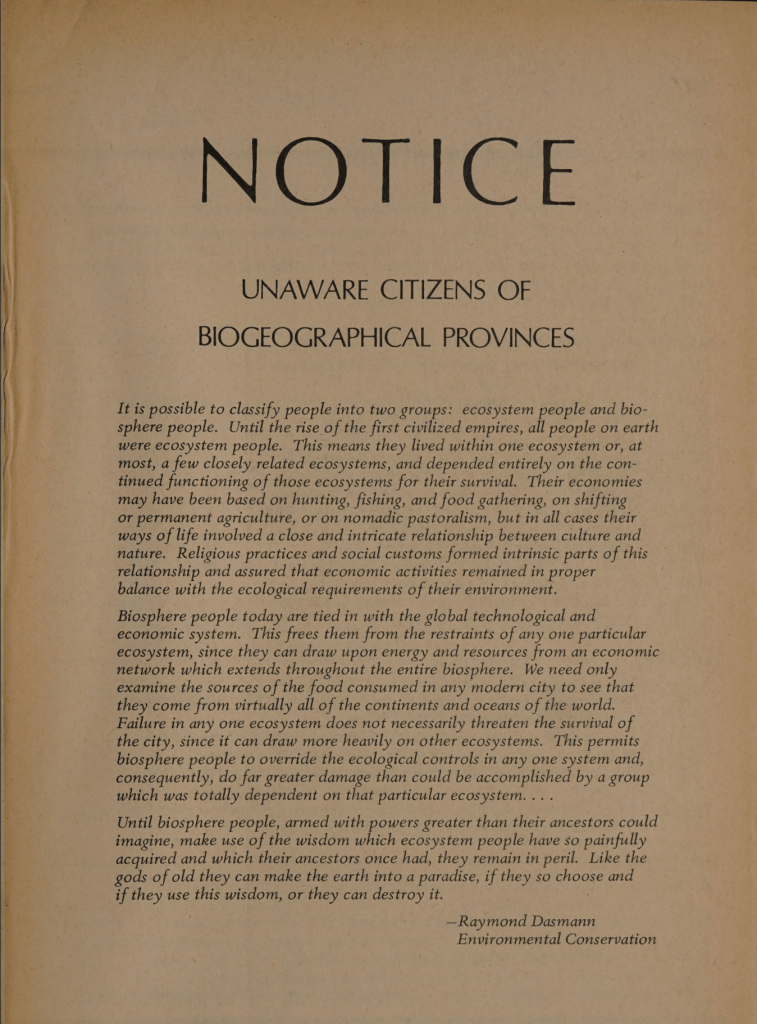
I’m not exempting myself from these hypocrisies: Es gibt kein richtiges Leben im falschen – Wrong life cannot be lived rightly.
In the veg box from Tillingham growers Sarah Green’s Organics on 8th May, the weekly note from the farm relates their first April without rain:
‘As the weather, seasons and consumer habits change we are constantly learning and evolving what we do on the farm and in the fields. Dad said that when he first left college to work on the farm rain could always be relied on, but now that’s not the case especially as this April has passed with disappointingly no April showers. Fortunately, we are able to irrigate the growing vegetables in the fields, but we don’t have enough surplus water available to irrigate our struggling 10 acres of newly sown herbal lay.
Our newly planted hedgerows are also struggling and the final hedgerow we planted in late winter is starting to die back. It is frustrating to see the leaves become brown and shrivelled and this week Nerjus has spent hours watering it, trying to save the hedge’
The following week’s vegbox added:
‘We’re still desperate for rain. I only measured 1.5mm of rainfall at the weekend – not enough to settle the dust. Dad told me that in 48 years of farming he has never known a month with absolutely no rain – that was April this year’
The Met Office gave a similar message: at the nearby weather station in Shoeburyness it was the driest April on record, with only 0.6mm of rain – just 2% of the monthly average.
On the Novara Live of 26th May, presenter Paul Holden said:
‘I was just actually out in Essex this weekend speaking to a bunch of farmers and they were saying to me, this is scary for us at this point in time. This is actually one of the most difficult crop years we’ve had. If we don’t get rain in the next one or two weeks, half of our crop doesn’t grow.’
On 28th May, the Dengie Climate Action Partnership hosted a nature talk in Tillingham. During the break I heard a local farmer talking about the devastating effect of drought. He said that wheat in the field ‘won’t even go to ear‘, that ‘they used to say an inch of rain would last you ten days’ and they hadn’t had that amount of rain over several weeks. He could see a lot of farms going up for sale ‘after this‘. There was more profit to be had in chickens, he said, but last year masses of them had died in the barn due to overheating and they had to fit misters in there to keep the temperature down, but that increased costs and the intensity of water use.
The House of Lords Environment and Climate Change Committee’s report Surviving drought: reclaim the rain (published May 21st 2026) lays out the future of a water depleted nation:
‘The taps could run dry… Drought threatens the very systems on which people and nature depend.’
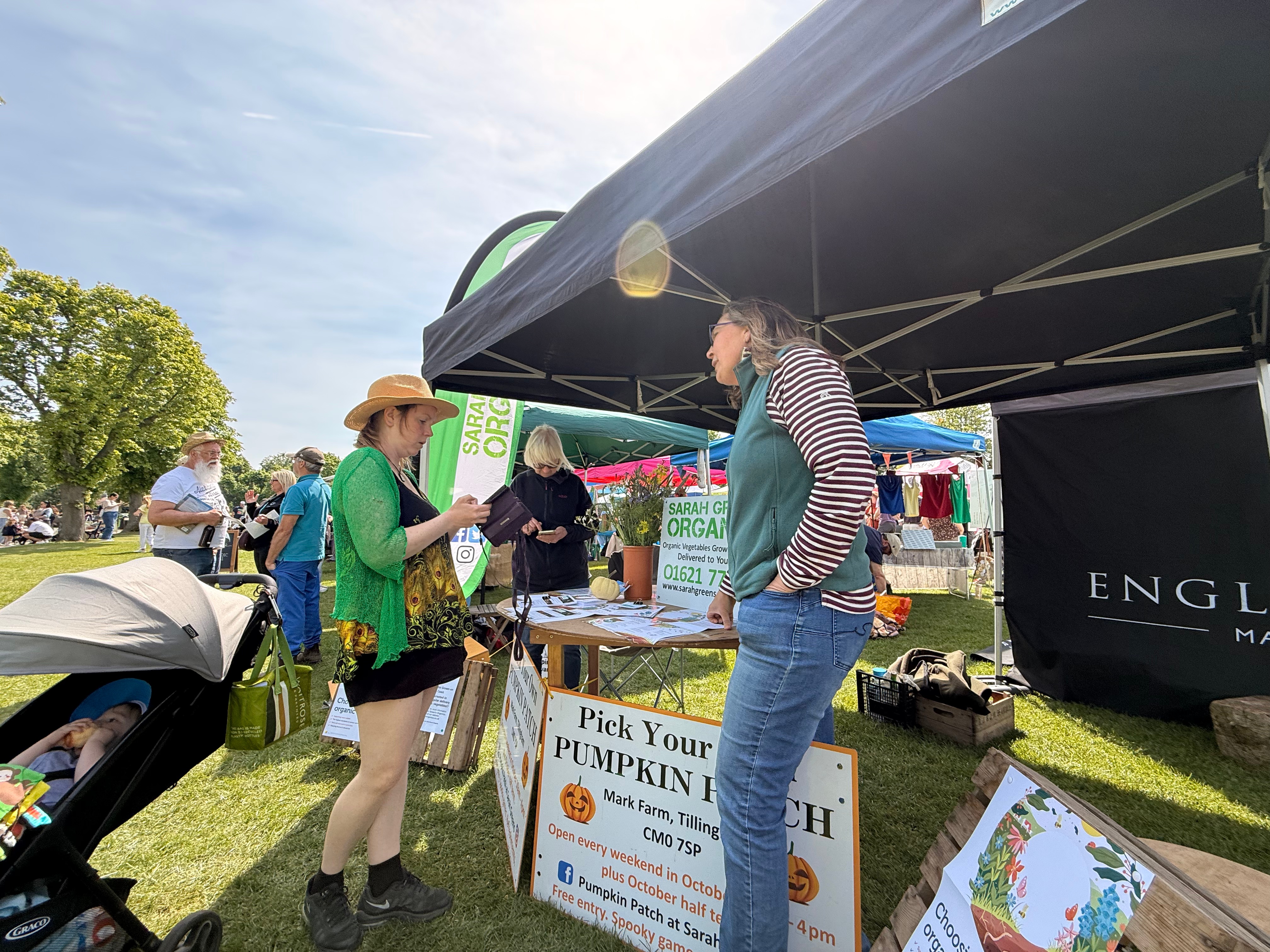
I spoke to Sarah at the Biodiversity & Regenerative Food Festival on 9th May and talked about water. It was her grandfather who built their on-farm reservoir into which winter rain in the ditches is pumped. Without that reservoir she couldn’t grow vegetables at all, she said.
With long-range forecasts predicting dry conditions throughout June in the east of England, and a possible Super El Niño increasing the odds of heatwaves in the UK in 2027, the climactic pressures on farmers are only going to build while the wider global effects on food production add stress to our supermarket shelves – compounding the fallout from the closure of the Strait of Hormuz.
Sarah’s father, Steven, also spoke about how local farmers were baulking at the price of fertiliser and other farm inputs. Farmer’s Weekly similarly reports on how Trump’s war is causing a ‘cost of farming crisis‘:
‘Agflation is being driven primarily by continued disruption linked to the Iran conflict and the threat this poses to shipping through the Strait of Hormuz, through which about 20% of global oil and gas flows… Around 30% of global urea supply passes through the same chokepoint, pushing UK farmgate urea nitrogen fertiliser prices to around £650-£700/t. Ammonium nitrate prices are following closely given their linkage to gas markets.‘
At the Future Rural launch in London, I eavesdropped on a conversation. A farmer was being asked about how they were being affected by Trumpflation. They told their interlocutors: ‘this year, the seed is in the ground so I’ll lose less money by producing the crop. Right now, I need to decide on buying seed for next year and I’ll lose less money by not producing the crop‘.
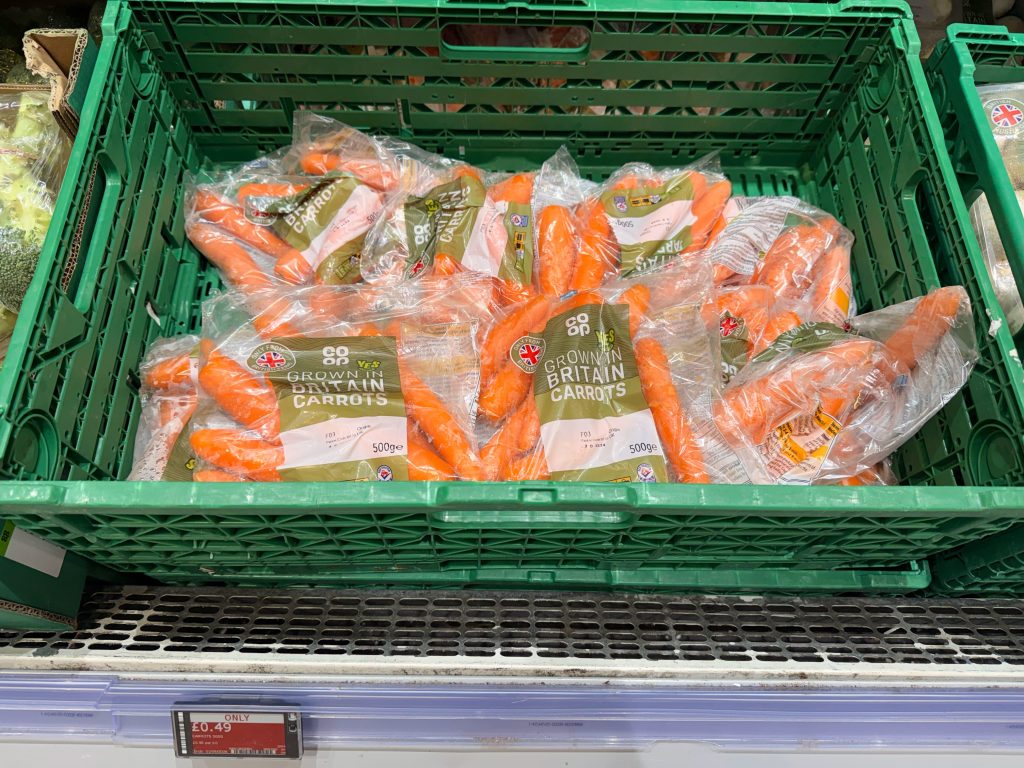
At the Festival, Sarah expanded on how consumer habits were affecting farmers like herself– not least how loss-leading 40p bags of carrots in the supermarkets meant folk won’t pay farm gate prices that reflect real costs. Agflation will feed through into food prices soon enough and the cost to chemical farmers and foreign importers will rise first, but everyone will feel the pinch.
The UK government has proposed price caps on essential food items in supermarkets in order to avoid a cost of living crisis, but the sector has asserted its absolute sovereignty over price-setting, Reuters quotes Marks & Spencer Chief Executive Stuart Machin saying:
“I don’t think the government should be trying to run business. I think they should probably try to understand business better,”… He said many retailers, including M&S, already sold staples such as milk, bread and bananas at a loss, adding that easing tax and regulatory pressures would do more to curb food inflation.’
He singles out ‘recent government measures’ like ‘a rise in the minimum wage’.
“The English workingmen have appreciated to the fullest extent the significance of the struggle between the lords of the land and of capital. They know very well that the price of bread was to be reduced in order to reduce wages”
– Karl Marx, ‘Free Trade’ (1848) [pdf]
The conjunction of a ‘cost of farming’ crisis and a ‘cost of living’ crisis has a history going back at least as far as the Corn Laws. The supermarkets play the lords of capital, provisioning goods from a global marketplace in order to push down retail prices and local wages. The local lords of the land meanwhile are much diminished from their earlier heyday and caught between the monopsony power of the supermarket sector demanding lower wholesale prices or trying to compete direct with retailers selling staples at a loss. Farmers are price takers not price makers.
A thriving rural future demands a new covenant between the nation and its food growers. Successive governments have provided rhetorical emphasis to British food production, but prioritise a “more affordable” food system. Rather than asking “can Britain feed itself?” they have asserted that it should not and that food security is dependent on a flow of cheap imports from around the world. While the 2021 National Food Strategy (aka the Dimbleby Report) repeatedly argued that the apparent cheapness of food concealed wider economic, environmental and health costs:
“The true cost of our food is far higher than the price we pay at the till”, “Much of the cost of the food system is not borne by the companies that profit from it”, “Farmers are often trapped in a race to the bottom”
The actual UK Government Food Strategy (2025) removed most of the explicit political economy of food pricing and production costs. Rather than highlighting how food prices are distorted by the existing system structure, it focuses instead on food affordability as a constraint to manage.
In Future Rural, both Fiona Reynolds and Sue Pritchard mention the, then forthcoming, Land Use Framework as a strategic intervention that might ‘integrate environmental, economic and social objectives’ for our landscape. The, now published, England Land Use Framework talks about maintaining domestic production volumes and reducing import dependency but the Landworkers Alliance pointed out that it ‘sets out no ambitions to explicitly tip the scale towards increasing domestic food production in the UK‘ and
‘If we are going to build a more resilient food system in the UK against a backdrop of volatile global supply chains and a climate emergency then maintaining current food production levels won’t be enough. This is particularly important now, at a time when global supply chains are becoming increasingly fraught as a direct result of overseas conflict and US imperialism. We are already being warned of empty supermarket shelves as a result of the war in Iran, and we have seen it before as a result of the war in Ukraine, overseas drought and extreme weather events and the Covid-19 pandemic.‘
[On 25th June, the CPRE is holding a Centenary Conference with University College London called ‘Running out: facing the crisis in land use‘ which may explore some of this in greater depth but it costs £60 to attend, so I won’t go].
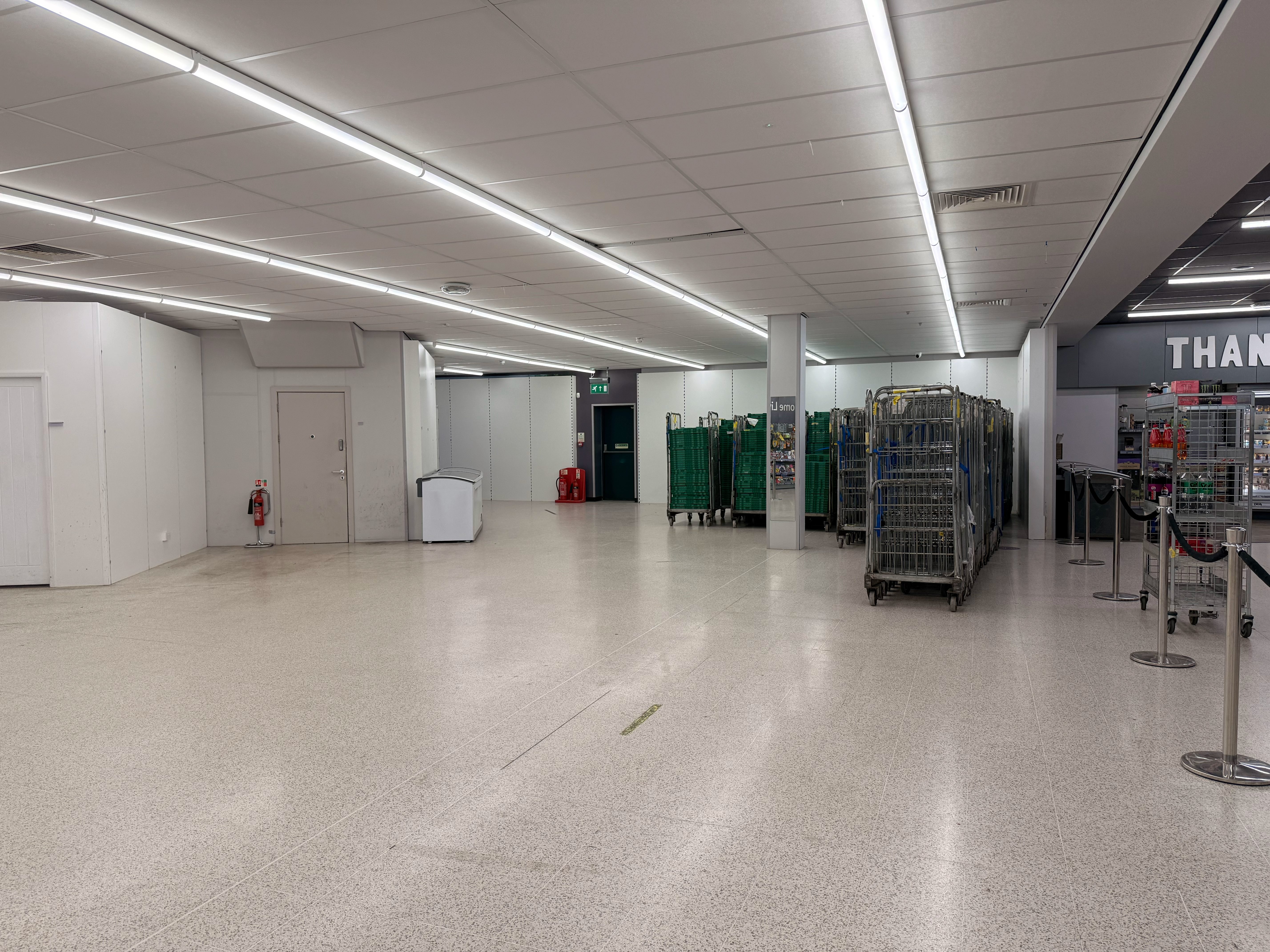
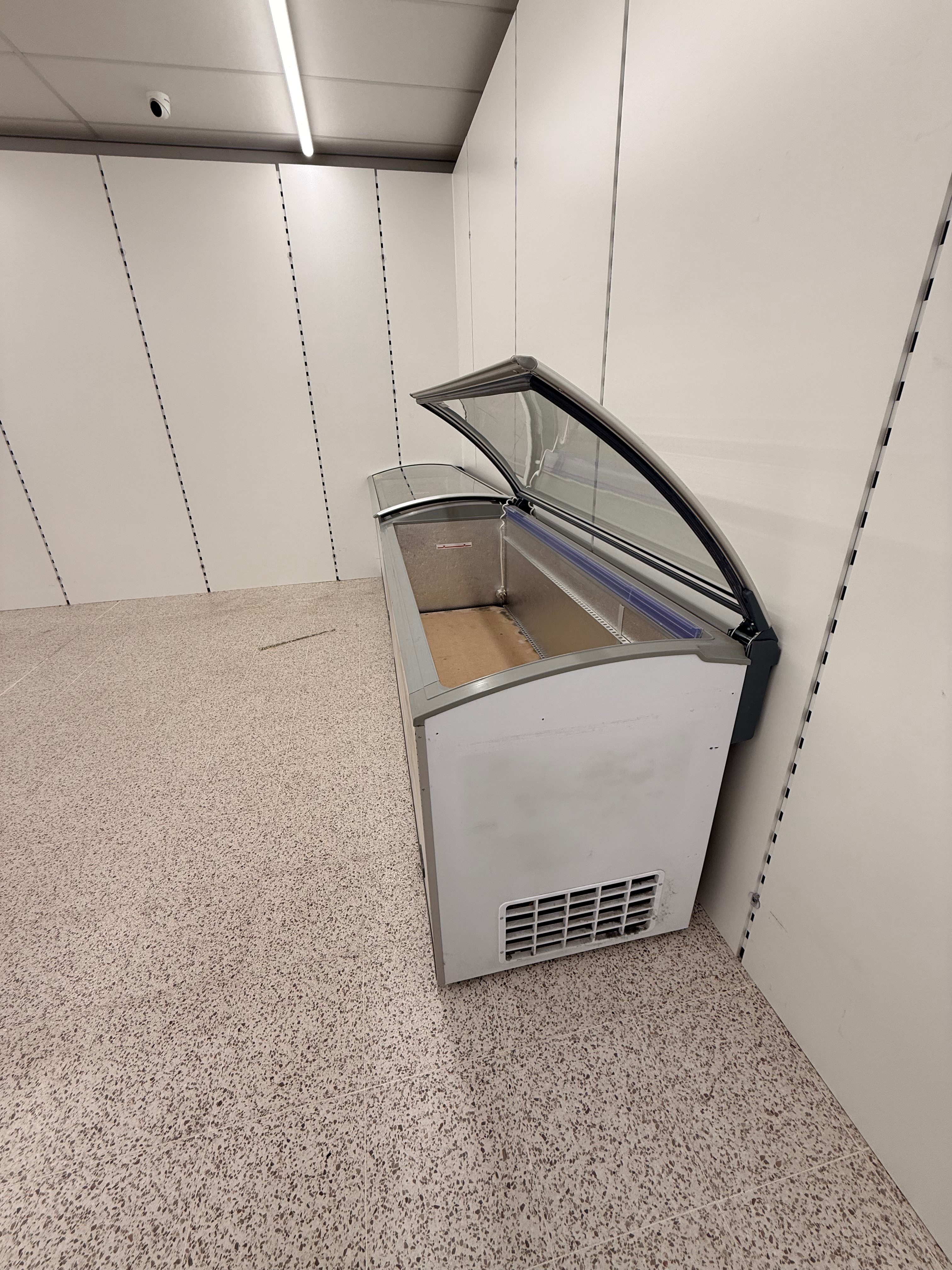
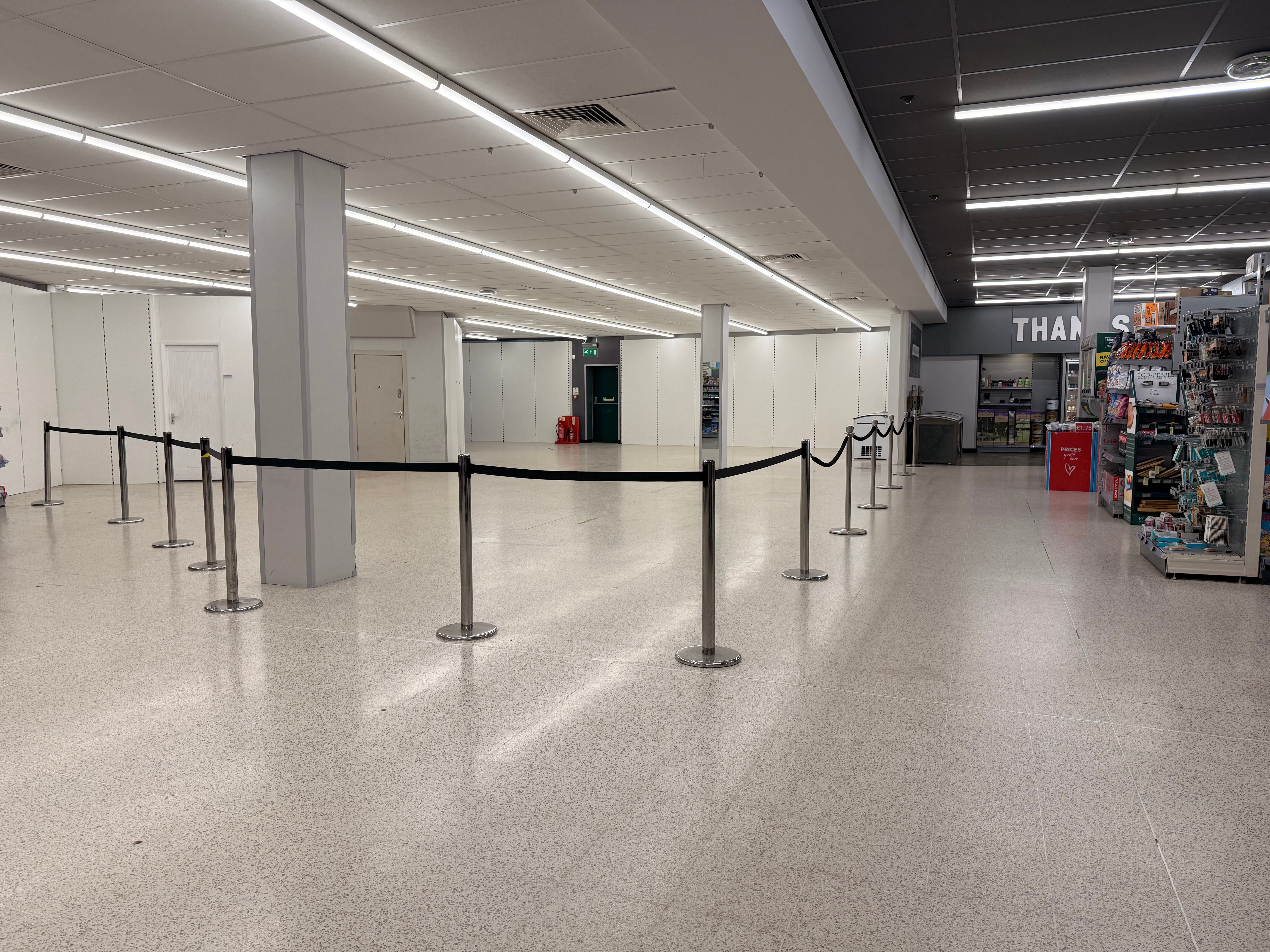
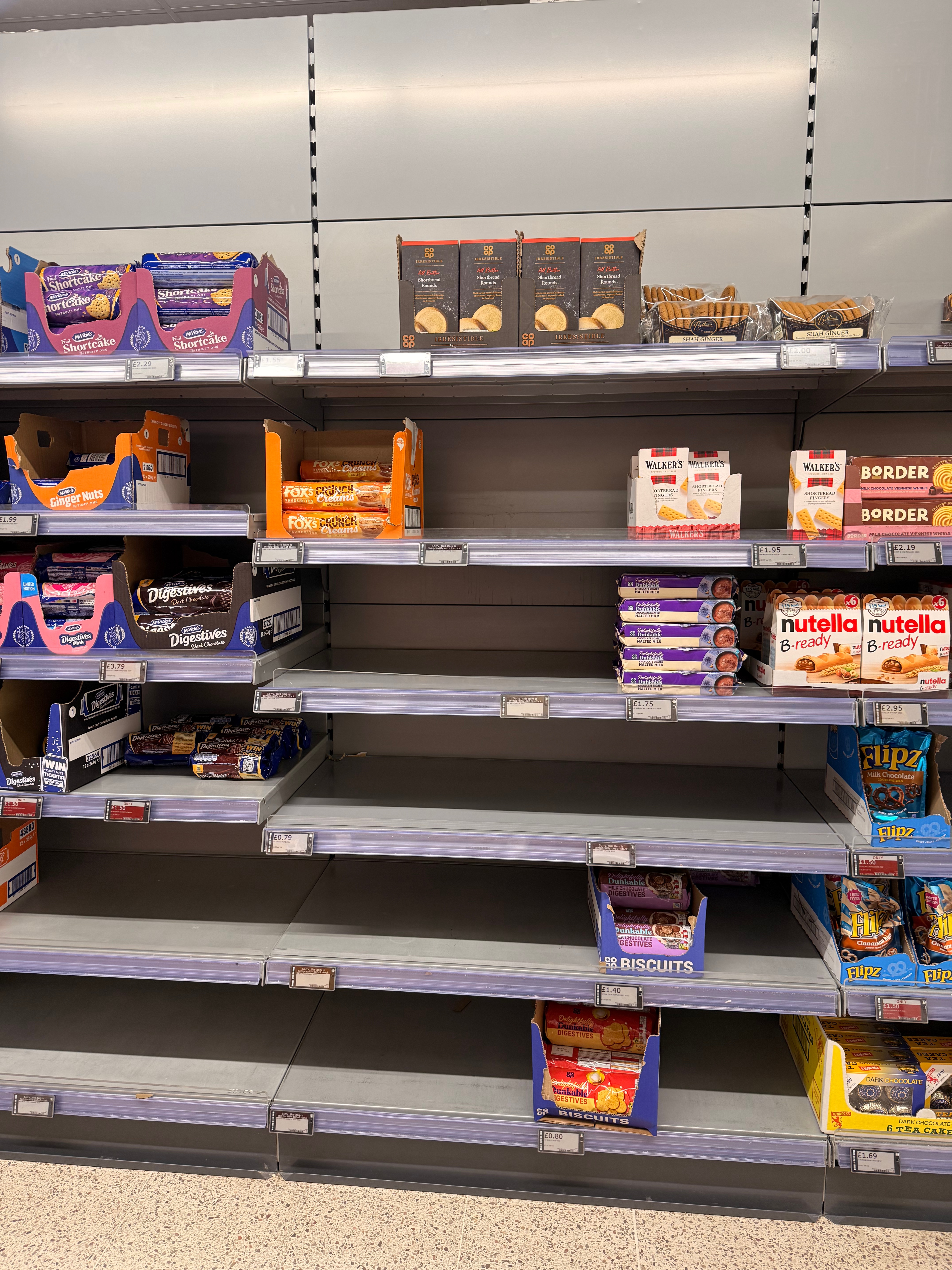
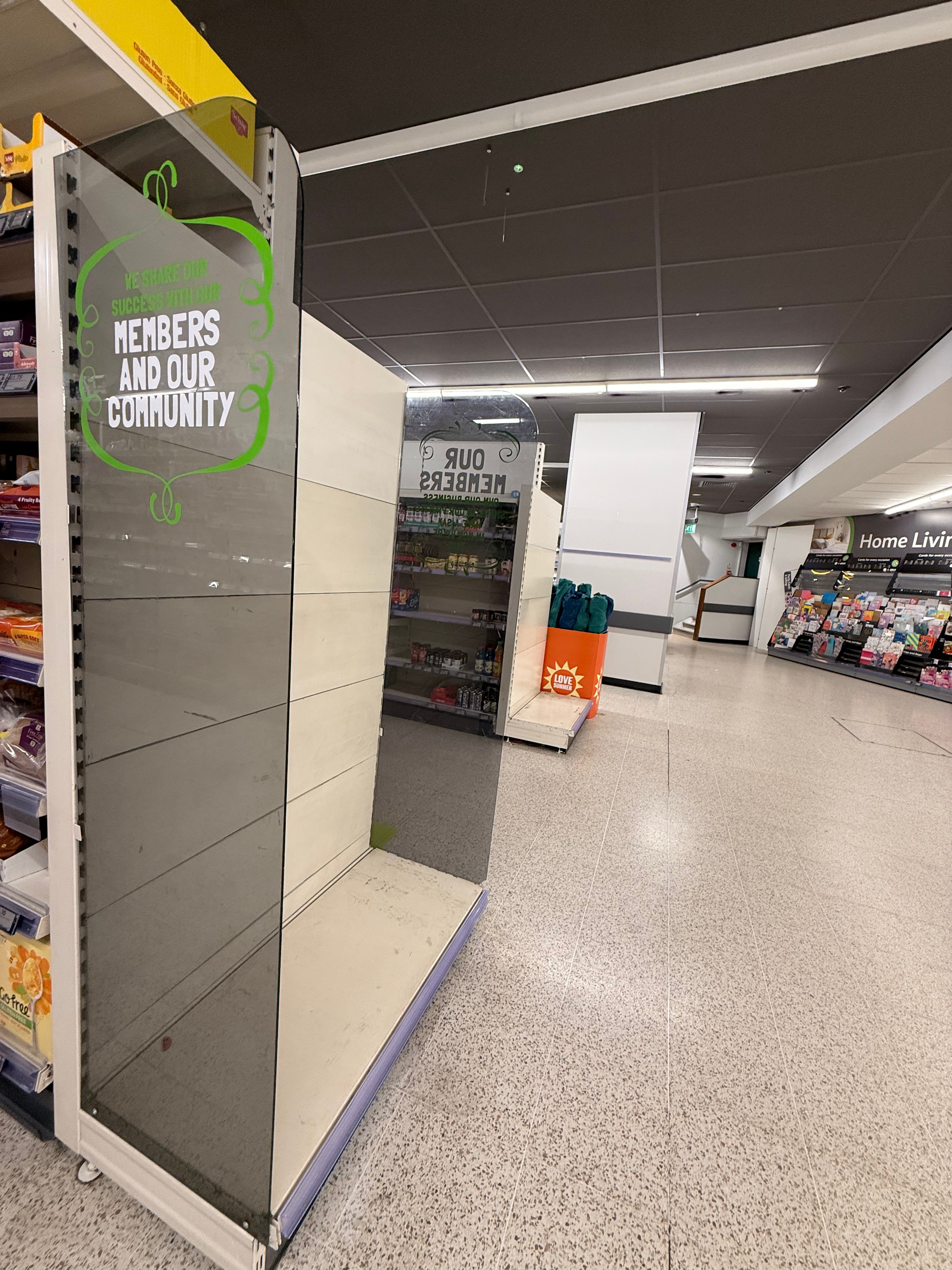
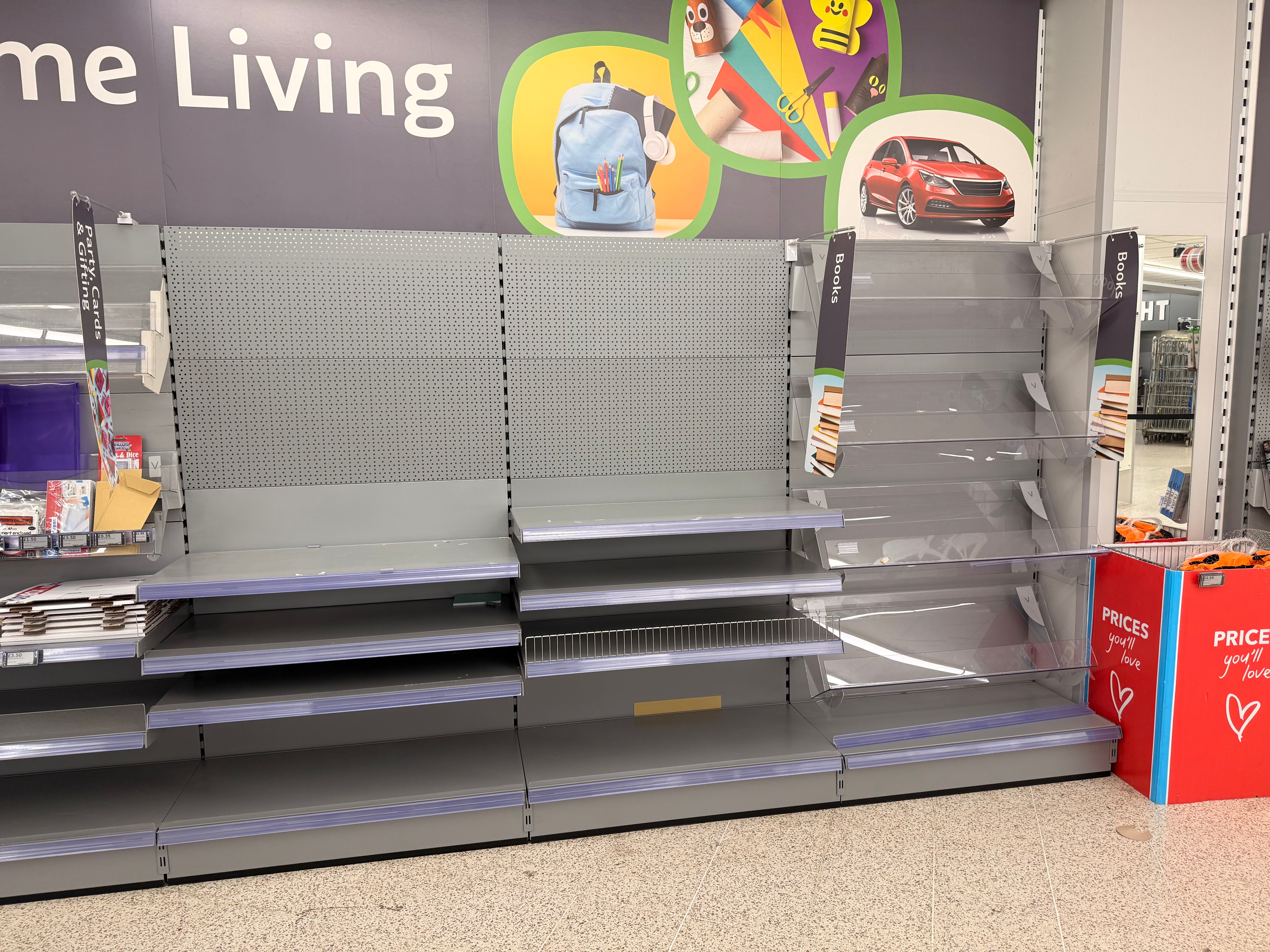

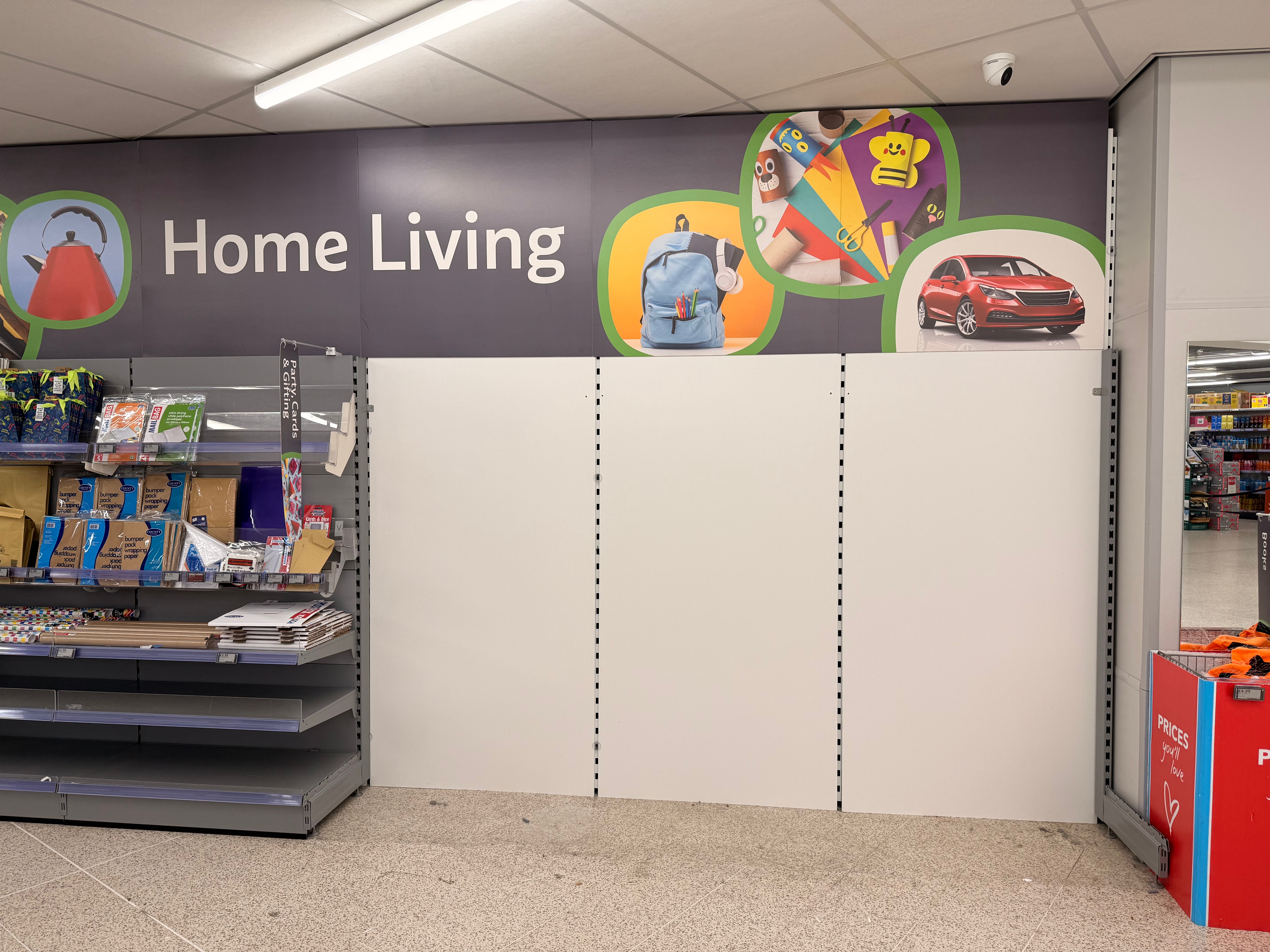
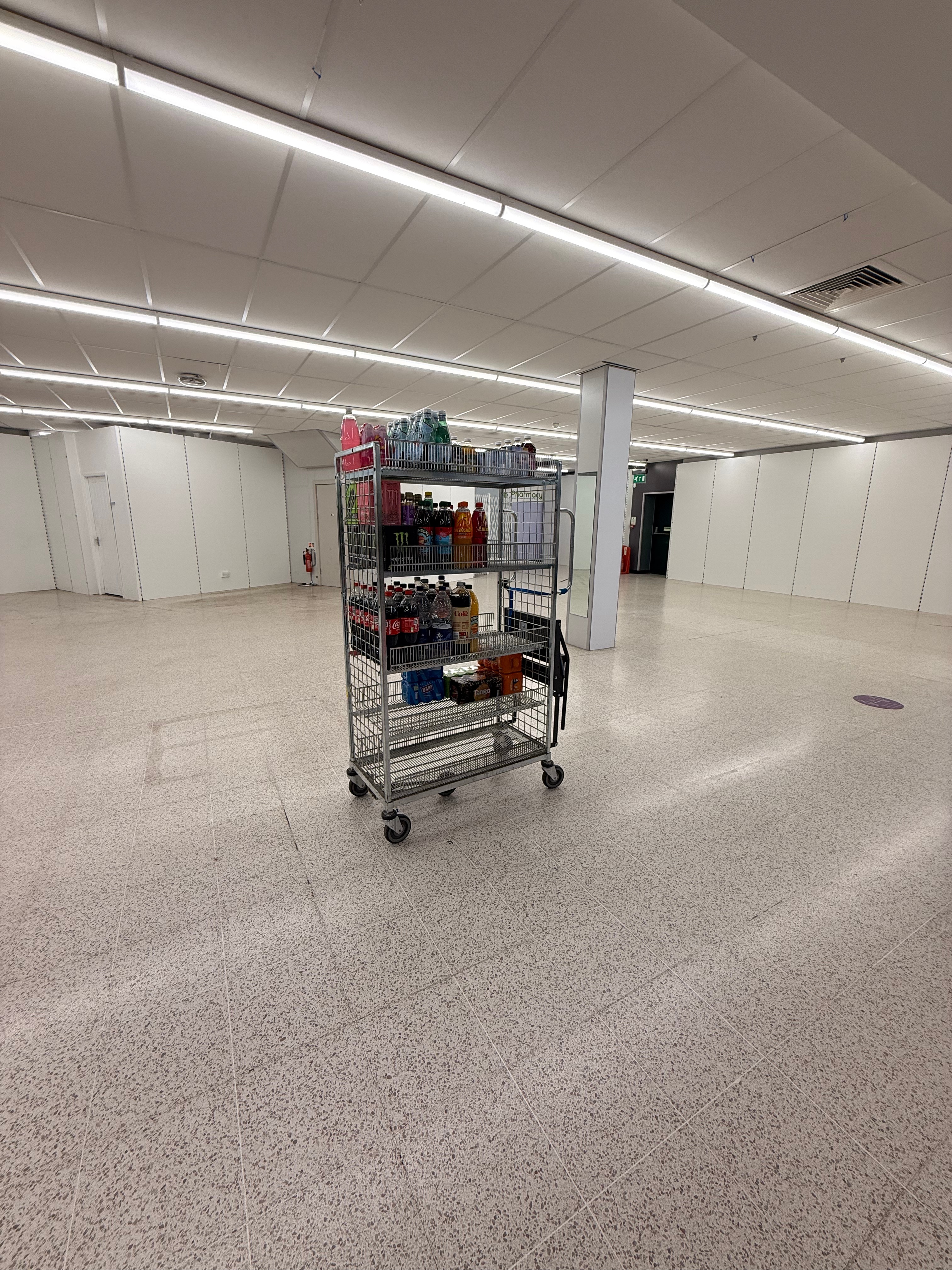
It’s less than a fortnight now until the East of England Co-op in Burnham-on-Crouch, the largest supermarket on the Dengie, closes it’s doors (13th June at 10pm). I hoped that, as a final act of gratitude to the local members and shoppers who have provided it with custom for decades and now face months without a food shop, they would have maintained a fully supplied store until their day of closure. In fact, for weeks now, the shelves have been slowly emptying, freezers and gondola bays have been removed and the stock has been reducing. This process is sure to accelerate in the remaining days and, with Trump’s war provoking a physical supply crisis, it offers an eerie prefiguring of the food shortages that may come later this year. In October, the building is due to reopen as one of the oligopoly players, a Sainsbury’s, but if the Strait of Hormuz remains closed it may have a muted initial offering, launching into a period of rationing, price controls, and market support.
Neither the Co-op or Sainsbury’s have offered free deliveries to local people while the store lies empty. The county, district, town and parish councils seem oblivious – they’ve certainly made no communication to local citizens or contingency plans.
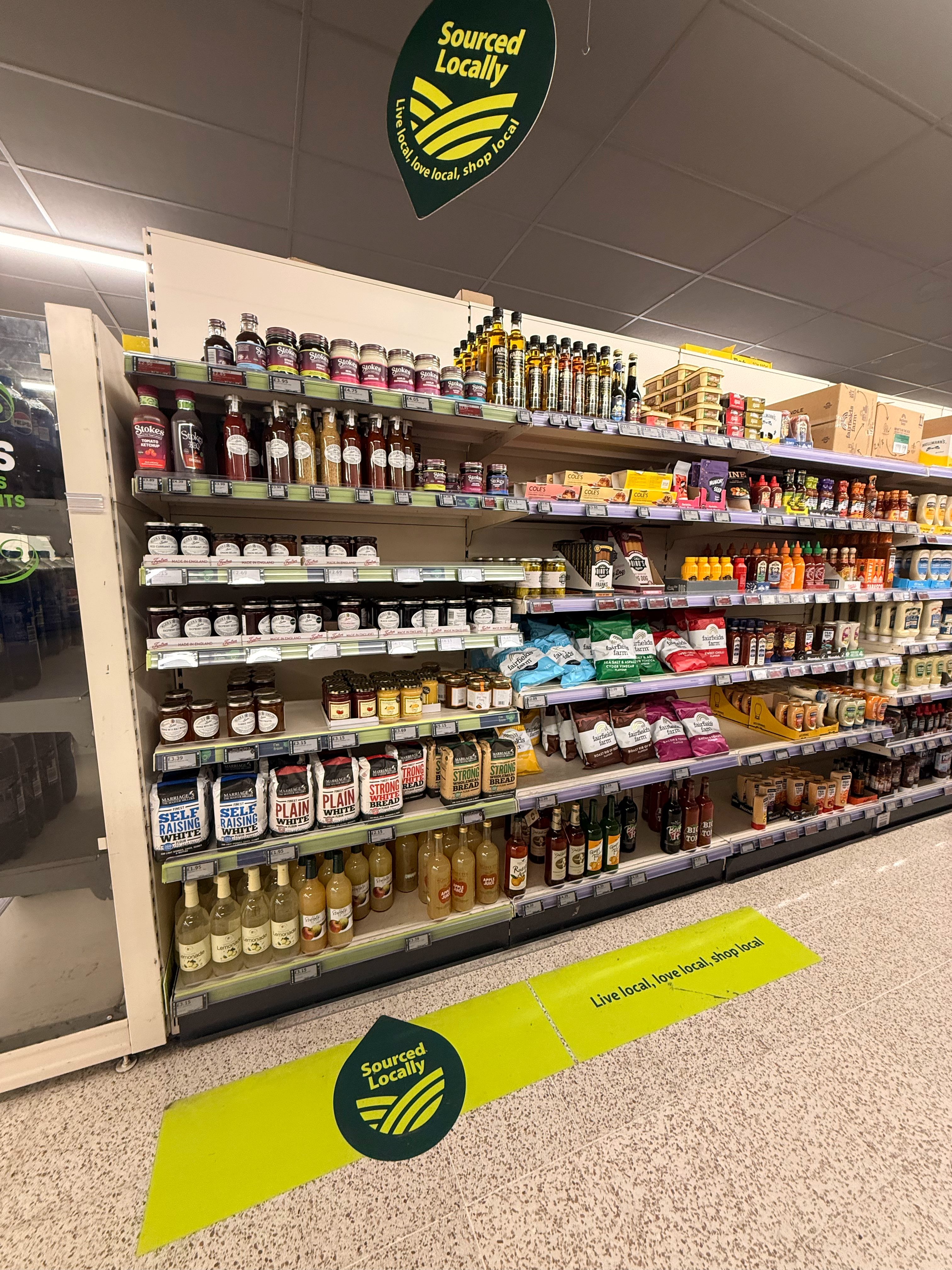
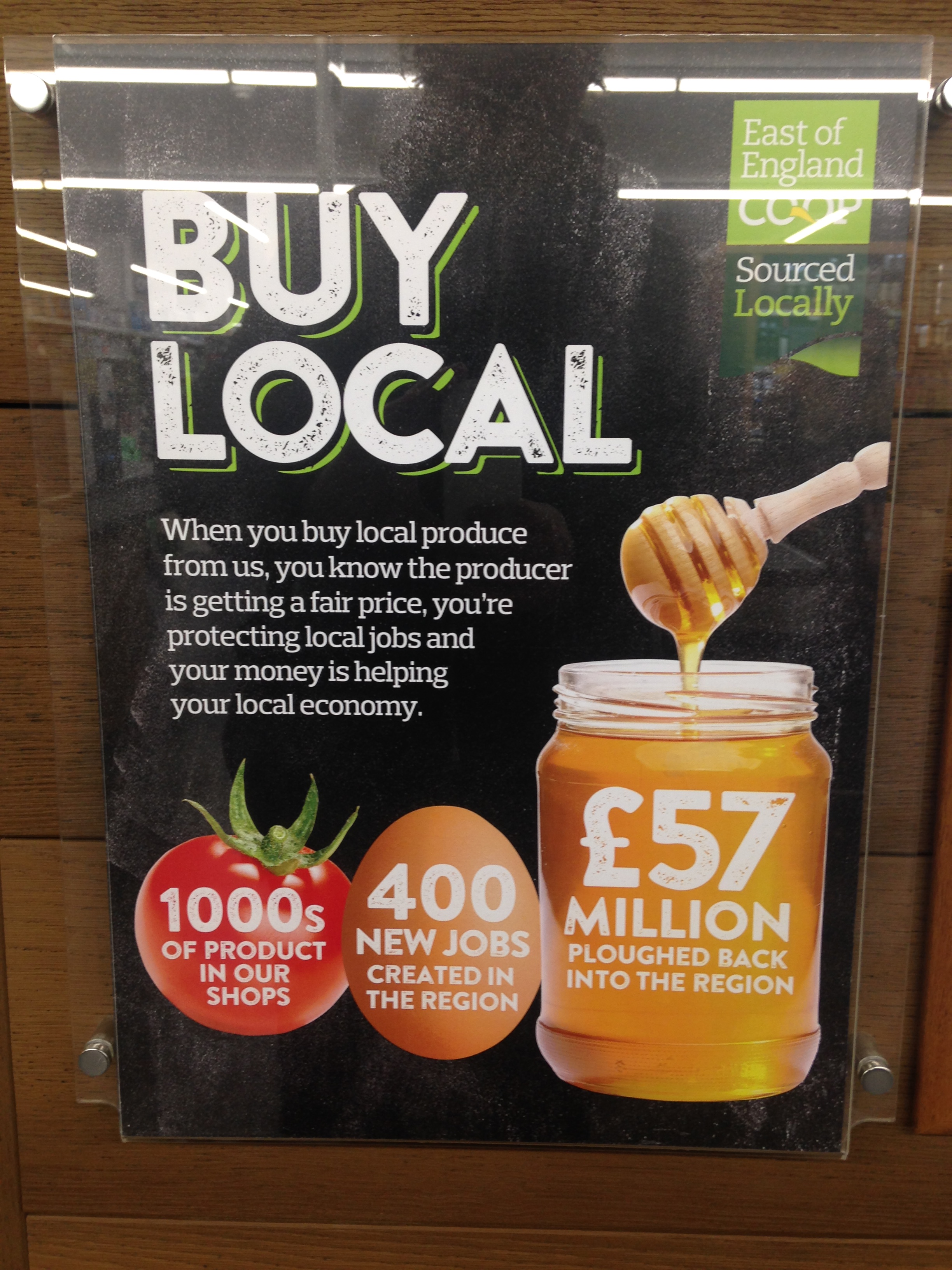
East of England Co-op had a “Sourced Locally” initiative, with these products largely confined to a specific area marked as such – as if local food was one of its limited-audience categories like Free From or Ethnic. Their “local” foodshed was really a regional one with stuff from Suffolk far more like to be stocked than stuff from Southminster. This asparagus season, they sold stalks from the Stour Valley up the A12 not from Thorogood’s Farm up the Tillingham Road. (The situation is unlikely to improve when Sainsbury’s take over the store. In the early 2000s, Sainsbury’s had a “Local Sourcing Initiative” including a ‘dedicated regional sourcing team to source locally produced foods from all parts of the country‘ but in the years since they’ve placed less emphasis on explicitly local procurement programmes and followed the wider sector trend for greater centralisation of buying, ‘supply-chain efficiency’ and price competitiveness. They now use “locally-sourced” to mean British.)
A story in the Maldon & Burnham Standard about the closure of the East of England Co-op includes comment from their CEO Andy Rigby:
“Protecting jobs, maintaining local services and supporting our colleagues throughout this process is our absolute priority.
“The transfer and lease of our Burnham store will provide secure long-term rental income, enabling us to prioritise investment where we believe it will have the greatest long-term impact.
This includes supporting new store openings, investing in existing sites, and developing new, innovative business ventures, as part of our focus on maintaining a strong, independent, and financially sustainable business.”
Mr Rigby said the decision would provide long-term financial stability for the Co-op, allowing it to reinvest in other stores and future projects across the region.
I.e. we are closing this store and ditching our local members and customers because we don’t think it’s worth investing here, we’d rather just collect rent in their town and spend it on our vision of the future somewhere else. This happy news relayed to the people of the Dengie reminded me of the words of the Vietnam era US Army Major: “It became necessary to destroy the town to save it“
Opposite the Co-op on Station Road is a Morrisons Daily convenience store, also now at risk of closure following the parent companies decision to axe 100 shops, blaming ‘significant cost increases resulting from government policy choices‘ like…. drumroll please…. ‘higher minimum wages‘. The large Morrisons on Limebrook Way on the edge of Maldon, used by many Dengie residents, shut suddenly on the 25th May ‘due to unforeseen circumstances‘ rumoured to be a flooding incident. The Maldon & Burnham Standard reports that it is ‘unknown at this stage when it will reopen.’
A study published this month (funded by Sainsbury’s Nourish the Nation Programme) found that living in rural areas doesn’t guarantee access to quality food, with an article in The Guardian drawing the conclusion that:
‘large supermarket[s are] typically the best guarantee of cheap, fresh produce’
Well, there’s no local supermarket to offer a guarantee of that THIS SUMMER on the Dengie, and perhaps in the following months too. On 24th May, The Guardian reported on a new publication from the National Preparedness Commission, warning that the UK supply chain is unprepared for major shocks.
‘Food. Although the UK is one of the least self-sufficient countries in Europe with a production to supply ratio of 62%, government neither has a strategic stockpile nor does it require key wholesalers and distributors to hold inventory. It has, however, begun to encourage households to stock up with non-perishable food and bottled water, although the Prepare webpage contains little detail on food items and no recommendation on duration.‘
Local activists are currently proposing a political meeting on food, recognising that food prices are going to rise and that climate change and war mean that food and hunger are going to be constant issues. Food precarity is already here, the Dengie Food Pantry and the social supermarket at the Burnham URC are currently filling in some gaps but, even before price hikes, the combination of the Co-op closure and local transport poverty will increase local need.
Productive farmland everywhere/ Nor a bite to eat.
‘You need to have it that the most affordable and easy way to get food is the local organic food that is grown in an ecological respectful way, and then you will get more and more people changing their behaviour regarding their food habits and things like that’– Martín Lallana at Ecosocialism Conference, 30 May 2026
Food security is only one claim on this land though and long-term agricultural viability is itself dependent on an intact ecosystem, whether that be healthy soil, natural pest control, pollinators, or water held in the landscape.
The 2023 UK State of Nature report concluded that the UK’s biodiversity continues to decline, that many habitats are in poor condition, and that current conservation efforts are insufficient to reverse long-term losses, but that targeted restoration can still produce measurable recoveries. Modern intensive farming was identified as one of the two largest drivers of terrestrial biodiversity loss in the UK, alongside climate change, and it repeatedly stresses that farmland occupies such a large proportion of the UK that nature recovery cannot succeed without major changes to agricultural land management.
This is manifest locally, the Maldon Nature Conservation Study, [pdf](Essex Ecology Services for Maldon District Council, February 2023) states that:
‘The Dengie peninsula has few local wildlife sites and many of these are isolated in a landscape dominated by intensively managed farmland, with few areas of natural or semi-natural habitats aside from the coast’
The Essex Local Nature Recovery Strategy (LNRS) is the county’s instantiation of the national effort to turn the UK state of nature around.
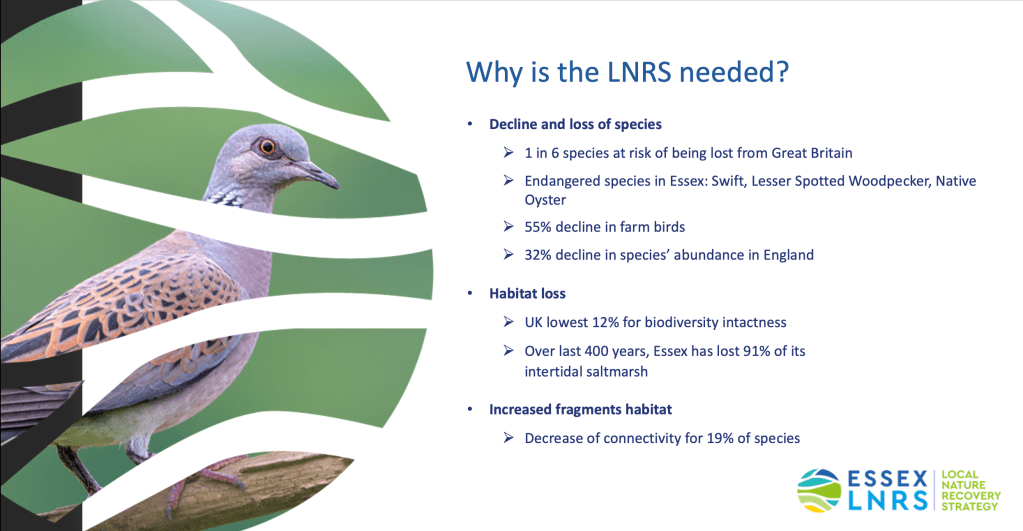
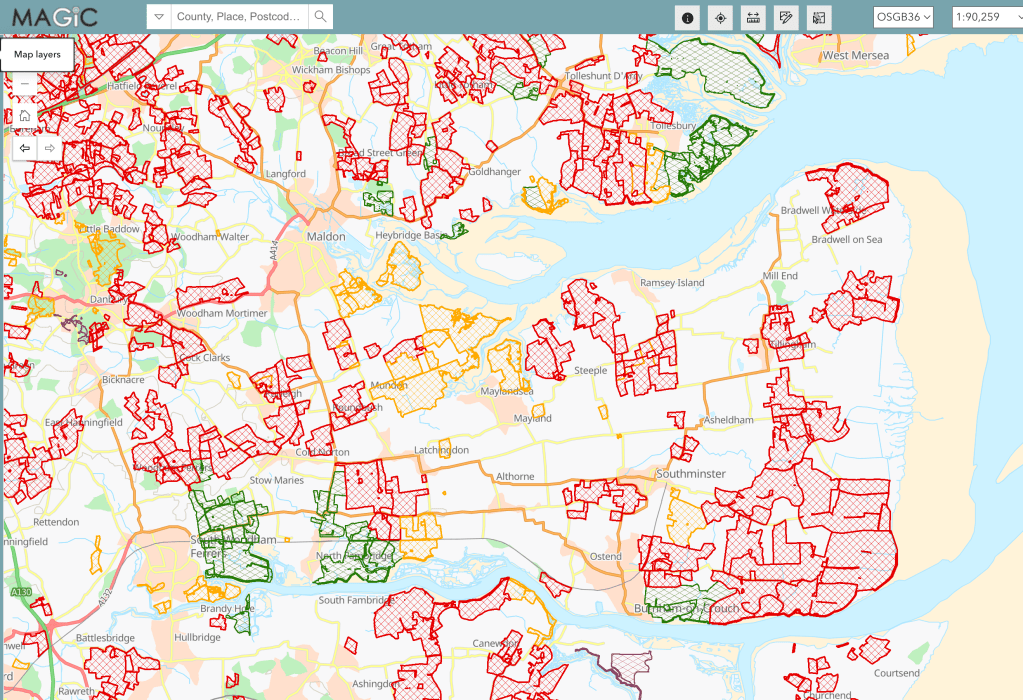
The Essex LNRS has an interactive map showing locations identified as having “strategic significance” due to their high potential to deliver benefits for nature and the wider environment. They are the coloured areas seen in the map below.
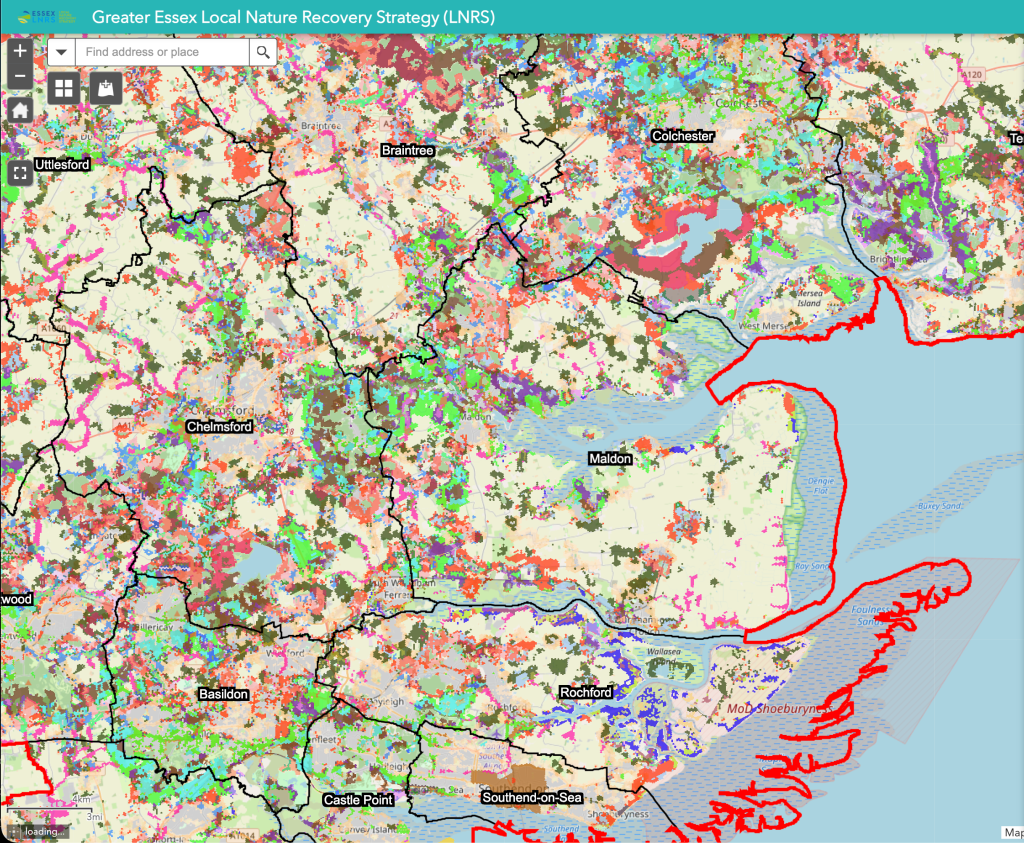
It’s hard not to notice that the Dengie is very pale. It has, according to the LNRS, a high concentration of areas without strategic significance.
The writer David Southwell has described the Dengie as Essex’s empty quarter. Our Rub’ al Khali is not a sand sea but what biologist Dave Goulson calls a ‘green desert‘. The intensification of farming practices with, according to the Essex Biodiversity Action Plan (1999) [pdf], the routine use of herbicides and insecticides have ‘eliminated most ephemeral weeds and insect[s]’, leading also to a decline in the birds that prey on them. It’s an ‘impoverished landscape dominated by large arable fields with few hedgerows’.
On the 6th May, I attended Creating a Local Nature Plan for your Parish, an event hosted by the Rural Communities Council of Essex (RCCE) to help councils deliver on their new biodiversity duties and work with the Essex Local Nature Recovery Strategy. There were presentations from Elias Watson, Essex County Council’s Local Nature Recovery Coordinator; Ben Howe, Essex County Council’s Biodiversity Net Gain Officer; Jane Houghton, Green Infrastructure Adviser at Natural England; Nicky Joshua from RCCE; and John Attiwell from Essex Wildlife Trust.
I went because I wanted to learn more about the opportunities for turning the county strategy into local action, and to help understand how parish plans could be multiplexed into a Nature Recovery Action Plan for the Dengie as a whole.
Cllr Anne Bailey from Althorne Parish Council asked a question about how nature recovery would happen within the agricultural context of the Dengie. The answer from Elias Watson included reference to the Dengie Farm Cluster which pricked up my ears because this names a semi-mythical creature which has never actually been seen.
In the last year or so, at a range of different events and in a number of conversations, farm clusters have been mentioned as the method by which nature recovery on a landscape scale might be achieved. This is important because two thirds of Greater Essex is farmland [pdf]. The farm cluster idea emerged in the UK in 2012 around a competition to create 12 nature improvement areas, with funding attached. Farmers with an existing interest in conservation formed groups with an aim of meeting local environmental priorities on their own farms and in their wider area. Since then, the model has continued with the establishment of an increasing number of bottom-up, farmer-led groups looking to share their experience and expertise to make landscape-scale change.
In Essex, the North Essex Farm Cluster formed in 2022 and the River Roding and West Essex Farm Cluster in 2023. The groups “cluster” around river catchments, those of the Rodings and the Pant/Blackwater, a classic bioregional framing. It reflects the common pool of shared water resources and the reciprocity captured in the maxim of agrarian author, poet, and environmentalist Wendell Berry: ‘Do unto those downriver, as you would have those upriver do unto you.’
Similar groupings in the south of Essex have not yet followed though, despite talk of a Dengie Farm Cluster. There may be something of geography in this – while the established clusters sit around freshwater catchments and a shared water resource, southern Essex is more dominated by Estuarine, briney, environments: the tidal waters of the Blackwater, Crouch & Roach and the Thames. The south east is a territory of islands: like Northey, Osea, Mersea and the Essex archipelago (Foulness, Wallasea, Potton, Havengore, Rushley, New England) and peninsulas with island characteristics: Dengie, Rochford, Shoeburyness.
It seems a stronger factor is political and economic though. The stop/start introduction of new farm subsidy regimes post-Brexit, and the end of direct payments following the UK’s exit of the Common Agricultural Policy, have soured communication about land strategies. This crystallised in March 2025 when the government temporarily halted new applications to the Sustainable Farming Incentive in England, creating major anger within the farming sector over the lack of notice, the uncertainty over future support, and fears of underfunding. Despite previous engagements with agri-environment schemes, it’s clear that in future buy-in to the elements of the Environmental Land Management Scheme related to local nature and landscape recovery is contingent on confidence in a funding stream to support them.

Elias had left the RCCE event before I got a chance to ask him about progress with the Dengie Farm Cluster, so I followed up with an email. In reply, he said that he had some preliminary conversations with both Maldon District Council and Dengie Crops, alongside the Local Nature Partnership, to explore the possibilities ‘but the appetite was somewhat reduced due to the issues with SFI’s sudden pause last summer‘ on a positive note he added that ‘the Sustainable Farming Incentive (SFI) is returning next month, so the appeal may have increased again‘ and that the ‘Essex Local Nature Partnership also has some funds that could contribute to pay for a ‘farm cluster lead’, a knowledgeable sustainable farmer in the area who could coordinate the activities of the cluster and support their peers through the transition to more sustainable practices‘.
He copied in Claire Williamson, the Technical Lead Climate Action at Maldon District and Katie Williams at Dengie Crops, the local farmer’s cooperative. Nothing more has been heard since, but I’d previously spoken to Claire about the same issue who suggested I approach Sarah Green and Dengie Crops. It all feels stuck, like a mist has descended and made the way forward unclear.
There’s been a strange mood hanging over environment events I’ve attended this year. A gallows mood began to manifest as it became evident there would be a change in administration at Essex County Council following the election on 7th May. As I mentioned in a previous post, under the Conservative administration there has been a relatively benign backdrop for action on the climate and nature emergencies in Essex, but Reform UK’s stated opinions on these issues suggest that the road ahead will be trickier and full of obstacles.
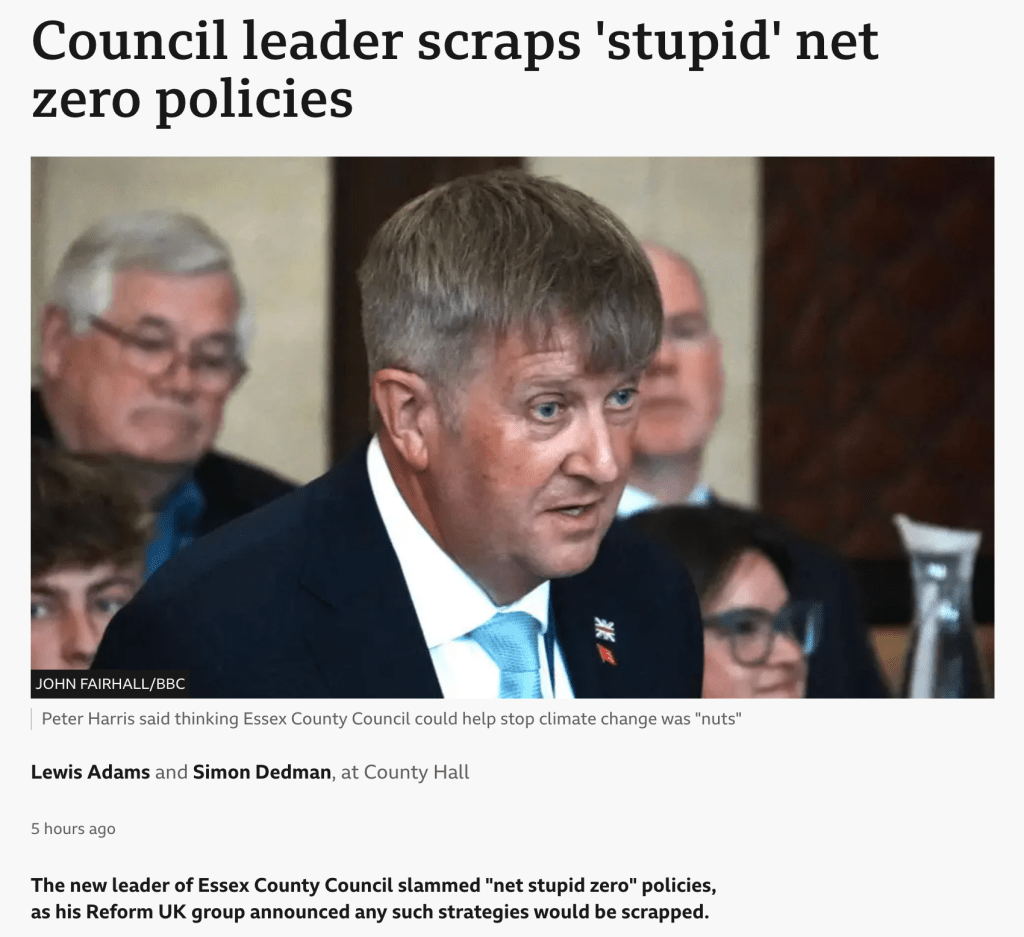
Both community groups and local government teams have discussed name changes and shifts of focus. Anticipating some DOGE like inquisition, phrases like “net zero” and “climate change” are being hastily reworded. A common strategy seems to be emphasis on nature and wildlife, concerns understood to cross the political spectrum.
Reform UK have said little about nature recovery, but they have been explicit on what they think farm funding should be about, their 2024 party manifesto stated that productive land ‘must be farmed, not used for rewilding‘. When the RSPB reviewed party manifestos before the 2024 general election they were alarmed by Reform UK’s pledge to scrap climate-related subsidies and current nature-friendly schemes and return to direct payments to farmers. Stating that farmers ‘need support to transition to more nature-friendly farming methods’ and that ‘[g]oing back to direct payments would lock farmers into a broken food system which is increasingly vulnerable to the impacts of climate change and a loss of nature’.
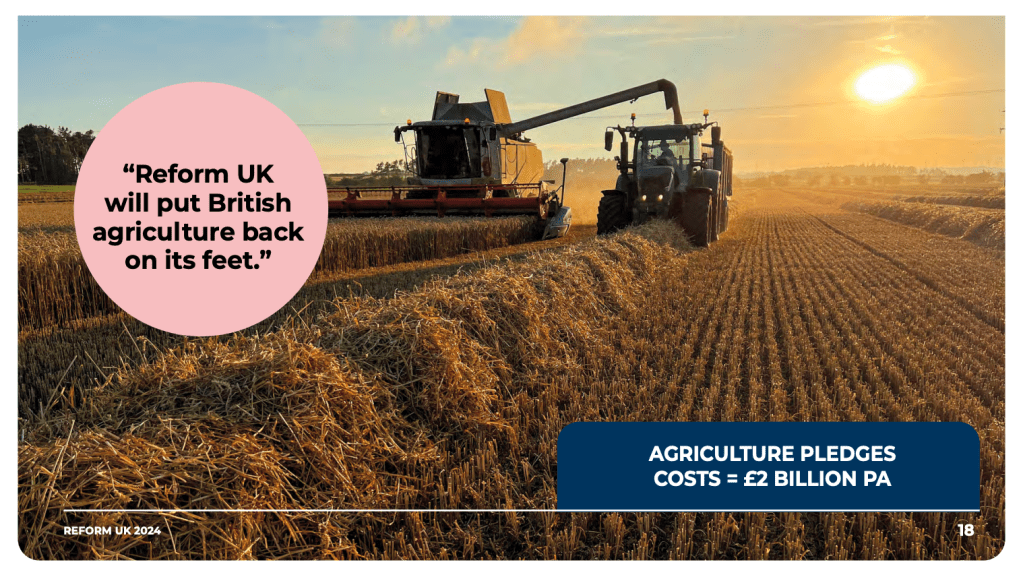
Reform UK’s current policy document on Agriculture & Fishing takes a different tone, with talk of ‘[f]armers as environmental stewards‘ but it maintains that ‘[e]nvironmental delivery must sit alongside, not replace, food production‘ which places these aims in tension. Worse, their proposals decrease confidence in the current farm funding regime going forward. While that’s central government policy, and they can’t change it unless, and until, they win a general election, their local administrations can decide how much support they want to give to the process. Is a farmer really going to engage with the Local Nature Recovery Strategy now to support a goal that might be scrapped and defunded in a few years time?
In A Well-Adapted UK; The Fourth Independent Assessment of UK Climate Risk, the Committee on Climate Change is clear what ignoring climate change means for British farmers:
‘UK farmers are already being impacted by the effects of extreme weather including flooding, heat, and drought. Challenging weather conditions for farming are often occurring in consecutive seasons and at unprecedented severity. For example, yields in the UK were over 10% lower than the 10-year average for crops like wheat and oats due to the hot and dry spring and summer in 2025. By 2050, under 2°C of global warming, the amount of high-quality farmland is predicted to drop from an average of around 40% of land in England and Wales (between 1961 to 1990) to just over 10% by 2050 without adaptation. In the worst years, disruption could make some farms unviable.‘
When I spoke to Sarah Green at the Biodiversity and Regenerative Food Festival, I mentioned the proposed Dengie Farm Cluster and whether she had been involved in any conversations about it. She said she read about clusters in the farming press but hadn’t heard anything about one locally and that if Dengie farmers hadn’t been enthusiastic about being involved it was because nobody had any time, everyone was too busy.
3. Neo-rurality
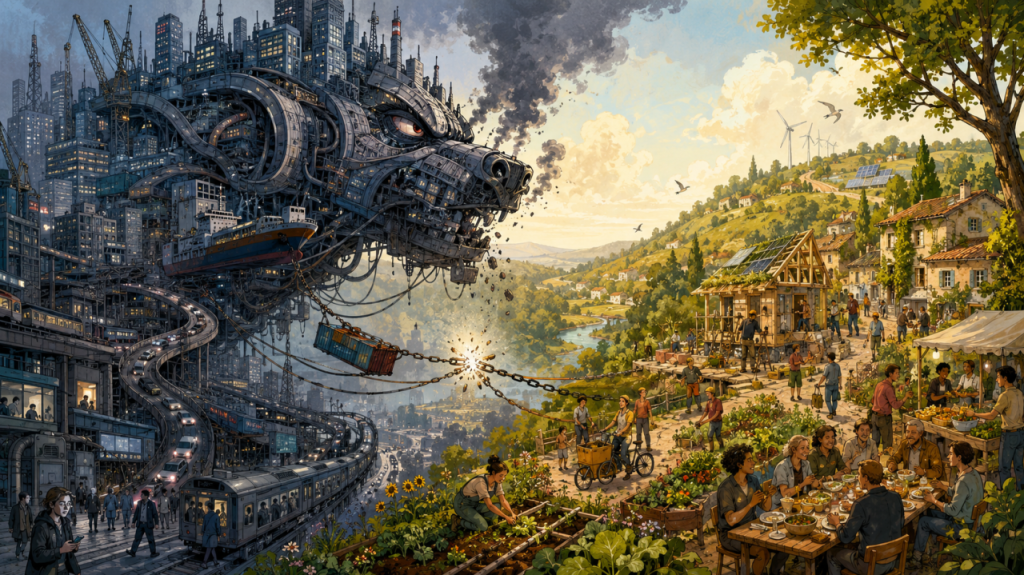
This month, saw the publication of a post by Frédéric Bosqué positing a new vision for the rural: ‘La ruralité n’est pas le passé des mégalopoles. Elle pourrait bien en être le laboratoire’ (May 19, 2026) [partial English translation by Michel Bauwens as: ‘Neo-rurality as the Future of Urbanity’]. It manifests a propositional mode lacking in Future Rural:
‘We need to create territories capable of robustness.
Territories that produce part of their own food. That relocalize part of their energy. That develop useful trades. That welcome inhabitants seeking meaning. That support local businesses. That invent citizen currencies. That train people for transition-related jobs. That build ecological housing. That make it possible to live, undertake, and invest differently.
That is what I call Rurality 2.0.
Not a museum countryside.
Not a commuter countryside.
Not a refuge countryside for tired urbanites.
A rurality capable of producing the future.’
Bosqué is the founder of the TERA (Tous Ensemble vers un Revenu d’Autonomie) project in the Lot-et-Garonne department of France. TERA was born out of a recognition of the ‘désertification des zones rurales’, the exodus of young working people to cities, and the closure of local shops and services. The project’s driving ambition is to relocalise provision through the cultivation of foodsheds, fibresheds, fuelsheds, and timbersheds. It parallels the ecosystem people approach of the bioregionalists, shifting away from demands on globalised production.
The project has four interlocking goals:
- to meet more than 85% of residents’ essential needs through local production within their territory;
- to adopt ways of living and producing in harmony with nature;
- to value that production in a local citizen currency, so that the wealth created does not drain away into speculative financial markets;
- and to issue that currency in the form of an unconditional basic income — a revenu d’autonomie — giving everyone a guaranteed and sufficient income to pursue the activities they choose.
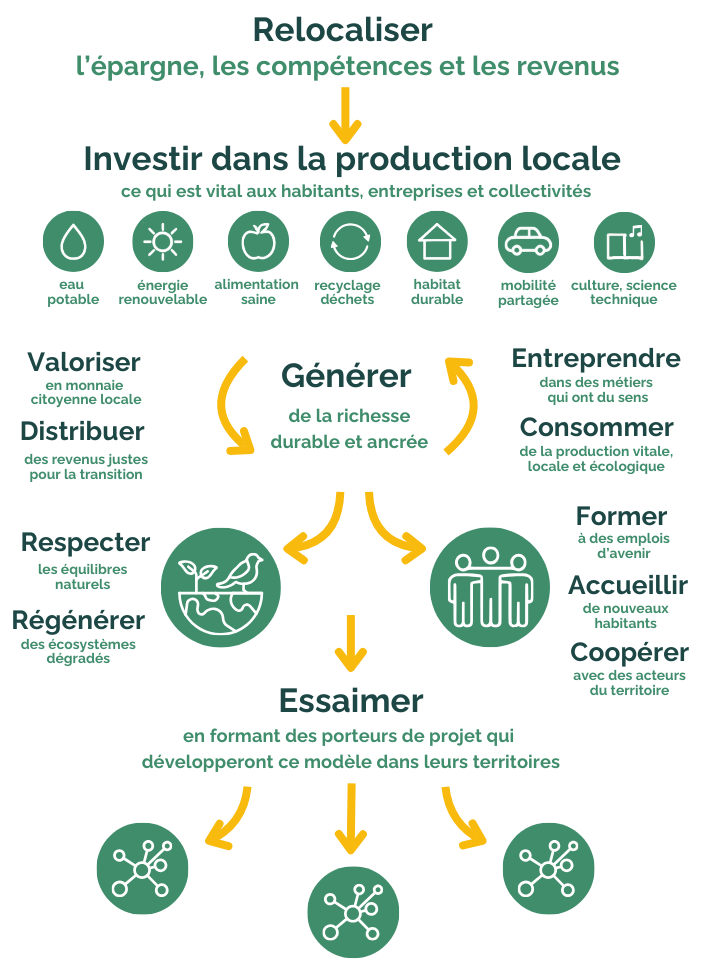
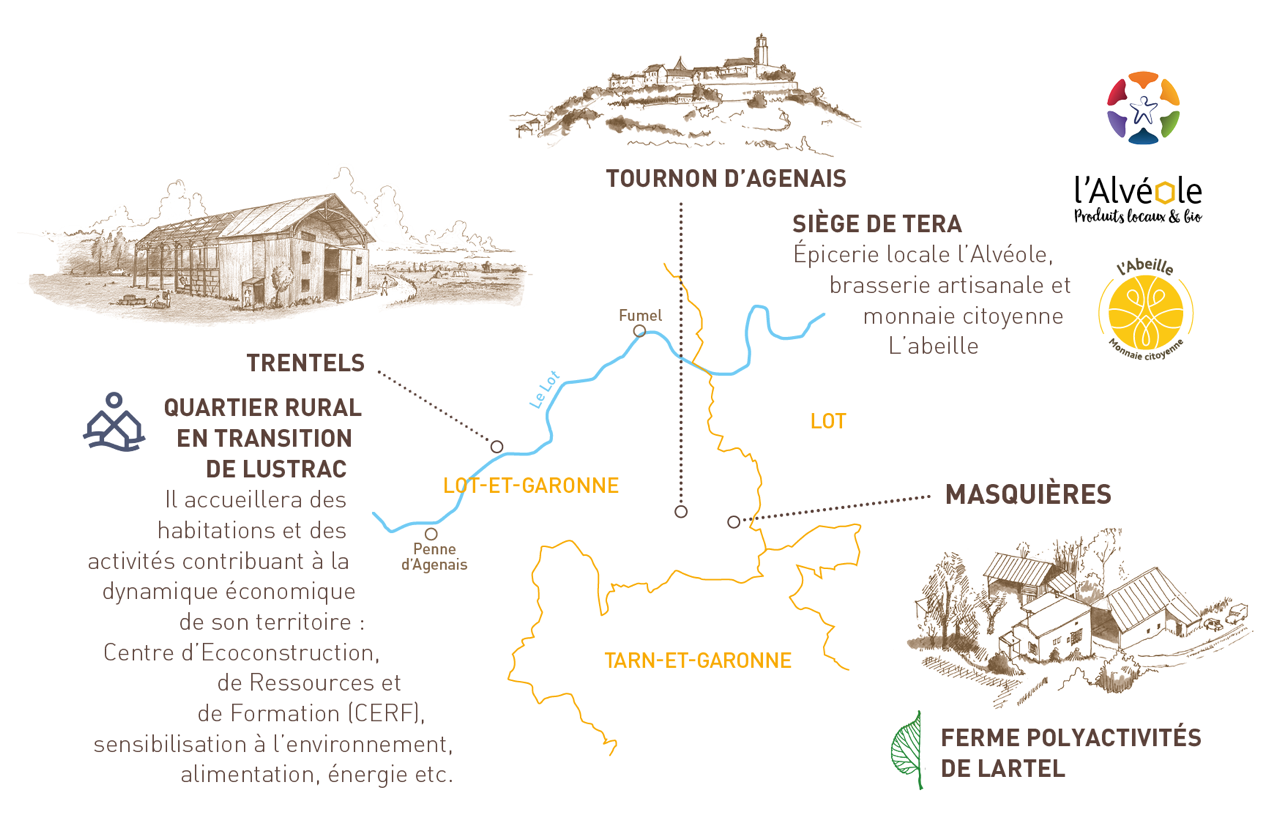
Bosqué sees the opportunity for rural areas to act as laboratories for regeneration, places that might produce sustainable futures that are beyond the urban imagination. He believes that it is in the marginal areas not the metropoles that we can cultivate tomorrow. ‘The future may not be where the brochures of modernity have taught us to look‘.
It’s stimulating to contrast Bosqué’s valorisation of the marginal quality of the rural with how the CPRE is pivoting. In what seems like a pitch for continuing relevance in the face of an urbanised population, the CPRE marks its century by focusing not on the rural but on the edge of town, the country beside rather than the countryside.
It’s borrowing from recent English nature writing that, without the epic de-peopled wilds of the American nature writing, looks to find the self-willed amidst the artificial. A strand of books which follow Paul Farley and Michael Symmons Robert’s Edgelands; Journeys Into England’s True Wilderness (2011), but with a lineage going back to Richard Mabey’s Unofficial Countryside (1973) and Derek Jarman’s Modern Nature (1991). Books which include Ken Worpole & Jason Orton’s The New English Landscape (2013), Gareth E. Rees’s works from Marshland: Dreams and Nightmares on the Edge of London (2013) onwards, Rob Cowen’s Common Ground (2015), Tim Dee’s Landfill (2018), MW Bewick and Ella Johnston’s The Orphaned Spaces (2018), Stephen Moss’s The Accidental Countryside (2021), Maxim Peter Griffin’s Field Notes (2022), and Richard Mabey’s The Accidental Garden (2025).
There are some excellent books here, but the edgeland device itself feels a bit tired now, overdone. Reading about edgeland nature gives me the same voltaic effect as the word liminal in a piece of prose: the uncomfortable sensation of biting down on a piece of aluminium foil in a mouth with metal dental work. I can’t really bear to read another thing that uses either conceit (despite the Tim Jackson piece quoted at the start of all this).
The CPRE pivot positions it as looking out on the rural from an urban position rather than being grounded in the land itself. Worse, in comparison with the visions for the rural conjured by people like Bosqué, the CPRE is failing to imagine the possibilities for tomorrow’s countryside and its preferable futures.

4. Future Rural in Essex
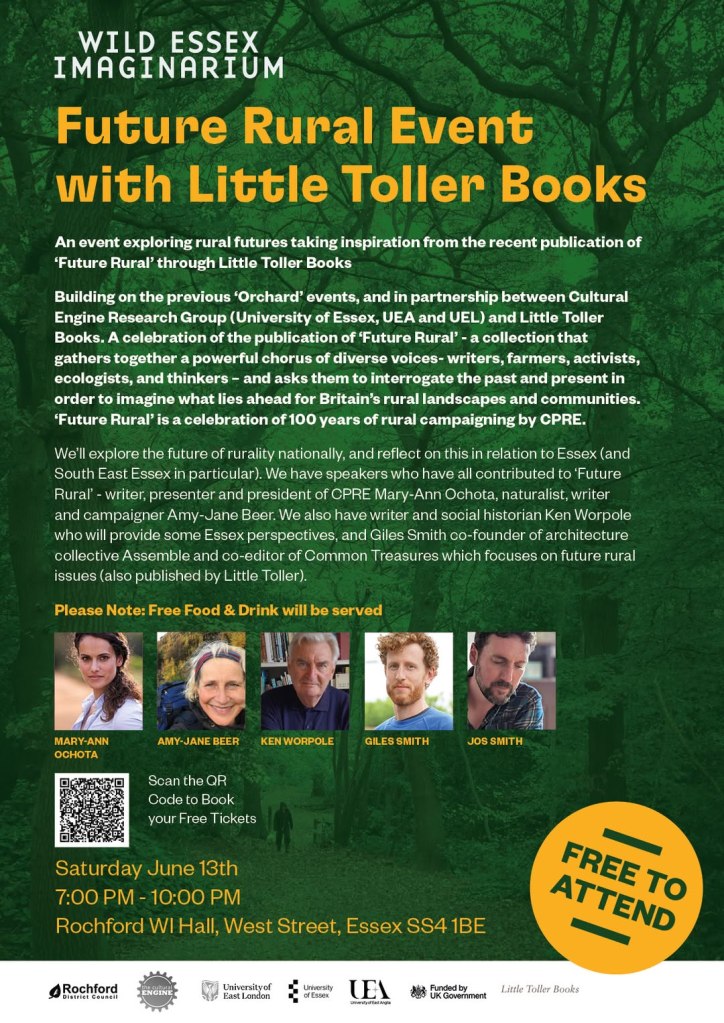
Next month sees the Essex launch of Future Rural (Free. June 13th. Rochford WI Hall) an event billed within the Wild Essex Imaginarium – a collaborative arts-and-environment initiative centred around the idea of “re-enchanting” the Essex landscape in the context of climate change, biodiversity loss, and local ecological recovery.
At the first Wild Essex Imaginarium symposium held at the Essex Business School in September 2025, Tony Sampson introduced their thinking around the ‘mezzo-level’ – an opportunity space between macro politics and micro-level communities where ‘new ecosystems of collaboration‘ might emerge and ‘form new ways of engaging with local governance and policy’.
‘an intermediary and collaborative tier operating between national/regional strategy and community action: an enabling infrastructure for joined‑up action, facilitating coordination, resource pooling and the translation of broad policy goals into context‑sensitive action’
– Tony Sampson, ‘Mezzo-level: imagination as policy infrastructure’ in Innovation Ecosystems: How innovation drives resilience and growth in our cities and communities [pdf] (i-PLACE Compendium no. 1, April 2026).
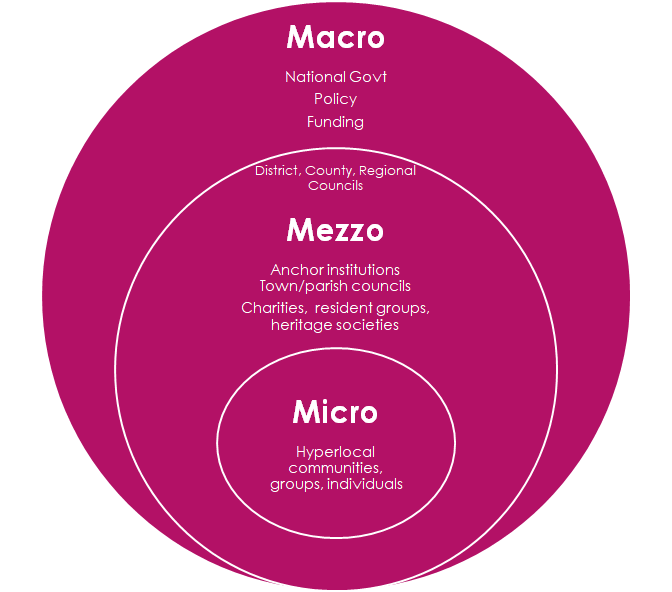
I immediately saw a parallel with a diagram I show when talking about bioregionalism on permaculture courses: David Holmgren’s application of the permaculture design tool ‘zones and sectors’ to permaculture activism. I use this to encourage participants to think about the conditions within which their designs sit and how they might affect and/or be affected by that context. In thinking about the bioregion (aka life-place) within which their individual, community and business activities occur, new opportunities emerge
Always design a thing by considering it in its next larger context – a chair in a room, a room in a house, a house in an environment, an environment in a city plan.
— Eliel Saarinen, cited in ‘The Maturing Modern‘, Time (2 July 1956)
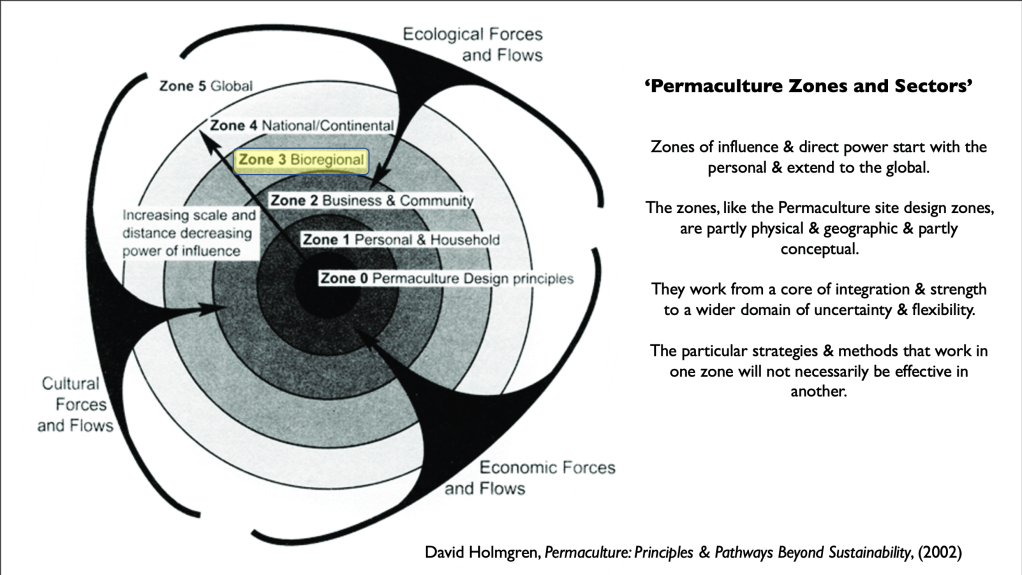
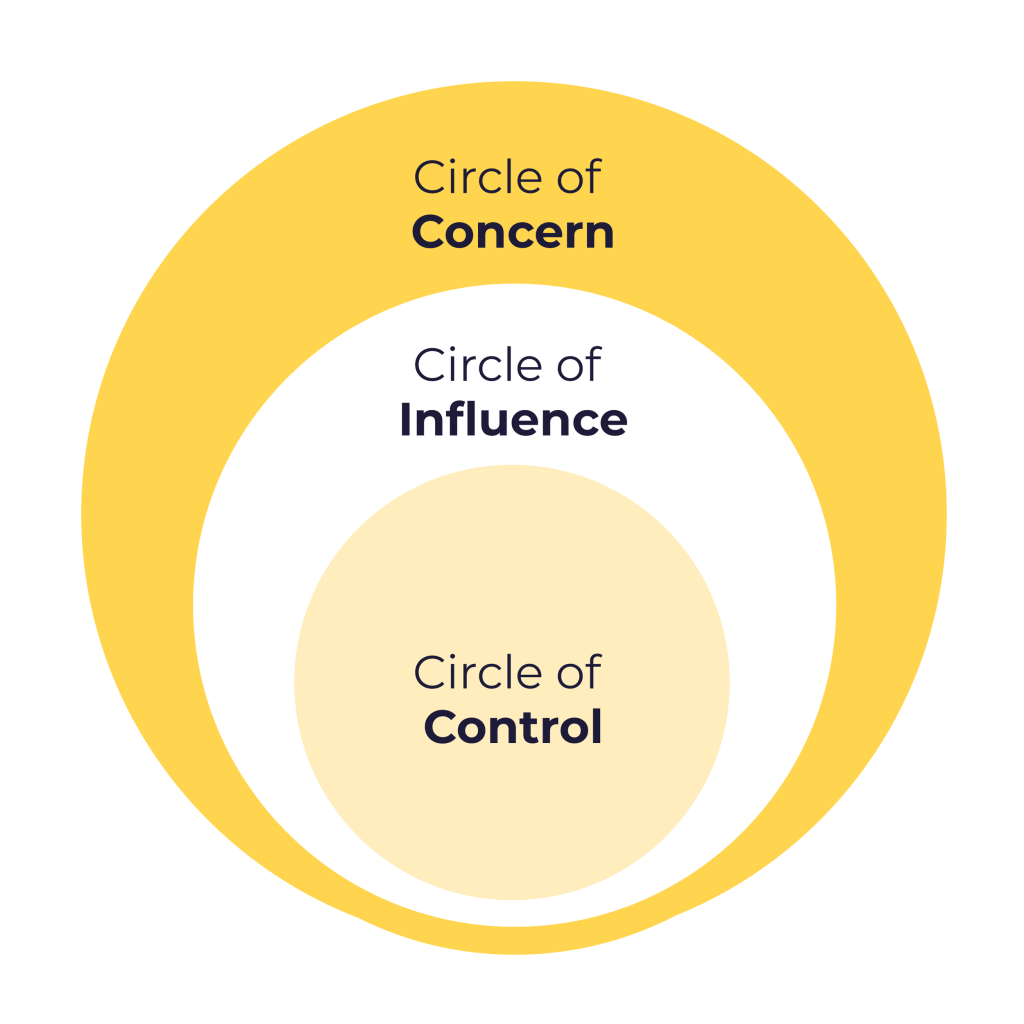
What both of these models share is an attempt to identify a place of agency, where an individual or community might leverage change at higher scales. I see this as an instantiation of a “think globally, act locally” strategy. (Both models share ancestry with Stephen Covey’s Circle of Concern, Influence, and Control from his book The 7 Habits of Highly Effective People.)
Where I think there is some divergence, at least in tone, is in politics and the subsequent shaping of place. The Holmgrenian take on the bioregional fits neatly with mezzo thinking when both are considered as an intermediary tier between the global problematique and what we do about it as individuals and groups. But Holmgren’s anarchistic tendency, skepticism towards state power and belief that solutions must come from grassroots sources, not governments, mean he has little interest in national/regional strategy and broad policy goals.
I have more sympathy with state planning but I do think that the existing geographies of nation, county, district, town, parish etc, are artefacts too often misaligned with the living world. The disruption of local government reorganisation affords us an opportunity to think instead about habitats, watersheds, catchments, species ranges – ecologically functional areas. How much do I care about the local government boundaries of Maldon District, determined in the 1970s?
I think the Imaginarium use of the term ‘neighbourhoods‘ is evocative and distinct from the artificial borders of governance geographies, the nod towards the parish as a meaningful unit is appealing (and resonates with Common Ground’s ‘positive parochialism’) but there is a risk on one side of focusing on too small ecological units, biotopes rather then ecosystems, and on the other of holding on to artificial jurisdictions that are neither ecologically coherent nor fit for the future.
The mezzo also encompasses geographic structures from the regional downwards. The East of England is 19,587 km², while the parish of Steeple is 10.37 km². Its difficult to see coherence across these scales or how both operate ‘at the scale of local ecosystems‘. I think the model might work better if the smaller governance units shifted into the micro zone, but really the bind of the tripartite classification struggles to reflect the differences between bodies bundled into the mezzo level. Admittedly, they ‘visualise the mezzo not as a rigid layer in a hierarchy, but as a dynamic, interstitial alignment engine‘ (parklife!)
Perhaps I’m making a category error and confusing the mezzo zone with mezzo-level entities.
‘a successful mezzo‑level entity must be more than a coordinating body; it must be a speculative
infrastructure. Its eventual output is not merely plans, but an enhanced civic speculative capacity; the shared cognitive and social ability of a community to imagine, debate and navigate alternative ecological futures, thereby turning imaginative engagement into a core mechanism for effective and legitimate environmental governance.’
Bosqué’s TERA is a mezzo-level entity. My vision for the Dengie Climate Action Partnership to be a meaningful actor at the bioregional scale places it as a mezzo-level entity. I’m also broadly interested in any forms (entities?) that can aid our navigation through the Strait of Bad News. Essex County Council is also a mezzo-level entity though, sitting between national policy and grassroots neighbourhood action. Now, under the control of Reform UK, it’s a counterrevolutionary force creating a chokepoint.
In Kim Stanley Robinson’s novel Ministry for the Future he writes about ‘the Dithering‘, the long period in which governments and societies understood the climate crisis but failed to act decisively. How do we exit this and avoid the long sequence of cascading global catastrophes described by William Gibson in The Peripheral novels as the ‘jackpot‘ – a clustered, accelerating process of systemic collapse, including: climate-driven disruptions, pandemics, resource depletion, energy shocks, and economic and geopolitical instability? Without our own ministry for the future, and lacking support from a hostile mezzo-administration, we are looking toward a messy assemblage of institutions, movements, co-operatives, technocrats, and local initiatives to gradually forge the civilisational transition.
If we depend on communities, groups and individuals to deliver change it will inevitably look different to the glossy government strategies. We will need to cut our coats according to our cloth. Will it even work? Dougald Hine’s book At Work In the Ruins (which should have been called Why I’m No Longer Talking to Bright People About Climate Change) is sceptical that the crises of the present can be “solved” through technical fixes, managerial policy, or more data-driven optimisation and instead points toward local, decentralised, community-scale initiatives to ride out the predicament. After reading it though, I came away thinking that, to paraphrase Thatcher, the trouble with voluntarism is that sooner or later you run out of other people’s time. So much community work I see locally depends on the time surplus of boomer retirees, a one-off burst of energy as finite as the petroleum interval that made their retirements possible.
Too many things that would ease the transition to a better world, don’t make economic sense in our current system. Sarah Green’s locally grown, organic carrots don’t depend on anything going through the Persian Gulf, but local people prefer the supermarket chemical agriculture carrots that the stores sell at a loss. Coco & Nut Pantry on Burnham High Street is a plant-based, zero-waste, refill store allowing customers to stock up on foodstuffs, cleaning materials and toiletries without a bunch of excess packaging, but customers looking for the cheapest bargains won’t shop there. The volume housebuilders won’t do passivhaus standards, heat pumps, rainwater harvesting or swift bricks because they optimise for standardisation, speed, land economics, and short-term return on capital. Public and active transport infrastructure that could offer a sustainable mobility future beyond car dependence isn’t built because people “depend on their cars and that’s where money should be spent”. The transition to renewable energy is lobbied against by those in favour of “cheap oil and gas”, even while those resources go into terminal decline. Many ethical businesses and right livelihooders go broke waiting for the great turning.
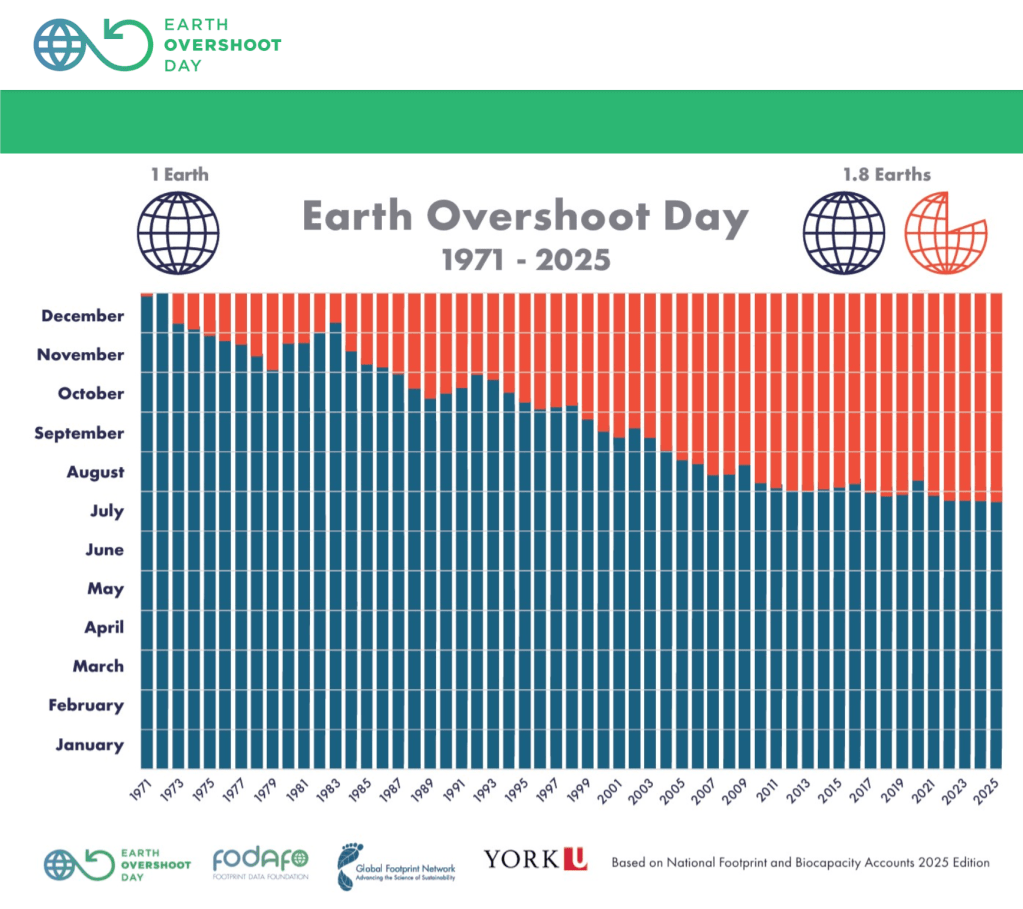
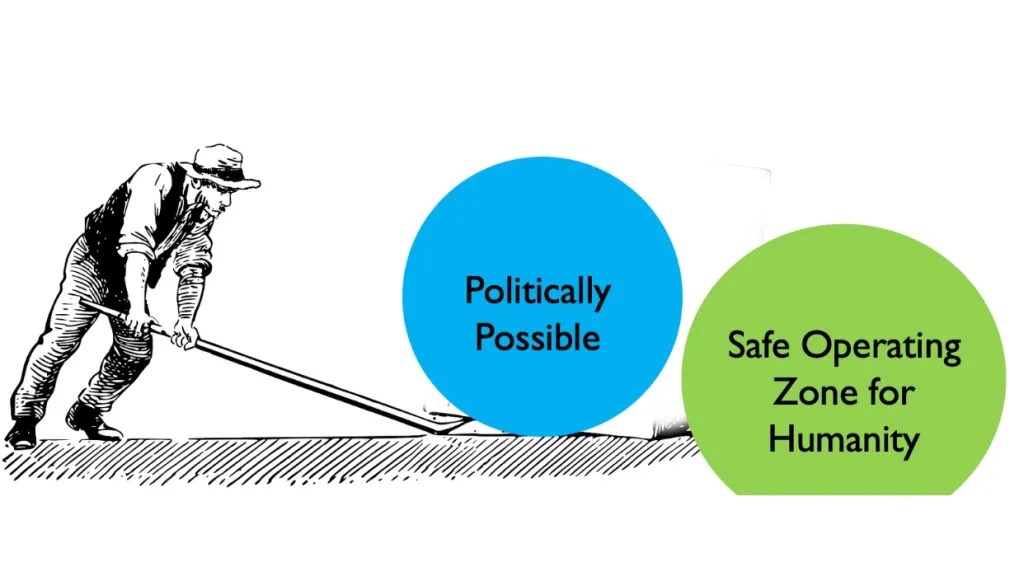
The line attributed to John Maynard Keynes that ‘markets can remain irrational longer than you can remain solvent’ bites anew in the era of ecological collapse. If the markets can remain irrational longer than the planet can remain ecologically intact then it’s easy to see why ‘it’s easier to imagine the end of the world than the end of capitalism‘).
When we finally internalise the costs that we currently externalise and live within our planetary means we will experience a change in our standard of living. Done equitably, this can also lead to improvements in our quality of life, but we are leaving it very late to make the change. I’m reminded here of Erik Olin Wright’s concept of the ‘transition trough‘:
The transition trough describes a likely dip in human welfare or systemic performance that occurs during the process of transforming a major social institution or system, even when the destination (the transformed state) would be superior to the starting point. It’s the valley between two peaks on a welfare curve.
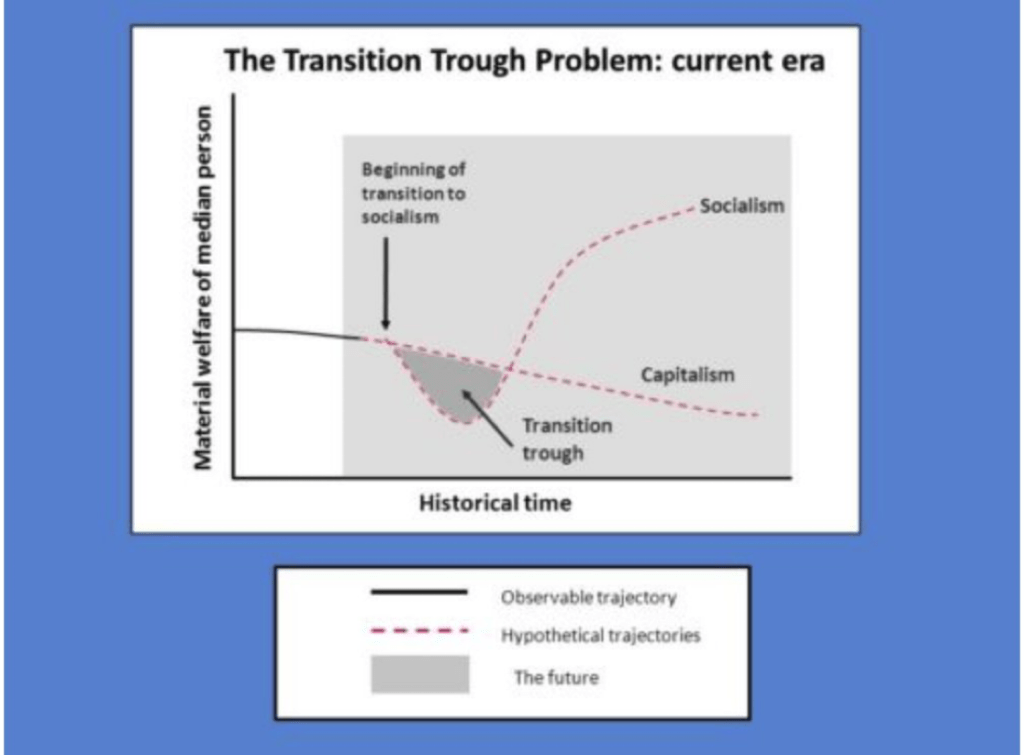
If we want a fairer society, food sovereignty, energy security, nature recovery, a liveable planet, sustainable livelihoods, affordable housing, rural regeneration and the rest we need to cross that gap.
‘I want to believe in it. I want to go on believing in it. But I cannot quite yet. Because we haven’t yet arrived. We are still undeniably at the bridge. The liminal chaos clings to our garments and clouds our vision. We must move. We must create this future. We must create it before we can believe it. One windward tack at a time.’
The financial crisis of 2007/8, the Brexit flounce, the Covid-19 pandemic and the Russo-Ukrainian war were missed chances to align our economies with the ecologically viable. The old order was propped up and austerity measures were put in place that reduced social and ecological capital; the situation was stabilised until the next crisis. The Trump War is similarly producing demands to extend and pretend that the old order is working: drill baby drill, scrap net zero, cut petrol taxes etc. In the UK, elections and leadership contests are reduced to arguments over who can better manage decline.
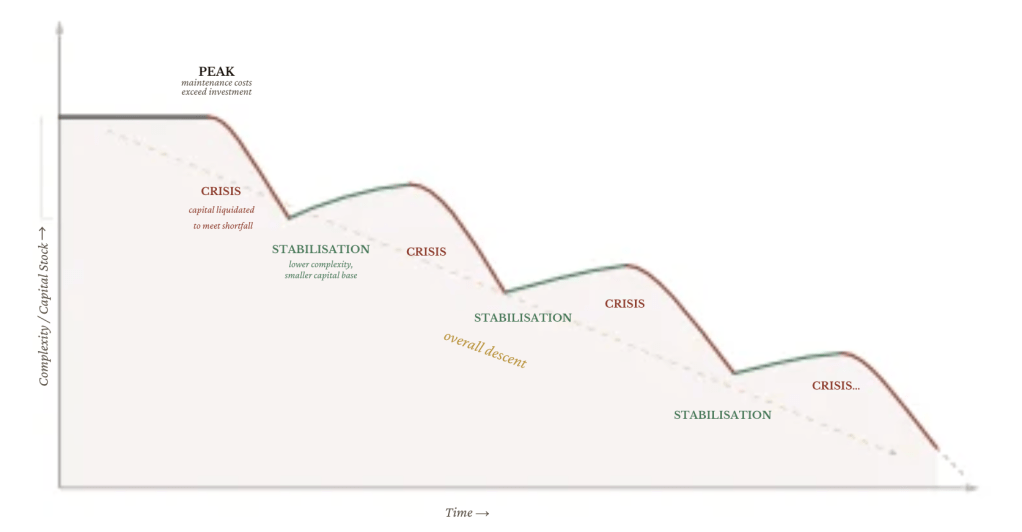
I’m reminded here of John Michael Greer’s staircase model of decline, or catabolic collapse, which posits that civilisations do not fall in a single catastrophic event but rather through a gradual, stairstep process of repeated crises and partial recoveries.
This model describes a self-reinforcing cycle where production fails to meet the maintenance requirements for existing societal capital (infrastructure, knowledge, and institutions), forcing the society to cannibalise its own capital to survive.
But crises provide an opportunity for transformation. The reductions in welfare they produce offer an opportune moment to traverse the transition trough and provide favourable circumstances for a transformative shift in how we live.
As Milton friedman noted: ‘[o]nly a crisis — actual or perceived — produces real change. When that crisis occurs, the actions that are taken depend on the ideas that are lying around. That, I believe, is our basic function: to develop alternatives to existing policies, to keep them alive and available until the politically impossible becomes politically inevitable.’ [pdf]
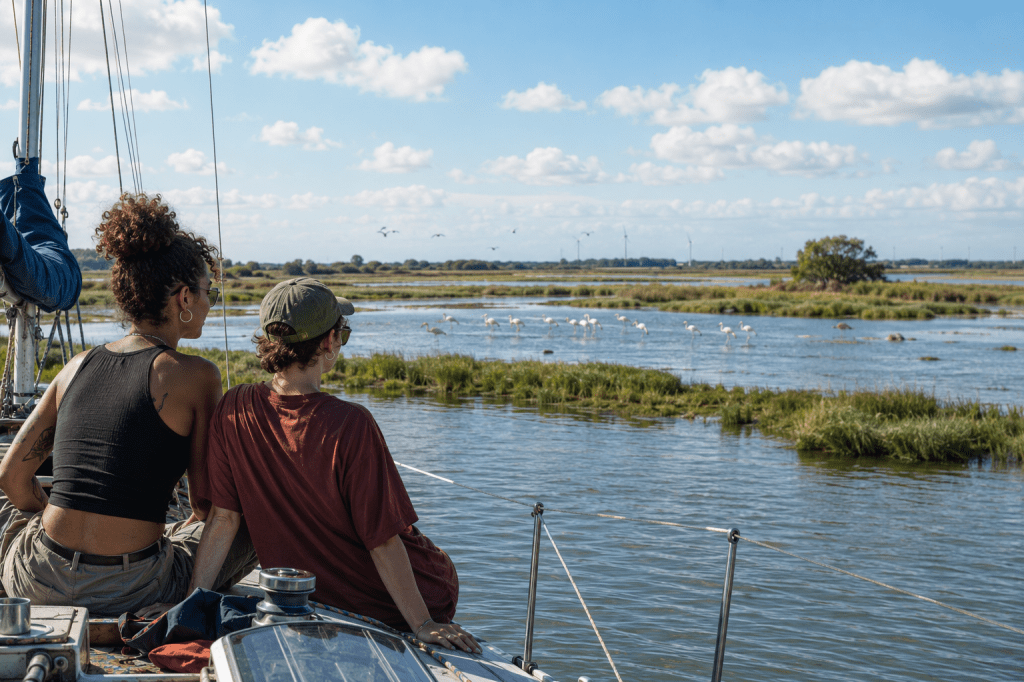
We are sailing into the wind, we are taking the windward tack up the Whitaker Channel into an easterly. There’s a pod of common dolphins at our tail for a while until they break off in pursuit of a school of herring. You know the best point to drop the sail so I leave that to you, then engage the electric motor to carry us over Ray Sand, through the gap that was Grange Outfall and into Asheldham Brook. The ecologists have got a monitoring station sat on stilts on Grange Horse and they flash their semaphore mirrors at us when they see us approaching. We take the deepest passage, so we don’t get too close to the horse but we are near enough for Ali’s voice to reach us as we pass, shouting Helllooo!!! Sarah must be kayaking out somewhere. We’ll catch them on the way back.
Once we’re in the brook we focus on the sunlight bouncing off the East Ware domes and navigate south east. At high tide the brook is wide and it’s not always clear where the shallows are. After that, the turbines at Middlewick and the treeline along Keelings Road to the north make it easier. We tie up at an Agency anchor point and get the binos out. You spot them first. It turns out those farm girls from the Tillingham commune weren’t bullshitting us after all – flamingoes! Right there in the shallow pan beneath Landwick. That’s drinks on us at the Cap and Feathers – next time we’ve got a positive balance of Dengie Dollars anyhow.
You’re getting it all down on the recorders, so I scope out southwards instead and catch a purple heron flying out towards the Southminster reedbeds. Then I roll out a towel on deck and watch the high clouds gently pass overhead. Enjoy it while it lasts. Next year we’re joining a construction crew out on Dogger for a cycle and there won’t be much snoozing in the sun, but we’ll be in good credit the following winter. We’re on the list for a 2-bed in an Althorne co-house close to the field studies centre and maybe we can start a family.
 Dengie Bioregion