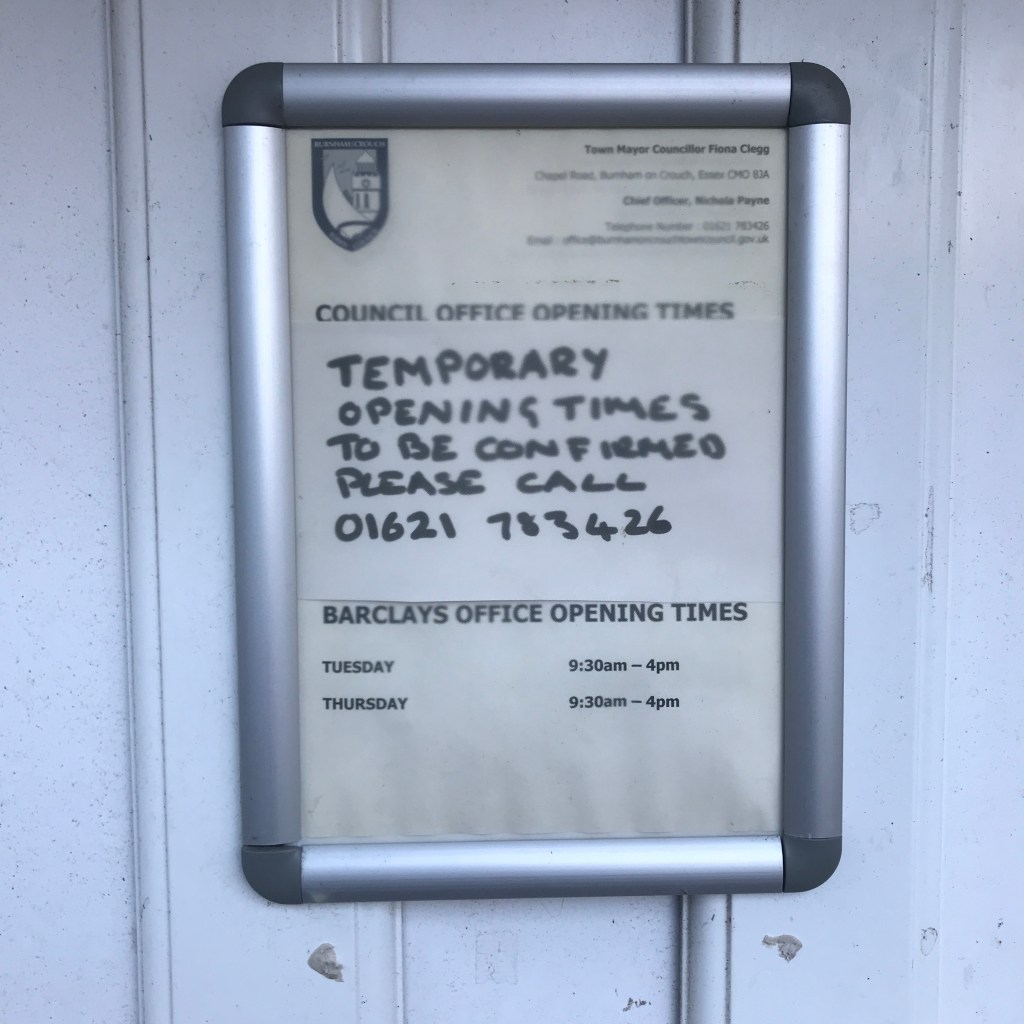
There’s chaos in Burnham on Crouch Town Council (BTC). Seven councillors resigned last week (including the Mayor and Deputy Mayor), the Chief Officer has not been seen for months and rumour suggests that another of the small staff team has departed. The resignations are the latest incident in a low-intensity conflict between the resignees and previous post holders, the details of which remain largely obscure and cloaked in ‘private and confidential’ ambiguity. Recent sniping in social media posts and comments from the guerrillas have received no return of fire from the occupying forces (an apparent attempt to avoid the bunfight such fora tend to produce) which has made it difficult to take a rounded view.
In May, the longstanding Town Councillor Una Norman stood down to concentrate on her other role as a District Councillor. When a town councillor stands down outside the normal election cycle, the remaining councillors can co-opt a replacement unless ten members of the electorate request an election. The soft war on Facebook now had a new focus and an online campaign swiftly got the required signatures. If only one person stood they would be elected uncontested, if more than one stood the full apparatus of the polling station, ballot boxes and official counts would be brought into action (apparently costing c.£9,000, about 5% of the town council’s annual budget).
In the event, two candidates ran: Clea Rawinsky and Wendy Stamp. They both ran as independents and their campaigns clearly marked out their positions on either side of the existing conflict. Rawinsky’s literature positioned her close to the existing regime, and a Facebook post in support of her candidacy from an existing councillor, Nick Skeens, both reinforced this and revealed her as their preferred co-option. That post also took aim at her adversary, Wendy Stamp. Stamp had been a Burnham Town Councillor before and is currently a Maldon District and Essex County Councillor. Her previous tenure on the town council had coincided with that of many current councillors and Skeens suggested in his post that her’ behaviour at Town Council… led to my resignation a few years back’ and that he found ‘her self-confessed abrasive style, plus what I view as her tendency to be over-defensive, very difficult to deal with.’
He continued that
‘My opinion is that Cllr Stamp, while she may not mean to, will bring division to the Town Council, not unity. And Cllr Stamp must know this risk exists because, when she was last on the Town Council, six councillors, all of them [current councillors listed above], stepped down because they could not handle her behaviour. To be frank, and as Cllr Stamp must know, they stood for election last May precisely because Cllr Stamp had decided to step down. This may sound harsh, but you do have to experience Cllr Stamp in full flight to understand it. As I say, I accept Cllr Stamp may not mean to do it, I accept that she sees her combative approach as her ‘marmite’ style.’
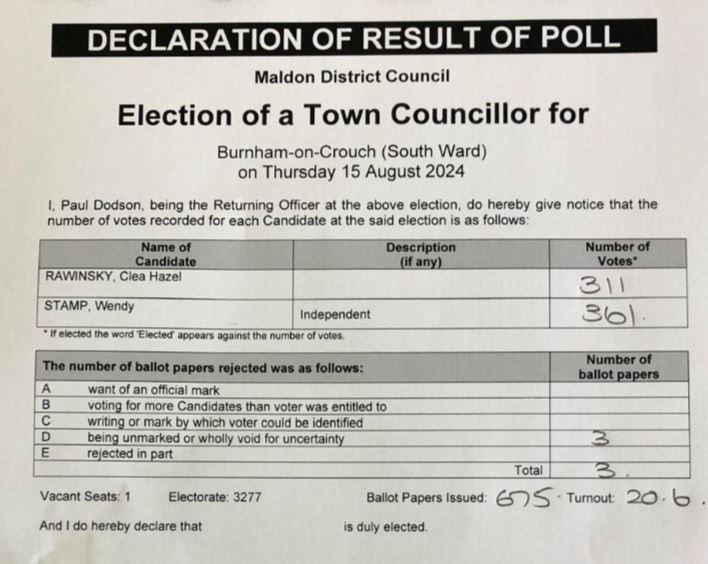
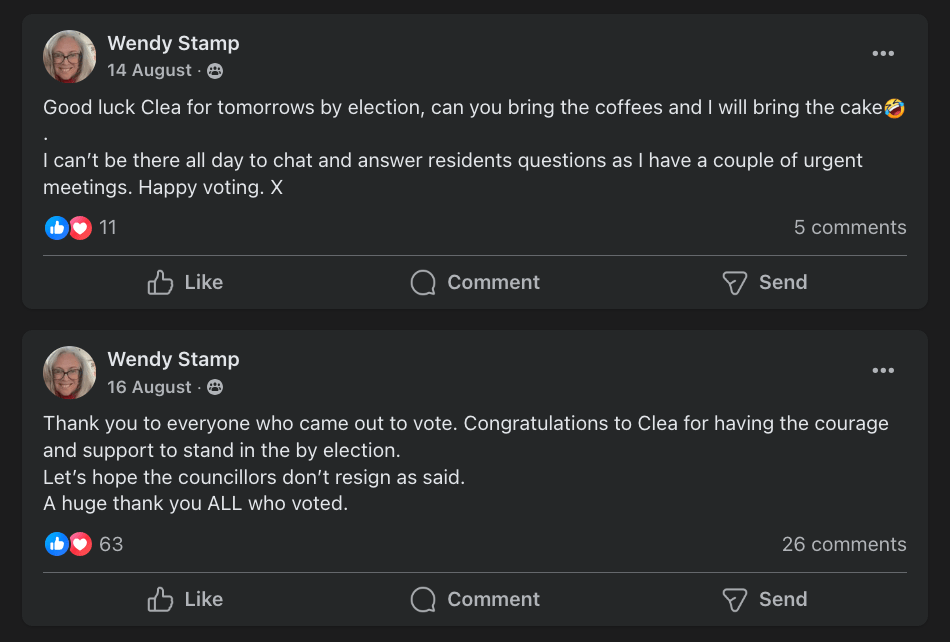
On 15th August, the election day, there was a 20.6% voter turnout and 50 votes separated the candidates. After Stamp won the election, some supporters asked, rather gleefully I felt, when the other councillors would resign. Stamp herself was more gracious in victory however, thanking everyone who came out to vote, and congratulating Clea for having the courage and support to stand – adding ‘Let’s hope the councillors don’t resign as said’.
The first fruit of the post-election councillor line-up was the calling of an Extraordinary Meeting on 29th October. The meeting announcement was signed by Cllrs Stamp, Stratton and Bown and included two motions that seemed to relate to issues touched on in social media sniping. Motion 2: ‘to consider a ban of any councillors under investigation attending the Town Council premises and surrounding land other than for Full Council and Planning Meetings’, and Motion 3: ‘to consider and agree to remove councillor (s) under early investigation with Essex Police, from access to the council’s financial systems, including governance’.
Accidentally unredacted minutes of a council meeting on 12th September indicated that Motion 2 pertained to a ban on Cllr Stratton, while Motion 3 seemed to be something Cllr Skeens referred to in his pre-election Facebook post as the councillors being ‘under continual attack from both within and without’, Cllr Clegg being ‘the target of multiple, baseless attacks’, and all the councillors ‘apart from Cllr Doug Bown, hav[ing] been subjected to a long series of baseless and distressing attacks and allegations, both to Maldon District Council and the police, presented in the foulest of language and the most intemperate of manners, by one particular town councillor with evident support from outside.’ With the numbers being against the signatories of the the Meeting it seemed to some that calling it was a piece of showboating and political theatre. On the day, only the signatories attended so the meeting was declared not quorate and the motions remained undiscussed.
The motions then reappeared on the agenda of the next Full Council meeting on November 12th. Unlike other social media users, I had not read Cllr Skeens’s description of previous resignations as a promise to do so again should Stamp be elected, but at the meeting on the 12th, those resignations began. By the end of the week, only 3 town councillors remained – a number which is not quorate and thus unable to conduct Council business. In the short-term Maldon District Council (MDC) has used to nominate temporary councillors. During a meeting on 14th November, Cllr Wendy Stamp asked to nominate District Councillors Vanessa Bell, Una Siddal-Norman and Ron Pratt to be temporarily appointed. All of these are former Burnham Town Councillors, and eagle-eyed readers will have noted that it was the standing down from the town council of one of them that initiated the tumultuous last few months.
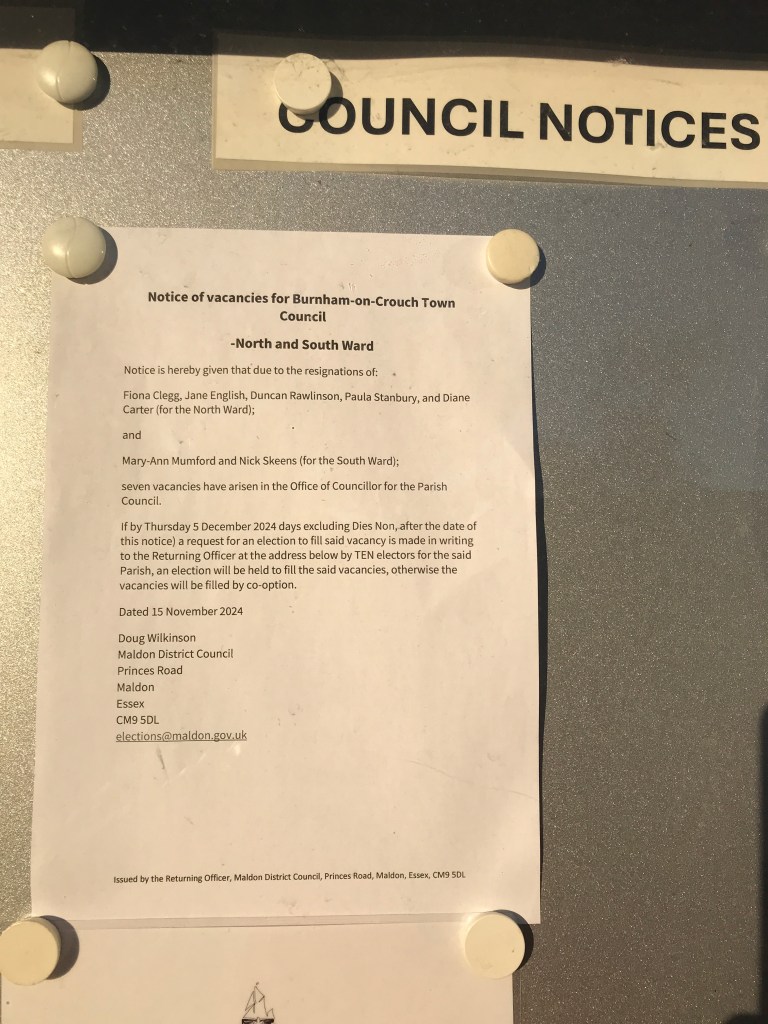
A notice of vacancies has gone up, once again ten electors of the parish must request an election to fill those vacancies (and do so by December 5th), ‘otherwise the vacancies will be filled by co-option’. There’s another 5% of the council budget gone if an election is called. If fewer than six people run in North Ward or fewer than three run in South Ward, those who do so will automatically join the council without a single vote cast. It’s hard to work out which is worse in the current circumstances, co-optees chosen by a small clique or the risk of anyone crazy enough to stand being elected by default. These are the rules, but it certainly feels like it’s pushing the envelope of democracy. Given the recent debacle, enthusiasm for standing is limited.
I wonder if this might mark the beginning of the end for independent* (publicly non-aligned to a political party) candidates. In 2011 and 2015, Burnham Town Council was dominated by Conservative councillors, matching a pattern of Conservative dominance up through District, Council, County Council, MP and national government. By 2019, independents dominated the town council and made strides with the district council too. To my mind, this was the result of two factors: one local and one national.
Locally, the push for new housing developments was highly unpopular and a campaign against the overdevelopment of Burnham began the political careers of independent councillors Vanessa Bell and Wendy Stamp. Bob Calver also stood on a ‘Put Burnham First’ ticket.
Nationally, frustration amongst Brexiteers about the inability to ‘Get Brexit Done’ was turning voters off the sitting government and locally was where they felt most agency to voice it. In 2015, UKIP took second place in the Maldon Parliamentary contest. In 2016 Maldon District voted 62.6% to leave the EU. UKIP fell back to 4th place in 2017 after the EU vote, but that frustration built up when it became clear that leaving the EU wasn’t as easy as voting to do so. Apart from the Conservative Party, no candidate has stood for Burnham Town Council on a political party ticket since 2007 when Labour and the BNP fielded candidates – Brexit dissatisfaction fed a local turn from the Tories to the independents. Only Cllr Bown currently represents the Conservative Party.
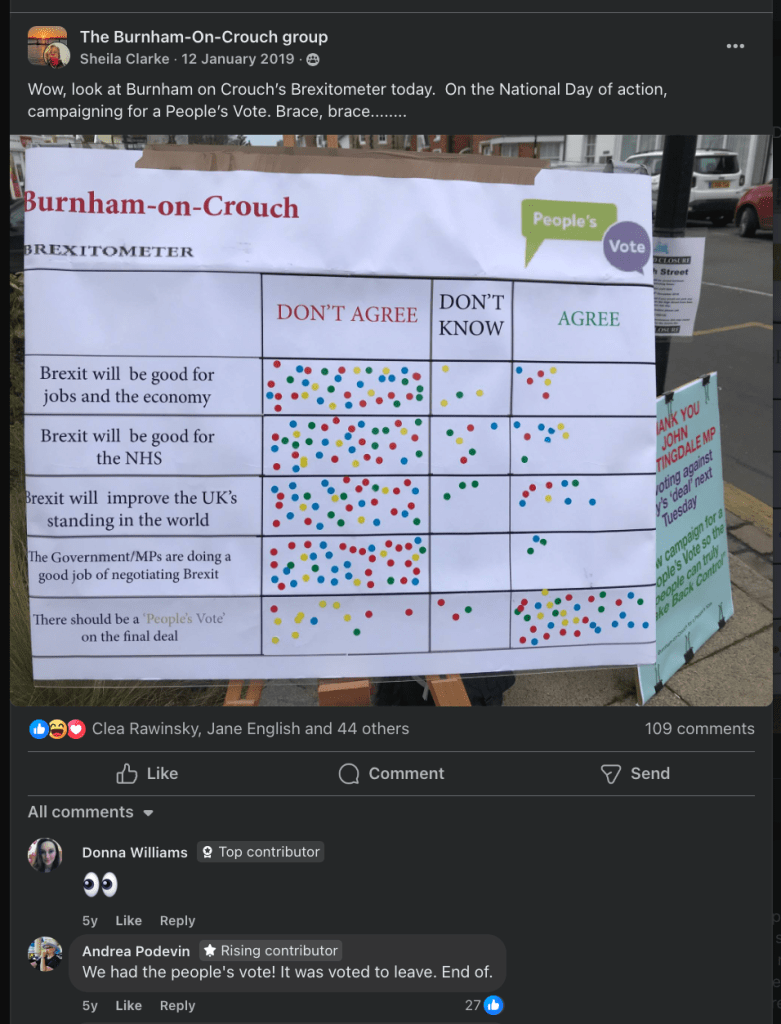
The promised sunlit uplands of Brexit are not within the gift of local politicians of course, but neither is any meaningful change to the amount of new housing in an area, where exactly it is located and what type is built. The mandates of the National Planning Policy Framework set the agenda for housing and an independent councillor with no connection to a parliamentary party has no greater influence over national policy than any other citizen. I doubt that the average local voter can point to any reduction in over-development in the years of local independent candidates achieving office at parish/town/district/county level. Years of cuts to local government finance by Conservative governments have further diminished local government activity and left those in office to carry public dissatisfaction. The attraction of independent candidates is much reduced, especially when they are embroiled in catty in-fighting.
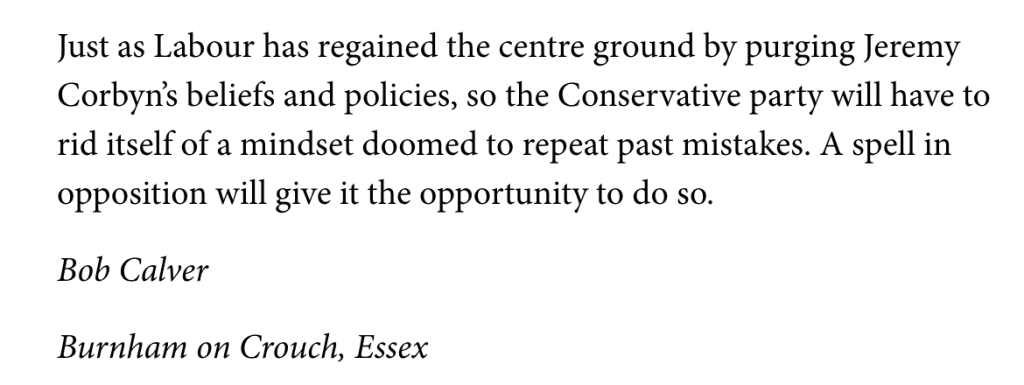
Now Labour are the incumbent national government and the whipping boy for Brexit frustrations I expect to see the Conservative Party settling into an oppositional role, fielding candidates and winning more seats in local elections. Reform came second here in the 2024 General election with 25% of the votes and I’ve heard local people celebrating both Farage and Richard Tice. I’m sure they could win seats here too but Reform doesn’t seem that interested in this level of politics. Farage is more interested in the American presidency than his own Essex constituency. I don’t expect to see them. Hopefully, the far right is too disorganised to stand too. The opportunity provided by Burnham’s current troubles seems ripe for a Conservative revival though. Ron Pratt’s temporary appointment doubles the Tory presence and in this uncertain time, the Conservative Party have the best resources and machinery to stand candidates.
It’s difficult, and perhaps not useful, to try and map the current local dispute onto a political compass. The classic left/right opposition doesn’t fit, a small ‘c’ conservative vs small ‘l’ liberal dimension seems to offer something while remaining incorrect. Similarly an open–closed political spectrum, a ‘Brahmin left’ vs ‘Merchant right’ axis, or a populism to progressivism range add depth without capturing all the nuance. Dan Evans’s petit bourgeoisie vs Professional Managerial Class distinction might better codify the forces in conflict, but we’re dealing with a small number of individuals here and no schema will be sufficient to chart them exactly.
In any case, the turn-out at the last election indicates that most of the local electorate is disinterested in who sits on the town council. While the trials and tribulations of BTC feed the small number of extremely online people who post and comment in local Facebook groups, most residents are blind to it all. While fears of libel have led the admin of one of those groups to turn off comments on some posts and remove comments on others, most folk out in the real world remain undisturbed and unaware of the online turf war.
I have to say that I’m rather disappointed by the whole turn of affairs. The disruption it brings exhausts time and energy that might otherwise be used in service of the town. I had spoken with councillors on how national net-zero and nature recovery policies might be incorporated in the next Neighbourhood Development Plan; on pushing through the Burnham-Southminster cycle route; and on broader walk/wheel/cycle infrastructure. I had attended meetings of the town’s environment committee. Now those councillors have departed, and the committee structure looks set to be disbanded. The process of establishing new relationships and new commitments must begin again.
Endnote
*
I have to stop myself from placing ‘independent’ in inverted commas every time I write it, but it has to be noted that this apparently clear word in fact obfuscates the politics of those standing. While many claim to be putting their area first, free of party allegiances they are, of course, not without their own political leanings. Standing as an independent has also been clearly used as a political strategy. Una Norman stood as an independent councillor on BTC while standing as a Labour councillor on MDC. Helen Elliott switched from being a Conservative Party candidate in the 2015 election to an Independent in the 2019 election (her husband Peter remained a Conservative Party candidate in both). Adrian Fluker, former Conservative Party leader of Maldon District Council, came back from his suspension for bullying and homophobia and now stands as an Independent in the ‘District Support Group’ (the group Stamp also sits in) representing Southminster Ward alongside his former colleague in the Conservative Party Ron Pratt. Over in Heybridge, the BNP took control of the Parish Council in 2016 standing under the more palatable ticket ‘Fighting Unsustainable Housing Because We Care’. Richard Perry, former councillor of Heybridge announced in 2018 that he had rescinded his membership of the BNP and maintained in 2023 that he was ‘a totally Independent Councillor’ but he maintains the vanity plate S5 BNP on his Lamborghini. His friend, former independent Maldon District Councillor Chrissy Morris was another BNP member]


Leave a Reply