I am grateful to Tony Fittock (District Councillor for Althorne ) for letting me know that the process of creating a new Local Development Plan for Maldon District has begun. So my previous post on the matter revealed my own ignorance of the Maldon District Local Development Plan (LDP) Review: Issues and Options Consultation, which ran from 17 January to 14 March 2022.
Mr Fittock also shared a link to the report ‘Growth Options for the Review of the Local Development Plan’ [p.33 onwards] provided to the meeting of Maldon District councillors on 14 September 2023.
From this, I learned that ‘the Plan Period for the review of the LDP Review is going to be 20 years.’ As the current plan runs until 2029, this indicates that its successor will cover the period up to 2050. As noted previously, the UK government is committed by law to reduce greenhouse gas emissions by at least 100% of 1990 levels (net zero) by 2050. The next Local Development Plan will therefore set out a vision and a framework for the future development of Maldon District that must include complete decarbonisation.
The government’s plans as laid out in Net Zero Strategy: Build Back Greener state ‘analysis suggests that over 30% of the emissions reductions needed across all sectors to deliver on our Carbon Budget 6 target, as set out in this strategy, rely on local authority involvement to some degree’.
They also indicate, however, that ‘[t]here are currently no net zero statutory targets on local authorities or communities in the UK, and we do not believe that a new general statutory requirement is needed.’ Instead, they ‘want to continue to empower our local leaders to take the actions which will lead to the biggest gains in emissions reduction, including the potential opportunities in building back greener’.
To me, that sounds like fluff. If you think that a third of the action necessary for national decarbonisation, and meeting your legal commitments, depends on what local government does in its next planning period then a few targets might not go amiss. I’m in favour of subsidiarity and local government empowerment – but this isn’t what this is. Under the current government, local authorities have been both de-financed and constrained by national policy – not least in planning. ‘Empowering’ without funding is empty rhetoric. It can’t work to pass the buck either, a national target is a national target.
It was inevitable that when successive governments’ main tactic for dealing with wicked problems was to kick them down the road they would eventually run out of road. When the last Labour administration signed up to a 2050 goal back in 2008 it must have seemed a Micawber enough interval between the two dates to leave the technocrats untroubled. The closer deadline dates get the more troubled they become.
The recent Conservative pushback on the death dates for gas boilers and fossil-fuelled cars, and the collapse of the Labour opposition’s Net Zero spending commitments are all of a piece.
In 2008, the Labour government introduced the Code for Sustainable Homes, a voluntary national standard for the design and construction of new houses, with the intention that by 2016 all homes would be ‘zero carbon’. The Conservative government scrapped that in 2015 in favour of looser building requirements. Eventually, the Tories came up with their own Future Homes standard, consultation on which closes next week
It’s a decade of delay we could have done without. A new report from the Green Britain Foundation states that the weakening of building standards added £2.6bn to the energy bills of new build homes between 2015-2022. The nation would have navigated the cost of living/energy crisis with greater ease without this unnecessary extra cost and energy use. The geopolitics of our gas supply revealed by the Ukraine war also demonstrated that energy sovereignty and national defence would have benefited from the demand destruction which higher standards would have produced.
Meanwhile, local planning authorities have been wary of demanding higher standards than the national requirements due to the risk of litigation from developers. Too many have been stung by successful and expensive appeals to their planning refusals – appeals based on national planning policies. All while being financially disadvantaged by nationally imposed austerity.
On 27 February, alongside many other local energy advocates, I attended an All Party Parliamentary Group (APPG) meeting on Community Energy. As the panelled MPs made their pitches, I wondered how many houses you could heat with all the hot air produced in the room.
There were lots of £billion promises for Great British Energy from the shadow energy minister Alan Whitehead, including a commitment to insulating every house in the UK. These were positive noises but I’ll wait and see what actually makes it into a King’s speech. It’s difficult to trust Labour’s assurances these days
Housing and transport are two obvious places where a Local Development Plan interfaces with national net zero objectives. The domestic and transport sectors remain the largest sources of energy consumption. The per-household consumption footprint for households in Maldon District is higher than the national average, with household and transport emissions both higher than the national average.
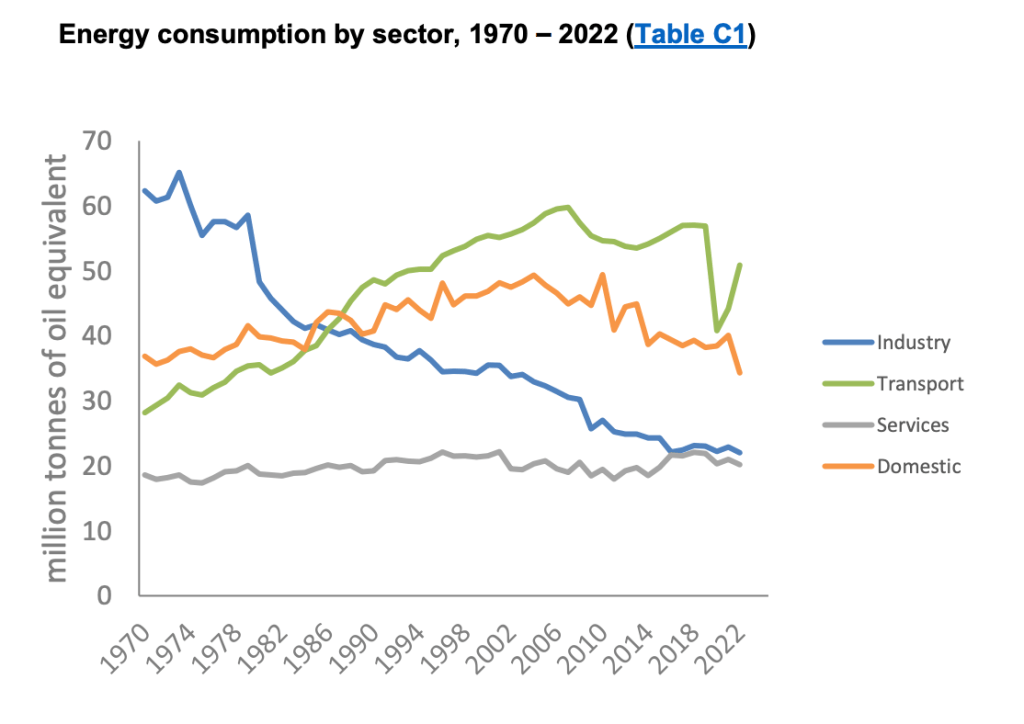
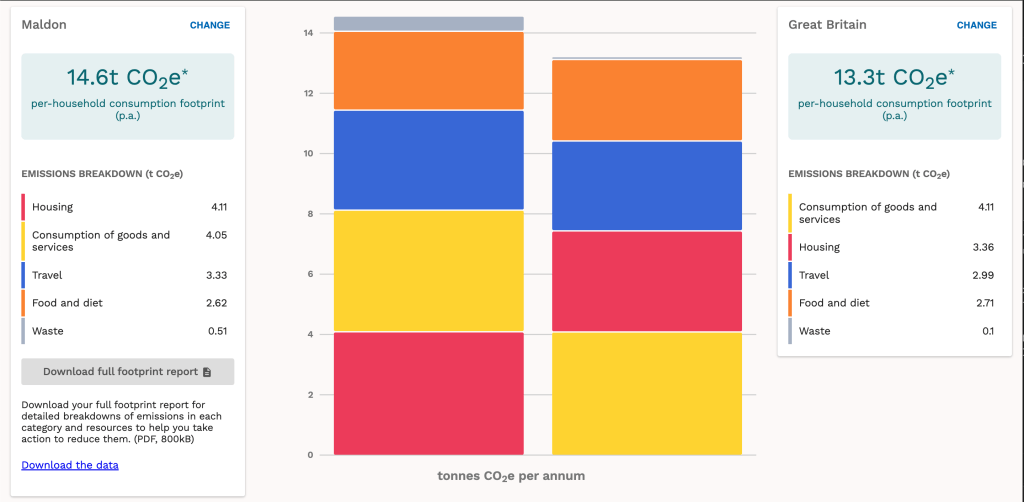
In general, we might expect that a net zero LDP would demand houses that are well-insulated, decarbonised, and energy producers. Also, individual homes would be built in relationship with a transport strategy based on the decarbonised movement of people and provisions. A strategy which would remove dependence on private automobiles by siting habitation within a network of public transport provision and walk/cycle routes.
One challenge for the LDP in achieving this is the separation of responsibilities across different levels of political authority:
Land use planning decisions are made at Maldon District Council, while transport decisions are made at Essex County Council. The district does not have the funding or responsibility for highways, footpaths, cycleways, subsidised transit, or commercial transit contracting. The county (and its highways authority) is just one of many consultees on land planning applications. As a result, new estates are built with bus stops that no bus service visits and cycle routes which end abruptly at the edge of a developer’s site.
Land use planning decisions are made at the District Council (the local plan, planning applications), but the land planning and construction rules are made at the national level (the National Planning Policy Framework, Building Regulations, Future Homes standards etc.). In recent local government elections, people have repeatedly voted for ‘independent’ candidates promising particular planning objectives – but the planning decisions are made by Council officers operating within national rules. The non-affiliated councillors have no party representation at the national level or any greater influence on the national rules than the wider electorate, leading to inevitable disappointment.
Much of transport policy remains national, with policy in England directed by the UK government. Bus service provision depends on private operators which range from small, family-run businesses to big multi-national companies. Rail infrastructure is the responsibility of Network Rail, while service provision in Essex is provided by Greater Anglia. There’s no integrated ticketing across modes, bus and train schedules aren’t coordinated, and commercial services can be altered or cancelled at their operators’ determination. In the Summer of 2023, Essex Highways and Maldon District Council consulted on a Maldon District Future Transport Strategy. Still, seven months on, no subsequent review or analysis has been published, the strategy does not appear to have been finalised or agreed upon, and no schemes have been announced.
Net zero adjacent considerations are thin on the ground in the ‘Growth Options for the Review of the Local Development Plan’. There is however
5.4 A greener future
5.4.1 Reducing the need to use the car for essential journeys is a key tenet of a greener future so growth should be located in the most sustainable places where other transport options can be provided. The growth options chosen for further consideration allows the Council to explore this fully.
All three of the growth options chosen for further consideration include existing settlements along the Crouch Valley railway line, with one of them explicitly described as ‘[f]ocus growth along the rail line’
Elsewhere in the document, it describes how that option and another might be combined and states:
4.5 …Having an analysis of the railway line and how it could interact with future growth in an option is a suitable alternative option and given the Climate Change emergency the Council has declared, the need to maximise the use of transport alternatives to the car.
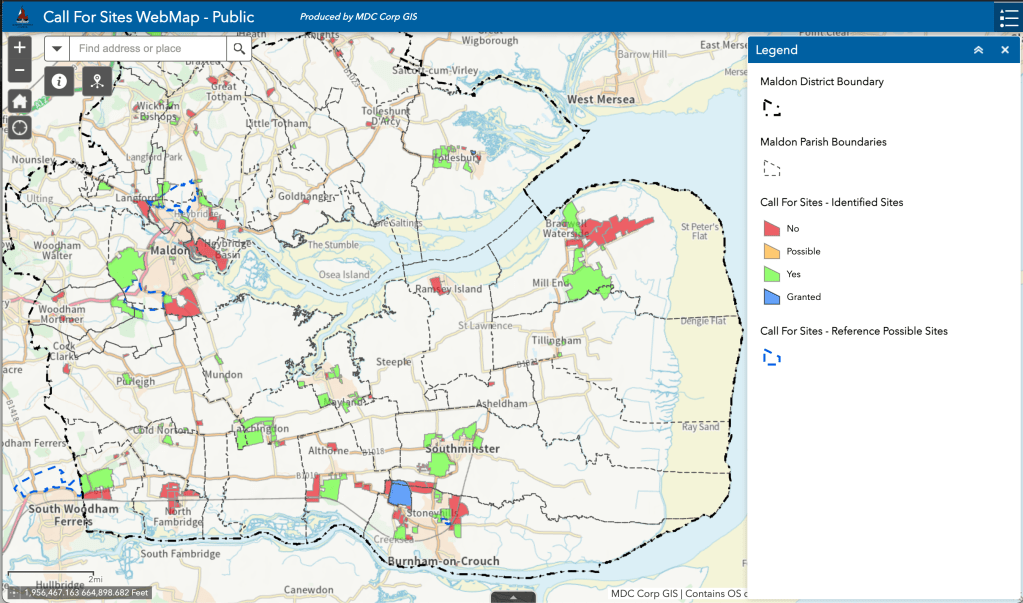
If we were being generous we might call this: ‘Transit-oriented development’ but that would suggest a pro-active vision which is absent from the document. When the district council has no influence on, or authority over, transport infrastructure; routes; pricing; service type; or timetables it can only base plans on what already exists (and might be expected to continue to exist through the plan period). The District Council’s powerlessness to produce a proactive transport strategy, one that might introduce new and extend existing services is evident in many places.
In the course of examining the growth options, it dismisses one based on small and medium villages, as ‘some of [these] do not have access to a railway station or bus services, and it may not be possible to provide a bus service if a settlement is particularly isolated.’
When it discusses options including settlements on the Crouch Valley Line it notes the opportunity to ‘bring in the railway line as a sustainable form of transport alongside potential improvements to the public bus network and other active travel options; however, there are known existing capacity/service challenges which would have to be analysed in the work following a reduction in the number of growth options.’
The Maldon District Future Transport Strategy consultation document pointed to many of the pertinent issues. It said that the authorities want to ‘to give people the option to leave the car at home’. That future schemes will focus on ‘[p]ublic transport enhancements: E.g. Bus network improvement plans, improvements to rail services, smart ticketing, demand responsive transport’ and that they might review ‘former railway lines to assess the feasibility of reinstating as bus rapid transit, walking and cycling and horse riding routes’. The document links to The Essex County Council Bus Service Improvement Plan 2021 to 2026 which is also full of good words like ‘[w]e do not want communities where you need a car or must wait for a lift to make the journeys you want to make. We want everyone to be able to make a sustainable choice.’
These sorts of words don’t amount to much though when they are accompanied by cuts in service. In the last couple of years, there have been cuts to the bus services between the district’s two largest conurbations (replacing a half-hourly service with an hourly one) and the merger of two bus routes to rural villages that have resulted in the loss of weekend services and a massive reduction in the weekday ones.
The casual talk about ‘improvements to rail services’ never details what improvements or how they might be achieved. The sustainable transport policy in the current LDP already states ‘[t]he Crouch Valley Line provides an opportunity to ease the District’s reliance on the private car for transport. Railway patronage could be increased by improving train services, and improving connections to rail stations with bus links to nearby settlements’ and they want ‘to optimise the capacity of rail services in the District and to encourage a modal shift away from using the private car, the Council will seek to improve sustainable transport connections to railway stations on the Southminster branch line, and to the mainline stations of Hatfield Peverel, Witham and Chelmsford.’
The current Neighbourhood Development Plan for Burnham-on-Crouch noted that the town ‘needs an improved railway service with better connections not only to London but also onto the East Anglia main line at Shenfield linking into Crossrail’ stating that Burnham Town Council would seek to improve the quality of train services including the ‘operation of trains later into the evening’. None of this has been delivered yet and there’s no evidence that the appropriate stakeholders (Network Rail/Greater Anglia) have even been spoken to.
A truly sustainable transport strategy for the district and a development plan fit to meet our net zero goal need to be much more ambitious and directly address the challenges and opportunities emerging from that ambition.
If both a modal shift from the automobile and the transport implications of future growth in the district are based on increasing the use of rail then there needs to be infrastructure and operational improvements to the rail provision. Early easy wins would include later train services, increasing through trains from the branch to destinations on the main line, integrated ticketing and the establishment of mobility hubs.
Transformative change necessitates doing more than easy things. The number of services on the Crouch Valley line is limited by the fact that it has been reduced to a single track for much of its length. At best, this provides one service every 40 minutes in each direction. Increasing capacity requires the re-introduction of more double-track sections. A line extension to Bradwell-on-Sea improving access to the transport-deprived settlements in the east of the district should also be considered. The opportunity of reopening rail services to Maldon requires more investigation, much of the route connecting the Crouch Valley Line to the former Maldon West station remains free of obstruction. Infrastructure improvement should also consider how rail can be used for parcel transport as well as broader provisioning and freight distribution.
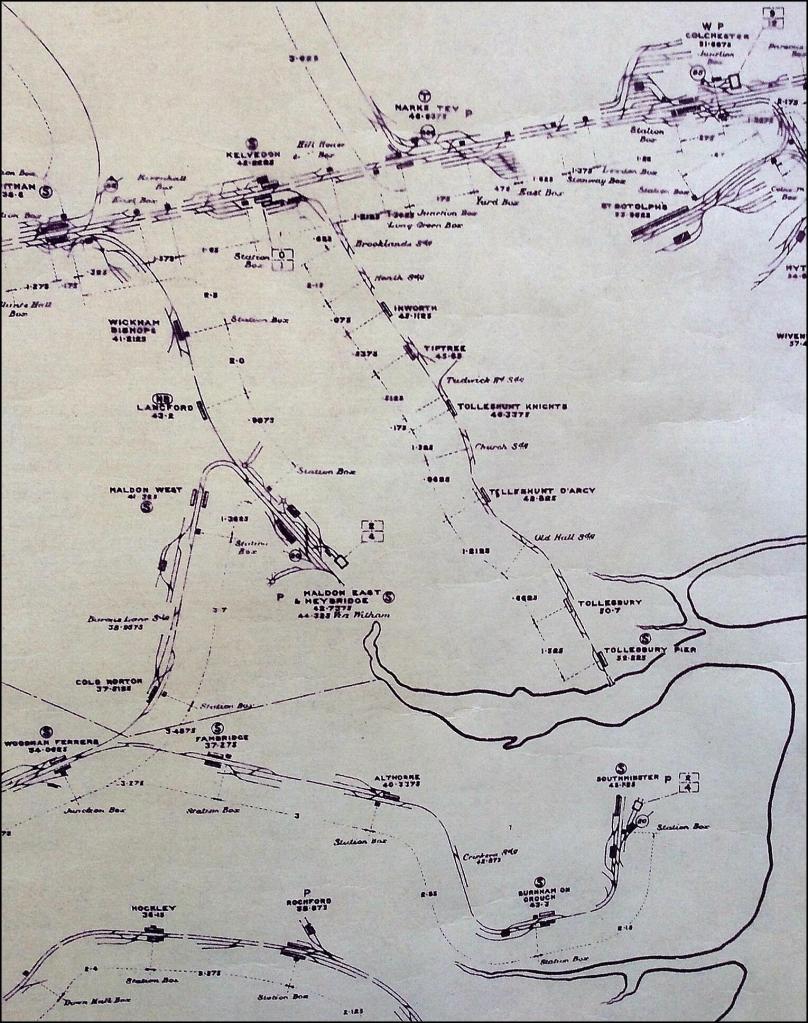
These types of plans may seem impractical and unachievable, if not eccentric and out of touch with reality. That such services, introduced in the reign of Queen Victoria, seem impossible now reflects a failure in the civic and political imagination. To be fair, a proposed scheme to reinstate the other lost Maldon route, the Maldon to Witham line, was submitted to the Government’s Restoring Your Railway Fund in 2020. This was unsuccessful and it’s a shame that neither the bid details nor the feedback received have been made public as that might have indicated more about the council’s future thinking and the perceived opportunity space. The Restoring Your Railway Fund was a competitive scheme with only £500 million allocated to it which is less than half the money just announced for widening the A12 between Chelmsford and Colchester. This is the type of policymaking that encourages a modal shift in the wrong direction and thinks it can outwit the Downs–Thomson paradox. It’s also depressing to read the Government’s 2023 report Future of Transport: Helping local authorities to unlock the benefits of technology & innovation in rural transport with its motorist focus and chapter headings like ‘Importance of rural roads for everyday journeys’ and ‘Driving towards a sustainable future’.
The closest we’ve come to a regional rail vision for the C21st appeared in July 2012 with Once in a generation – A rail prospectus for East Anglia but that was nearly 12 years ago and from a different climate era. While some of its rolling stock expectations have been delivered (longer passenger trains with air-conditioning, automatic doors, Wi-Fi and plug sockets), its rail infrastructure vision has not.
It noted the problem back then:
“The electrified branch lines to Southend, Southminster, Braintree, Clacton and Walton, and Harwich all carry large numbers of passengers but suffer from a lack of investment in track infrastructure, trains and stations.”
“improving core service attributes – frequency, speed and reliability – increases rail usage.”
“The many different users on the line to Southminster… would increase if the existing constraints around frequency, capacity and line speed were addressed.”
It proposed improvement over two time frames, a short-term vision (to 2019) and a long-term vision (to 2032). The short-term vision included an analysis of incremental service improvements on each route, like late-night services and a requirement for better integration of rail with bus transport. These service enhancements would be:
“Underpinned by incremental infrastructure improvements to address key gaps or constraints as appropriate – line speed issues to signalling capacity, platform lengths, level crossings or lack of loops/passing places on single lines”
Allowing its long-term vision to include ‘[h]alf-hourly weekday/Saturday service on all [branch line] routes’.
There’s no sign of these improvements or of any plans to introduce them. The weekend line closures and rail-replacement buses on both the Southminster branch and Southend Victoria mainline have returned this February despite a decade or more of closures for track renewal and ‘essential maintenance’. It’s not-running to stand still. Despite the working-from-home revolution, the ridership on Greater Anglia was already back to 78% of pre-Covid figures in the 2022-2023 financial year. Decarbonising Transport: A Better, Greener Britain doesn’t quantify its #1 strategic priority ‘[a]ccelerating modal shift to public and active transport’ but we might find a guide in the Welsh government’s 2021 transport strategy, Llwybr Newydd, which set a target of 45% of journeys to be made by public transport, walking and cycling by 2040. As the Maldon District Future Transport Strategy informs us that ‘[c]ensus ‘journey to work’ data shows that 71% of the district’s residents travel to work by car’ the expected future users of the rail line will be much higher, even before the projected population growth.
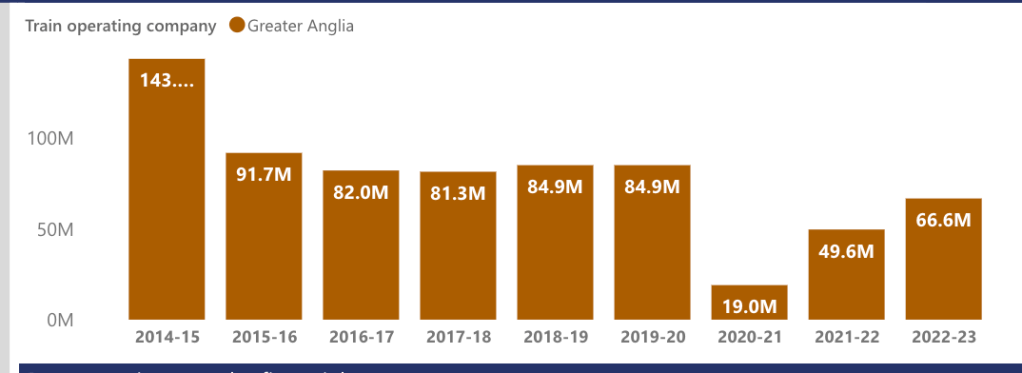
It’s still early days for the 2030-2050 Maldon District Local Development Plan, perhaps we shouldn’t expect too much detail right now, and no doubt there’s more work going on behind the scenes around it. We don’t have time to waste though if we want that greener future and all of this needs to be out in public view. There seems to be an underlying assumption that we can totally decarbonise transport simply by shifting to electric cars and using the already existing public transport services: the lightest green tinge to business as usual. If the next LDP looks like the current one it will be an abject failure that has failed to understand the scale, scope and impact of achieving net zero.

 Dengie Bioregion
[…] writing about the role public transport, particularly the railway, must play in planning local […]
LikeLike