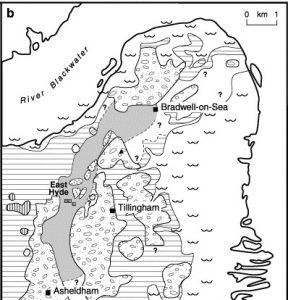
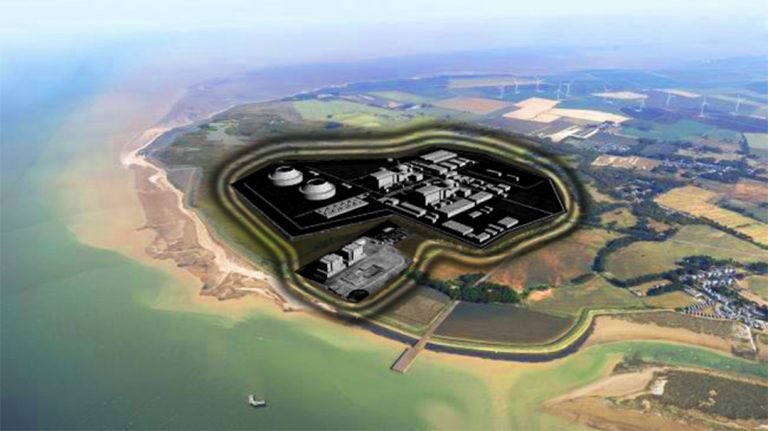
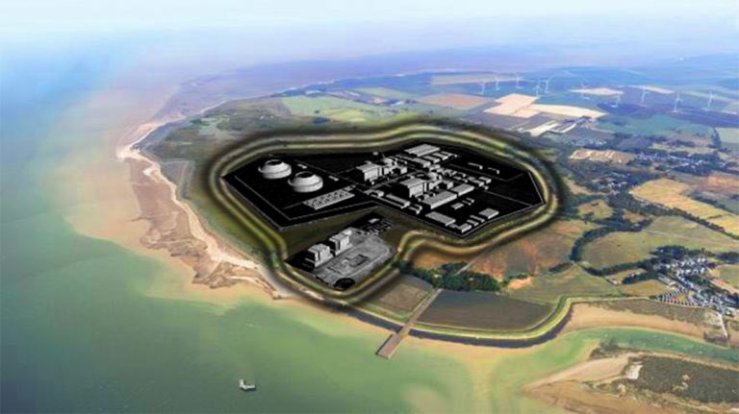
The Dengie BioRegion continues to be threatened by the prospect of a new nuclear power station at Bradwell-on-Sea, a massive industrial plant that would dwarf the concrete tombs of the original and decommissioned Bradwell power station.
Tomorrow (Wednesday 1st July 2020) at 23:59 is the deadline for responses to the sham consultation that the Bradwell B Group has persisted with during the coronavirus crisis and lockdown. I finally wrote and submitted my response, which follows, with some heavy cribbing of documents produced by the Blackwater Against New Nuclear Group (BANNG), Essex Wildlife Trust and Chelmsford City Council and posts in the BAN – Bradwell B Action Network Community Group on Facebook. Connect up with BANNG and BAN to keep in touch.
If you would also like to respond – do it now! Quick! Feel free to copy/adapt anything I’ve written here, and use the resources linked above.
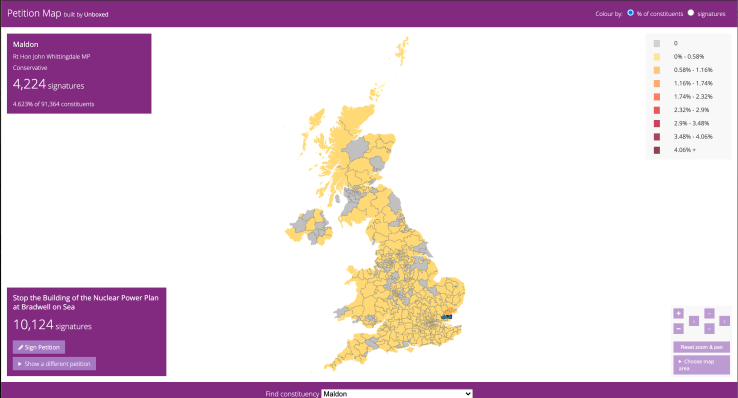
If you’ve not got enough time to do that, or the deadline has passed then there’s also currently a petition on the UK Government and Parliament site to ‘Stop the Building of the Nuclear Power Plant at Bradwell on Sea’. A tremendous recent effort has got the number of signatories over the 10k mark, which means that the Government will respond to the petition. Please add your name to increase the weight and push on towards the 100K where the petition will be considered for debate in Parliament.
Dear Sir or Madam,
I am writing in response to the Bradwell B Pre-Application Stage One Consultation.
I would like to begin by making it clear that I consider it highly inappropriate for you to have continued with this process during the national public health emergency associated with Covid-19. I recognise that you slightly extended the consultation period and made some effort to mitigate the cancellation of exhibitions and opportunities to speak face to face with representatives by providing a virtual alternative. I consider these mitigations to have been inadequate however and to have unfairly disadvantaged those without a computer, or confidence in using one. In any case, the nature of the unprecedented public health emergency has meant that the public’s attention has been, quite rightly, devoted to both ensuring their own, and their families, continuing protection from the disease, and to navigating the present and ongoing economic impact. Under these conditions, no public consultation on another issue can successfully reach all those potentially impacted by its contents nor can it, in good faith, contend that even those reached had the appropriate attention resources to critically consider the information made available, recognise where it was lacking and form a response in line with their understandings. Even those, like myself, who are determined to respond – lest our silence is considered consent – are writing under suboptimal circumstances.
The pause in the consultation which current conditions demand would have been a useful opportunity for the project to reflect on its premature nature. The consultation was scheduled before several important issues regarding a new nuclear site at Bradwell have even been considered and before any of them have been resolved. Step 4 of the Generic Design Assessment (GDA) will not be completed until, at the earliest, 2021. The UK Government’s Energy Review has not yet been published, so the national view on new nuclear post-2025 has not been established. Similarly, the revised National Policy
Statement (NPS) on Nuclear Energy is unresolved concerning the future suitability of the site at Bradwell and the failure to review the suite of energy national policy statements is currently subject to a legal challenge. Given this high degree of uncertainty regarding whether expensive, nuclear energy is necessary, given the increasing availability and lower costs of renewable sources of electricity generation, the determination to press ahead with this consultation at this time seems imprudent.
I understand that BRB intends to analyse and summarise the feedback received during this consultation and to detail it in a Consultation Report, a document which will be ‘submitted in support of its application for development consent’. I wish to make it clear that I do not support any such application for development consent. I am concerned that responses will be cherry-picked for those readable as offering support for such development consent. Therefore, in the interests of both transparency and openness, all the responses to the consultation which you receive should be published on the BRB website in full, so that the public can view and consider the totality of the feedback that is received, not a mediated selection or summary which might elide parts of that submitted in favour of those interpretable as ‘support’.
I must say that I found the consultation document itself a very curious means of genuinely determining public opinion. The early statement in the document that that ‘the principle of the need for new nuclear power stations and the choice of Bradwell as a potentially suitable site is a matter for Government policy and outside the scope of this consultation’ rather destroys the credibility of the process as one which might, in actuality, capture people’s views regarding the power station, or indeed ask about the issues of most importance to them. I’m afraid that I must conclude that the consultation is primarily a propaganda exercise to create a sense of inevitability regarding a new nuclear site being built. The scope of the consultation is so limited it amounts to little more than do you prefer Pepsi or Coke? do you prefer this new road over land we don’t own and don’t have planning permission to build on, to carry 700 highly-polluting construction vehicles a day to a new nuclear power station, or do you prefer this alternative new road over land we don’t own and don’t have planning permission to build on to carry the 700 highly-polluting construction vehicles a day to a new nuclear power station instead?
If this consultation is to actually serve the public, rather than the interests of a corporation that wishes to construct a new nuclear site regardless of local opinion, then I would expect the consultation to include questions seeking public views on:
• the massive, physical size of the project
• the on-site, long-term management of highly radioactive wastes
• the ecological, environmental and historical legacy of the site
• the impacts on the economy and wellbeing of the communities of the Bradwell area.
I suggest that you include open questions regarding these topics in the inevitable repeat of this consultation and to share the feedback and responses received. As I noted earlier, in these extreme and unprecedented times of public health and economic emergency it is difficult to find the time and attention to devote to a full response to the proposals outlined in the document, nor the broader implications of the proposed development. So, while my objections and concerns are not limited to those outlined in this response I will concentrate my remaining comments on the unsuitability of the proposed site.
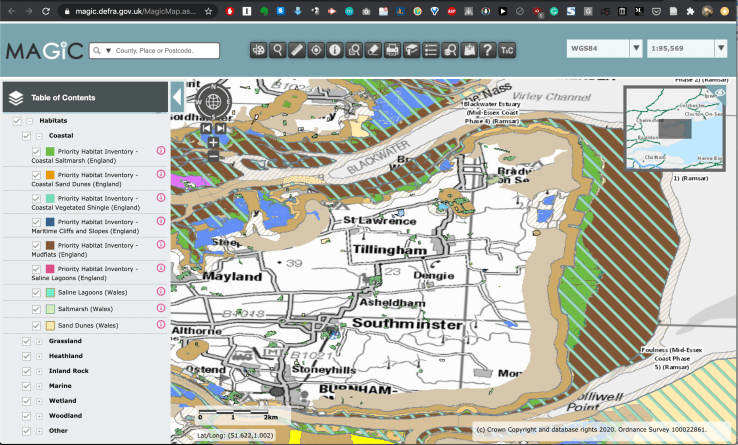
The proposed nuclear power station would be situated on one of the most highly designated ecological sites in the UK, at the heart of which is the Blackwater, Crouch, Roach & Colne Estuaries Marine Conservation Zone (MCZ). Construction and operation of the proposed site would negatively impact the Dengie nature reserve, a biological and geological Site of Special Scientific Interest which is also a National Nature Reserve, a Special Protection Area, holds several priority habitats, is a Nature Conservation Review site, a Geological Conservation Review site, an internationally recognised Ramsar site and part of the Essex estuaries Special Area of Conservation. Bradwell B would be a threat to internationally and nationally important wildlife species and to a number of critical habitats in Essex. The Essex Native Oyster Restoration Initiative (ENORI) and Natural England’s Recreation ReMEDIES project to restore fragile marine habitats and protect seagrass meadows in the River Blackwater would both be negatively impacted by the proposal. I understand that research, funded by BRB, is being undertaken by Essex University to consider the effects of the proposed nuclear power station’s cooling system on the native oyster and other wildlife. This research should be carefully monitored and peer-reviewed to ensure it is independent, with all results and outputs made freely available and widely accessible.
The Essex Wildlife Trust has noted that the ‘impact on our marine, coastal, and terrestrial habitats [of the proposed nuclear site] cannot be overstated’ and that ‘local ecology is internationally important and too fragile to suffer any degree of adverse effect.’ The construction of a massive new industrial site, over several years, in this rich and precious complex of ecosystems that includes salt marshes, reed beds, ancient grazing marshes and deciduous woodlands would inevitably adversely affect those ecosystems.
The Bradwell site is low-lying and vulnerable to sea-level rise, storm surges and other coastal processes that are likely to be accelerated by climate change. The proposed solution to adapt to the selection of such an inappropriate site is to raise up a massive platform several metres higher than sea-level. This would require the quarrying, transportation, deposition and grading of thousands of tonnes of material. This alone would be a radical shock to local ecology, from the subsoil to the skies – not only within the fragile habitats of the construction site but along a long chain from the hollowed places the foundations would be scooped from and along all the routes the fill would be transported, heavy vehicles expelling diesel fumes down rural roads and lanes. All to produce an atomic island raised above the surrounding land, destroying views enjoyed for millennia. An ugly plant for overpriced electricity, using the technology of a century that’s passed, profits leaking overseas to foreign investors. A brittle redoubt destined to hold a chamber of poisons no living thing can touch.
I appeal to you, to leave Bradwell be.

 Dengie Bioregion
Brilliant, James Taylor. LOVE what you are doing. Have you read Robert MacFarlane’s “The Wild Places? Chapter 13 Saltmarsh
LikeLike
Thanks Karen. I have read The Wild Places, I’m a fan of MacFarlane’s work!
LikeLike
A stunning commentary …
LikeLike
Reblogged this on and commented:
You have to wonder at the thought processes leading to thinking the siting of a massive new nuclear power plant on – a) land that is becoming more vulnerable to flooding from rising sea levels and b) is of massive ecological importance – is in any way, a sound idea. It patently is NOT a sound idea in any way, shape or form!
LikeLike