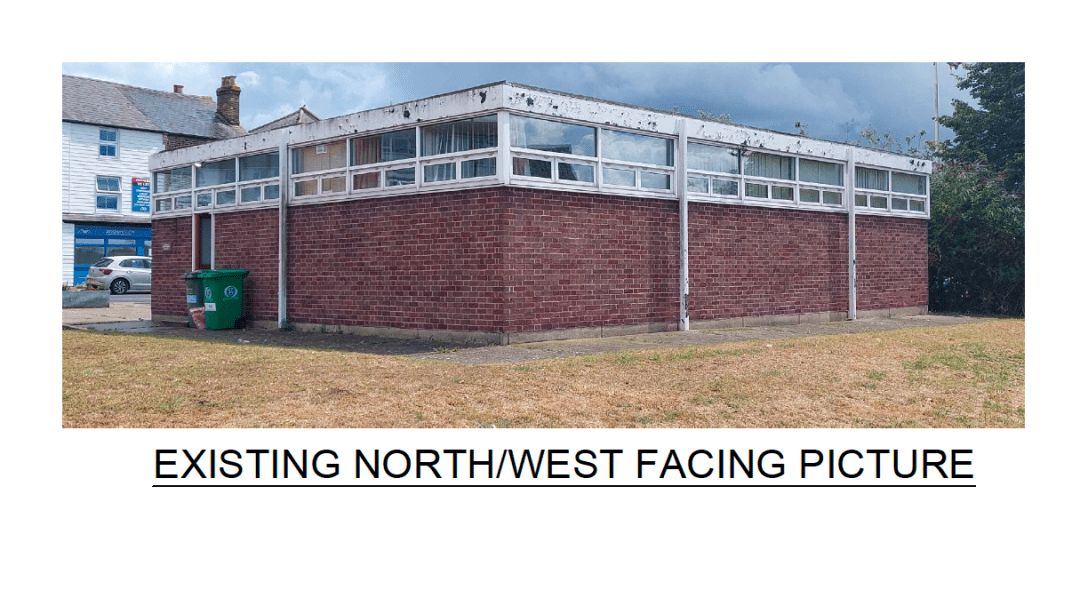
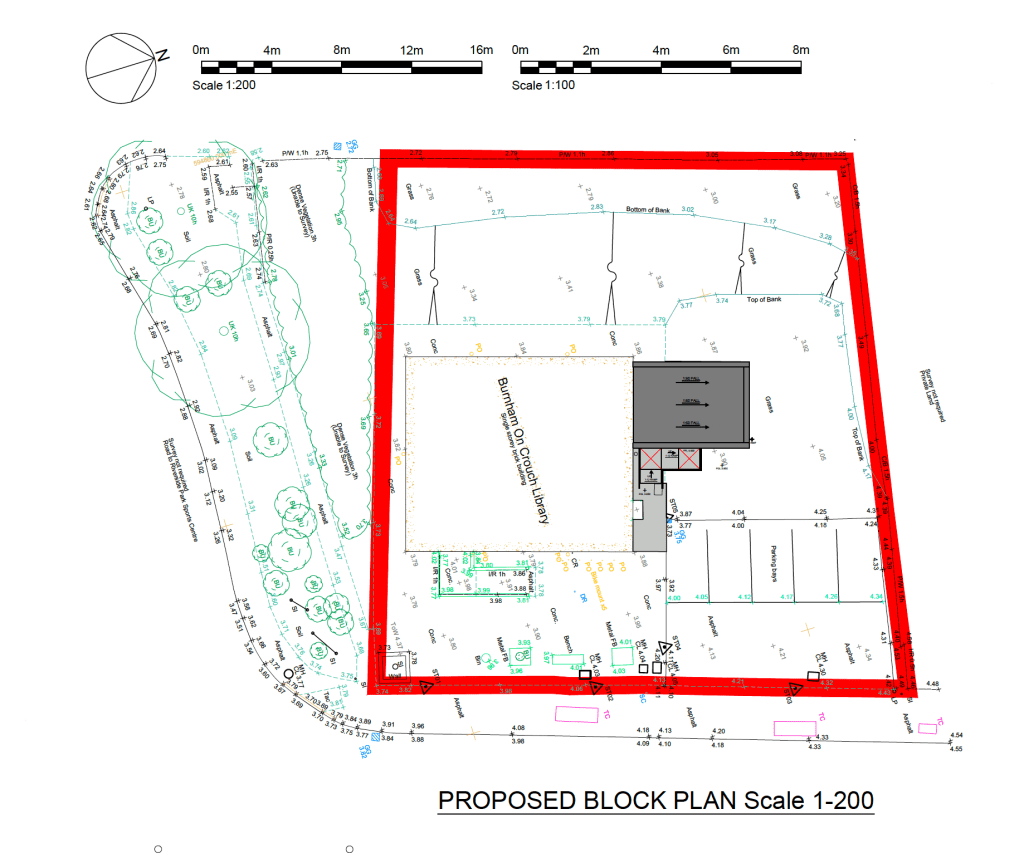
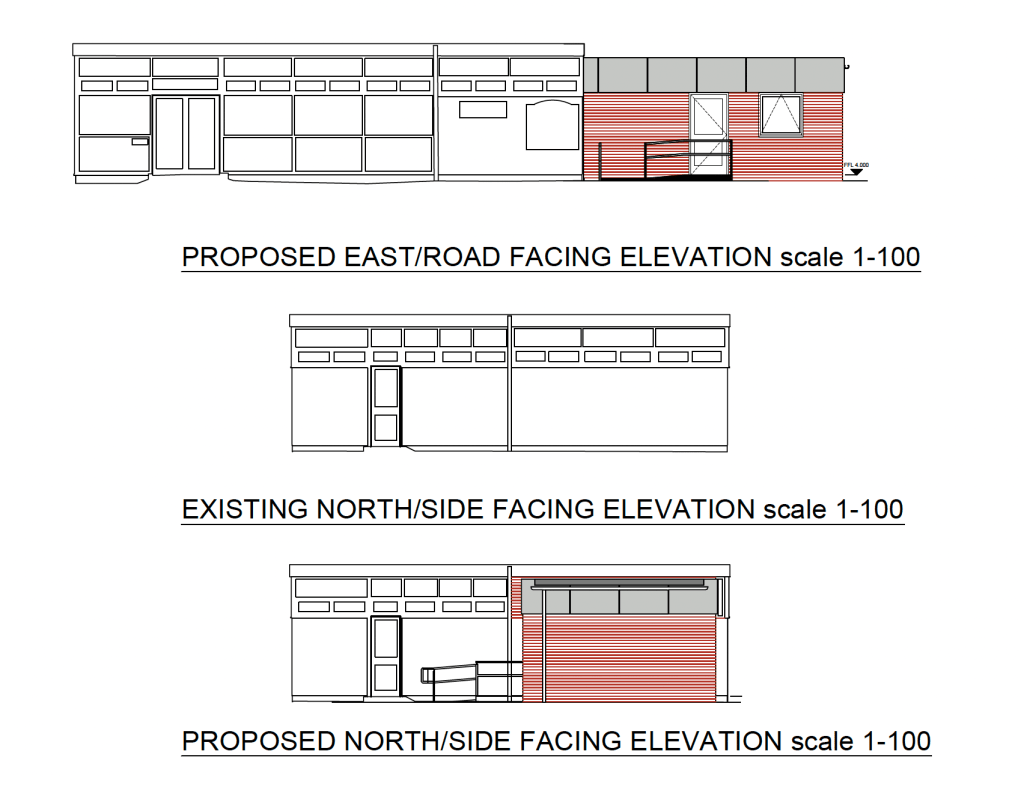
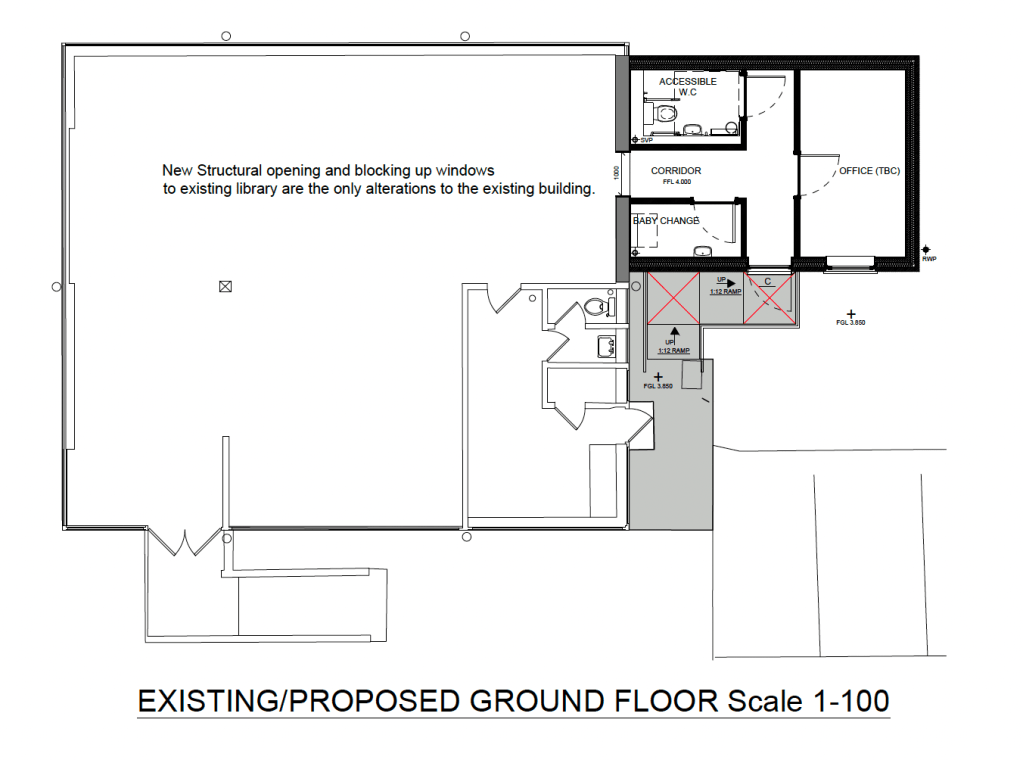
The planned extension to the Burnham Library building is interesting. The planning documents reveal it will house a Family Hub Delivery site, relocating the existing Family service from a temporary building at Ormiston Rivers Academy to this central location. This is all to be applauded. The service deserves a permanent home and facilities. Co-locating it with the library has benefits, and places it closer to public transport links.
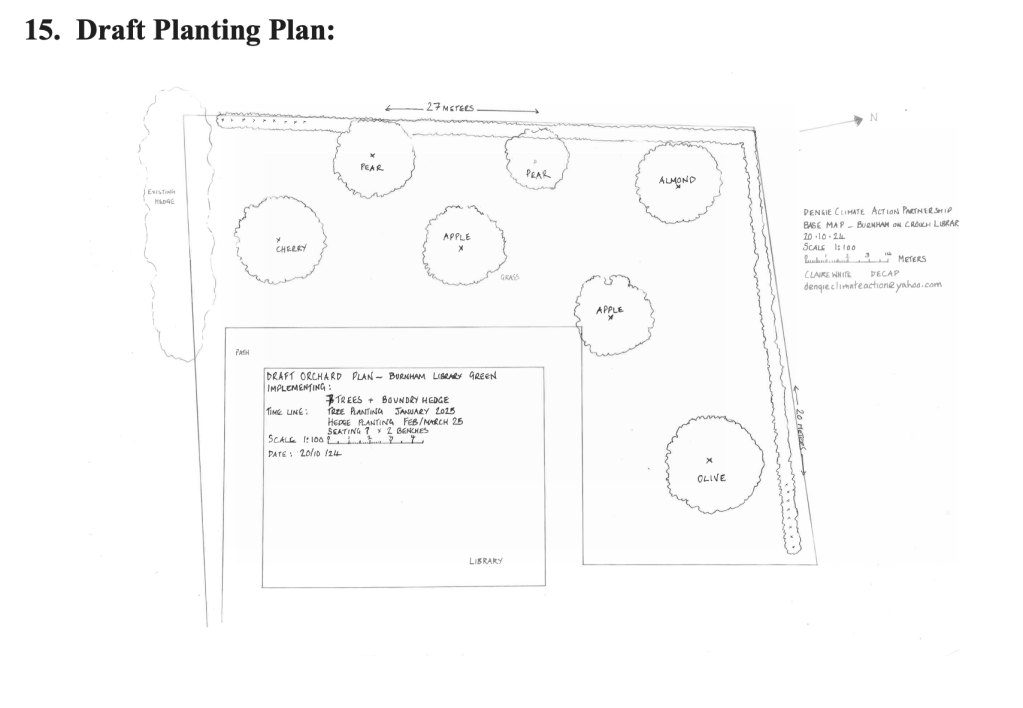
This extension may explain why Essex Libraries turned down the Dengie Climate Action Partnership proposal for a wildlife-friendly community orchard on the Library gardens. Essex Libraries were initially enthusiastic and encouraging about our proposal but suddenly went cold. We could, and would have, worked around this extension of course – and still could!
The planning application states the proposal is exempt from Biodiversity Net Gain requirements and will have minimal impact on existing habitats. However, if Essex County Council were seriously considering their own Essex Local Nature Recovery strategy, they should have taken advantage of this opportunity to enhance biodiversity on-site. This could have helped it reach the LNRS priority to create 3,100 hectares of new habitats in urban areas in Essex. It’s hard to see how ECC will motivate the public and private developers to engage with nature recovery if it does the bare minimum for biodiversity (nothing) on sites it develops itself.
The proposed extension, meanwhile, is surprisingly modest and a missed opportunity to make an extension and improvements to the library itself. A tool and toy library perhaps, a co-working space, a makerspace, solar PV, a heat pump – things that would improve facilities for the public and/or decrease the running costs of the building.
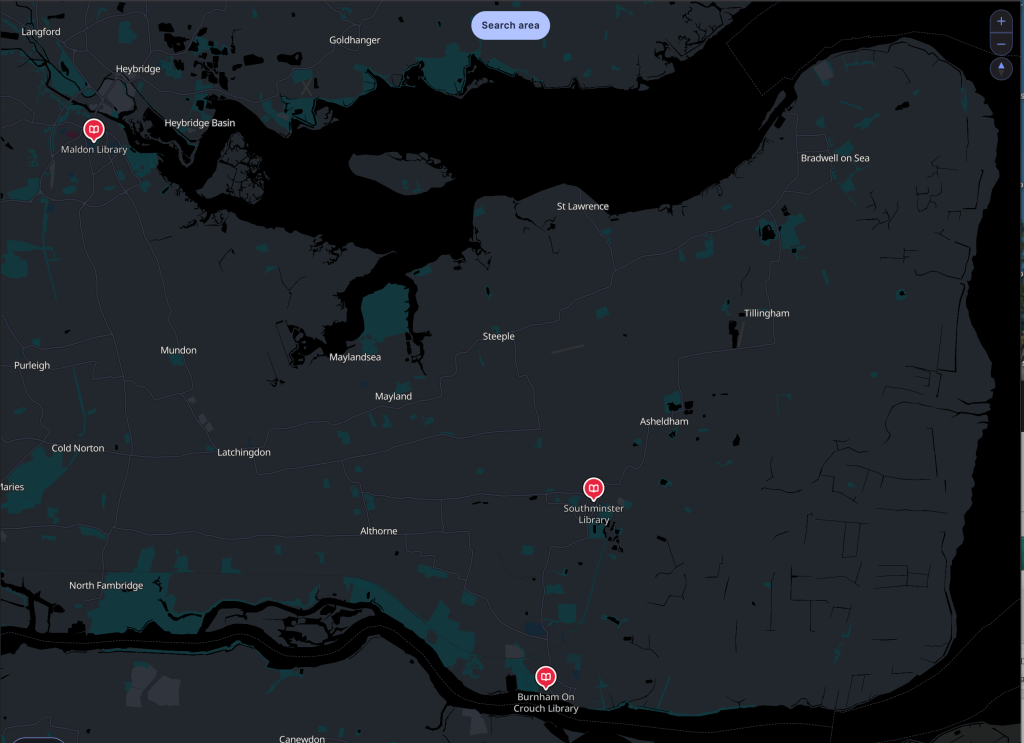
At the end of the day though it’s Burnham Library’s opening hours that are most shocking to me. It’s only open one weekday morning for example. It’s more likely to be closed than not. Getting the library open on a decent schedule should be the priority. It’s one of only two libraries on the Dengie and the other, at Southminster, is even more diminished. The public library offers an excellent model for lower impact living and should be celebrated, well-funded and enhanced.
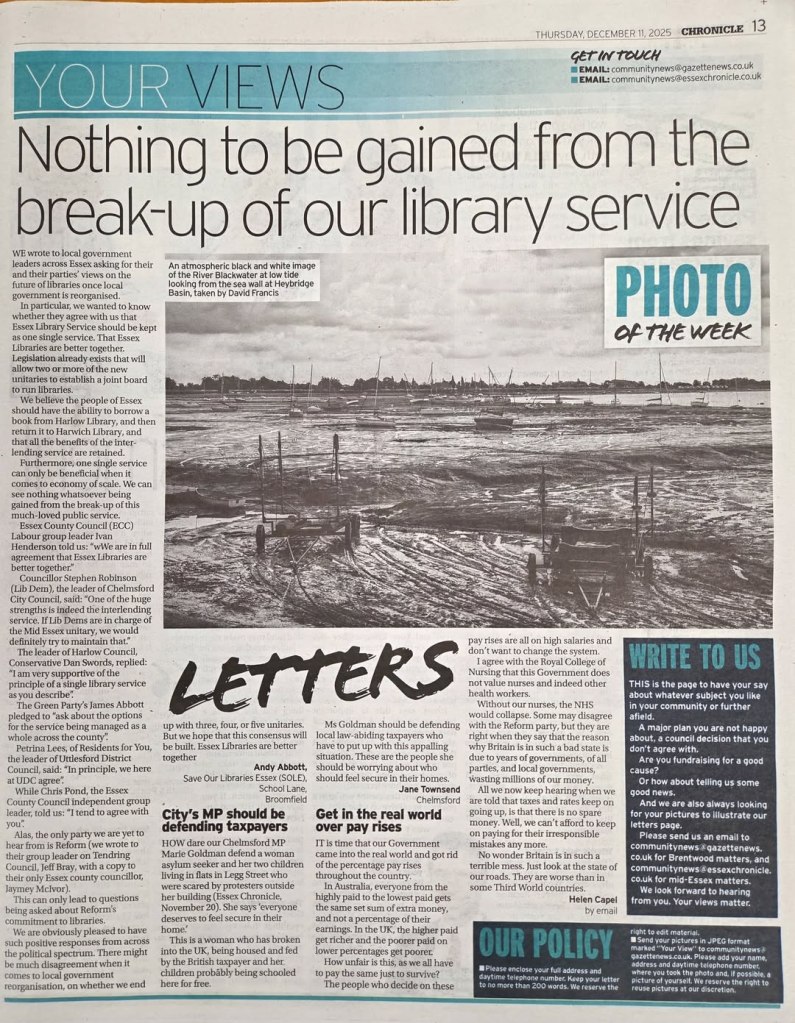
But with the fate of Essex Libraries uncertain in the face of the forthcoming Essex Mayoralty and Local Government Reorganisation (nobody knows where responsibility for library provision will end up!) the future of all our libraries is ambiguous and confused. #essexlibrariesbettertogether https://www.facebook.com/SaveOurLibrariesEssex/
These are not the sort of issues that planning authorities have much say in, but you might want to express any feelings you have at https://planning.essex.gov.uk/ where you’ll find all the planning documents and can reply to the consultation (ends 3rd February). This is application number CC/MAL/91/25.
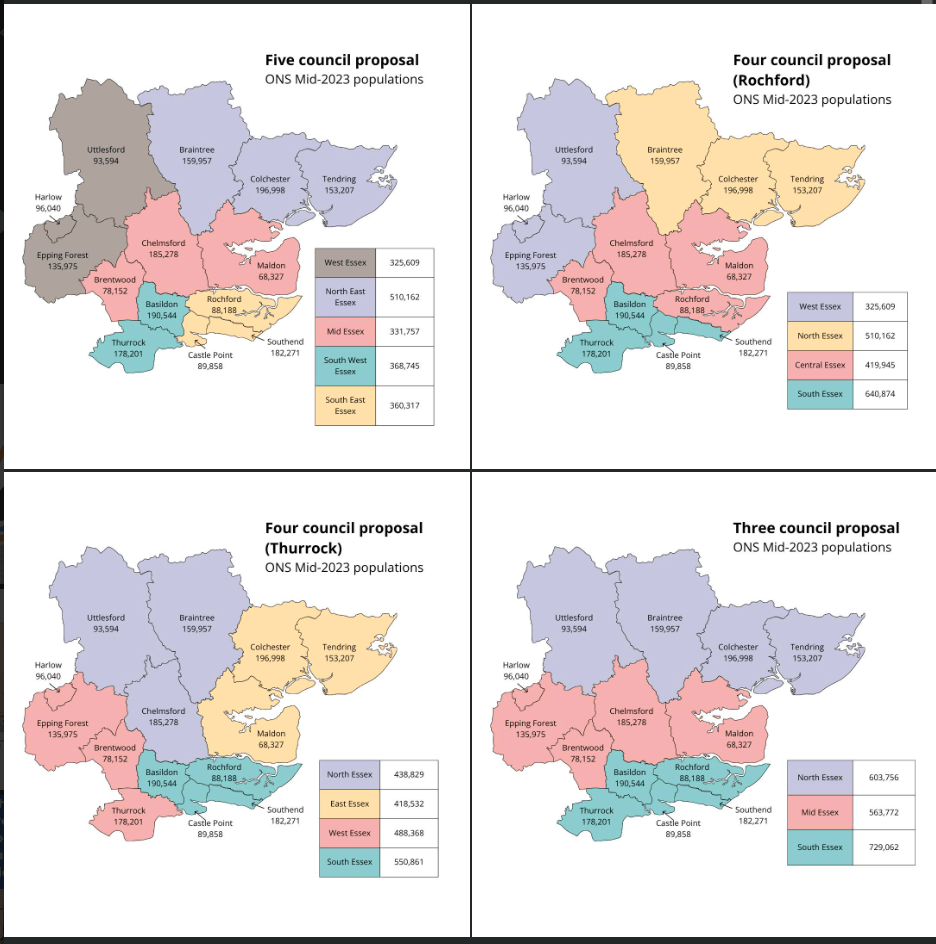
By national government edict the 15 councils in ‘Greater Essex’ must reorganise to form new unitary authorities through a process of Local Government Reorganisation. This will change the current two-level council system into one in which there are new, bigger councils called unitary councils.
I’ve been reviewing the four competing proposals submitted by existing councils as to how that reorganisation should take shape. (They’re all published here). They divide Essex into 3,4 or 5 new unitary authorities:
*Three unitary council proposal [3] *Four unitary council proposal (led by Thurrock) [4T] *Four unitary council proposal (led by Rochford) [4R] *Five unitary council proposal [5]
(in square brackets I’ve added a number used in the figures below)
There are several hundred pages to go through here (874 pages to be precise), so I’ve done a bit of barefoot textual analysis as a first attempt to see what they have to say about the climate and nature emergencies.
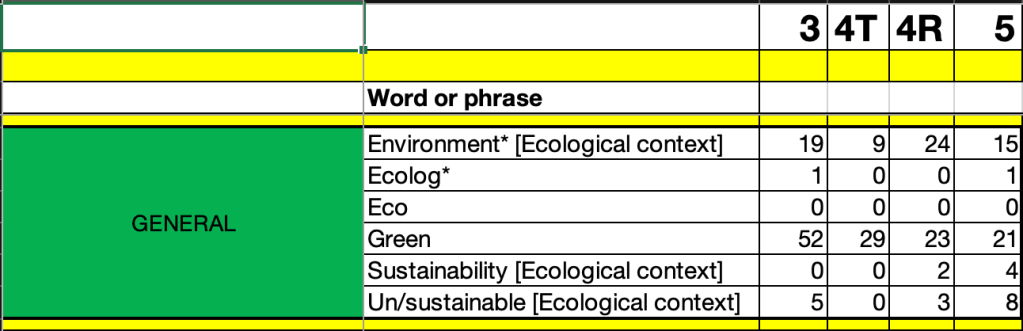
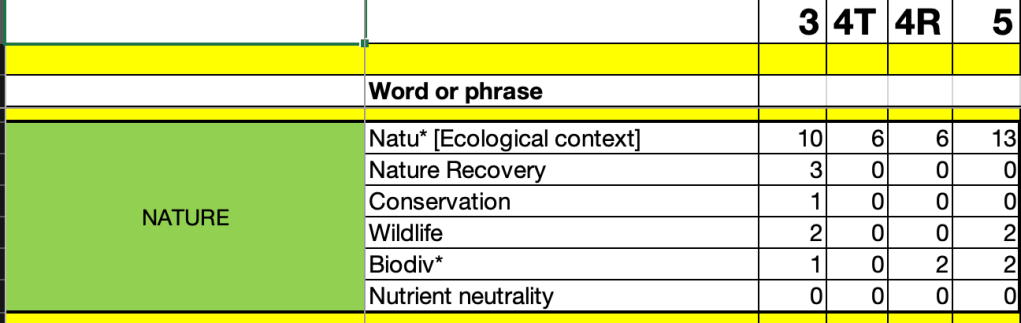
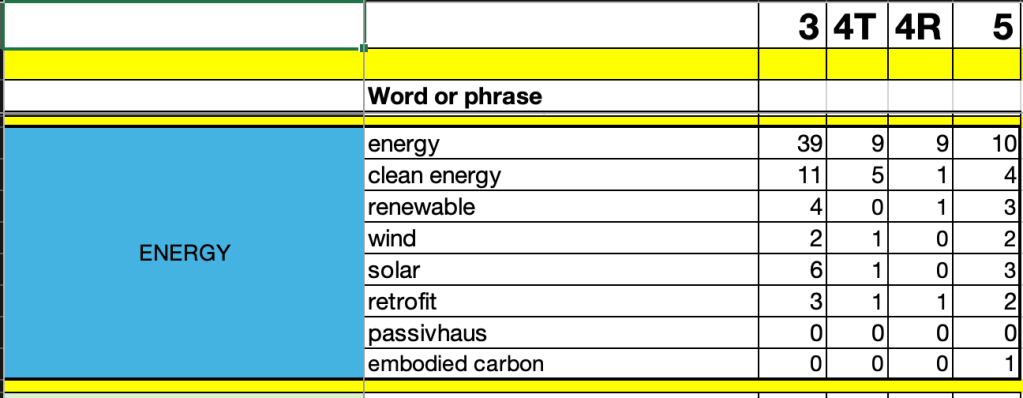
My quick and dirty approach was to quantify how many times some key words and phrases related to these issues appear in the respective documents. I chose words to search for that are either words ordinary people might use or they are part of the common lexicon used by governments, NGOs and the climate movement. I began with general terms.
It’s pretty clear that the old favourite ‘sustainability’ is out of favour. That word and sustainable or unsustainable feature often across the documents – 502 times in fact – but very rarely in an ecological context. Only 22 instances of the words relate to ecological sustainability or bear any relationship to the famous definition of “sustainable development” in Our Common Future: ‘Development that meets the needs of the present without compromising the ability of future generations to meet their own needs.’ The words are used primarily as part of the phrase ‘financial sustainability’.
Words derived from the root ecology – ecology itself, ecological, ecologist etc, are almost entirely absent, appearing once each in two of the documents. The contraction ‘eco’ does not appear at all,
The favoured words are clearly ‘environment/al’ and ‘green’ which feature much more often – and to be fair are terms that ordinary people will commonly use. It’s probably worth noting that 45.6% of the times that the word ‘green’ appears in an ecological context it is within the phrase ‘green belt’ (68.6% in the Three unitary council proposal and 65.2% in the Four unitary council proposal (led by Rochford))
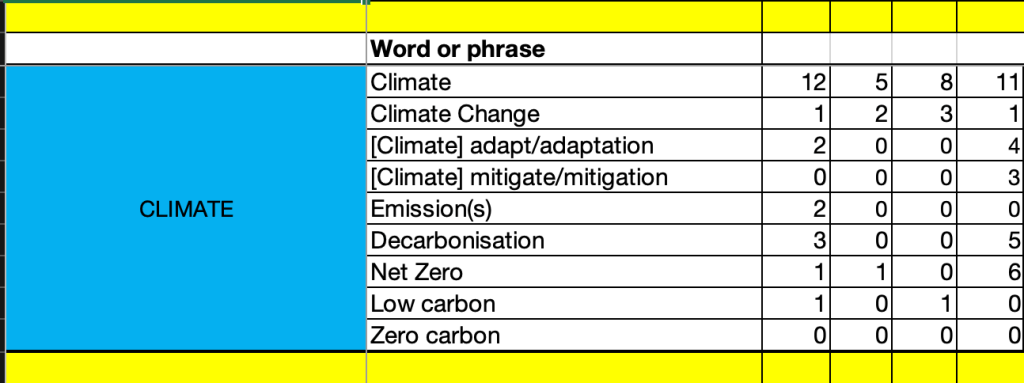
Turning to the climate emergency declared by the UK parliament in May 2019, I looked for where these documents referred to the climate and the national legal commitment to decarbonising all sectors of the UK economy to meet our net zero target by 2050. The phrase ‘climate change’ appears only 7 times across all four documents, ‘net zero’ appears 8 times (and is completely absent from the Four unitary council proposal (led by Rochford)). Decarbonisation also appears 8 times but is completely absent from both the Four unitary council proposal (led by Thurrock) and the Four unitary council proposal (led by Rochford). The word ’emission/s’ appears twice in the Three unitary council proposal but nowhere else. ‘Low carbon’ appears once a piece in the Three unitary council proposal and the Four unitary council proposal (led by Rochford) but not at all in the other two. ‘Zero carbon’ appears in none of them.
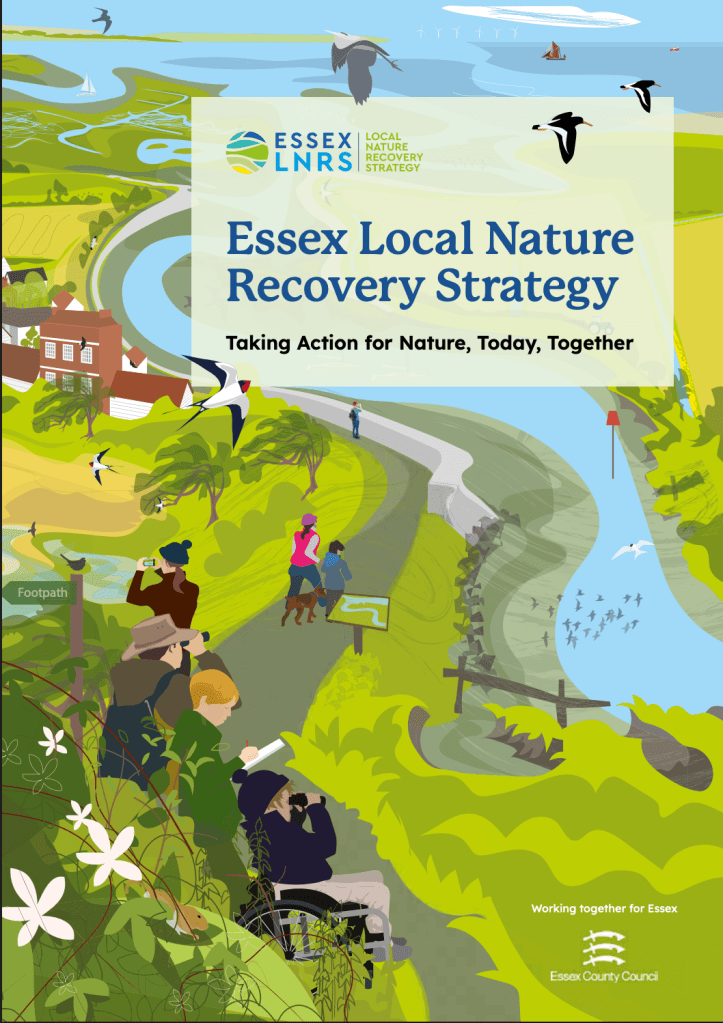
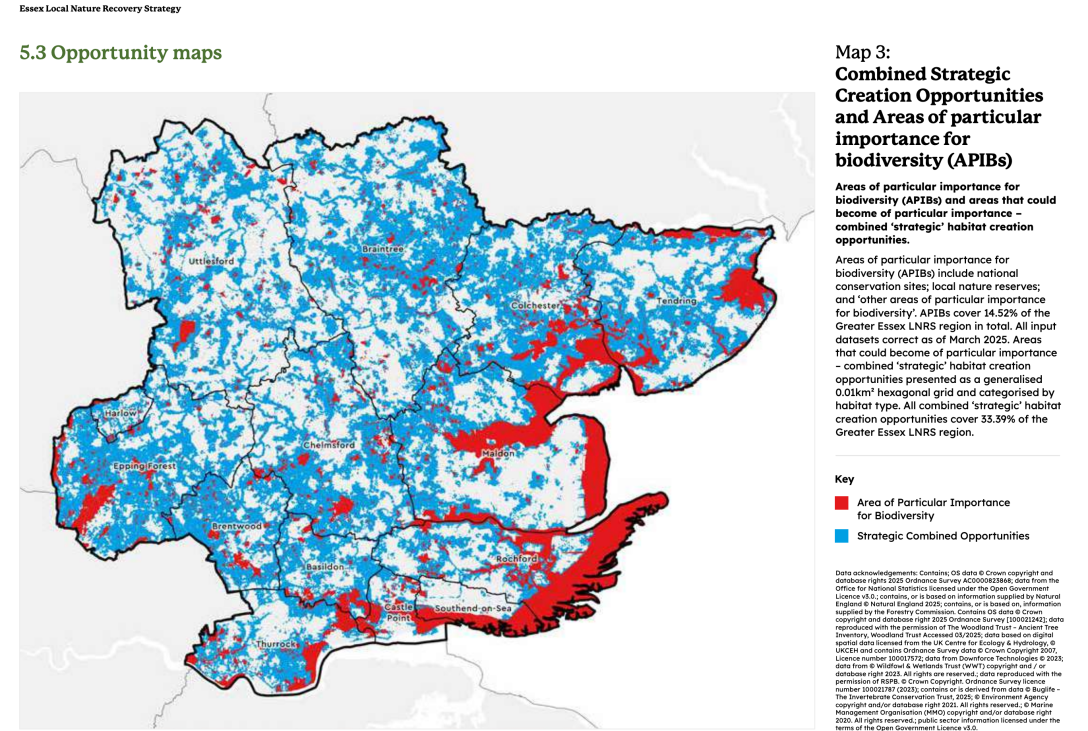
What then of the ecological emergency? England is ‘widely considered to be one of the most nature-depleted countries in the world following historic and ongoing declines. Government has made legally-binding commitments to end these declines and for nature to recover‘. Essex County Council is one of the responsible authorities delegated to prepare a Local Nature Recovery Strategy [LNRS] designed to: deliver the necessary action to reverse the current path of decline in our biodiversity; and, bring about a recovery for nature. Essex published its LNRS in July this year.
The phrase ‘nature recovery’ only appears in the Three unitary council proposal. This proposal was made by Essex County Council and the absence of ‘nature recovery’ in all the others perhaps indicates a failure to fully engage the other authorities in the county with this task.
Despite the new planning mandates for ‘biodiversity net gain’, the words biodiversity or biodiverse barely appear. The commonly recognisable terms ‘conservation’ and ‘wildlife’ are fewer and far between.
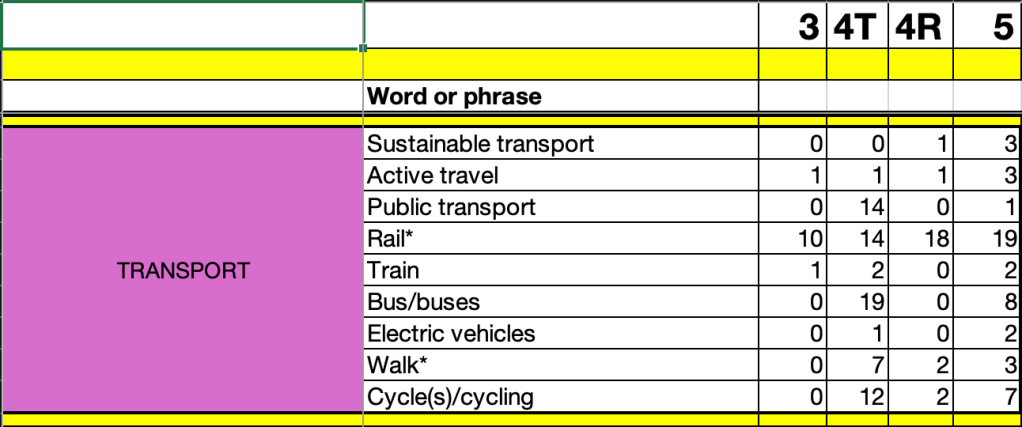
Domestic transport is the largest source of emissions in the UK, accounting for 29.1% of greenhouse gas emissions in 2023. The largest source of emissions from UK transport is road vehicles, which includes passenger cars and freight vehicles using petrol and diesel. Addressing this is key to a lower carbon future and one of the reasons I’m trying to rECOnnect Dengie. What do these proposals have to say about sustainable transport? Two of them don’t use the phrase.
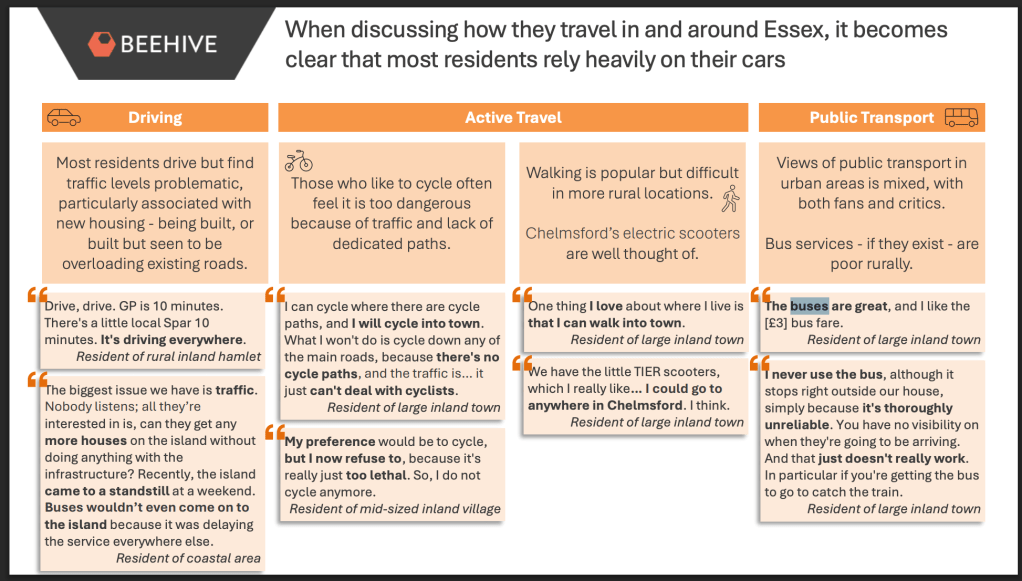
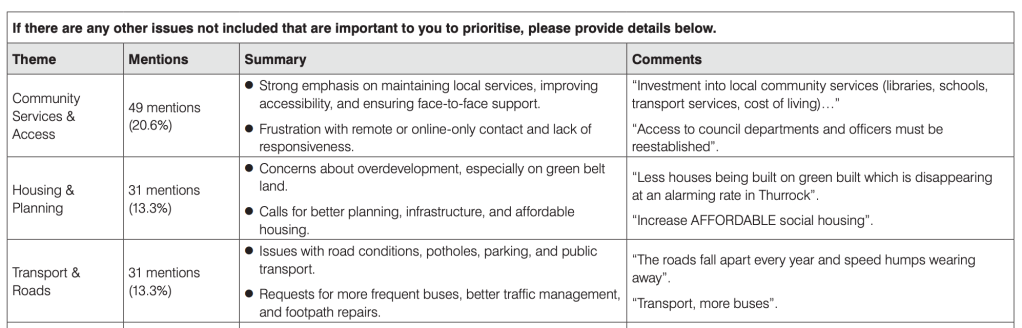
‘Public transport’, ‘bus/buses’, and ‘electric’ [vehicles], are all missing from the Three unitary council proposal and the Four unitary council proposal (led by Rochford). The Three unitary council proposal is particularly lacking in this area with no mentions of ‘sustainable transport’, ‘public transport’, ‘bus/buses’, ‘electric vehicles’, ‘walk/walking/walker(s)’ or of ‘cycle(s)/cycling’. The amount of attention apparently given to this area by the the Four unitary council proposal (led by Rochford) is also deceptive as many of these words appear primarily in summaries of public responses to surveys saying what they would like rather than any clear strategy to deliver them (see slides below).
A couple of slides from the Four unitary council proposal (led by Rochford) with the public’s transport issues
On the topic of clean/renewable energy there’s a bit more attention, but still surprisingly little on some of the keys areas in which we need to act to reduce carbon emissions.
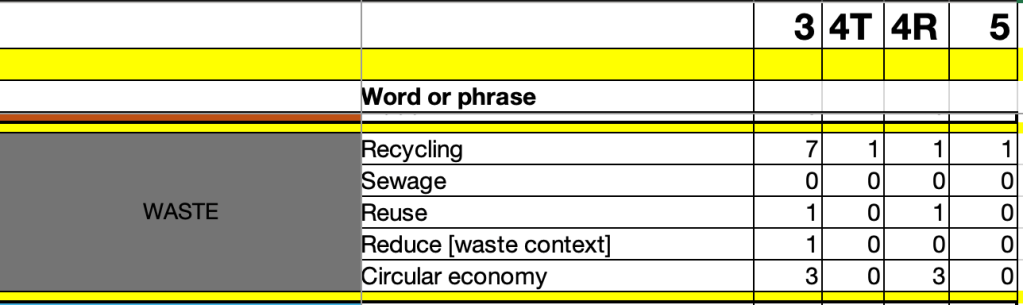
Concerning waste there’s very little, especially in the key areas of reduction and reuse. It’s good to see some nods to the ‘circular economy’ but the county still seems to be celebrating ending landfill by burning rubbish rather than anything more transformative. Despite the massive public outcry against shit in the river and the pollution of our watercourses, none of the proposals dare say ‘sewage’.
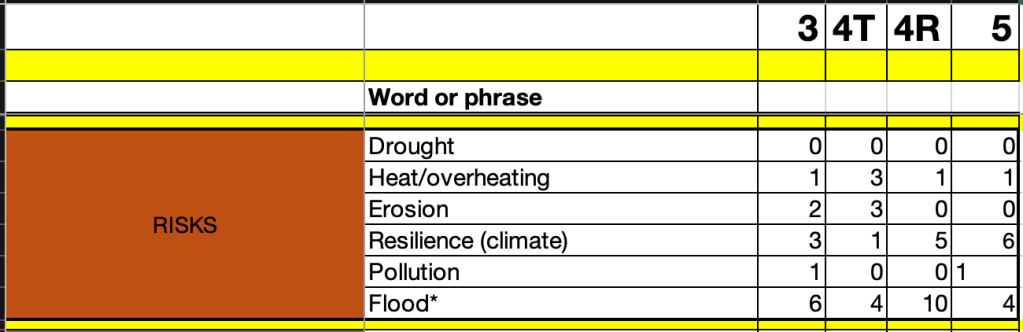
The less we mitigate climate change, the more risks we will face and the greater adaptation we will need to make. There’s not much about this in these forward looking documents and some risks get more attention than others.
As I said at the start this is a quick and dirty analysis – adding up the numbers here won’t tell you which proposal is best – you still need to read the documents and work that out for yourself. More of these words appear in the Three unitary council proposal (279) than any other, the fewest appear in the Four unitary council proposal (led by Thurrock) (189) – but more isn’t necessarily better. A lot of good words have been written in various documents over the years – but what matters is what actually happens not the words.
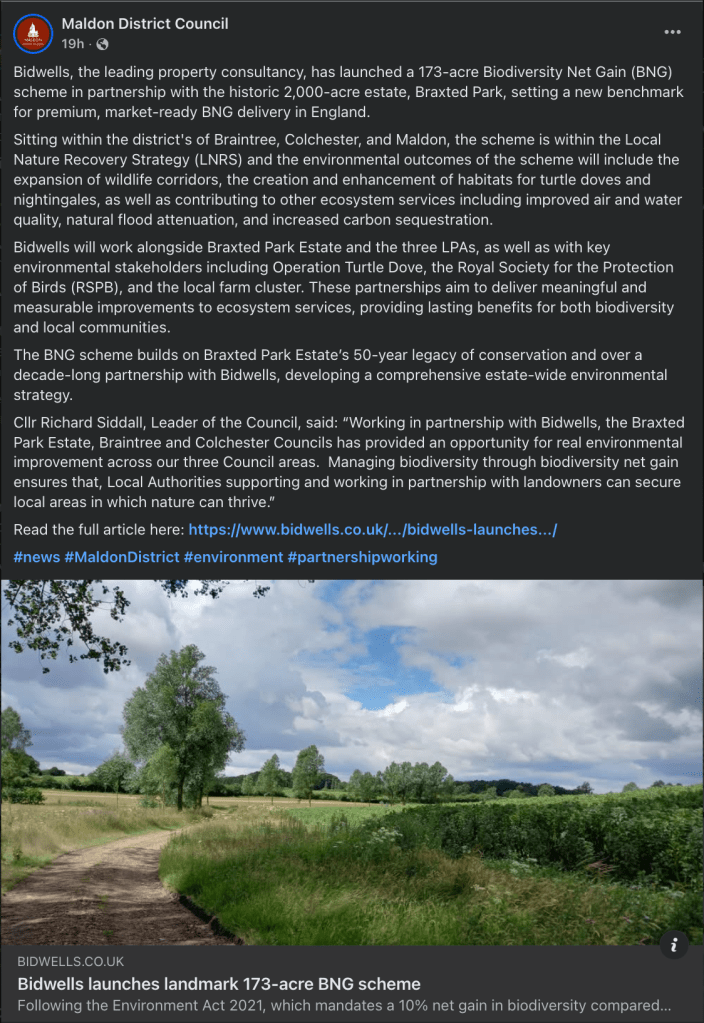
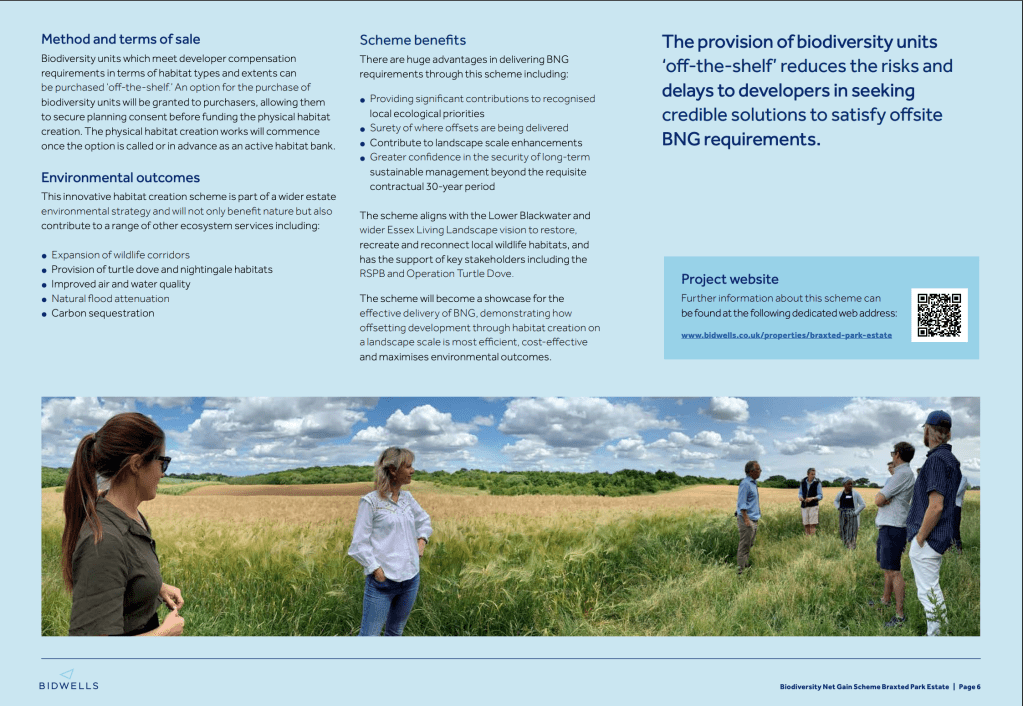
Yesterday, Maldon District Council (MDC) shared on social media that they would be working in partnership with a property consultancy company that has launched a Biodiversity Net Gain (BNG) scheme with the Braxted Park estate.
The post and linked article are light on detail, and there’s nothing about it on the MDC website, but this looks like MDC shaping up to allow developers to meet their ‘increase biodiversity’ requirements by paying someone else to do the nature recovery off-site.
Local District Councillor Wendy Stamp informs me that this scheme has not been discussed by Councillors and is seeking further detail.
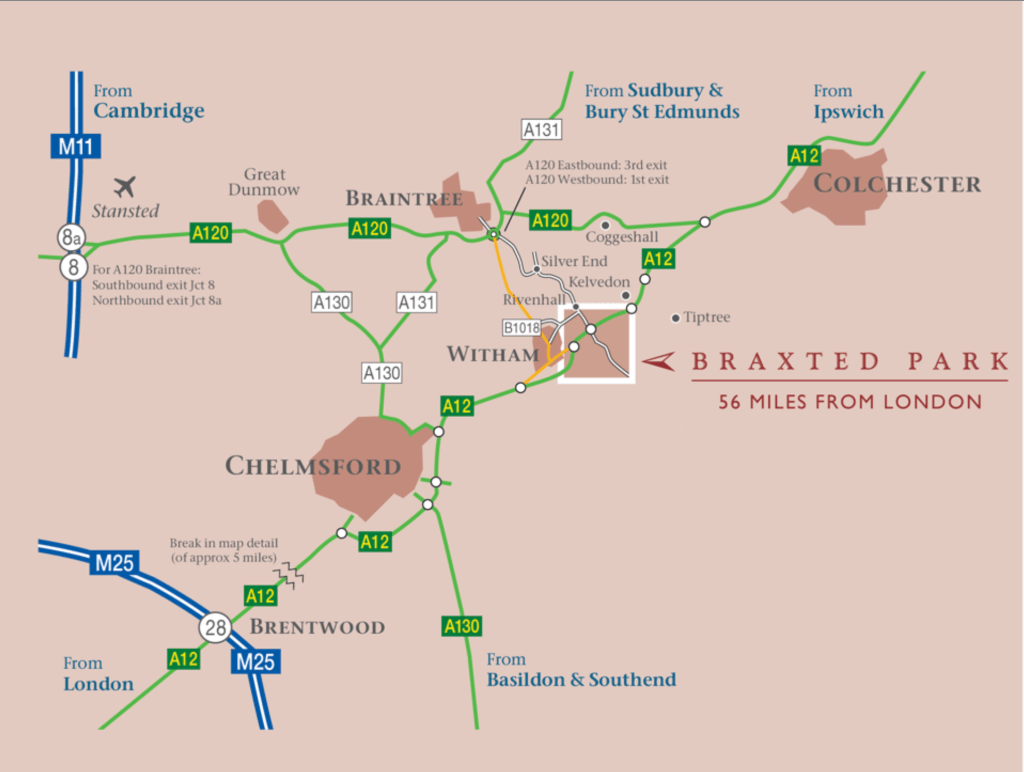
Map on the Braxted Park website illustrating that it is ‘well connected’ shows no connection to locations in Maldon District
I can see some advantages in consolidating nature recovery activities in the best sited locations and that working at a landscape scale can have environmental outcomes not available to smaller sites
but…
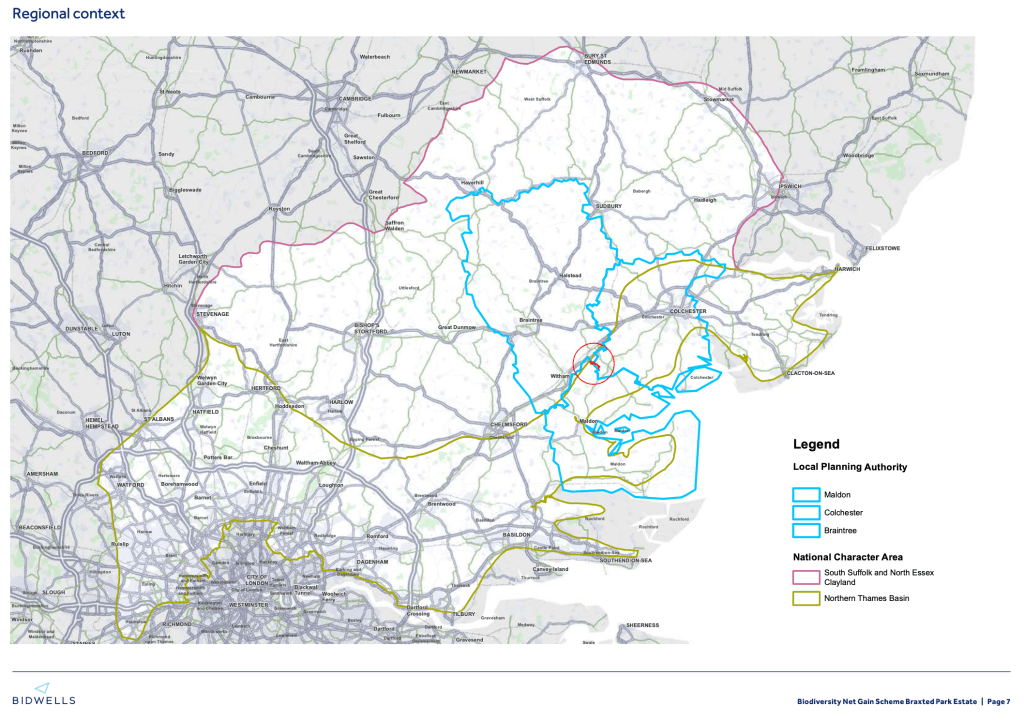
Braxted Park is barely in Maldon district (it’s on the North-west border with Braintree District, near to Witham) and it’s a long way from the Dengie peninsula. (It’s over 20km as the turtle dove flies from Braxted Park to the proposed Romans Farm development in Burnham on Crouch for example) It’s hard to see how the environmental outcomes of the scheme will improve nature recovery out here.
We must demand that nature recovery schemes happen locally to us, no biodiversity offsetting in distant locations!
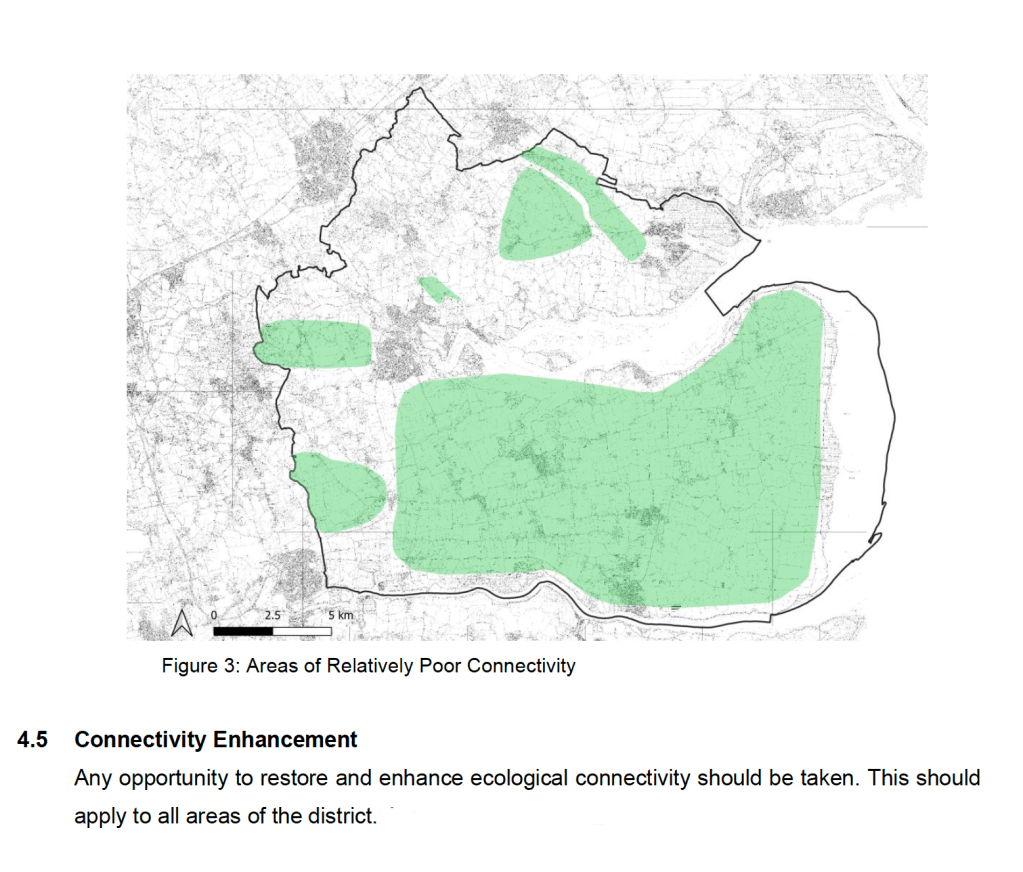
The Maldon Nature Conservation Study (February 2023) produced by Essex Ecology Services (EECOS) for MDC spoke of the importance of wildlife corridors in the district and stated that ‘[t]he taking of measures to enhance connectivity would be worthwhile anywhere in the district… Certain areas suggest themselves as potential priority targets… Any part of the Dengie peninsula‘
Map from the ‘Maldon Nature Conservation Study 2022′ (February 2023) [pdf]
The whole peninsula was mentioned because the Study notes that ‘[t]he Dengie peninsula has few [local wildlife] sites and many of these are isolated in a landscape dominated by intensively managed farmland, with few areas of natural or semi-natural habitats aside from the coast’
It notes that ‘[t]he woodlands of Maldon are heavily concentrated in the north west of the district [where Braxted Park is located] and are virtually absent to the east of Northey Island, both north and south of the Blackwater estuary. The Dengie peninsula, in particular, is virtually devoid of woodland.’
Elsewhere in the document the Dengie is described as an ‘impoverished landscape dominated by large arable fields with few hedgerows’ and that ‘[t]he planting of new hedges and appropriate management of these features would be of great benefit to wildlife, including breeding birds, and any measures that can be taken to encourage this should be considered. The establishment of a well-connected network of hedgerows would represent a major landscape-scale enhancement.’
MDC knows where, and what, nature recovery interventions on the Dengie would be effective because the Study they commissioned informs them.
This new scheme looks like a way for developers to avoid caring for and improving the natural world where they build by just paying a fee for someone else, to do something, somewhere else.
It should not be ignored that replacing an intensively managed, chemically dosed, arable monoculture field in our ‘impoverished landscape’ with houses and gardens will in itself create new niches for wildlife. Housing developments don’t in themselves, however, create a well-connected network of hedgerows, they don’t establish new woodlands, areas of natural or semi-natural habitats, or wildlife corridors between existing sites of biodiversity. Construction of these developments too often begins with violently making their site a tabula rasa, removing mature trees, bushes and hedgerows, blocking access to fauna, filling in scrapes, stripping topsoil, compressing the earth. It concludes with establishing neat show homes, where the ‘messiness’ of the wild is manicured away – no care to share the territory with what came before – no hedgehog holes or bee bricks, no bird and bat boxes, no quarter given to burrowing badgers and foxes, insects starved of fodder. In the amenity spaces, sapling trees are planted and then neglected to dry out and die. A councillor once told me that developers are generally contracted to support these trees for 5 years, but that it’s cheaper for them to replace those that die at the end of their period of responsibility than to maintain them for the intervening period. Any survey of the new estates in Burnham swiftly finds the desiccated evidence
BNG seemed to me from the get-go to be ‘biodiversity off-setting’ in the disgraced mode of carbon off-setting before it. So, it comes as no surprise that we are immediately seeing nature commodified and traded by third-party intermediaries.
When a developer grubs out a 300 year old oak tree near me, and the squirrels who ate the flowers disappear, the moths that relied on it don’t return, the oak-mining bee loses its pollen, the badger and wood mouse find no acorns, the jay has nothing to bury, and the caterpillar doesn’t come that the blue tit might consume, when the bat doesn’t roost, the fungus doesn’t feed, the lichen don’t spot the bark, the mushroom doesn’t fruit from its subterranean romance with roots – then I guess I can take solace in the knowledge that a seven hour walk from where I live, on the country estate of a retired banker, that an ‘off-the-shelf’ purchase by the developer will have financially contributed to the ‘creation of high-quality biodiverse habitats targeting ‘good’ condition as defined by the DEFRA Statutory Metric’. Call me a romantic if you will, but I prefer stewardship to the spreadsheet.
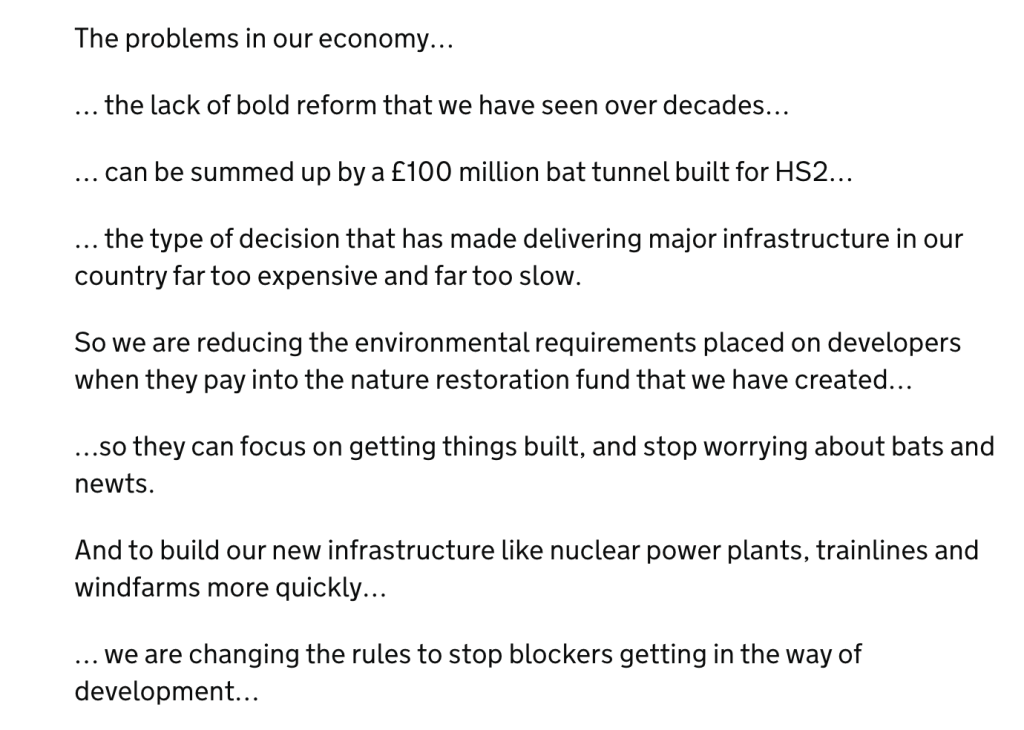
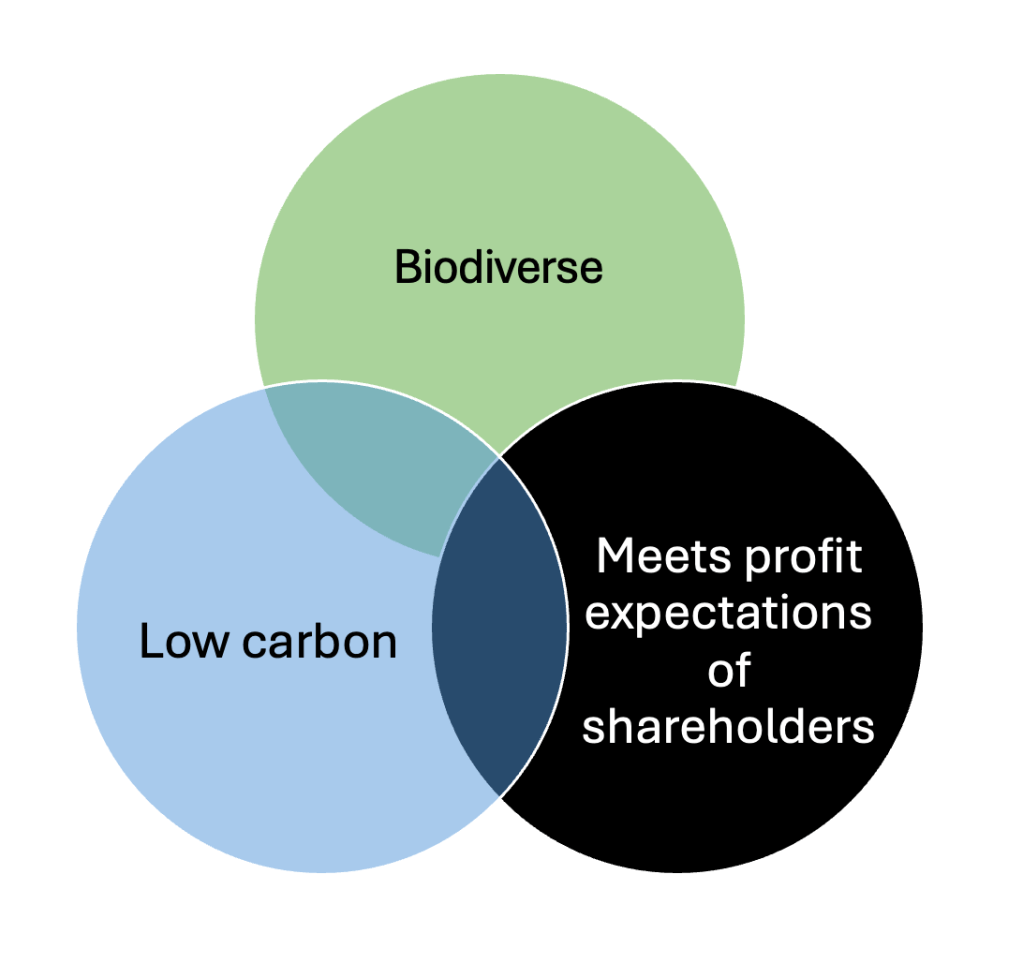
An ‘abundance’ YIMBYism is on the rise, an attitude on both the left and right of politics, and on both side of the Atlantic, that the future has been cancelled out of a gratuitous consideration for ‘bats and newts’, that we must just BUILD. Increasingly often this comes with a sanctimonious sneer that pits mitigating climate change against nature conservation “we could accelerate the construction of renewable energy infrastructure and energy efficient homes if you would just leave it out with bat tunnels and newt-counting delays”.
But why can’t we have both things? Because there’s a missing third part of this iron triangle
The great shapers of places in the UK, of our land and homes, are six volume housebuilders (Barratt/Redrow, Vistry, Taylor Wimpey, Bellway, Berkeley Group, Persimmon) and they are driven by profit, excessive profit. A 2023 report from the UK Collaborative Centre for Housing Evidence, Why have the volume housebuilders’ been so profitable? notes that
‘Since 2014, the largest housebuilders, and in particular the three largest housebuilders by volume (Taylor Wimpey, Barratt and Persimmon – herein, the ‘big three’) have consistently reported supernormal levels of profitability, with gross profit margins reaching 32% and never falling below 17%’
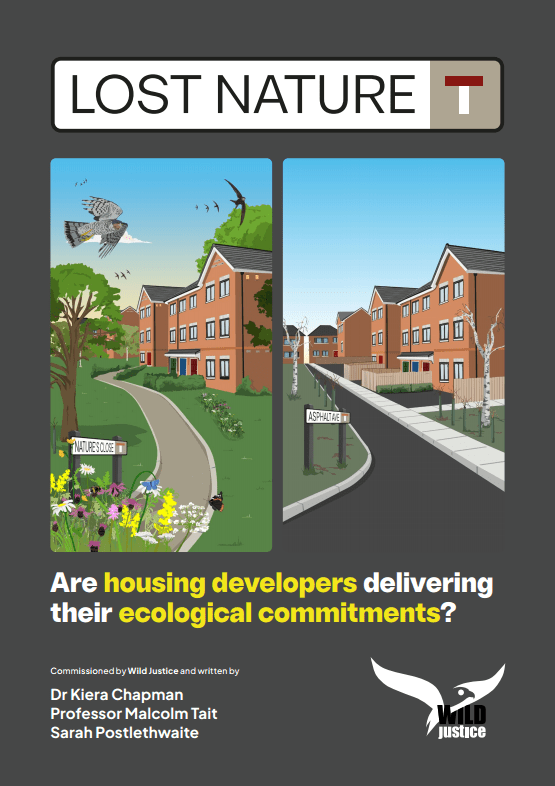
So, obviously, these companies are not interested in the business of stewardship, of long-term commitments to places, or indeed any commitments past the point when contracts are exchanged. A survey by University of Sheffield academics for the wildlife campaigning group Wild Justice discovered that nearly half of the nature-friendly enhancements promised by developers building new homes have failed to materialise.
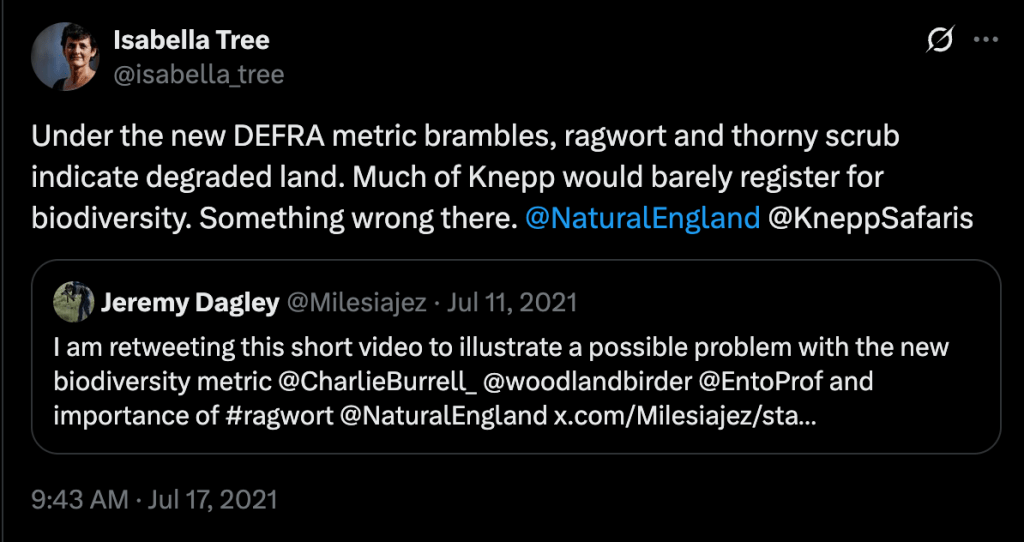
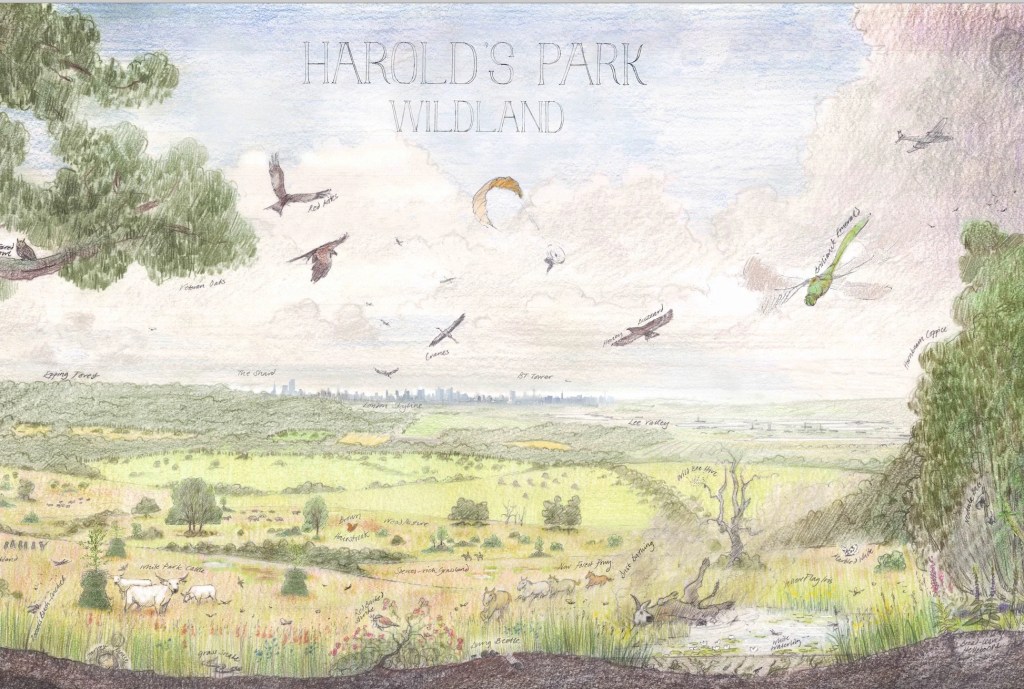
Instead of enforcing these commitments and penalising developers who fail to adhere, the BNG system surrenders and turns this all into a one-off transaction. Developers pay some ecologists to do a baseline survey before development, a wonk does some sums to account for 10% BNG, they pay a one-off fee to a mediator like Bidway and they’re done – on to the next one. The mediator creams some agency fees and passes on the remainder to a land owner adding BNG to their diversifed income streams. It could be a conference and wedding venue like Braxted Park, it could be elsewhere in Essex like the farm turned rewilderness Harold’s Park – 45km as the turtle dove flies from Braxted Park. (Recently purchased by ‘natural capital and rewilding company’ Nattergal.) These Essex projects stand in the shadow of the Knepp estate in Sussex -the poster child for UK rewilding – although Knepp’s owner Isabella Tree says it wouldn’t meet the DEFRA metrics.
All this is an approach to nature recovery that seems to depend on special places that are protected, another form of nature reserve, rather than forging a new symbiosis with nature and accepting that humans are completely embedded within a more-than-human world. Essex county council has a target of transforming 30% of Essex into wild and nature areas. Every place should be special, distinct among others of a kind. Nature recovery here, and there, and everywhere. Let a Thousand Knepps Bloom.
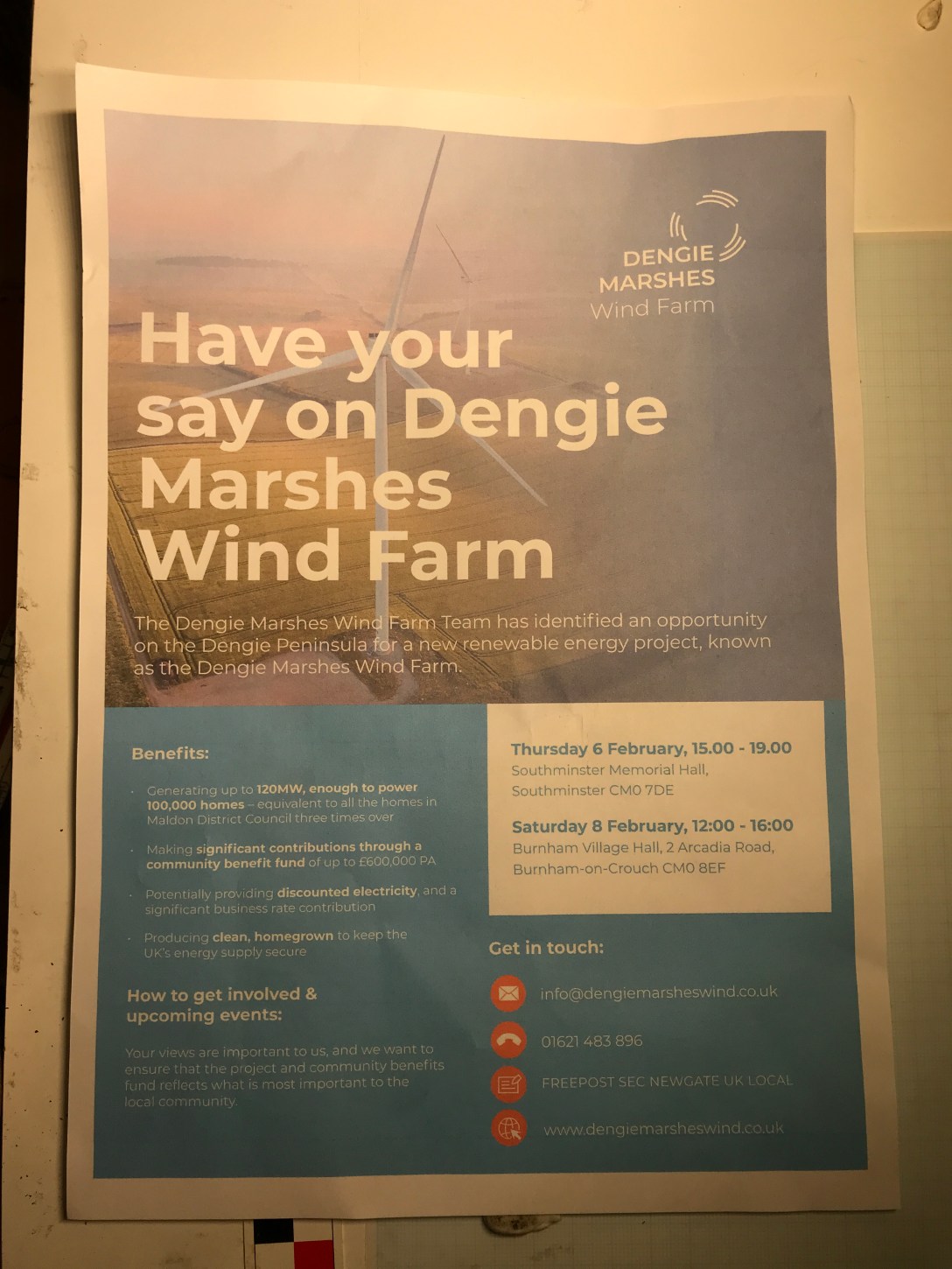
The proposed Dengie Marshes Wind Farm is moving forward into a phase of public survey and persuasion. (A company called Dengie Marshes Wind Farm Limited was incorporated on 18 October 2024 and shares directors with Blenheim Renewables, the company which initiated the project.)
The project has a website and is holding a series of consultation events with two scheduled for this week:
Thursday 6th February 15:00 – 19:00 Southminster Memorial Hall, Southminster, CM0 7DE
Saturday 8th February 12:00 – 16:00 Burnham Village Hall, 2 Arcadia Road, Burnham-on-Crouch CM0 8EF
They aim to submit a planning application this ‘summer’.
We had our monthly meeting on Thursday and tried to do some Thermal Imaging of 4 homes at the same time – which was ambitious. The only way to make it work was to split the group in two and I wasn’t really happy with things working out that way. Earlier in the week I spent some time looking through Parish Plans and Neighbourhood Development Plans from across the Dengie looking for opportunities and commitments.
Jo Coombes and I have been working on an idea I’m tentatively calling ‘Looking out for Nature’ inspired by the work that Wild Justice did identifying that ‘Nearly half of the nature-friendly enhancements promised by developers building new homes have failed to materialise’. I shared this report on local social media and suggested that because Maldon District Council has no professional ecologists on staff it was in high peril of developers not fulfilling their legal biodiversity commitments. I got a comment that ‘MDC Planning employs Planning Enforcement Officers who are responsible for investigating developments where planning has not been granted and checking that planning conditions attached to planning approvals have actually been carried out. Where a condition regarding trees or bird box has been inserted then they would check the compliance’ with a link to the Planning Enforcement. If you actually look at the Planning Enforcement site though it doesn’t support the claim that Planning Enforcement are proactive and makes checks. ‘ Their own overview description of their work simply states: ‘The planning enforcement team has responsibility for investigating complaints [my emphasis] principally where unauthorised development has taken place and aims to resolve these using the most appropriate means.’ i.e. they are reactive. It’s impossible to see how planning authorities like Maldon will be able to assess whether developments meet the 10% biodiversity gain
This places the responsibility to identify breaches with concerned citizens, hence the project. Do we really have the capacity to do it though?



 Dengie Bioregion