Hostile Environment

It’s a Quintuple!

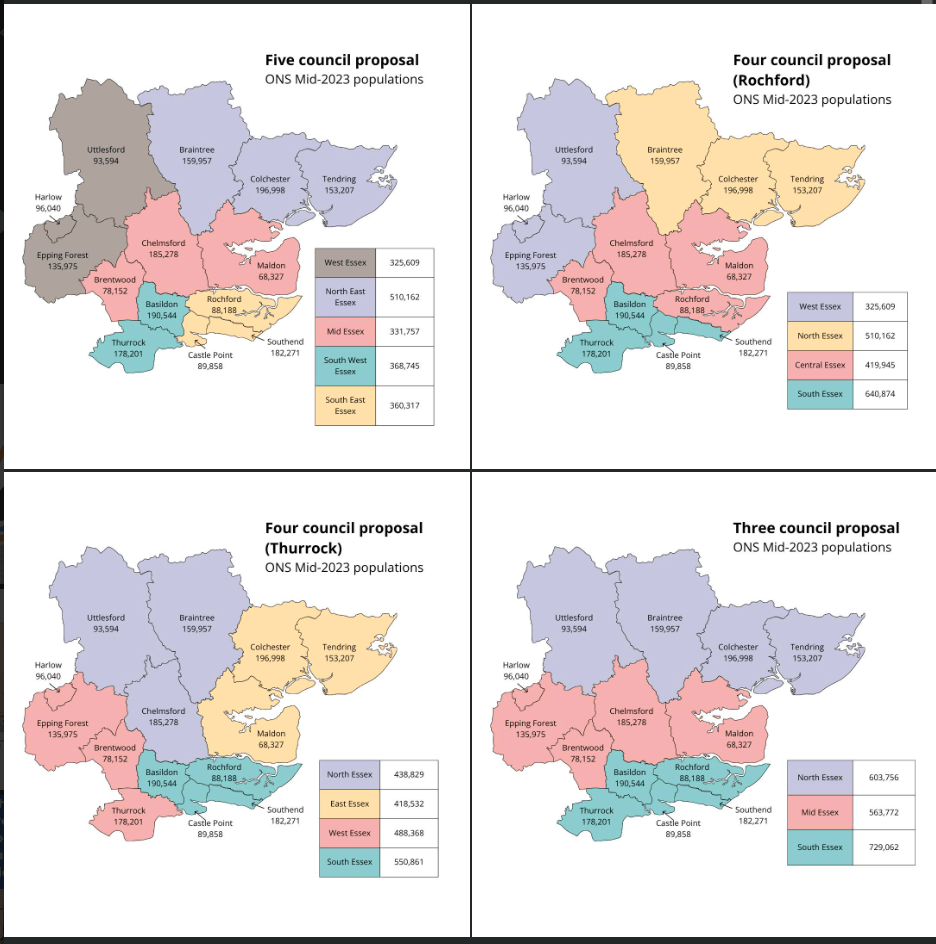
The Gods have spoken. Communities Secretary Steve Reed came down from Mount Westminster this weekend and proclaimed that 15 councils in Essex will be abolished and replaced with five local authorities. I was surprised that UK Gov had not gone with the three unitary authority model proposed by Essex County Council, which seemed to be the only one that fit the government brief.
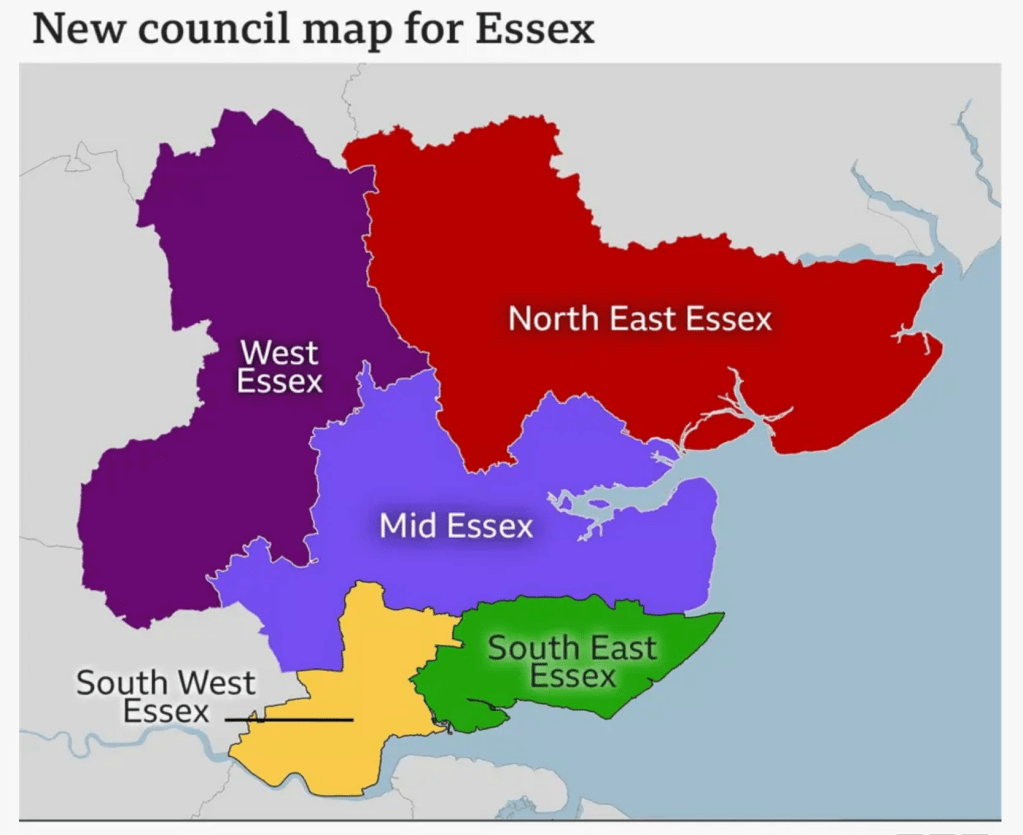

The five authority model was the one favoured by most existing authorities and does not centralise powers as much as the three model. It is still a centralisation however and decision making will move further away from the people it affects, while the case that the reorganisation will save money is surely weakened by choosing to have five rather than three.

Read more: Hostile Environment


The Dengie will be in the ‘Mid Essex’ unitary – an authority that will stretch from the Greater London boundary to the North Sea coast. It seems likely that the seat of power will be in the City of Chelmsford. It’s the only city in the region, it’s fairly central geographically and it has the buildings and staff of the doomed Essex County Council to draw on, making a transition easier. For similar reasons, I imagine that Chelmsford will also be the seat of the Greater Essex Mayoral Authority when an Essex Mayor is elected in May 2028.


(this all presupposes that a General Election doesn’t happen before local government reorganisation and the Mayoral election and that the next government doesn’t cancel the whole thing as a Starmer folly. Reform UK leader Nigel Farage has said he is “deeply sceptical” about changes to local councils in Essex, “I think that to maintain overall the presence of an identifiable county council is the right way to go” and that Reform UK would try to put a stop to local government reform).

Design and Climate Change section of the Maldon District Local Development Plan


For the Dengie, a move of powers from Maldon to Chelmsford means authority moving from a town it abuts to one that is further away. It’s unclear what value strategies developed at Maldon District level will have when Maldon District is no more – not least the Maldon District Local Development Plan 2014-2029 (reviewed Feb 2025), more recent Neighbourhood Plans across the district that are constrained by the LDP, and the Maldon District Council’s Climate Strategy and Action Plan [pdf].
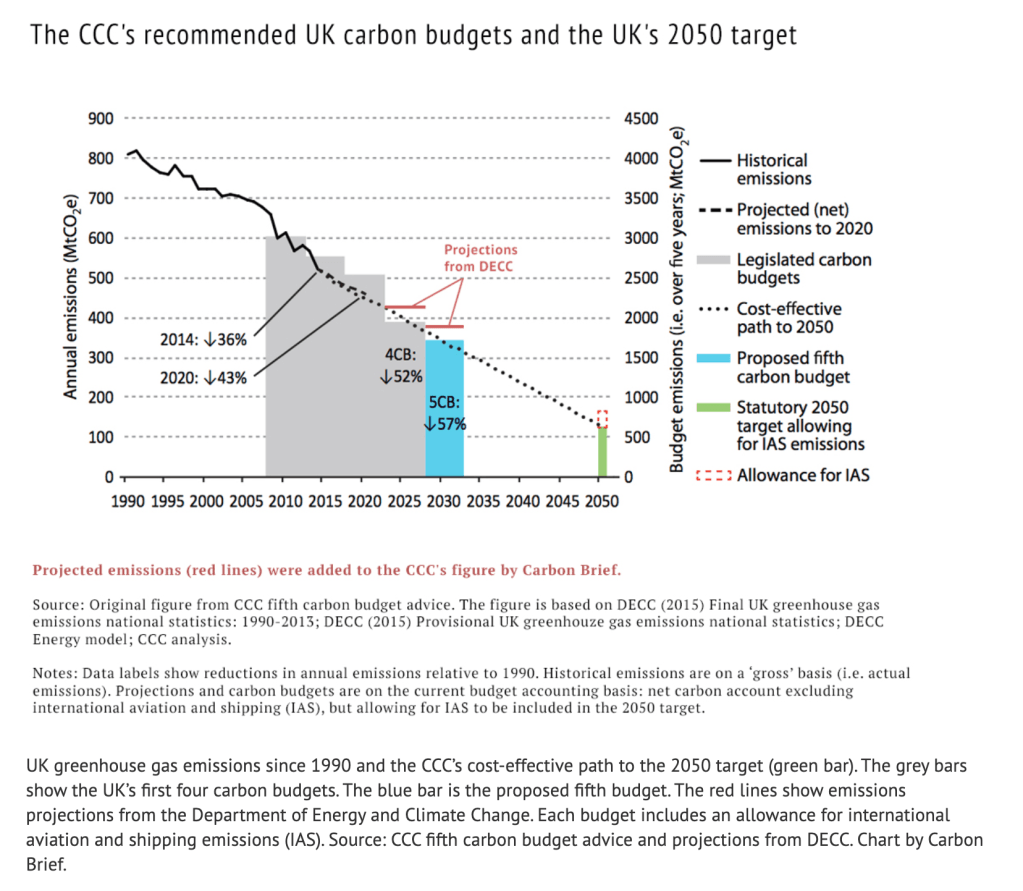
https://www.carbonbrief.org/ccc-cut-uk-emissions-61-by-2030-for-fifth-carbon-budget/


We are entering a crucial period for achieving the UK’s legally binding target of net zero greenhouse gas emissions by 2050 and the interim target of a 58% reduction by the period 2028-2032.

This uncertainty at District level is multiplied at County level. Essex County Council, under a Conservative Party administration, has developed a raft of climate and environment strategies and policies which say a lot of the right things, even though delivery has often been frustratingly slow.
Net Zero: Making Essex Carbon Neutral [pdf]


That lack of speed may prove fatal if the political character of the local authorities changes to one less enamoured of net-zero and climate goals. The current polling is therefore sobering.
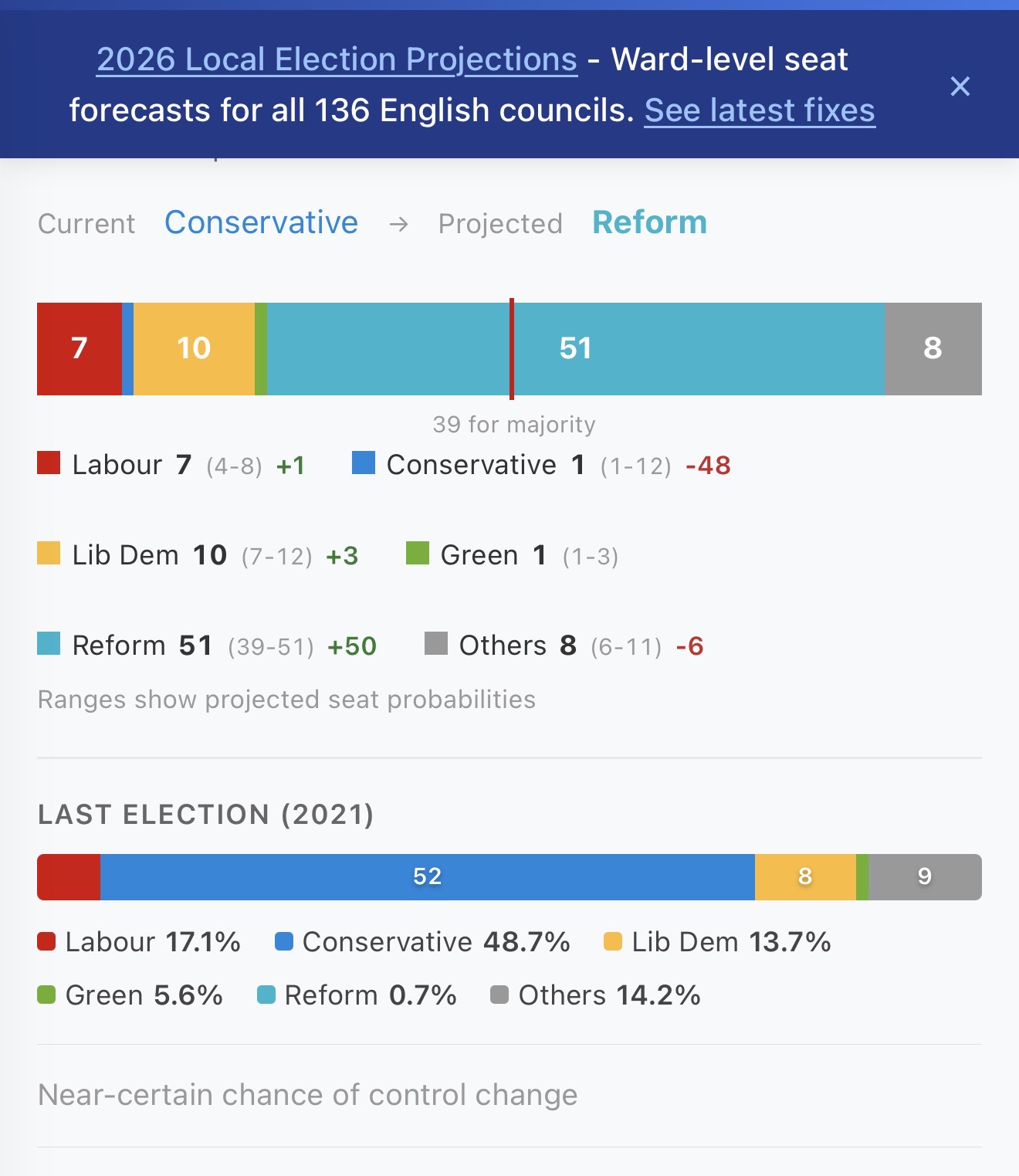
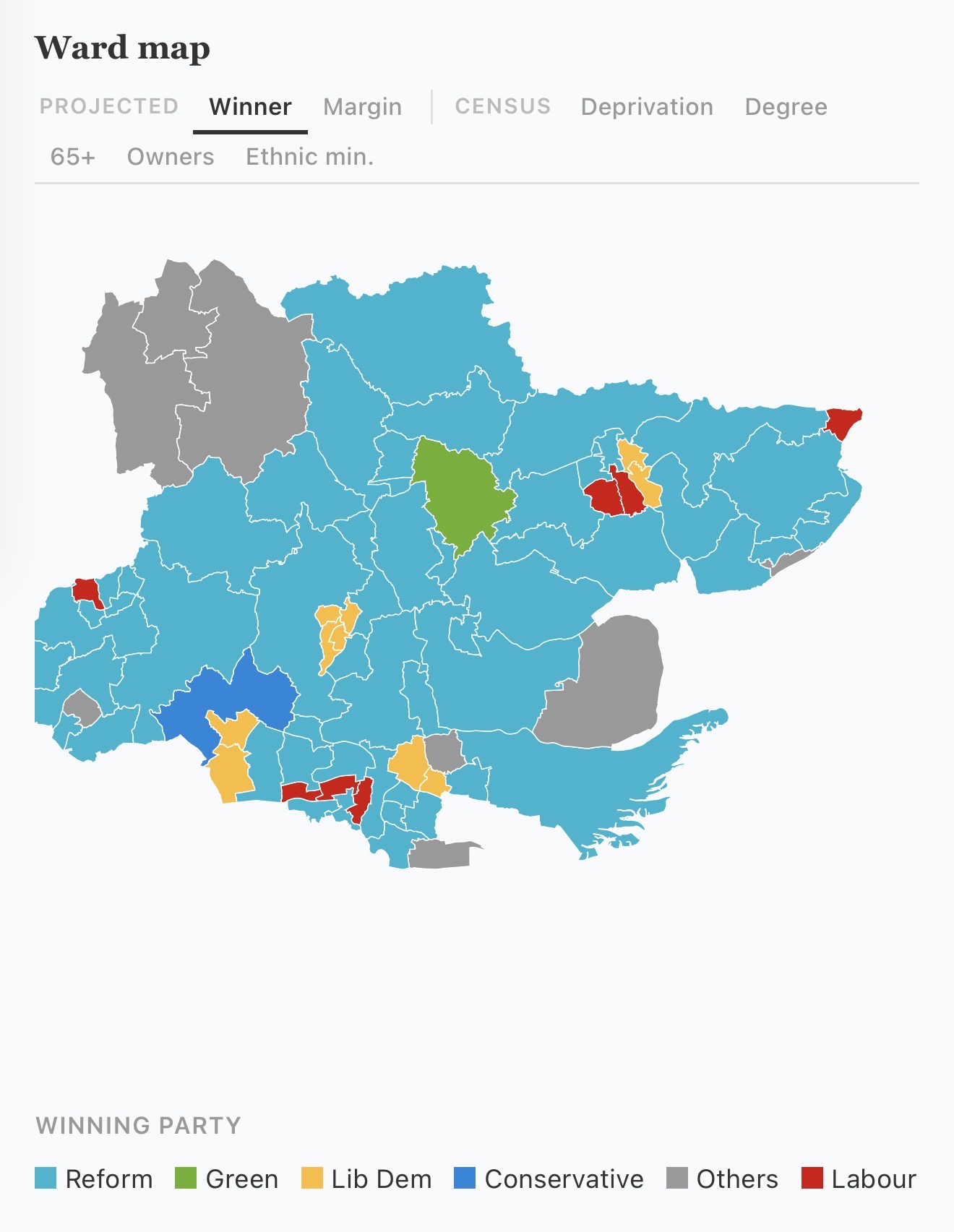
https://www.pollcheck.co.uk/council-projections/essex/#/essex


With a few weeks to go, the Conservatives look set to be wiped out at the May County Council elections. Even the low end of projections for Reform UK would give them majority control in Essex. Conservative Party ‘Climate Czar’ Councillor Peter Schwier is one of those who looks set to lose his seat to Reform UK.

What happened across the Thames at Kent County Council (KCC) when Reform UK took control is a guide as to what to expect: the party initiated sweeping reversals of previous climate commitments.

• Reform UK councillors rescinded KCC’s 2019 Climate Emergency Declaration
• The Reform-led council removed Net Zero/carbon neutrality targets and abandoned efforts to meet those targets previously set by the council.
• Background information provided by the Reform UK group said the council’s 2019 climate emergency declaration had “endorsed the unproven view of anthropogenic (human-induced) climate change” [pdf].
• They cancelled £32 million of renewable energy property modifications.
• They cancelled £7.5 million of electric vehicle transition plans
• They voted down motions aimed at supporting the recovery and growth of wildlife and biodiversity by reducing harmful pesticides – despite environmental and public‑health concerns.
• Reform UK councillor Chris Hespe called anthropogenic global warming a “hoax”.
• Reform UK councillor David Wimble shared a Facebook post highlighting a “Climate Catastrophe Hoax”, where “the climate apocalypse narrative is exaggerated, wrong, and built on fear rather than fact”
• Seven out of ten Reform UK controlled councils have scrapped their climate targets since being elected
• Academic analysis from the Grantham Research Institute (LSE) found that Reform‑run councils “removed content about climate change from strategy documents” after taking control. KCC is explicitly listed among the councils where Reform UK councillors expressed climate‑science denial and participated in these removals [pdf].
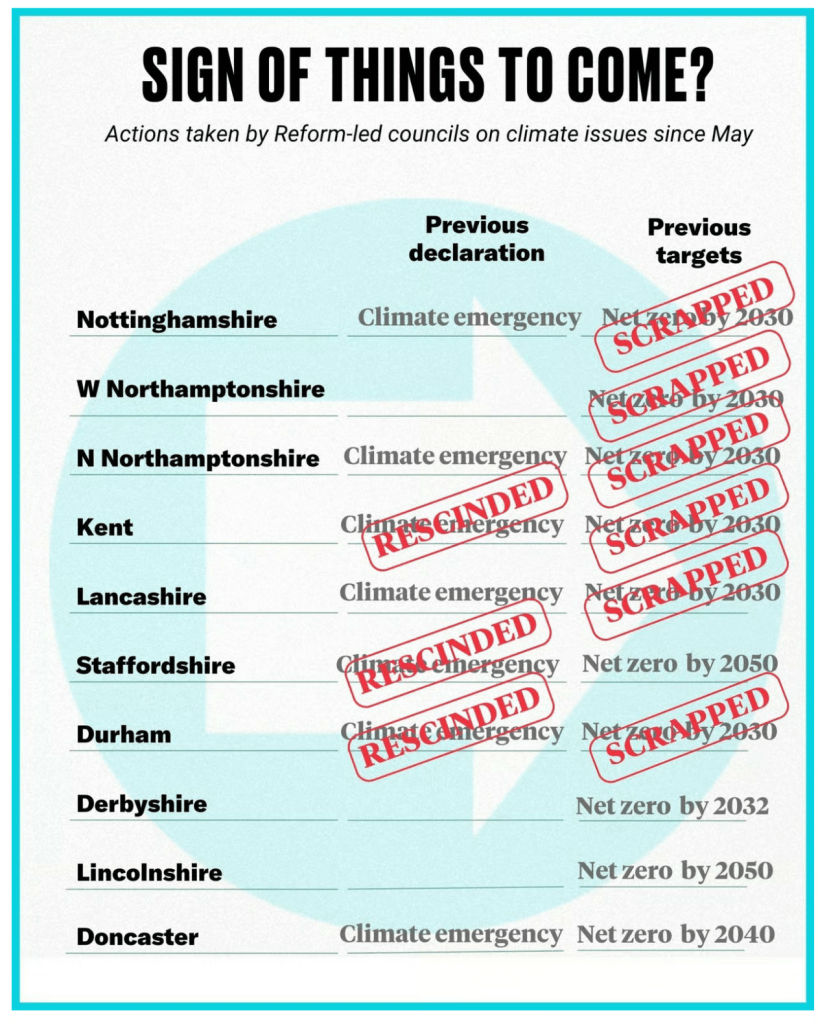
Reform’s local councils are bringing climate denial into the mainstream

Strategies and policies are much easier to reverse than already existing actions on the ground. I can’t help but think that much of the last decade was wasted and all the pretty pdfs and consultations produced are now dead in the water. Essex should have taken direct control of buses and integrated public transport ticketing and timetables, planning authorities should have demanded net-zero, low bills, homes with domestic energy generation, rain/grey water recycling and minimum 30% on-site biodiversity net gain, the county should be laced with segregated walk/wheel/cycle paths breaking car dependency and improving health outcomes, money spent on waste incinerators should have been burned creating a circular economy instead, our anchor institutions should have collaborated and built community wealth via local procurement led by the public authorities.

Peter Harris, the Reform UK mayoral candidate for Essex, hasn’t yet made any statements specifically about environmental issues such as climate change, net‑zero, renewable energy, pollution, or biodiversity. He has mentioned ‘protecting our green spaces’ as part of a very general policy agenda, but there’s no detail on what this means in practice.
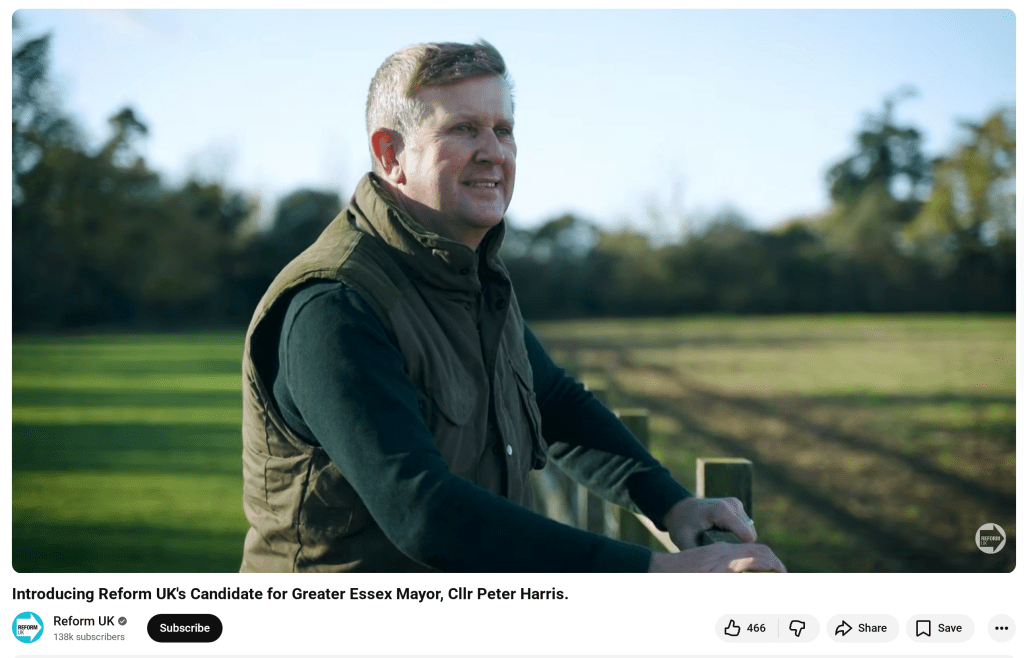

His promo video has him stood in some fields and his comments there seem to position the ‘green spaces’ protection as being about housing developments rather than nature recovery or habitat protection.
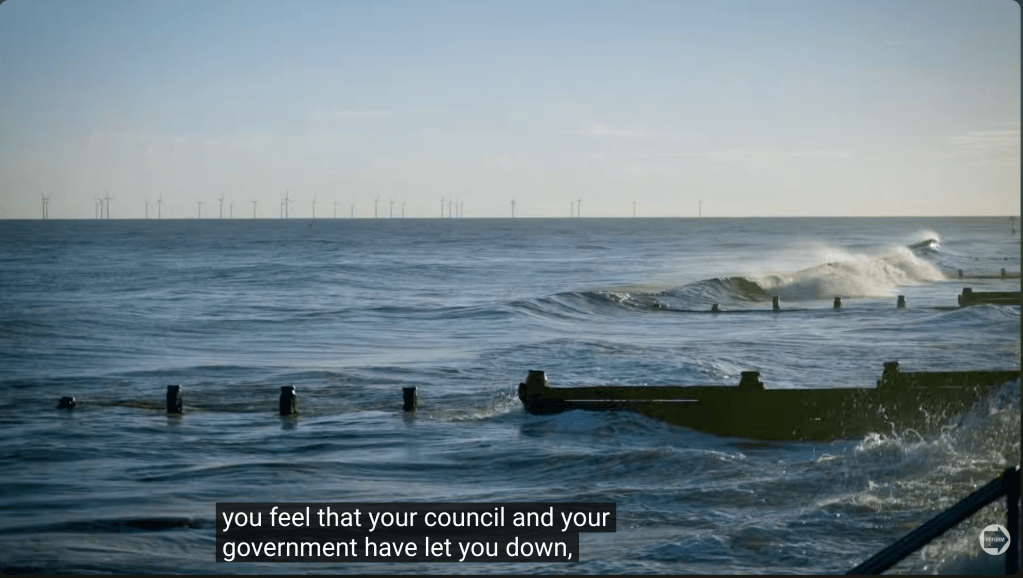
There’s a brief shot of the tide coming in on the Essex coast with the Gunfleet Sands Offshore Wind Farm visible in the distance – but there’s no mention of sea-level rise or renewable energy. Over this image, Harris is talking about the council and the government ‘letting you down’ – is the tide and the wind farm relevant to this, or just B-roll? Hard to tell.
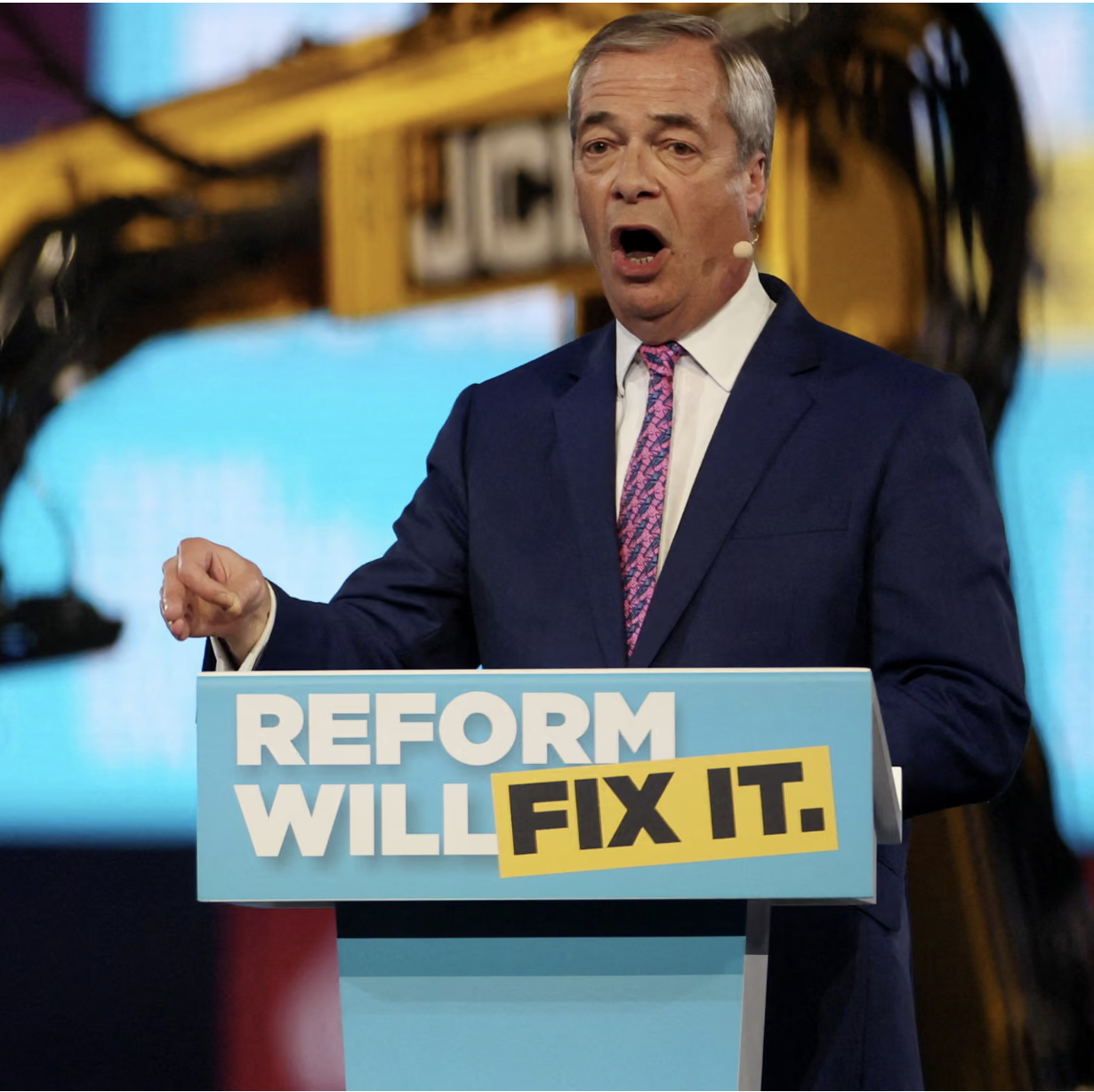
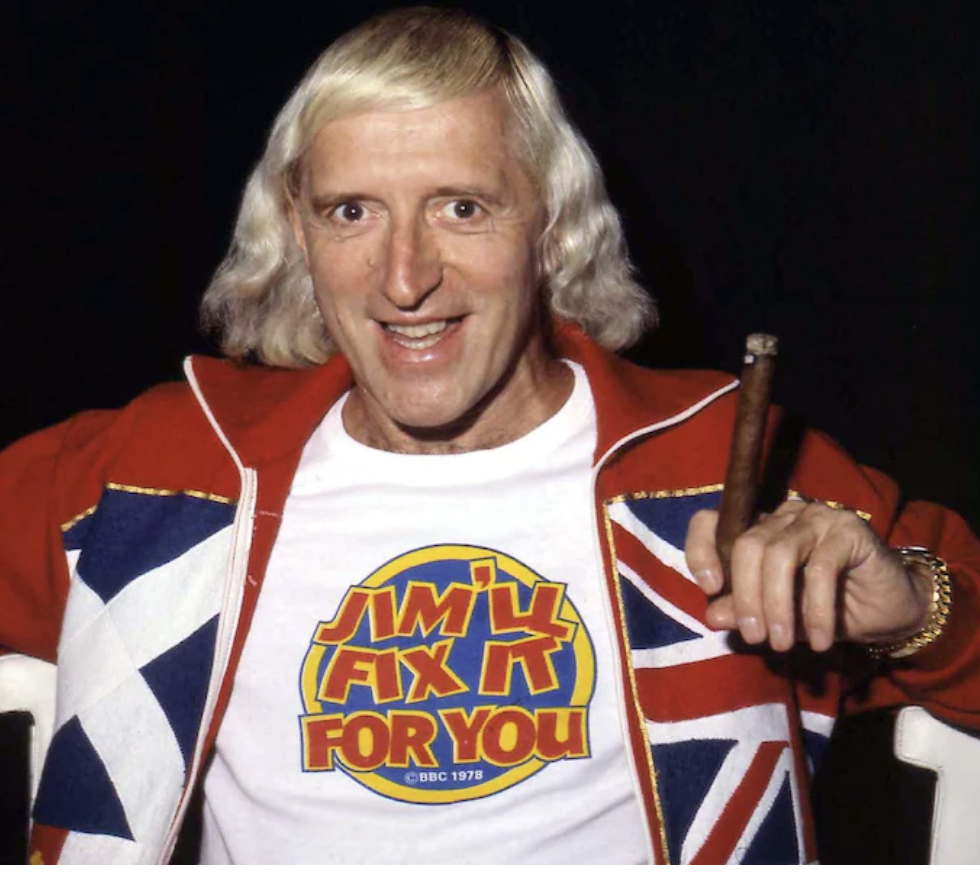
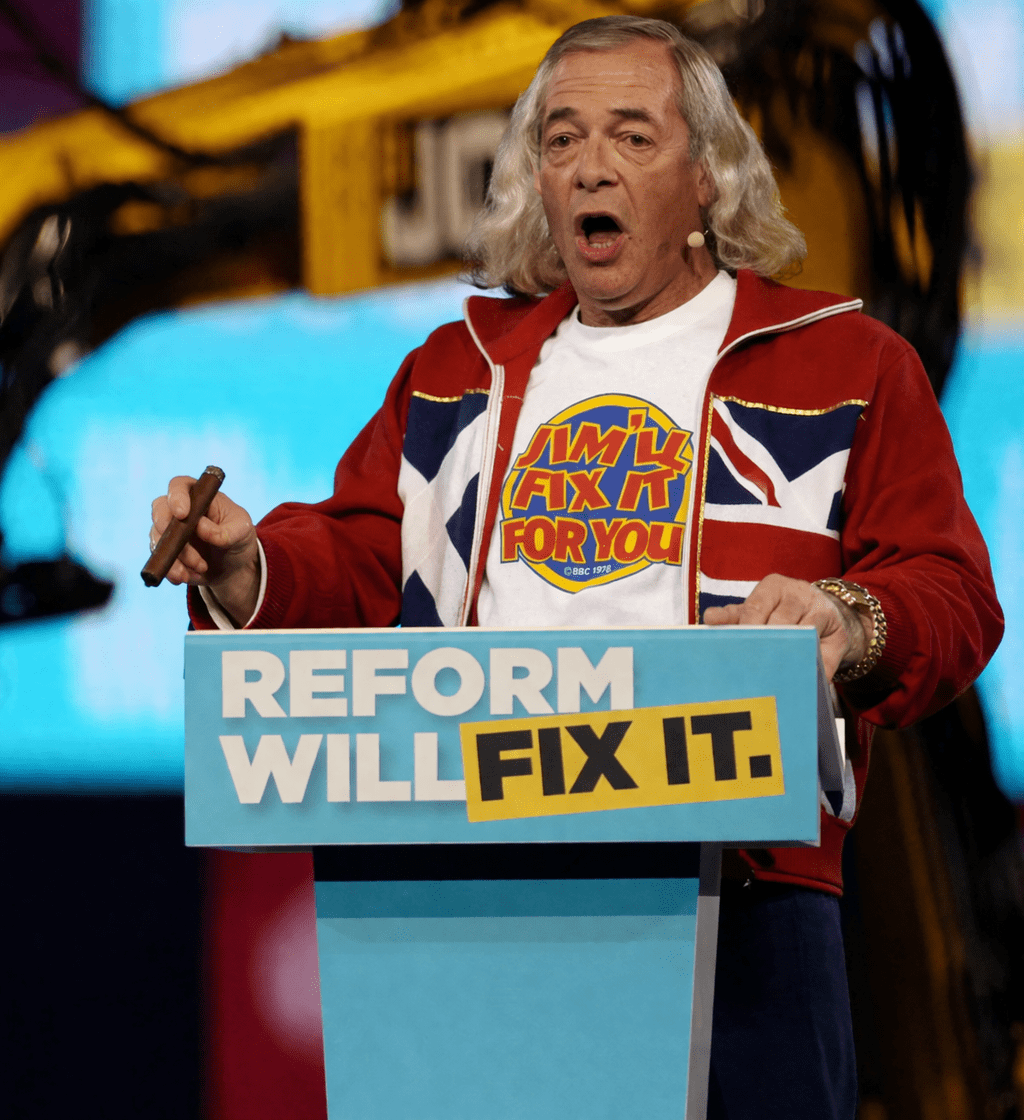
Last week, The Reform UK Local Election Tour, obliviously called ‘Reform will Fix It’, visited the Circus Tavern in Purfleet, Essex. Following some chat with former glamour model Jodie ‘#frippsfarce’ Marsh and Cllr Jaymey ‘bankrupt / ‘unsolicited private parts’ McIvor, and a warm-up from David ‘ONLY Reform UK will scrap the insane Net Zero targets’ Bull, it was on to Zia “If there’s one thing [the UK] is not under threat from, it’s climate change” Yusef, and Nigel “I haven’t got a clue whether climate change is being driven by carbon-dioxide emissions” Farage.
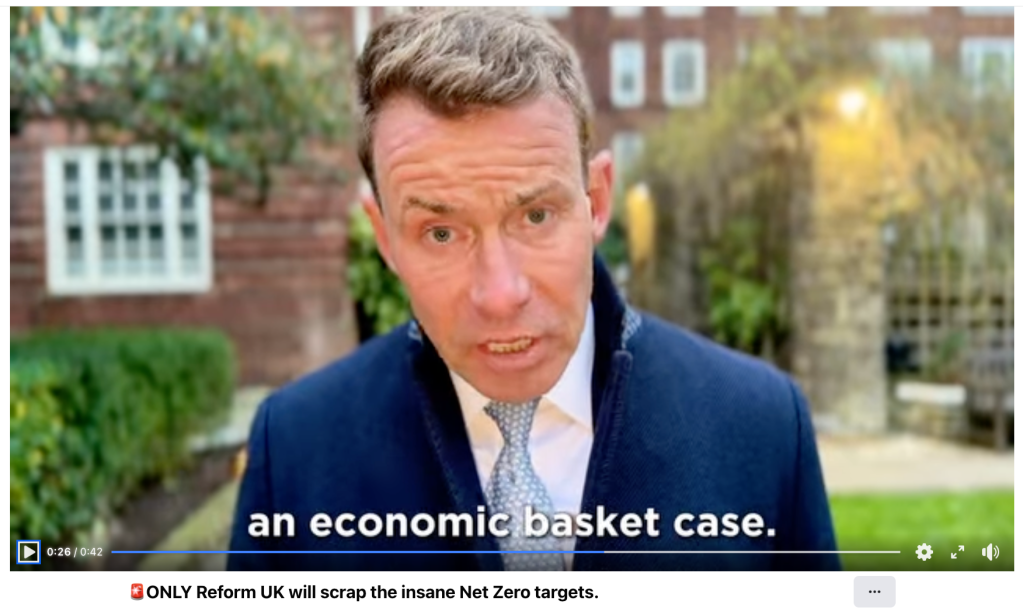
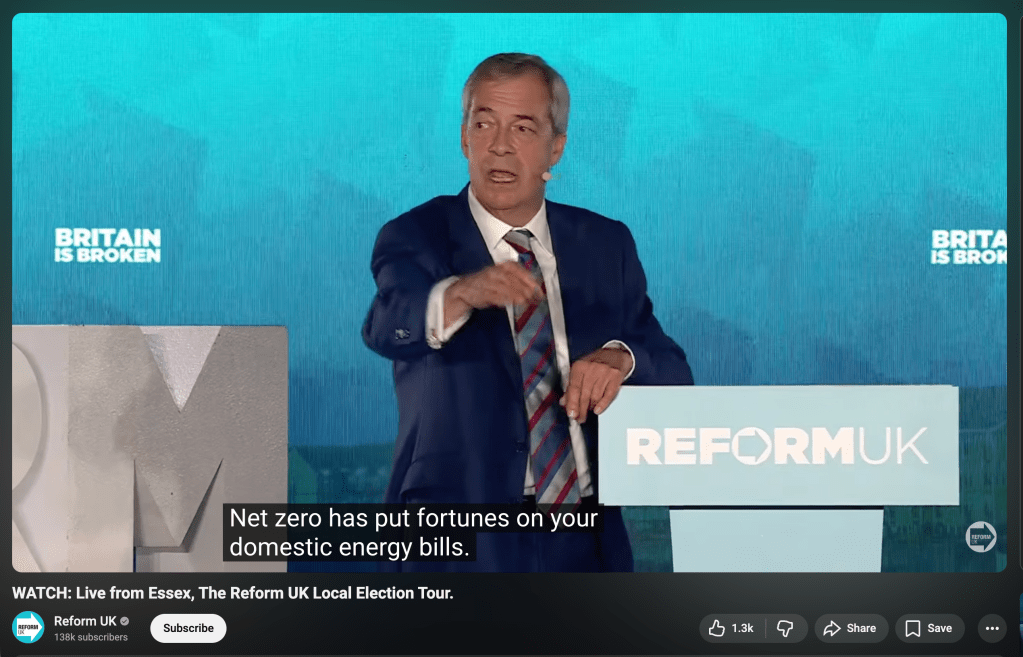
Dr David Bull
Nigel Farage stand-up set at the Circus Tavern

With the Earth’s climate further out of balance than at any time in recorded history, the crash in wildlife populations constituting an extinction event, and human activities increasingly disrupting the natural equilibrium, creating consequences for hundreds and thousands of years, the return of climate change denialism is a bitter pill to swallow.

This week The Times reported that it had seen a document called ‘Status of Defra’s critical systems to 2030 and beyond’, commissioned before the 2024 election by civil servants at the Department for Environment, Farming and Rural Affairs (Defra).

Tasked with identifying looming threats to the underpinnings of modern life, its authors in the Defra Futures team, an expert group of civil servants, concluded that not only Britain’s food supply but also its water supply and international trade networks were “almost certain” to be “on a decline and collapse trajectory”, meaning there was “a realistic possibility that by 2030 (increasing to 2050) our food, water and natural ecosystems (etc) are at strategic risk of catastrophic failure”.’

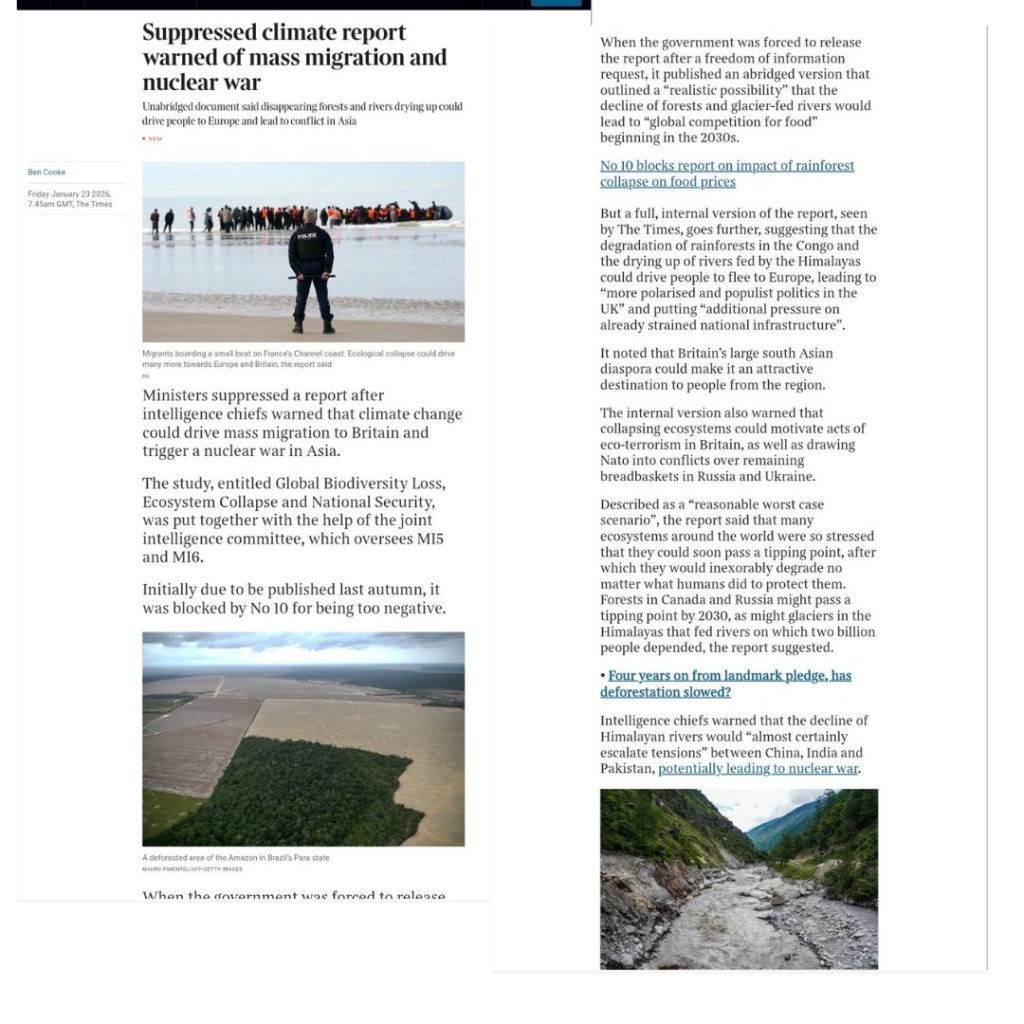
The Government denies a document with this name exists, but a couple of months previously, The Times reported on a different study ‘Global Biodiversity Loss, Ecosystem Collapse and National Security‘ put together by the joint intelligence committee (which oversees MI5 and MI6). Due to be published last Autumn, it was suppressed until an FOI request produced an abridged version.
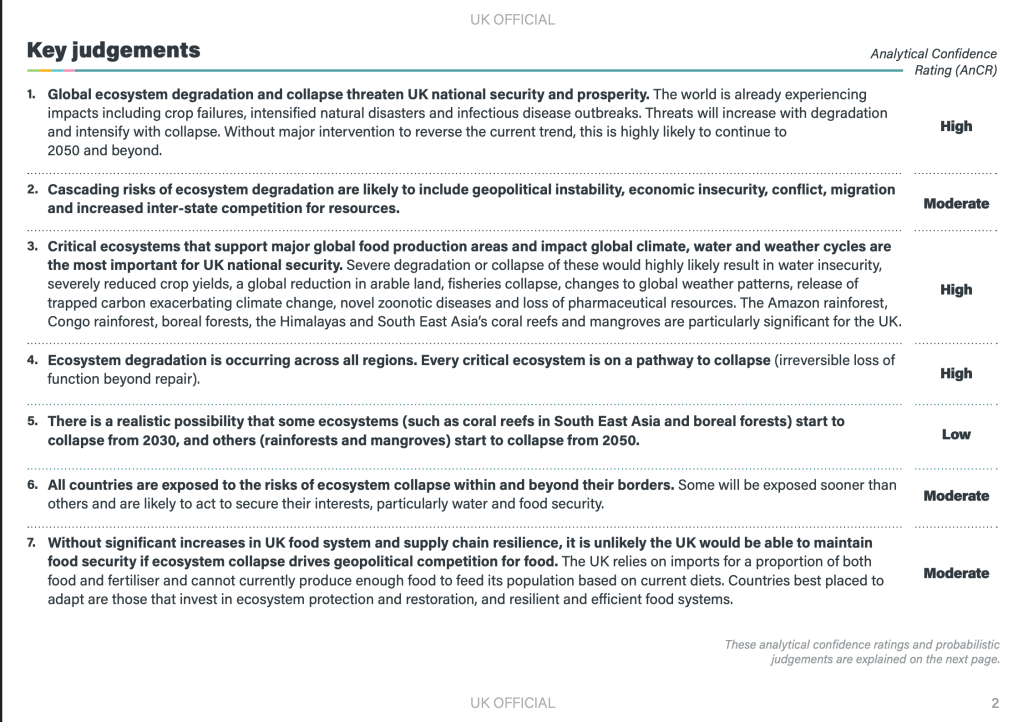
From the abridged ‘Global Biodiversity Loss, Ecosystem Collapse and National Security’

The Times reports that it has seen the unabridged version which paints an even gloomier picture of how climate change might affect the UK: driving mass migration from parts of the world made uninhabitable, provoking wars and acts of terror, and creating a global competition for food.
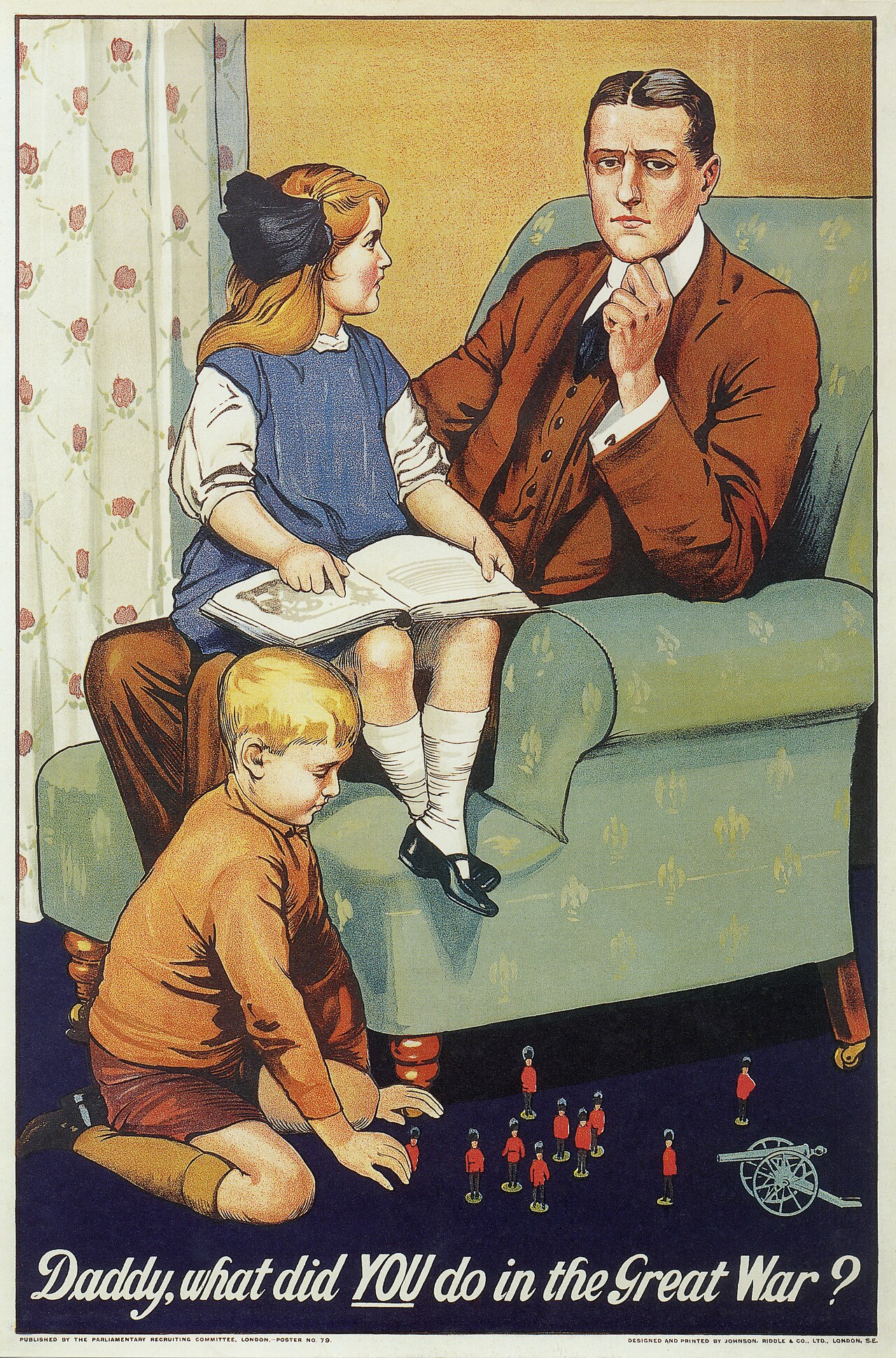
It looks like those of us working to address the climate and ecological emergencies are about to encounter a hostile political environment. When I directed my energies into working with a local climate action group (which was encouraged into existence by the local district council), I did so because I saw opportunities for genuine positive change afforded by the commitments and strategies agreed at political levels from the national to the parish. If, and when, those commitments are abandoned, those strategies are shredded, targets are scrapped, and actions to address the climate and ecological emergencies are ditched – the way forward is unclear. These are the conditions that often produce climate despair and depression, a fatalistic surrender to personal consumption and hedonism, or moves towards more confrontational approaches and direct action.
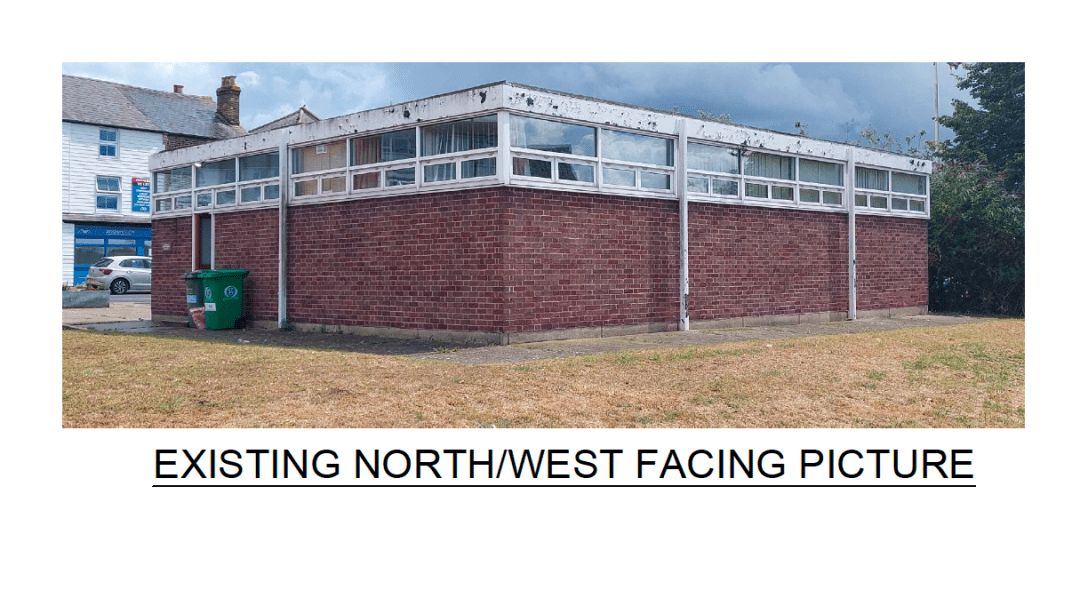
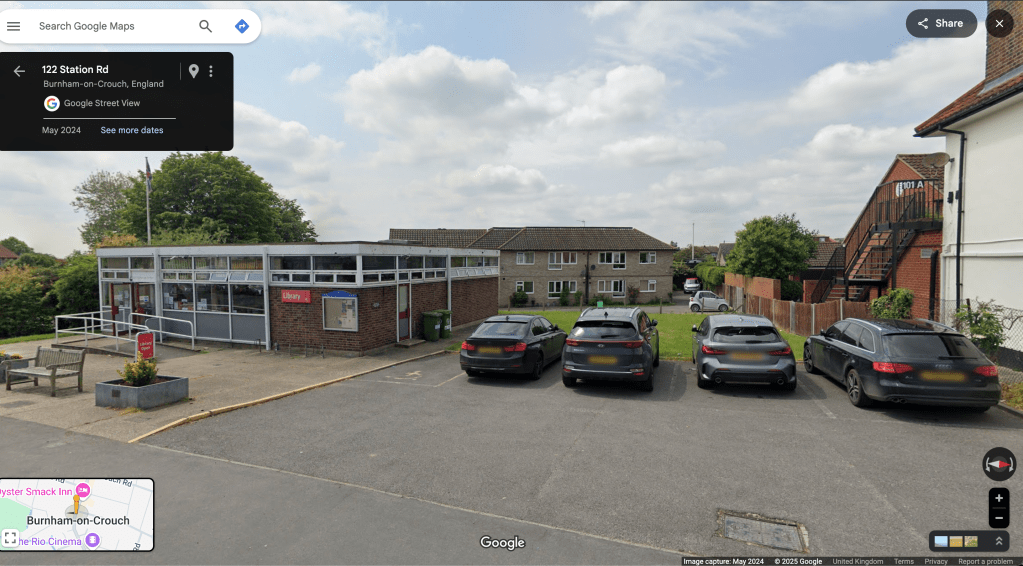
Urban Habitat: Burnham Library

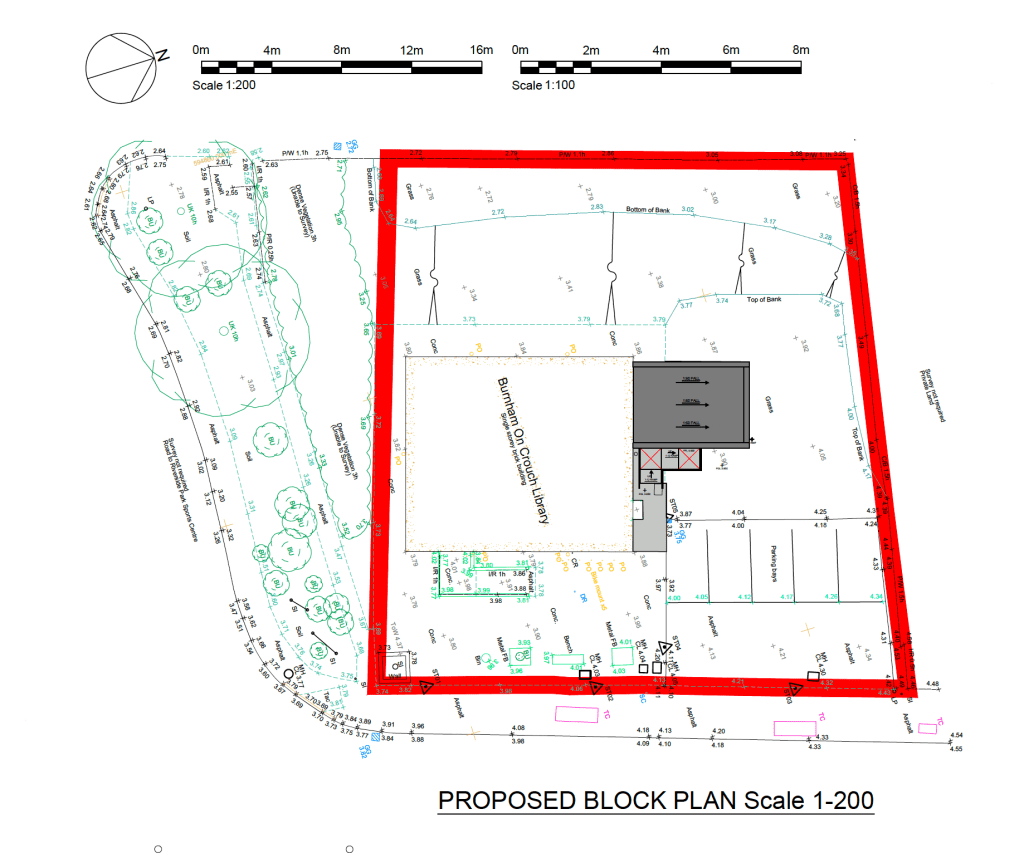
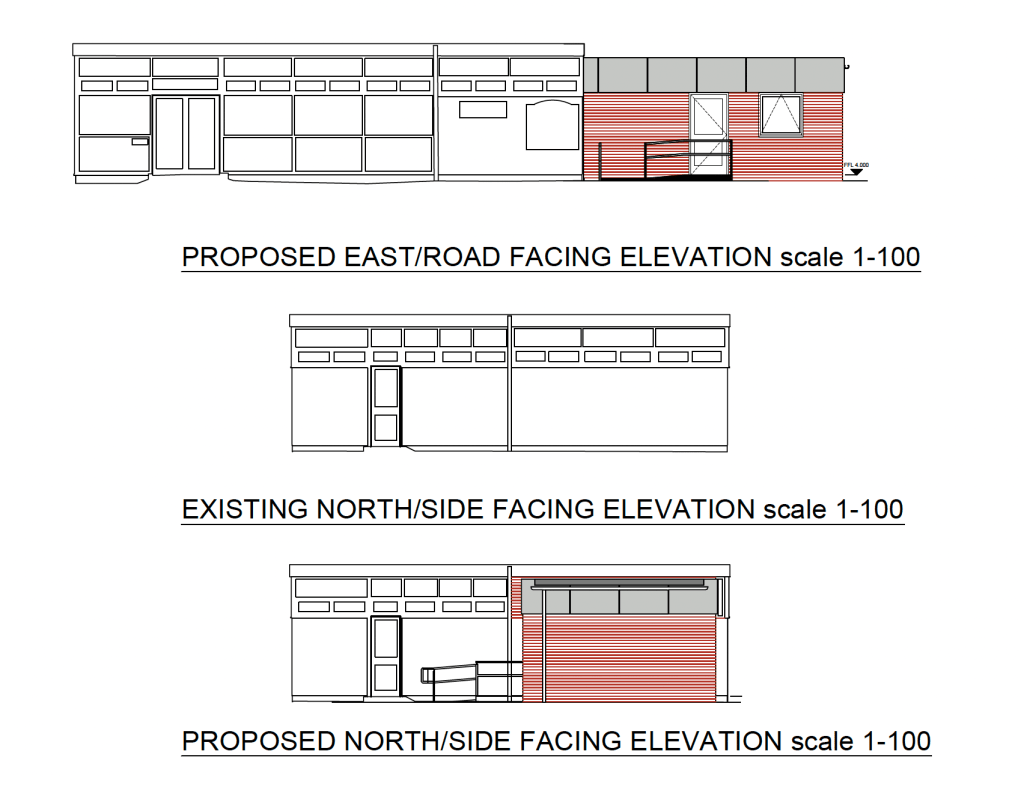
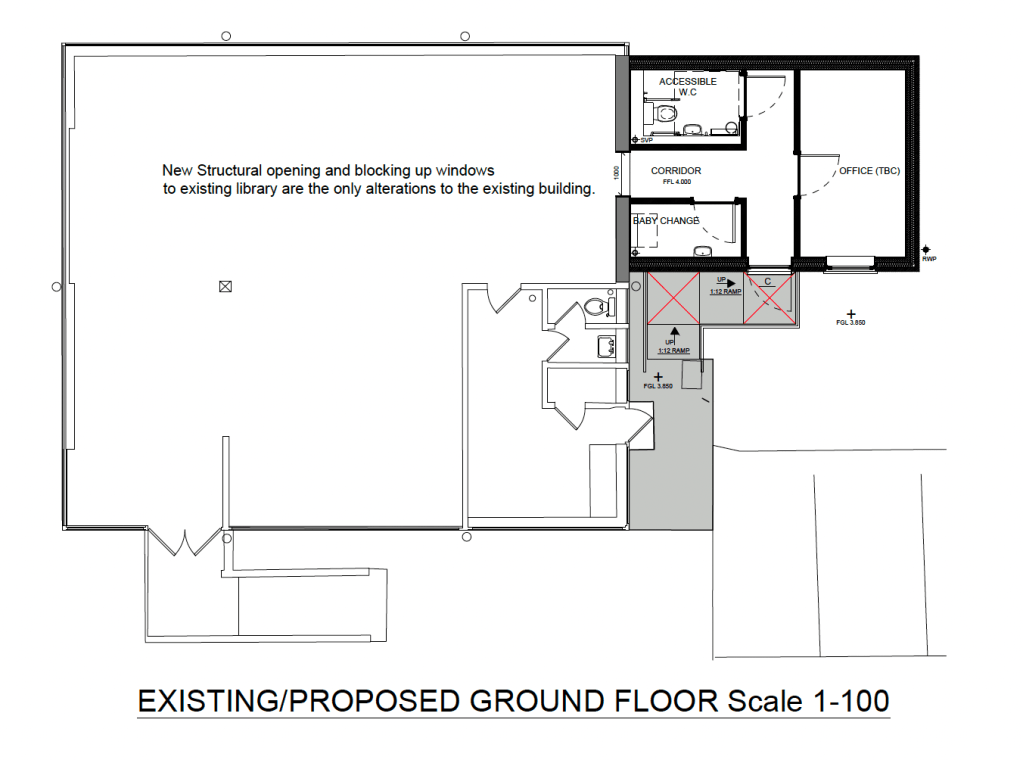
The planned extension to the Burnham Library building is interesting. The planning documents reveal it will house a Family Hub Delivery site, relocating the existing Family service from a temporary building at Ormiston Rivers Academy to this central location. This is all to be applauded. The service deserves a permanent home and facilities. Co-locating it with the library has benefits, and places it closer to public transport links.

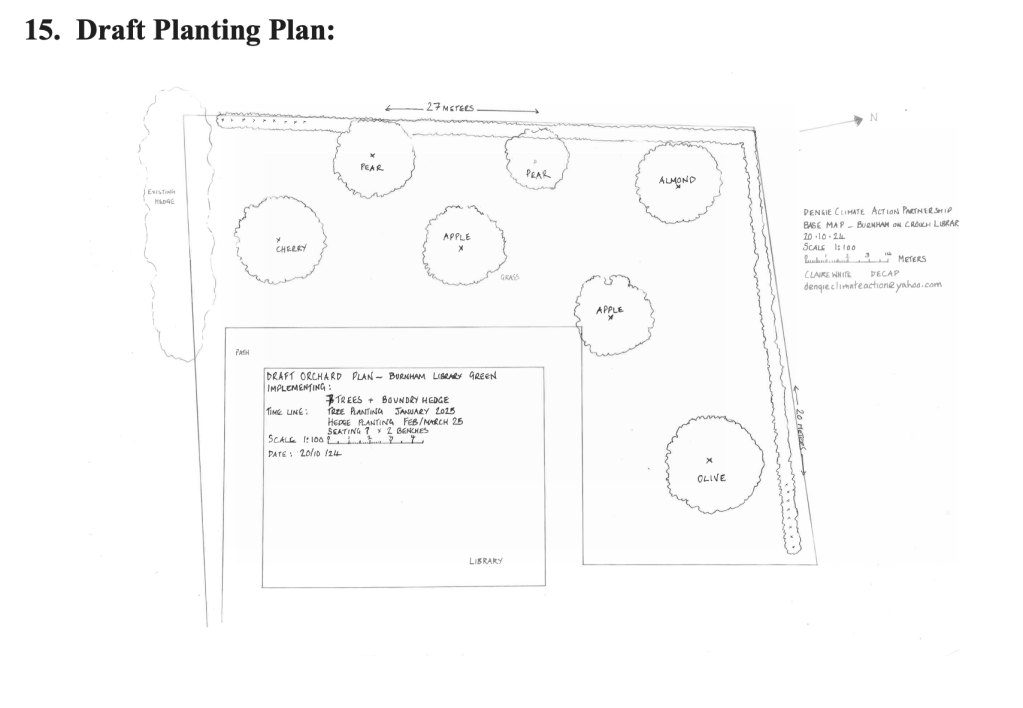
This extension may explain why Essex Libraries turned down the Dengie Climate Action Partnership proposal for a wildlife-friendly community orchard on the Library gardens. Essex Libraries were initially enthusiastic and encouraging about our proposal but suddenly went cold. We could, and would have, worked around this extension of course – and still could!

Read more: Urban Habitat: Burnham Library

The planning application states the proposal is exempt from Biodiversity Net Gain requirements and will have minimal impact on existing habitats. However, if Essex County Council were seriously considering their own Essex Local Nature Recovery strategy, they should have taken advantage of this opportunity to enhance biodiversity on-site. This could have helped it reach the LNRS priority to create 3,100 hectares of new habitats in urban areas in Essex. It’s hard to see how ECC will motivate the public and private developers to engage with nature recovery if it does the bare minimum for biodiversity (nothing) on sites it develops itself.

The proposed extension, meanwhile, is surprisingly modest and a missed opportunity to make an extension and improvements to the library itself. A tool and toy library perhaps, a co-working space, a makerspace, solar PV, a heat pump – things that would improve facilities for the public and/or decrease the running costs of the building.

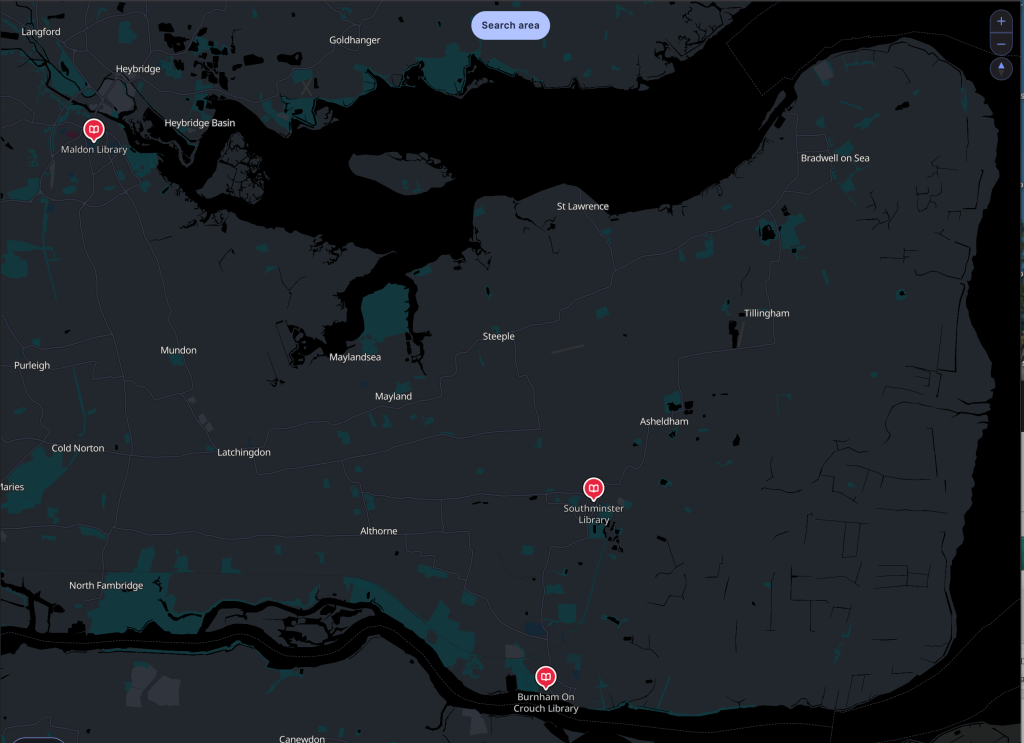
At the end of the day though it’s Burnham Library’s opening hours that are most shocking to me. It’s only open one weekday morning for example. It’s more likely to be closed than not. Getting the library open on a decent schedule should be the priority. It’s one of only two libraries on the Dengie and the other, at Southminster, is even more diminished. The public library offers an excellent model for lower impact living and should be celebrated, well-funded and enhanced.

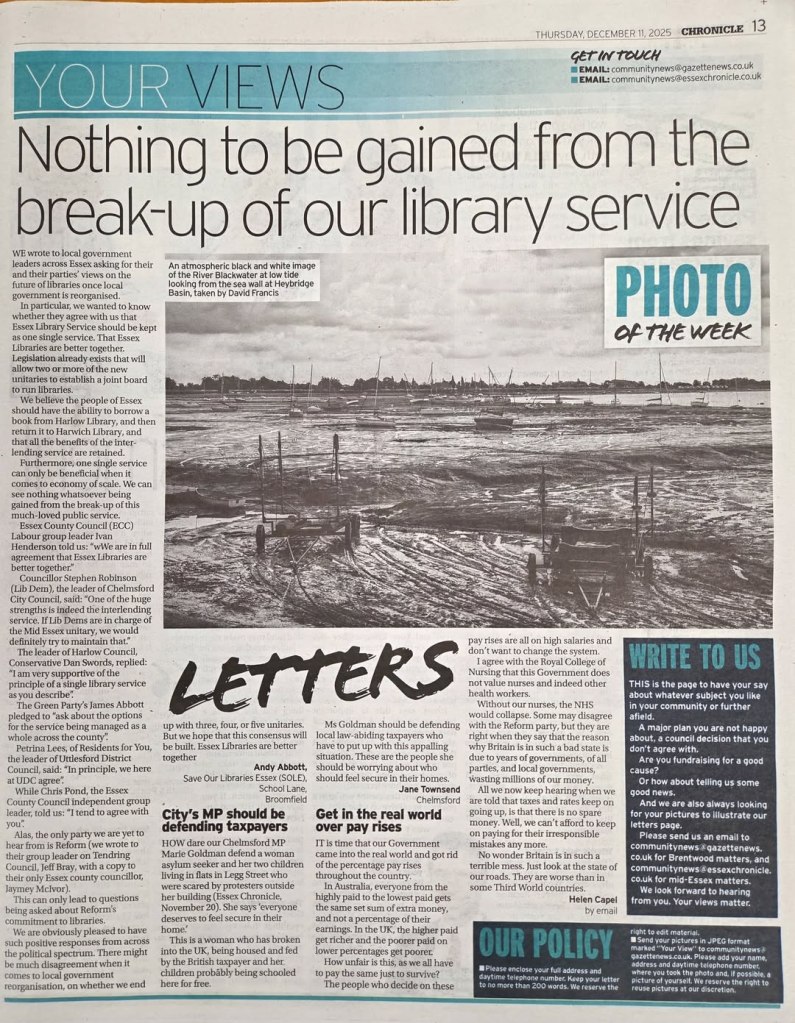
But with the fate of Essex Libraries uncertain in the face of the forthcoming Essex Mayoralty and Local Government Reorganisation (nobody knows where responsibility for library provision will end up!) the future of all our libraries is ambiguous and confused. #essexlibrariesbettertogether https://www.facebook.com/SaveOurLibrariesEssex/

These are not the sort of issues that planning authorities have much say in, but you might want to express any feelings you have at https://planning.essex.gov.uk/ where you’ll find all the planning documents and can reply to the consultation (ends 3rd February). This is application number CC/MAL/91/25.

Unfollowed

I’m concerned by groupthink and getting trapped in an intellectual bubble where my own opinions are reflected back to me.

To counter that I read across the political spectrum, and on social media I follow people who have differing perspectives on the world. On Twitter this has always included people whose views I strongly disagree with, but it seemed a worthwhile attempt to try and understand rather than rush to judgment. I still think there is value in this.

The Muskification of Twitter has released a broader range of right wing views than I feel comfortable with but comfort is not an important intellectual characteristic. Discomfort can be a useful clarifier of our own positions and can expose our prior assumptions. it’s always useful to be aware of what we take for granted.

Sometimes people are just arseholes though and their execrable opinions and prejudices don’t contribute anything useful to the ‘great conversation’. I will unfollow people, and remove their input from my SM streams whenever I judge it right to do so. The ‘For You’ feed of Twitter these days is like a Nazi biker bar at 2am and the ‘Following’ feed requires careful curation if you want to keep the methheads out.

Read more: Unfollowed

This is often a quick decision, swiftly implemented but not always. There are some voices I give more leeway to, more time. On Twitter I follow thousands of people, so I generally don’t recall who someone is, what they are about, why I followed them in the first place. When a post, or more commonly a series of posts by someone, gives me cause to think about whether I still want to follow them the first thing I do is go check their profile page. This helps me think again about why I followed them and can make me decide that despite the posts that concerned me I will continue to allow them in my feed.

Over the last year I’ve noticed that I have repeatedly disagreed with posts from a person I follow and have kept going back to her profile. There I note the words ‘future’ and ‘design’ in their handle, I see we have many mutual follows and I read in their bio ‘Advocate for reclaiming the natural and social commons for all. I follow a motley bunch to burst bubbles including my own’ . Each time this has been cause enough for me to choose not to unfollow. I see shared interests, I see a direct reference to following ‘a motley bunch’ and the desire to burst groupthink that I share.

This morning though my feed delivered a repost that I think must be the camel back-breaking straw. I have to admit I’ve been more generous with her in the past than I really should and that I don’t think that I’ve actually read anything posted by her that stirred me intellectually or provided a useful challenge to my thinking.

She doesn’t have the ‘retweet does not equal endorsement’ disclaimer in her bio but I give folk some leeway in this. As a reader we can use context to understand what, and to what purpose, something is shared. We can also situate an individual RT within the wider output of an individual.

Considering both context and her output, her strong anti-immigration stance has been evident from the start but I feel it is important to understand people’s concerns on this issue. Concern about immigration is not equivalent with racism, even when every racist is anti-immigration. The climate crisis seems likely to produce the largest human migration in the history of our species and we will, necessarily, be having conversations about it for centuries. This climate migration will include people escaping unliveable wet bulbs temperatures, permanent drought, flooding and more.

We tend to imagine this being about people fleeing hot equatorial regions or exotic low-lying islands for other counties but it will also include internal migration of people from, say, English coastal towns and cities to inland villages and rural uplands. It may be people from these islands post an AMOC collapse seeking better lives in warmer climes. So, although she’s previously posted and/or reposted some increasingly provocative stuff about migration to Ireland, I’ve thus far kept it in my feed.

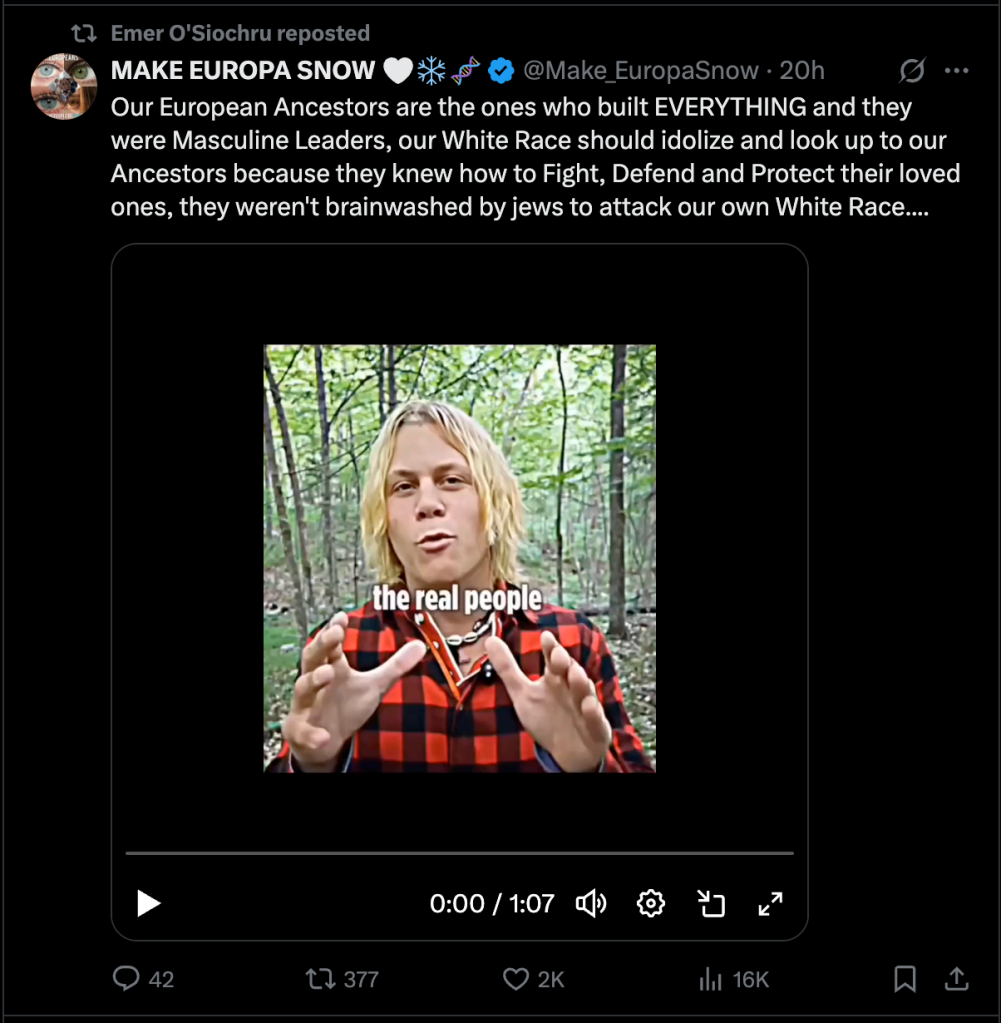
Then you get this share with an accompanying video mash-up:

“Our European Ancestors are the ones who built EVERYTHING and they were Masculine Leaders, our White Race should idolize and look up to our Ancestors because they knew how to Fight, Defend and Protect their loved ones, they weren’t brainwashed by jews to attack our own White Race….”

There’s no room for the motley here. The account that originally posted this: MAKE EUROPA SNOW 🤍❄️🧬 is avowedly racist and, as witnessed in this tweet alone, so straight-up Nazi that one hopes that its Russian maskirovka rather than the actual ideology of someone you breathe the same air as.

I don’t want to read this shit anymore. They are free to say it and share it, but I don’t have to listen to it. Unfollowed.

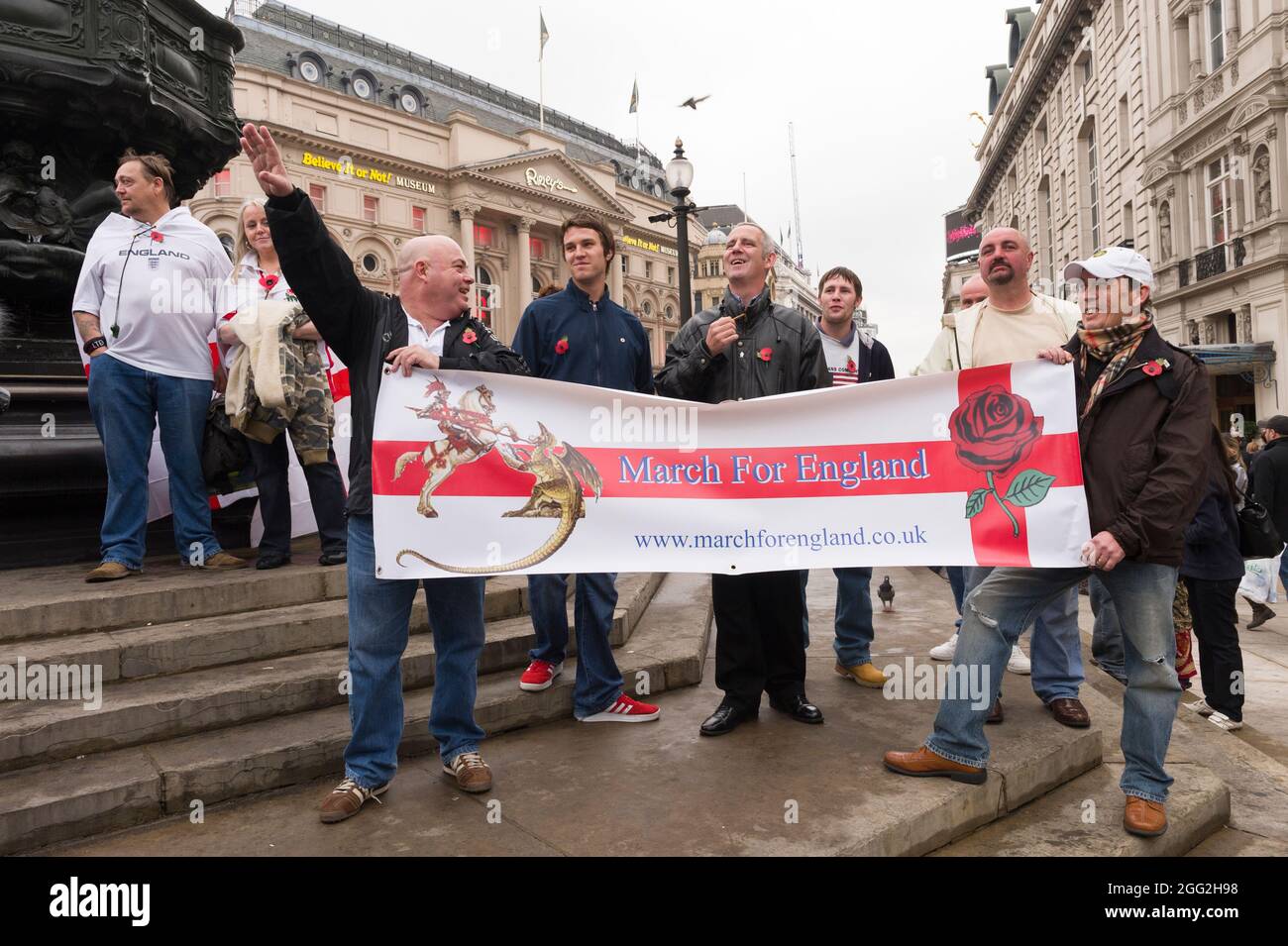
In Burnham, the Remembrance events provided cover for Temu patriots to put up some more cheap Chinese polyester on local lamp posts (White cable ties this time around). The earlier wave of flags are already looking pretty tatty and forlorn. Limp, half-mast, upside down, creased, fraying at the edges, weak at the joins. High quality infrastructure, aftercare and maintenance don’t seem to be on the nationalist agenda, it’s ‘broken Britain’ all the way down.

Online and on the streets, some people are stepping on a platform marked ‘concern about irregular migration’ and flying the Union Jack or the Bratach na hÉireann. When the platform slowly moves to ‘against all migration’ and ‘pride in our national flags’ most are happy to go with it. But this isn’t a “common sense” travelator dropping you off at the departure gate, it’s a far-right escalator and you don’t want to see what’s at the top.

The Lost Words

By national government edict the 15 councils in ‘Greater Essex’ must reorganise to form new unitary authorities through a process of Local Government Reorganisation. This will change the current two-level council system into one in which there are new, bigger councils called unitary councils.

I’ve been reviewing the four competing proposals submitted by existing councils as to how that reorganisation should take shape. (They’re all published here). They divide Essex into 3,4 or 5 new unitary authorities:

*Three unitary council proposal [3]
*Four unitary council proposal (led by Thurrock) [4T]
*Four unitary council proposal (led by Rochford) [4R]
*Five unitary council proposal [5]

(in square brackets I’ve added a number used in the figures below)

There are several hundred pages to go through here (874 pages to be precise), so I’ve done a bit of barefoot textual analysis as a first attempt to see what they have to say about the climate and nature emergencies.

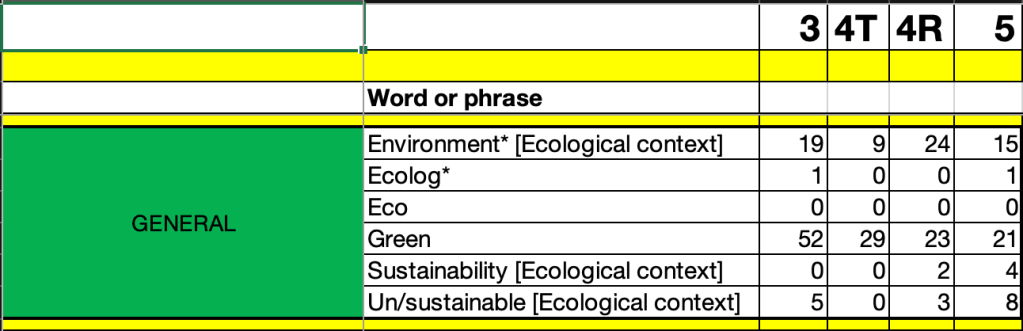
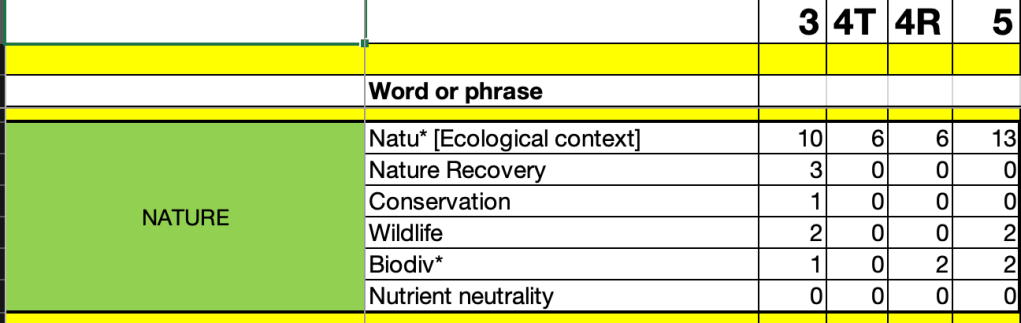
My quick and dirty approach was to quantify how many times some key words and phrases related to these issues appear in the respective documents. I chose words to search for that are either words ordinary people might use or they are part of the common lexicon used by governments, NGOs and the climate movement. I began with general terms.

Read more: The Lost Words

It’s pretty clear that the old favourite ‘sustainability’ is out of favour. That word and sustainable or unsustainable feature often across the documents – 502 times in fact – but very rarely in an ecological context. Only 22 instances of the words relate to ecological sustainability or bear any relationship to the famous definition of “sustainable development” in Our Common Future: ‘Development that meets the needs of the present without compromising the ability of future generations to meet their own needs.’ The words are used primarily as part of the phrase ‘financial sustainability’.

Words derived from the root ecology – ecology itself, ecological, ecologist etc, are almost entirely absent, appearing once each in two of the documents. The contraction ‘eco’ does not appear at all,

The favoured words are clearly ‘environment/al’ and ‘green’ which feature much more often – and to be fair are terms that ordinary people will commonly use. It’s probably worth noting that 45.6% of the times that the word ‘green’ appears in an ecological context it is within the phrase ‘green belt’ (68.6% in the Three unitary council proposal and 65.2% in the Four unitary council proposal (led by Rochford))

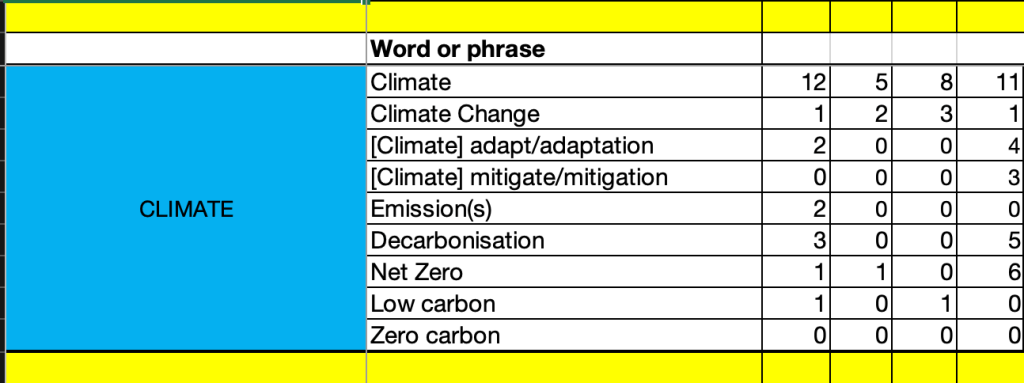
Turning to the climate emergency declared by the UK parliament in May 2019, I looked for where these documents referred to the climate and the national legal commitment to decarbonising all sectors of the UK economy to meet our net zero target by 2050. The phrase ‘climate change’ appears only 7 times across all four documents, ‘net zero’ appears 8 times (and is completely absent from the Four unitary council proposal (led by Rochford)). Decarbonisation also appears 8 times but is completely absent from both the Four unitary council proposal (led by Thurrock) and the Four unitary council proposal (led by Rochford). The word ’emission/s’ appears twice in the Three unitary council proposal but nowhere else. ‘Low carbon’ appears once a piece in the Three unitary council proposal and the Four unitary council proposal (led by Rochford) but not at all in the other two. ‘Zero carbon’ appears in none of them.

What then of the ecological emergency? England is ‘widely considered to be one of the most nature-depleted countries in the world following historic and ongoing declines. Government has made legally-binding commitments to end these declines and for nature to recover‘. Essex County Council is one of the responsible authorities delegated to prepare a Local Nature Recovery Strategy [LNRS] designed to: deliver the necessary action to reverse the current path of decline in our biodiversity; and, bring about a recovery for nature. Essex published its LNRS in July this year.

The phrase ‘nature recovery’ only appears in the Three unitary council proposal. This proposal was made by Essex County Council and the absence of ‘nature recovery’ in all the others perhaps indicates a failure to fully engage the other authorities in the county with this task.

Despite the new planning mandates for ‘biodiversity net gain’, the words biodiversity or biodiverse barely appear. The commonly recognisable terms ‘conservation’ and ‘wildlife’ are fewer and far between.

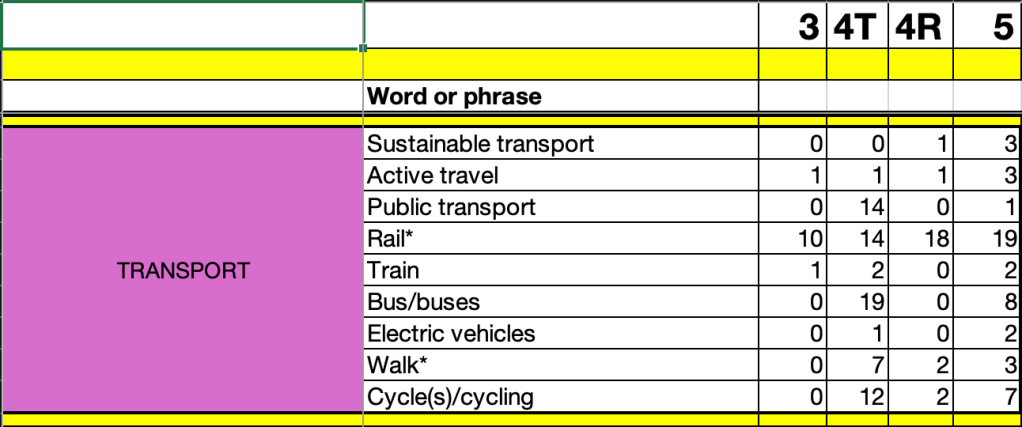
Domestic transport is the largest source of emissions in the UK, accounting for 29.1% of greenhouse gas emissions in 2023. The largest source of emissions from UK transport is road vehicles, which includes passenger cars and freight vehicles using petrol and diesel. Addressing this is key to a lower carbon future and one of the reasons I’m trying to rECOnnect Dengie. What do these proposals have to say about sustainable transport? Two of them don’t use the phrase.

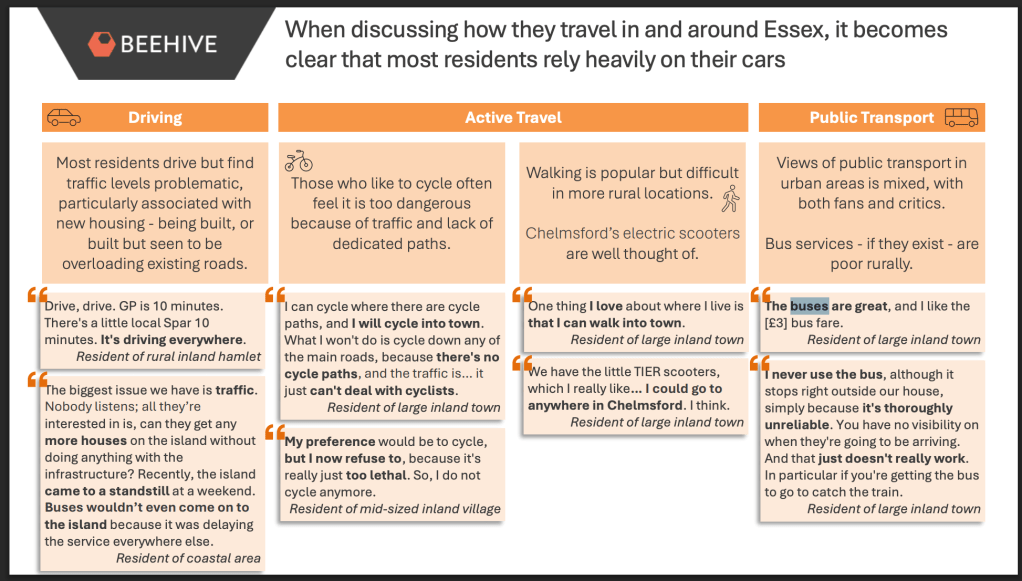
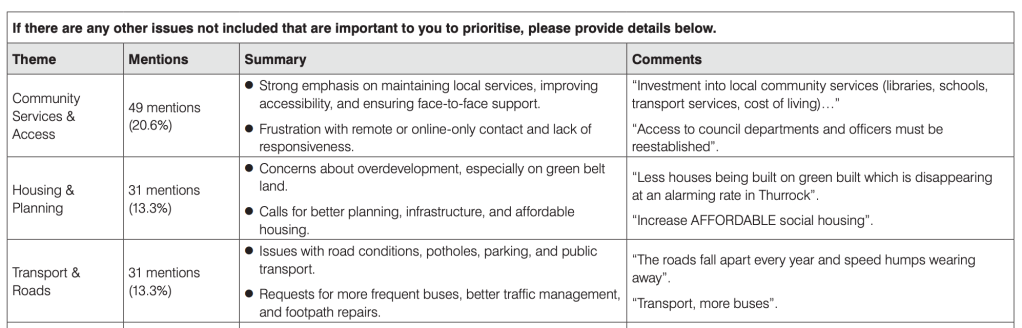
‘Public transport’, ‘bus/buses’, and ‘electric’ [vehicles], are all missing from the Three unitary council proposal and the Four unitary council proposal (led by Rochford). The Three unitary council proposal is particularly lacking in this area with no mentions of ‘sustainable transport’, ‘public transport’, ‘bus/buses’, ‘electric vehicles’, ‘walk/walking/walker(s)’ or of ‘cycle(s)/cycling’. The amount of attention apparently given to this area by the the Four unitary council proposal (led by Rochford) is also deceptive as many of these words appear primarily in summaries of public responses to surveys saying what they would like rather than any clear strategy to deliver them (see slides below).

A couple of slides from the Four unitary council proposal (led by Rochford) with the public’s transport issues

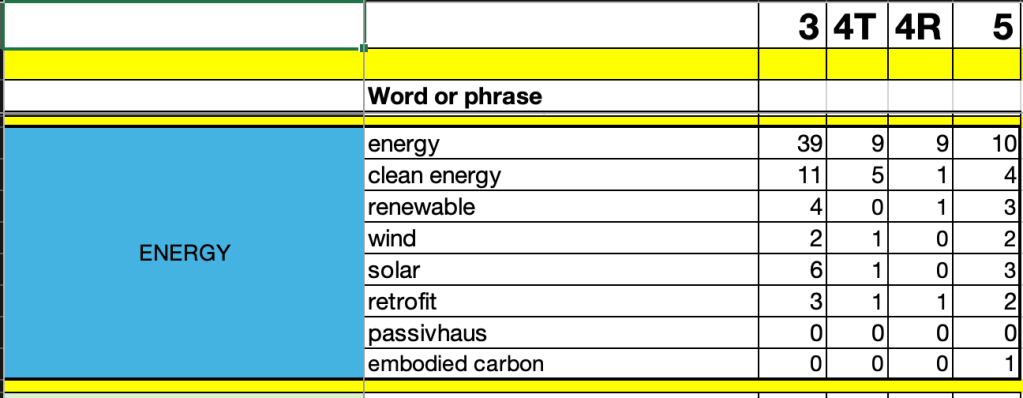
On the topic of clean/renewable energy there’s a bit more attention, but still surprisingly little on some of the keys areas in which we need to act to reduce carbon emissions.

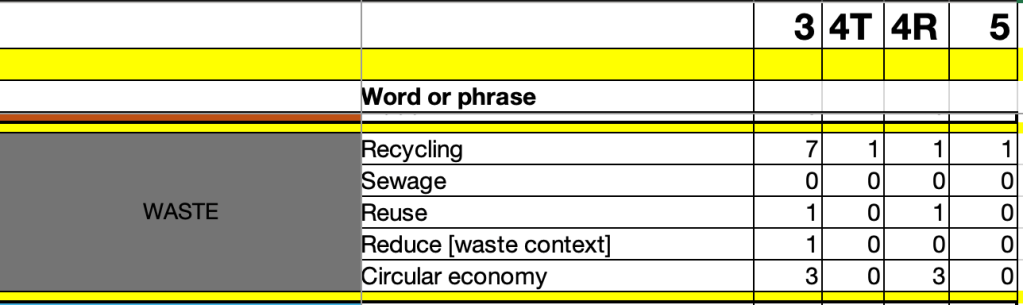
Concerning waste there’s very little, especially in the key areas of reduction and reuse. It’s good to see some nods to the ‘circular economy’ but the county still seems to be celebrating ending landfill by burning rubbish rather than anything more transformative. Despite the massive public outcry against shit in the river and the pollution of our watercourses, none of the proposals dare say ‘sewage’.

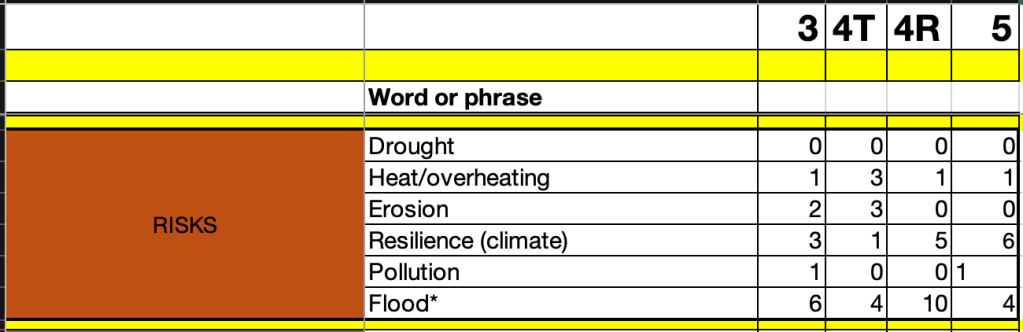
The less we mitigate climate change, the more risks we will face and the greater adaptation we will need to make. There’s not much about this in these forward looking documents and some risks get more attention than others.

As I said at the start this is a quick and dirty analysis – adding up the numbers here won’t tell you which proposal is best – you still need to read the documents and work that out for yourself. More of these words appear in the Three unitary council proposal (279) than any other, the fewest appear in the Four unitary council proposal (led by Thurrock) (189) – but more isn’t necessarily better. A lot of good words have been written in various documents over the years – but what matters is what actually happens not the words.

You Say You Want a Devolution

This week, the Greater Essex devolution consultation opened – part of the fast-track reorganisation of local governance. The consultation concerns the proposal to form a Mayoral Combined County Authority for the local government areas of Essex County Council, Thurrock Council and Southend-on-Sea City Council. An area it calls ‘Greater Essex’ but once was just called Essex. The first election for a Mayor is scheduled to take place in May 2026 – in 15 months.

The consultation does not concern the proposals for new unitary local government replacing the existing two-tier system, where services are split between a county and district council. This seems like replacing one two-tier system with another one: county & districts replaced with mayoralty & unitary authorities. Suffice it to say, they are not taking a bioregional approach.

Continue reading “You Say You Want a Devolution”

Weeknotes 02025 Q1 W7

DCAP

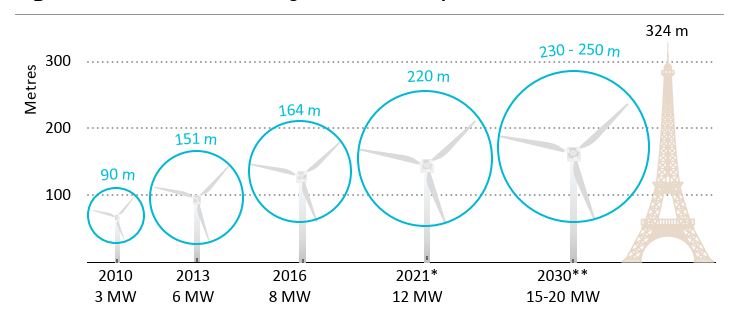
Monday. Community Led Energy Planning Teams call with ECC and Joolz. Also discussed the Dengie Marshes Wind Farm and the possibility of a community asset stake. The more I think about it the more concerned I am about the work necessary if eMpower got involved – especially as I was the only eMpower person on the call – maybe planning around the £600k pa community benefit fund would be a better approach. I saw some anti-wind posting in a local FB group where the poster was saying they would be as tall as the Eiffel Tower – a bit of an exaggeration I thought but I looked up a comparison graphic and (at up to 225m) they would be a significant fraction of the height – plus there could be 17 of them. I find them aesthetically pleasing but 17 two-thirds Eiffel Tower scale turbines would be a dramatic change to the skyline. *Having gone up the Eiffel Tower last month, this was actually a useful comparator).

Monday. C is distributing tree whips to people across the Dengie, she hasn’t had any photos/locations back yet though to map this little forest initiative.

Tuesday. Sorting out details for Riverwatch attendance at the February DCAP meet. Arranging time to talk with Gilly St Lawrence about the March meeting there.

Tuesday. Chasing ECC about dates of LTP4 consultation part 2. Some emails with Mary-Ann Munford and John McCarthy about putting in a bid to Essex Cycle Grant for a feasibility study on the Burnham-on-Crouch – Southminster cycle route. I sent a speculative email to Sustrans to see if they could do one and what the costs would be.

Tuesday. I read the updates from Sarah Green’s Organics that come in the vegbox – the recent rain has allowed them to draw on Bradwell Brook and fill their reservoir. The asynchronous water capture of winter rain is essential with the increasingly dry summers out here

Thursday. Teams call with Gilly re : St Lawrence DCAP meet in March. There’s a possibility that Andy Wright from Essex Wildlife Trust will come to speak about the seagrass restoration project and what else is happening in this part of Essex

Friday- Climate Action Partnerships catch-up call. Heybridge & Maldon Climate Action Partnership are thinking about changing its name to reach a wider audience that isn’t attracted by the current framing. The name HUMAN4NATURE was posited. It made me think about the Burnham Town Council meeting earlier in the week where I had heard some audience guffawing when ‘Net-zero’ was mentioned (they guffawed at the mention of a Covid-19 victim’s remembrance day as well). It also made me think about some recent interactions in a local Facebook group where the idea of the UK taking any climate mitigation action was roundly dismissed and wrapped up with culture war issues and the evils of foreign aid. Climate action is clearly now understood to be in the Woke area of the political spectrum and another nonsense to be dismissed by RUK fans. Later in the day, I watched a Nate Hagens video where he posited that ‘facts and values will not overcome traits and human behaviour and structures’ and spoke about the differences between ‘how the world ought to be and how it is’ – ‘facts and values are important but not sufficient for the times we are living in’ ‘facts and values are no longer sufficient to steer humanity away from the more dystopian outcomes’. He also mentioned, concerning communicating about some topics, that there are things he won’t say publicly because he doesn’t ‘want the Eye of Sauron focussing on Red Wing, Minnesota’ [where he lives]. I’m feeling the Eye of Sauron on me a bit lately.

Friday. I reflected on Heybridge Cllr Paul Spencely’s comments about Heybridge population size after new developments are completed – while she says ‘Heybridge is not a town’ – the imminent population increases will take it over 10k and therefore make it an ‘urban’ place in the UK government terminology.

Friday- I represented the Dengie Hundred Bus Users Group again on a Teams call about the Love Your Bus grant application. There was low attendance though – just the convenor from BTC, Mayowa from Mayland and me – so the meeting was cut short, which suited me – on too many calls lately.

Sunday – Zoom call with Mary-Ann and John about my contact with Sustrans, the questions Sustrans threw back at us, what do we mean by feasibility study? etc.

Day Job

Someone from Digital did the weekly internal editorial blog and wrote about Conway’s Law

Everyday Life

Tuesday. dentists – all good, but booked hygienist for next week.
Tuesday eve. BTC meeting – the first with all the new councillors. There was an agenda item question regarding community groups making free use of the council chamber – it felt rather pointed, as DCAP was singled out as being a group with no BTC representative on it and Cllr Stamp challenged its right to free use of the space. In other news, the EV chargers are finally going to be completed in Providence car park.; there will be no renewal of the Station House lease; there was no clear answer on whether tey are going to do No Mow May or not. New councillors Les Macdonald and Tory guy were jointly appointed to the Environment role on the council. One of the new RUK guys didn’t turn up and didn’t send an apology (turns out he’s quite active on TikTok though) – one of the shy Tories sent an apology – it was the first meeting in which they could participate and they were no-shows. In the public forum section, I didn’t make friends when I raised concerns about some loose communications regarding the recent elections. The secret squirrel section closed to the public was about devolution – the implication from earlier chatter is that the end of District Councils in Essex means local assets (eg. Riverside Park, car parks etc.) and possibly extra responsibilities will devolve to town/parish councils – assume some budget comes with – wait to see on this one.

Wednesday troubled sleep. I had a vivid dream in which I went lucid and had cause to pull myself out. On FB I posted something about reinsurance companies saying that the UK needs to spend £31 billion a year on flood defences – a pertinent subject for a flood risk area that got inundated in 1953 – and presented it as an example of what RUK’s ‘we just have to adapt’ agenda means in practice – it stirred up the standard responses from the standard men – mainly Nige can do no wrong types trying to talk about foreign aid or some other confection. Where factual errors were being presented I countered, and I tried to take a couple of commentators down the logical path of their statements. It gives me no pleasure to relay that straight-up climate denial is alive and well in Burnham-on-Crouch.
Last night’s council nonsense and this FB melee – both set against the latest Trump and Musk drivel, the situation in Gaza, the general rise of the Fash, and Rafael Behr’s Guardian article – boiled my brain. I went out for a walk, musing on whether there was value in saying anything about anything these days and whether protecting my own mental health needed to be prioritised. C and I talk about a lot of this but there’s only so much stuff your partner can take and I miss some larger group of affinity I could talk this shit out with.
Saturday: C and I took the bus to Danbury and then walked to Maldon through ‘The Wilderness’ (got some Shinrin-yoku) and via The Cats public house. The Cats isn’t open much, only takes cash and this was the first time the stars aligned for us – it was open and we had cash. It’s a wonderfully eccentric country pub that you don’t see the like of much anymore. Afterwards, cold rain that wanted to be sleet accompanied us for the last stretch past Beeleigh Abbey and we stopped for another at The Carpenter’s Arms in Maldon before catching the bus home.

Sunday: Blood donation in the morning in South Woodham, #59. They were running late which meant that I had to launch and chair the Zoom call I was hosting on my phone while I was still laid up pumping claret.

Media

Films

Elevation – Amazon post-apocalypse fare. More of the same that we’ve seen before. This one is only 18 months after the event, so I gave them a break on the cars – but it’s amazing/appropriate that in American post-apocalypses the essentials of society remain automobiles, firearms and packaged foods. You generally get a few nods to foraging and periculture but the dish of the day tends to be pulled from an abandoned kitchen cupboard, a defunct vending machine or a supermarket shelf – ‘Mac n’ cheese’ (Elevation), a can of coke (The Road), canned food (Walking Dead) etc. Americans were always already eating like the world had fallen.

TV

Severance S02E05 Trojans Horse – lots of elements point away from my ‘their consciousnesses are inside the computer’ hypothesis but I’m holding on to it. Folk who think that Lumon is doing cloning will find more to support that idea.

Yellowjackets S03E01 and S03E02 Cristina Ricci is still great but I’m not feeling this series yet.

Books

Finding it hard to sit down and read.

Music

On the Yellowjackets trip

Online

I loved the mega library in the latest Srsly Wrong podcast: Morning in Utopia

Les bibliothèques ou la barbarie!

Future Thinking and Dreaming

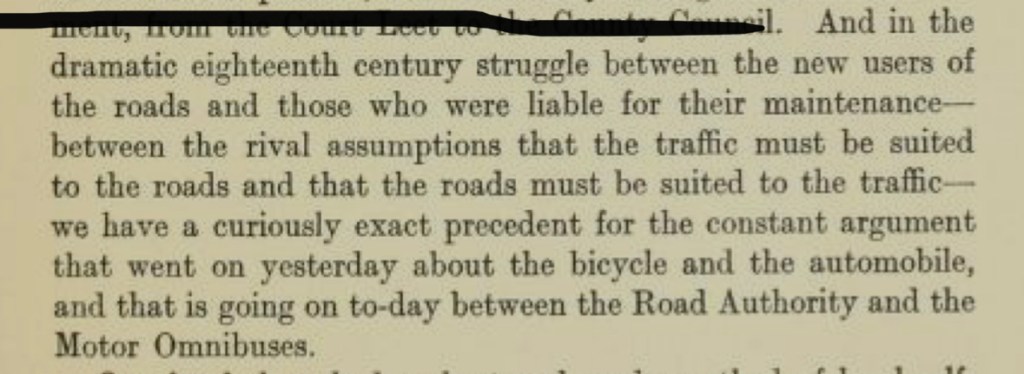
  • Found this paragraph early on in the Webb’s book The King’s Highway (1913)
  • I posed a question on the microblog sites: ‘Creative trespass and wild camping are the most well-known techniques of Tactical ruralism, what else is the toolbox?’

    I don’t think it’s helpful to just list a bunch of things with the prefix wild appended though – wild camping, wild swimming, wild foods etc. I’m trying to imagine something other than that – but what? Some tactical urbanism techniques apply equally, but what are the rural opportunities. Guerilla grafting? guerilla rewilding?
  • I thought that the rich countries going for ‘net zero’ by 2050 was analogous to elite athletic teams having the goal of an as yet unborn competitor winning a bronze medal in six Olympics time while secretly just hoping that they qualify for the Games.
  • I pondered what the Faragist Project 2029 looks like
  • the existence of the Veluwemeer Aqueduct gives me hope for the world – but make that road a railway!
Aquaduct Veluwemeer in the Veluwe lake near Harderwijk

Weeknotes 02025 Q1 W6

Over the weekend we received the disappointing news from Essex County Council that they were unwilling to let the Burnham Library Orchard project go ahead, with some not very detailed reasons about ‘infrastructure’ which seem to pertain to the library building itself which would have been unaffected by the proposal.

Burnham-on-Crouch Library

Tuesday. The Dengie Hundred Bus Users Group (DHBUG) monthly meeting. Hints that the D1 bus might be under threat of being withdrawn now, another hit to Dengie services.

Wednesday – I signed some documents as part of the process of formally registering eMpower Maldon as a Community Benefit Society. John Philpot’s done most of the admin work getting us to this point. We should be registered before the Community Led Energy Planning meeting in Maldon town in March.

Continue reading “Weeknotes 02025 Q1 W6”

The Reformation

Thursday 5th December was the deadline for electors to request a ballot to fill the empty seats on Burnham-on-Crouch Town Council (BTC). I’ve seen a couple of people online saying they would be requesting one for the sake of democracy and to avoid the remaining councillors co-opting whoever they please. There’s still no news about the result and whether elections will be forthcoming. I suspect enough folk will have asked for an election to get one, but not enough people will stand for there to be a contest—certainly in the North Ward.

Continue reading “The Reformation”

Off Target

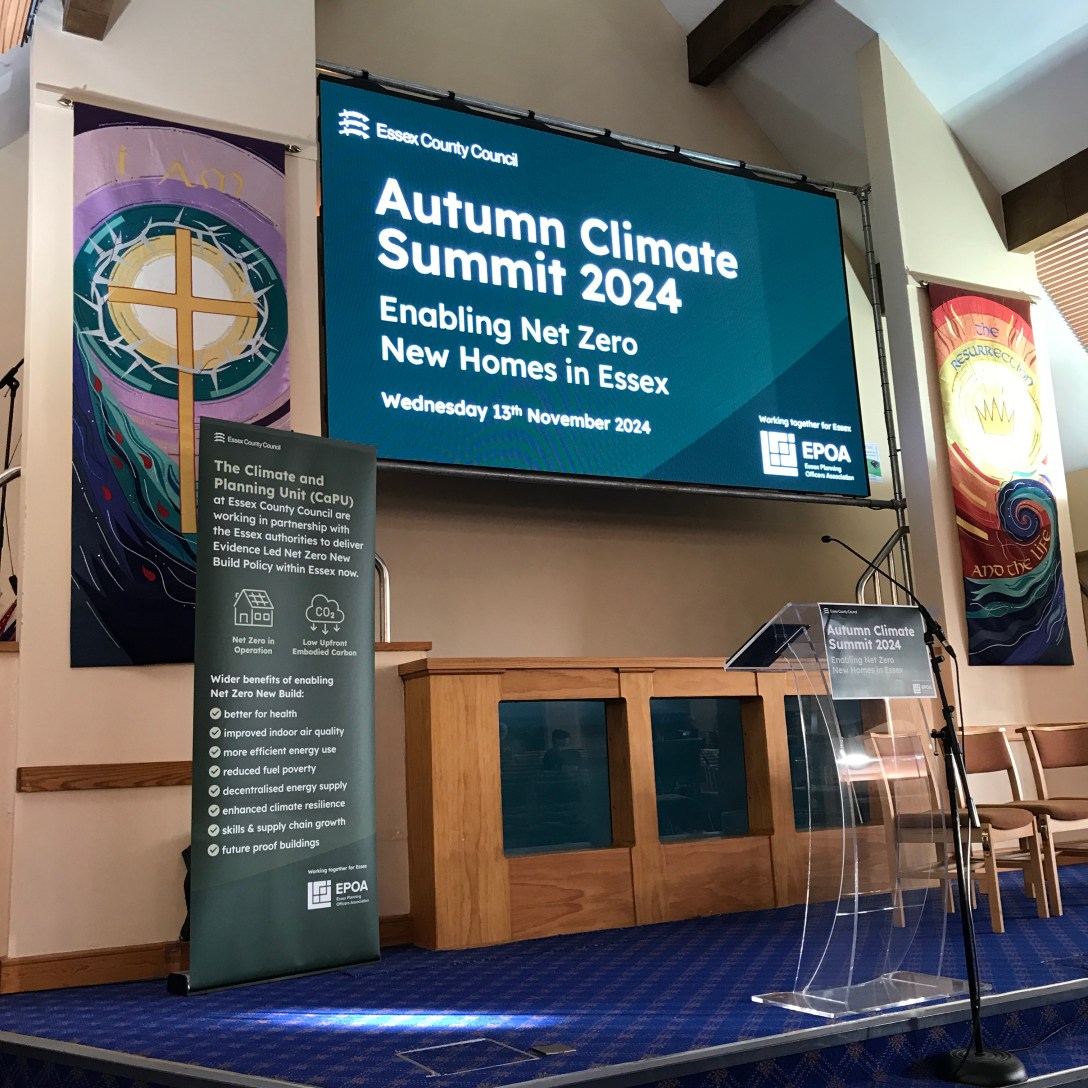
Empty lecturn in front of a screen reading 'Autumn Climate Summit 2024'

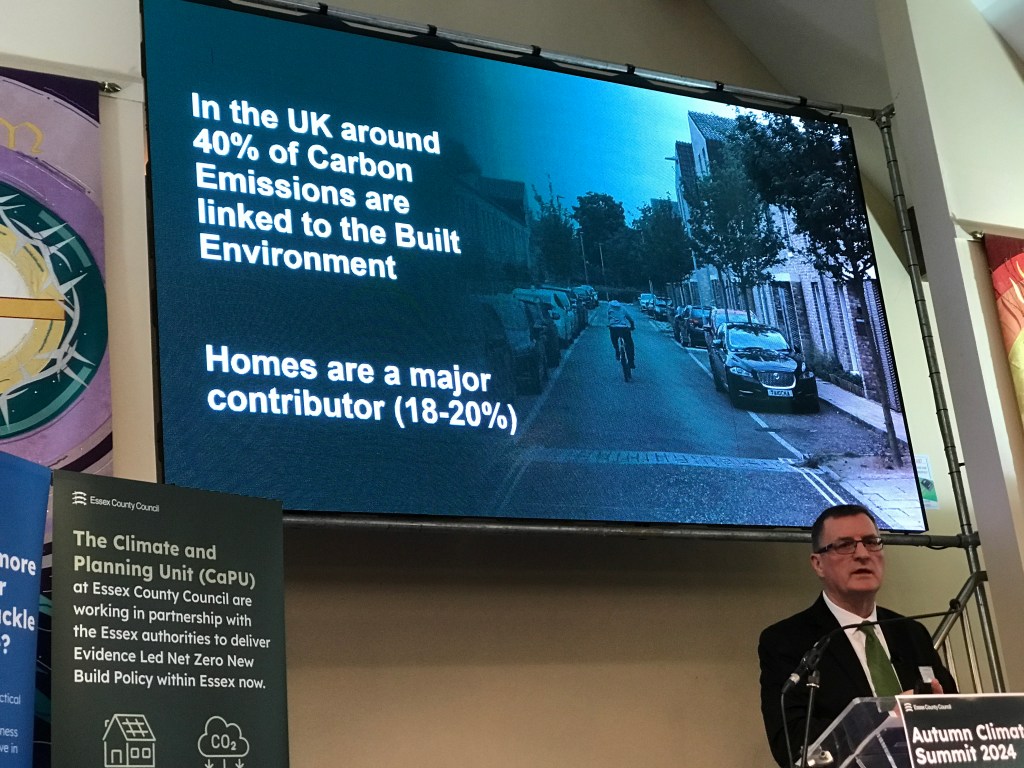
On the 12th of November, I attended the Essex County Council Autumn Climate Summit ‘Enabling Net Zero New Homes in Essex’. I was excited that the Summit showed a level of ambition aligned with the gravity of the national net zero task and our international commitments. (You can watch a recording of the Summit here).

I was also impressed by the statements that Essex was taking a leading role, especially with the Essex Climate Action Commission Set Targets for all new homes to be net zero by 2025 and for all new buildings to produce more energy than they use by 2030.

Continue reading “Off Target”

Read them and Understand them

There’s chaos in Burnham on Crouch Town Council (BTC). Seven councillors resigned last week (including the Mayor and Deputy Mayor), the Chief Officer has not been seen for months and rumour suggests that another of the small staff team has departed. The resignations are the latest incident in a low-intensity conflict between the resignees and previous post holders, the details of which remain largely obscure and cloaked in ‘private and confidential’ ambiguity. Recent sniping in social media posts and comments from the guerrillas have received no return of fire from the occupying forces (an apparent attempt to avoid the bunfight such fora tend to produce) which has made it difficult to take a rounded view.

Continue reading “Read them and Understand them”