By national government edict the 15 councils in ‘Greater Essex’ must reorganise to form new unitary authorities through a process of Local Government Reorganisation. This will change the current two-level council system into one in which there are new, bigger councils called unitary councils.
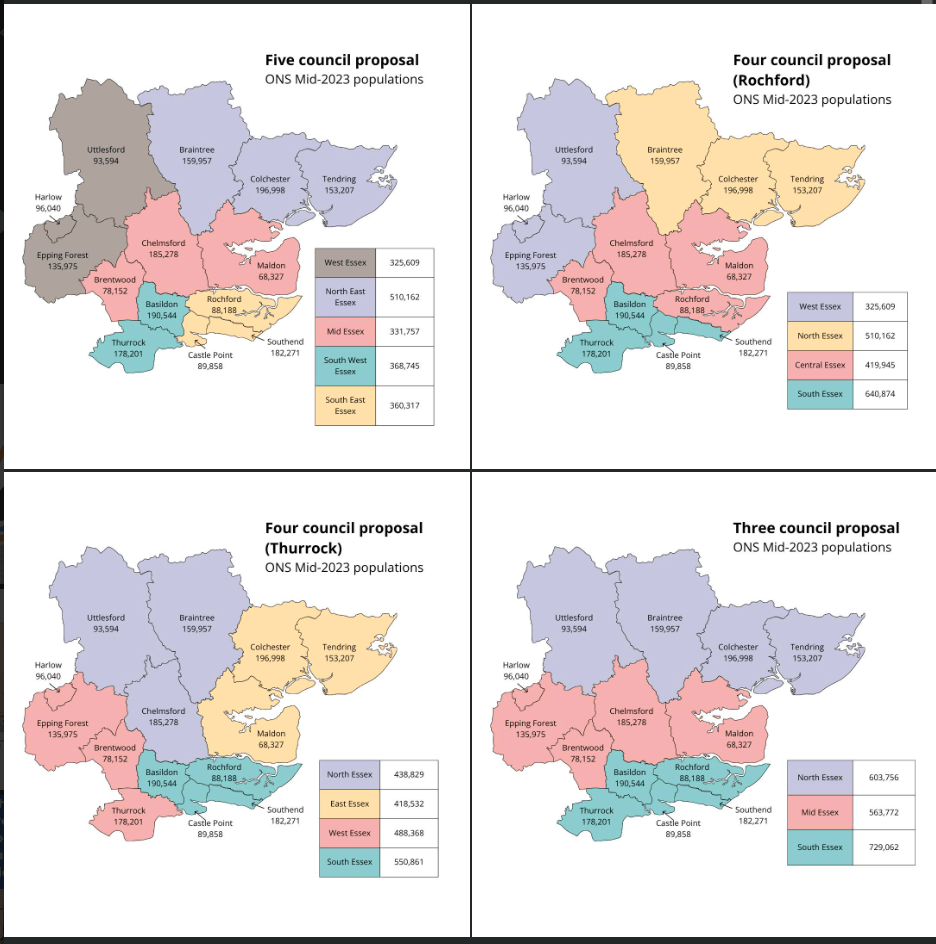
I’ve been reviewing the four competing proposals submitted by existing councils as to how that reorganisation should take shape. (They’re all published here). They divide Essex into 3,4 or 5 new unitary authorities:
*Three unitary council proposal [3]
*Four unitary council proposal (led by Thurrock) [4T]
*Four unitary council proposal (led by Rochford) [4R]
*Five unitary council proposal [5]
(in square brackets I’ve added a number used in the figures below)
There are several hundred pages to go through here (874 pages to be precise), so I’ve done a bit of barefoot textual analysis as a first attempt to see what they have to say about the climate and nature emergencies.
My quick and dirty approach was to quantify how many times some key words and phrases related to these issues appear in the respective documents. I chose words to search for that are either words ordinary people might use or they are part of the common lexicon used by governments, NGOs and the climate movement. I began with general terms.
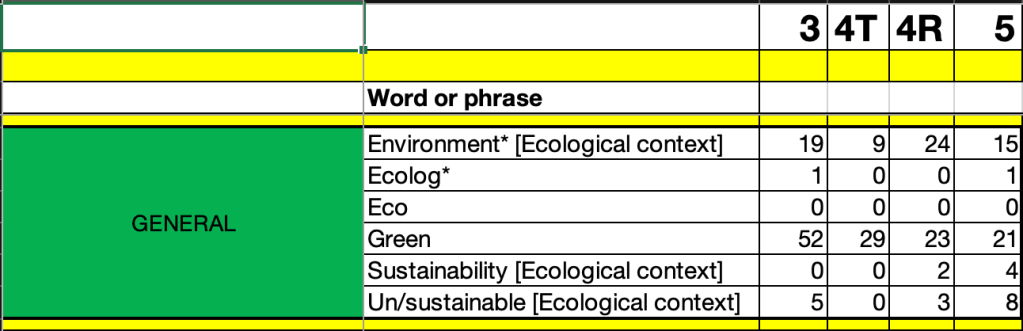
It’s pretty clear that the old favourite ‘sustainability’ is out of favour. That word and sustainable or unsustainable feature often across the documents – 502 times in fact – but very rarely in an ecological context. Only 22 instances of the words relate to ecological sustainability or bear any relationship to the famous definition of “sustainable development” in Our Common Future: ‘Development that meets the needs of the present without compromising the ability of future generations to meet their own needs.’ The words are used primarily as part of the phrase ‘financial sustainability’.
Words derived from the root ecology – ecology itself, ecological, ecologist etc, are almost entirely absent, appearing once each in two of the documents. The contraction ‘eco’ does not appear at all,
The favoured words are clearly ‘environment/al’ and ‘green’ which feature much more often – and to be fair are terms that ordinary people will commonly use. It’s probably worth noting that 45.6% of the times that the word ‘green’ appears in an ecological context it is within the phrase ‘green belt’ (68.6% in the Three unitary council proposal and 65.2% in the Four unitary council proposal (led by Rochford))

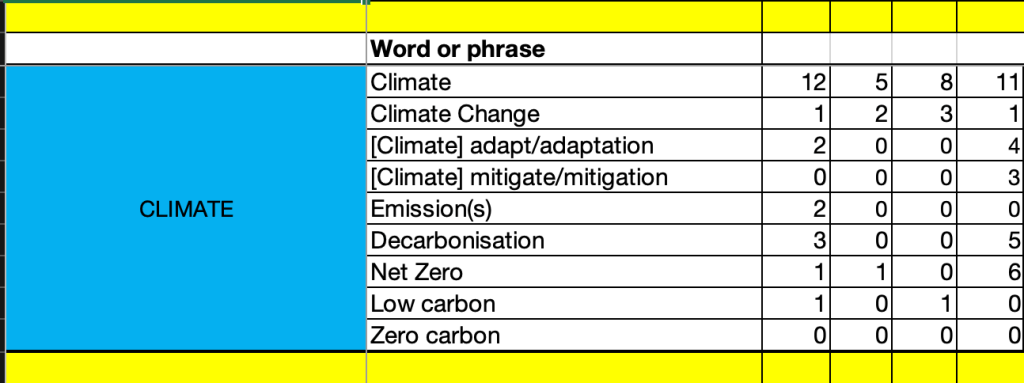
Turning to the climate emergency declared by the UK parliament in May 2019, I looked for where these documents referred to the climate and the national legal commitment to decarbonising all sectors of the UK economy to meet our net zero target by 2050. The phrase ‘climate change’ appears only 7 times across all four documents, ‘net zero’ appears 8 times (and is completely absent from the Four unitary council proposal (led by Rochford)). Decarbonisation also appears 8 times but is completely absent from both the Four unitary council proposal (led by Thurrock) and the Four unitary council proposal (led by Rochford). The word ’emission/s’ appears twice in the Three unitary council proposal but nowhere else. ‘Low carbon’ appears once a piece in the Three unitary council proposal and the Four unitary council proposal (led by Rochford) but not at all in the other two. ‘Zero carbon’ appears in none of them.
What then of the ecological emergency? England is ‘widely considered to be one of the most nature-depleted countries in the world following historic and ongoing declines. Government has made legally-binding commitments to end these declines and for nature to recover‘. Essex County Council is one of the responsible authorities delegated to prepare a Local Nature Recovery Strategy [LNRS] designed to: deliver the necessary action to reverse the current path of decline in our biodiversity; and, bring about a recovery for nature. Essex published its LNRS in July this year.
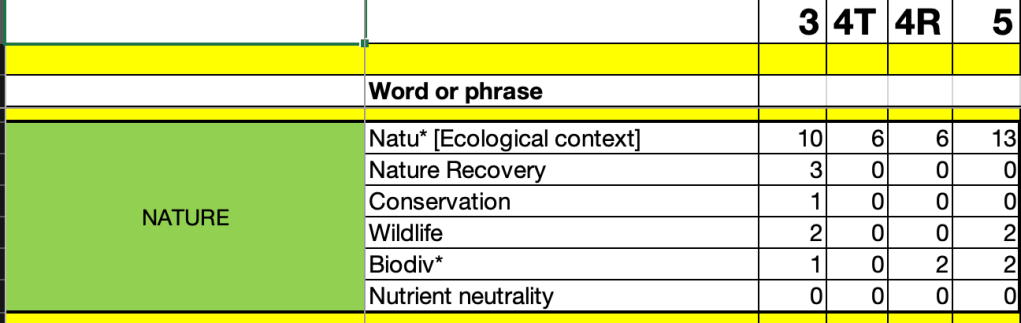
The phrase ‘nature recovery’ only appears in the Three unitary council proposal. This proposal was made by Essex County Council and the absence of ‘nature recovery’ in all the others perhaps indicates a failure to fully engage the other authorities in the county with this task.
Despite the new planning mandates for ‘biodiversity net gain’, the words biodiversity or biodiverse barely appear. The commonly recognisable terms ‘conservation’ and ‘wildlife’ are fewer and far between.
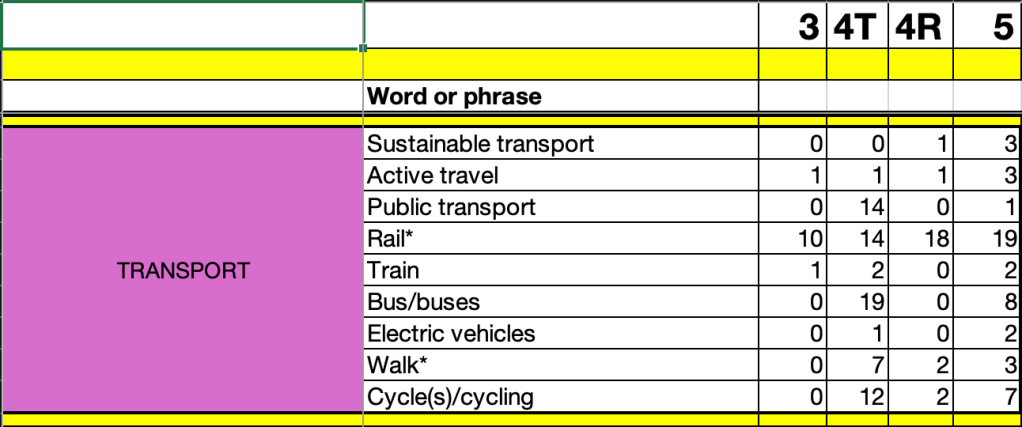
Domestic transport is the largest source of emissions in the UK, accounting for 29.1% of greenhouse gas emissions in 2023. The largest source of emissions from UK transport is road vehicles, which includes passenger cars and freight vehicles using petrol and diesel. Addressing this is key to a lower carbon future and one of the reasons I’m trying to rECOnnect Dengie. What do these proposals have to say about sustainable transport? Two of them don’t use the phrase.
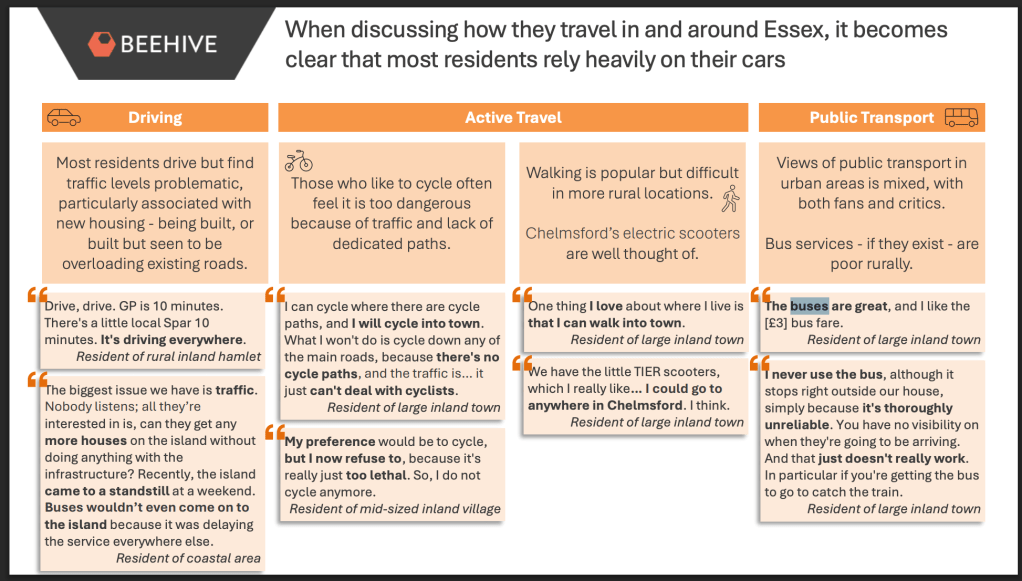
‘Public transport’, ‘bus/buses’, and ‘electric’ [vehicles], are all missing from the Three unitary council proposal and the Four unitary council proposal (led by Rochford). The Three unitary council proposal is particularly lacking in this area with no mentions of ‘sustainable transport’, ‘public transport’, ‘bus/buses’, ‘electric vehicles’, ‘walk/walking/walker(s)’ or of ‘cycle(s)/cycling’. The amount of attention apparently given to this area by the the Four unitary council proposal (led by Rochford) is also deceptive as many of these words appear primarily in summaries of public responses to surveys saying what they would like rather than any clear strategy to deliver them (see slides below).
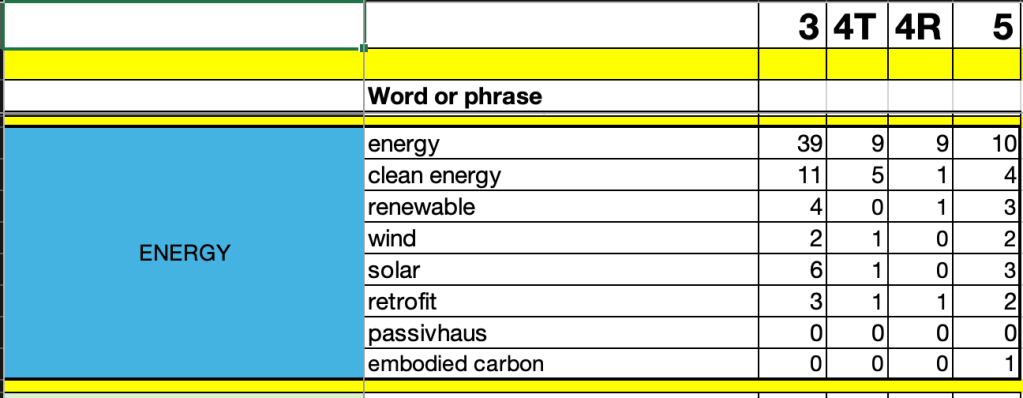
On the topic of clean/renewable energy there’s a bit more attention, but still surprisingly little on some of the keys areas in which we need to act to reduce carbon emissions.
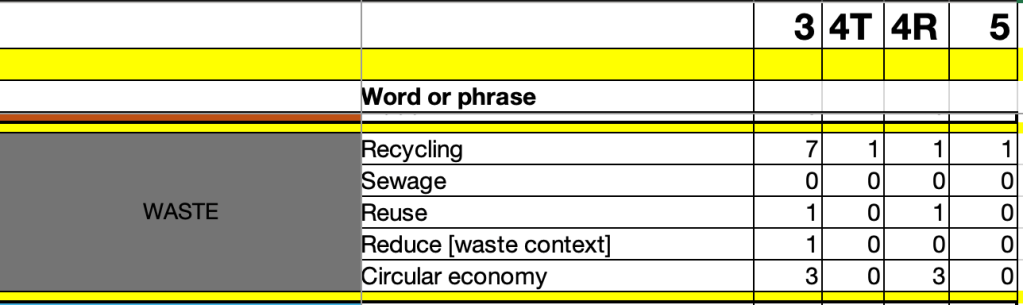
Concerning waste there’s very little, especially in the key areas of reduction and reuse. It’s good to see some nods to the ‘circular economy’ but the county still seems to be celebrating ending landfill by burning rubbish rather than anything more transformative. Despite the massive public outcry against shit in the river and the pollution of our watercourses, none of the proposals dare say ‘sewage’.
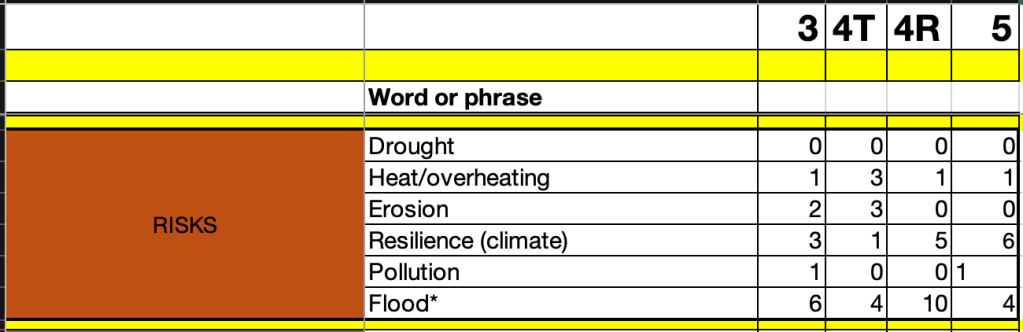
The less we mitigate climate change, the more risks we will face and the greater adaptation we will need to make. There’s not much about this in these forward looking documents and some risks get more attention than others.
As I said at the start this is a quick and dirty analysis – adding up the numbers here won’t tell you which proposal is best – you still need to read the documents and work that out for yourself. More of these words appear in the Three unitary council proposal (279) than any other, the fewest appear in the Four unitary council proposal (led by Thurrock) (189) – but more isn’t necessarily better. A lot of good words have been written in various documents over the years – but what matters is what actually happens not the words.

 Dengie Bioregion