Thursday 5th December was the deadline for electors to request a ballot to fill the empty seats on Burnham-on-Crouch Town Council (BTC). I’ve seen a couple of people online saying they would be requesting one for the sake of democracy and to avoid the remaining councillors co-opting whoever they please. There’s still no news about the result and whether elections will be forthcoming. I suspect enough folk will have asked for an election to get one, but not enough people will stand for there to be a contest—certainly in the North Ward.
Three District councillors have been temporarily added to BTC to ensure quoracy and continuity, an done of those three has been made Mayor despite not being elected here. The situation is an awkward interregnum and we now wait to see if the council will get new elected members, some uncontested ones, some co-optees, or a mix of all three.
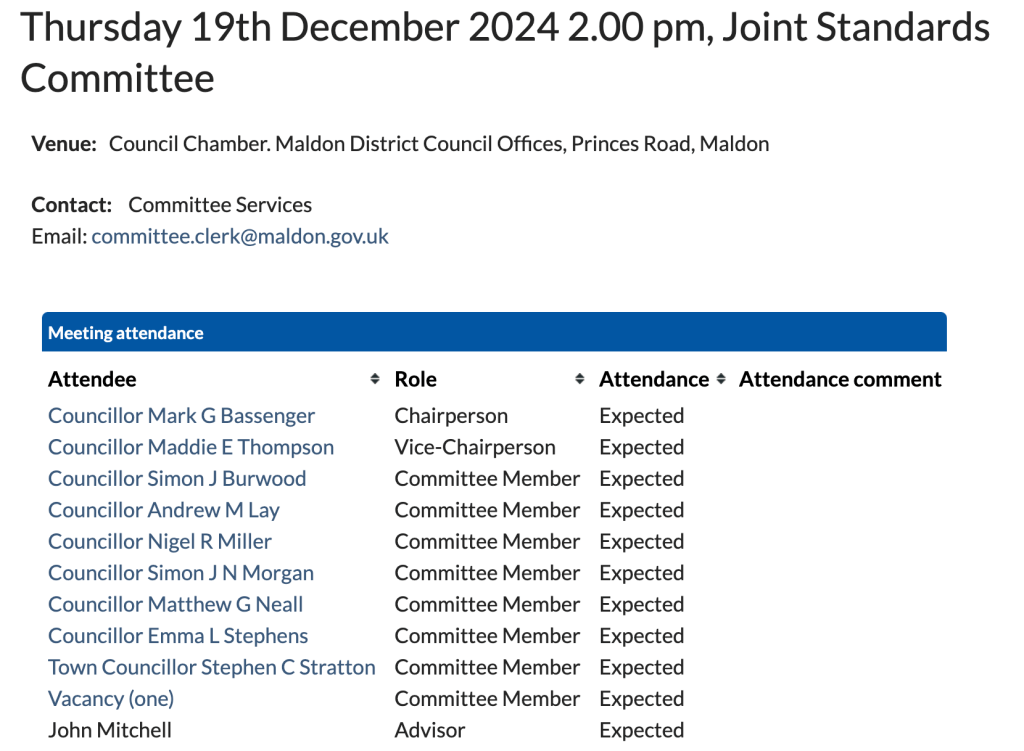
Today the Joint Standards Committee (JSC) of Maldon District Council (MDC) will sit to consider one of the many issues that has led to recent factional conflict in the Town Council with hints and allegations against various councillors about bullying, harassment, financial misconduct, coopting mates and inappropriate behaviour. The already published report by independent investigators PKF Littlejohn tells a sorry story.
No matter what the conclusion of the meeting today, or of other outstanding matters, I think all this is likely to provoke questions from the people of Burnham like: why is this happening on our council? what is going on? why are we so poorly represented here? One would assume it is a deviation from some happier norm that exists elsewhere. An article published earlier in the year by East Anglia Bylines, and written by an ex-parish councillor in Norfolk, suggests otherwise. The article, titled ‘Parish councils – toxic, dysfunctional and outdated’, opens with the paragraph:
‘Parish councils are in trouble. Across the country, there are stories about bullying, financial mismanagement and silencing complaining parishioners, excessive precept rises, code of conduct breaches, warring factions, or just plain bad behaviour.’
The article goes on to talk about mass resignations on some Norfolk parish councils, on the risks of councillors either ‘elected uncontested’ or ‘co-opted’, of chumocracies, of councillors operating in ways contrary to the council’s governing Financial Regulations. It all sounds very familiar.

There’s not much in the article about the reasons why these problems exist and what the solutions for them are. It states that ‘[p]arish councils, their legislation and especially their governance, need urgent reform’ and points towards a Review ‘looking at accountability within public bodies and the importance of acting on early warning signs’. The independent Committee on Standards in Public Life consulted on that Review, the consultation closed on 14th June 2024 and has not yet reported its findings.
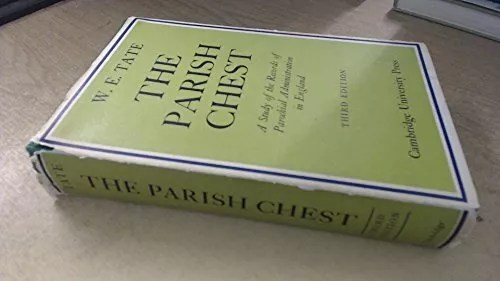
As far back as the 17th Century, the Vestry Committees, which are ancestors to today’s parish councils, were already renowned for their venality – a product of their governance ‘by a self-perpetuating elite’ recruited largely by co-option. In his book The parish chest: a study of the records of parochial administration in England (1946), W.E. Tate notes that by 1819 the Select Vestry had ‘become a byword for Jobbery and corruption’. No doubt good work was done and continues to be done at this level of government but centuries of ill-repute will tend to persist and make it easy to besmirch any post holder.
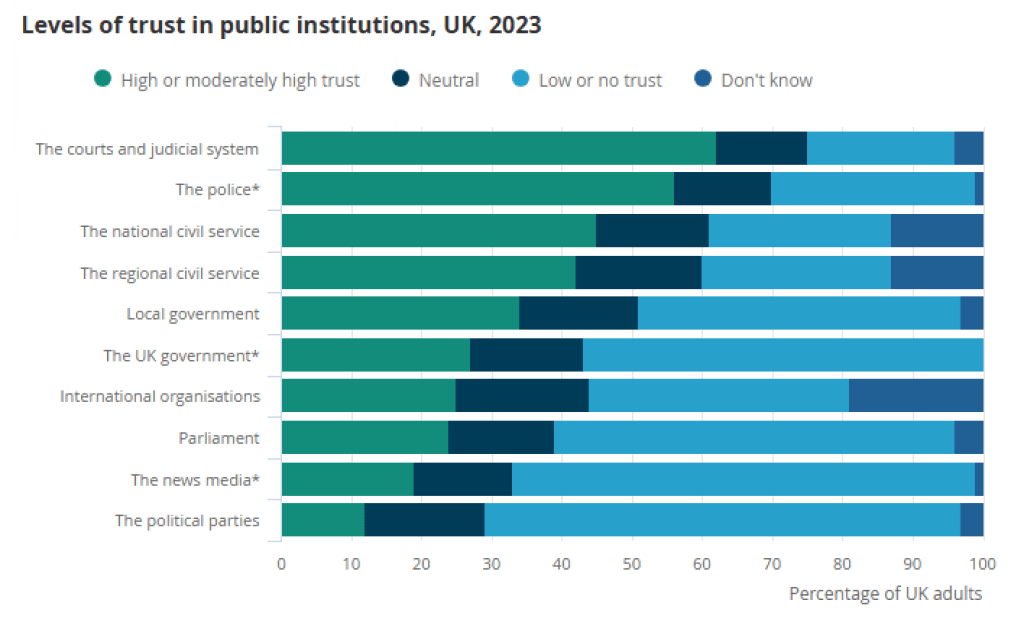
Singling out the lowest level of government is also perhaps unfair. The latest British Social Attitudes (BSA) report found that ‘ Trust and confidence in Britain’s system of government [was] at [a] record low’. The Office for National Statistics ‘Trust in Government Survey’ in 2023 found that local government was actually trusted more than the UK Government. A series of scandals including everything from MPs expenses, dodgy dossiers, Partygate, and Covid contracts for mates, to cash for questions, cash for access, and cash for influence has holed public confidence below the waterline and trust has been sinking ever since.
I wrote previously about recent electoral cycles and how not-getting-Brexit-done and the resulting mistrust in politicians helped fuel local support for Independents. I wonder now if the pendulum is swinging more towards ‘populists’, whether they be Faragists or just people who talk loudly and often on social media about their achievements and what they are doing for YOU!
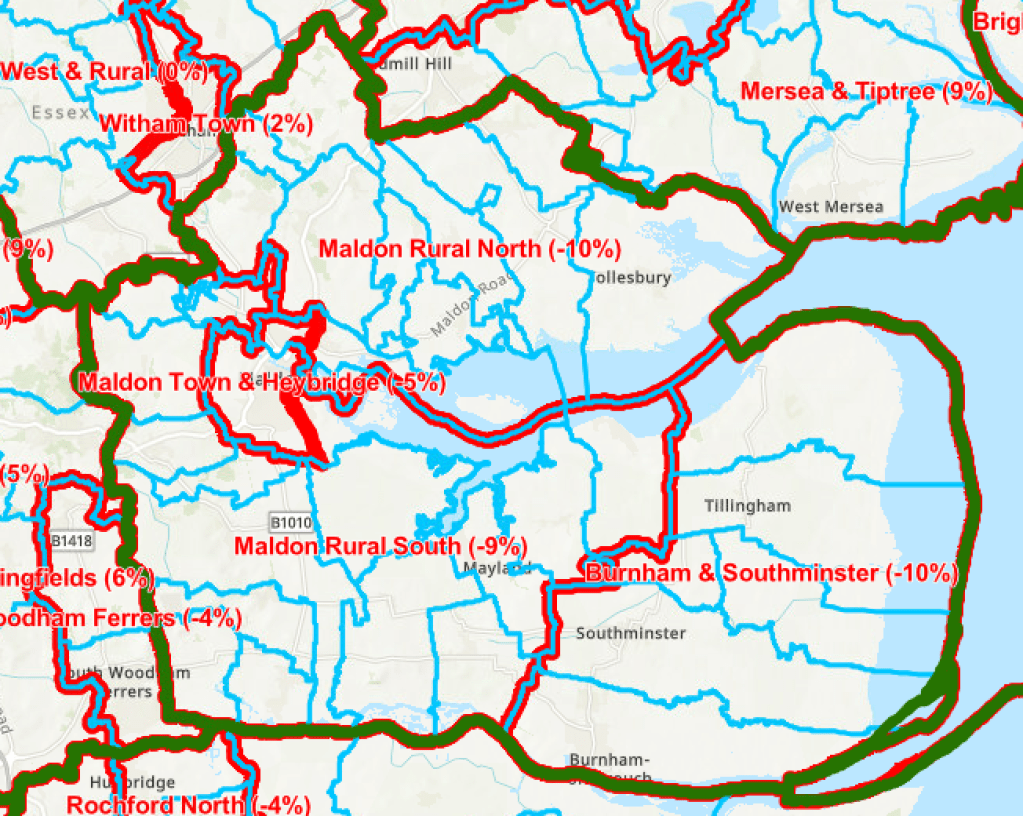
1st May 2025 will see County Council Elections in Essex, the first after boundary changes. The two divisions that currently contain Dengie parishes, ‘Maldon’ and ‘Southminster’ will go, and the Dengie will now fall into ‘Maldon Rural South’ and ‘Burnham & Southminster’.
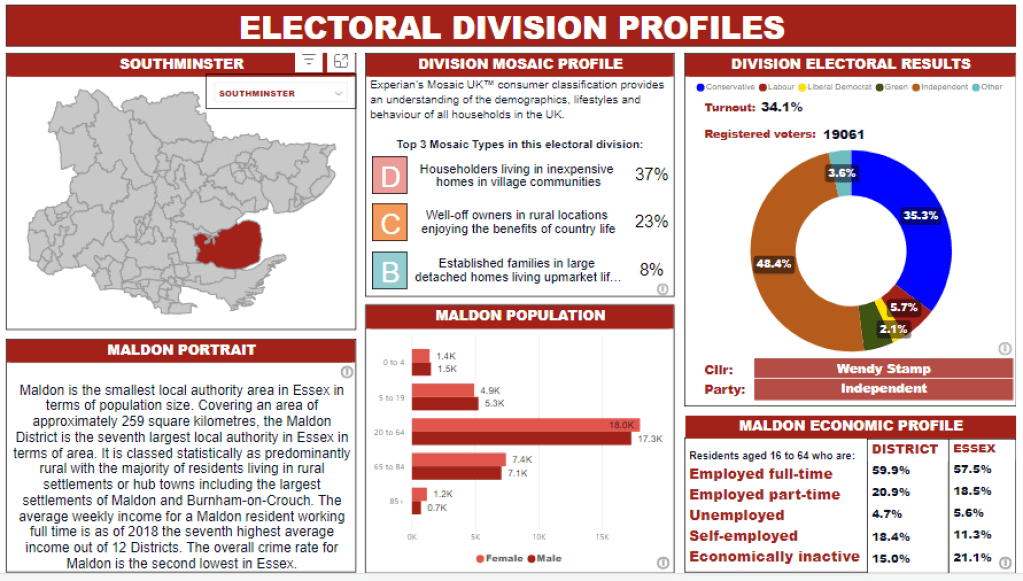
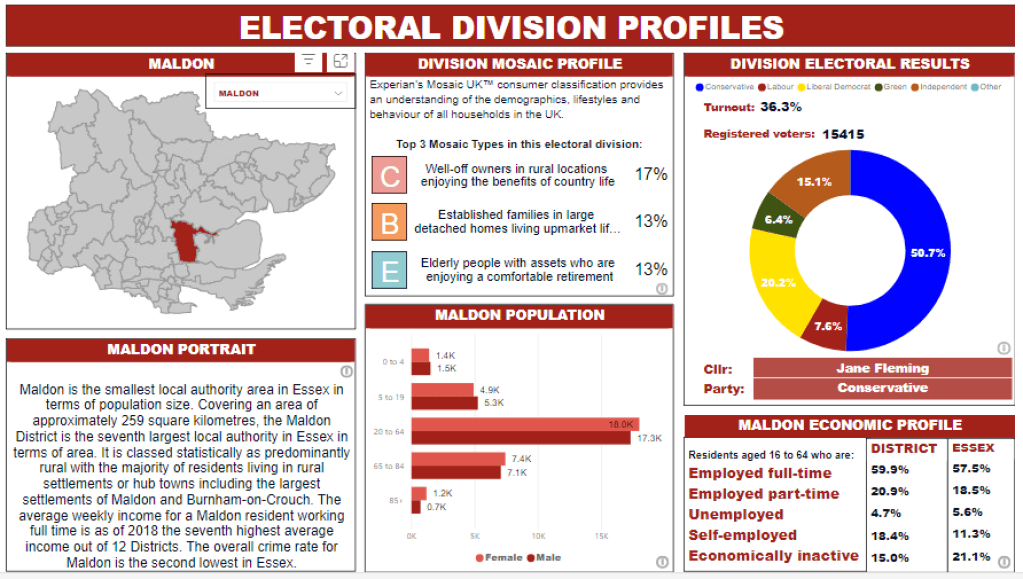
The sitting incumbents will presumably stand again. ‘Burnham & Southminster’ is close enough to ‘Southminster’ division to assume Cllr Stamp (Independent) will be the continuity candidate but Cllr Jane Fleming (Conservative)’s ‘Maldon’ seat is split, with the Dengie element in ‘Maldon Rural South’ and urban Maldon ville in ‘Maldon Town & Heybridge’. The thing to watch out for is Reform UK candidates, might they be a more appealing choice than an Independent or a Tory this time around?
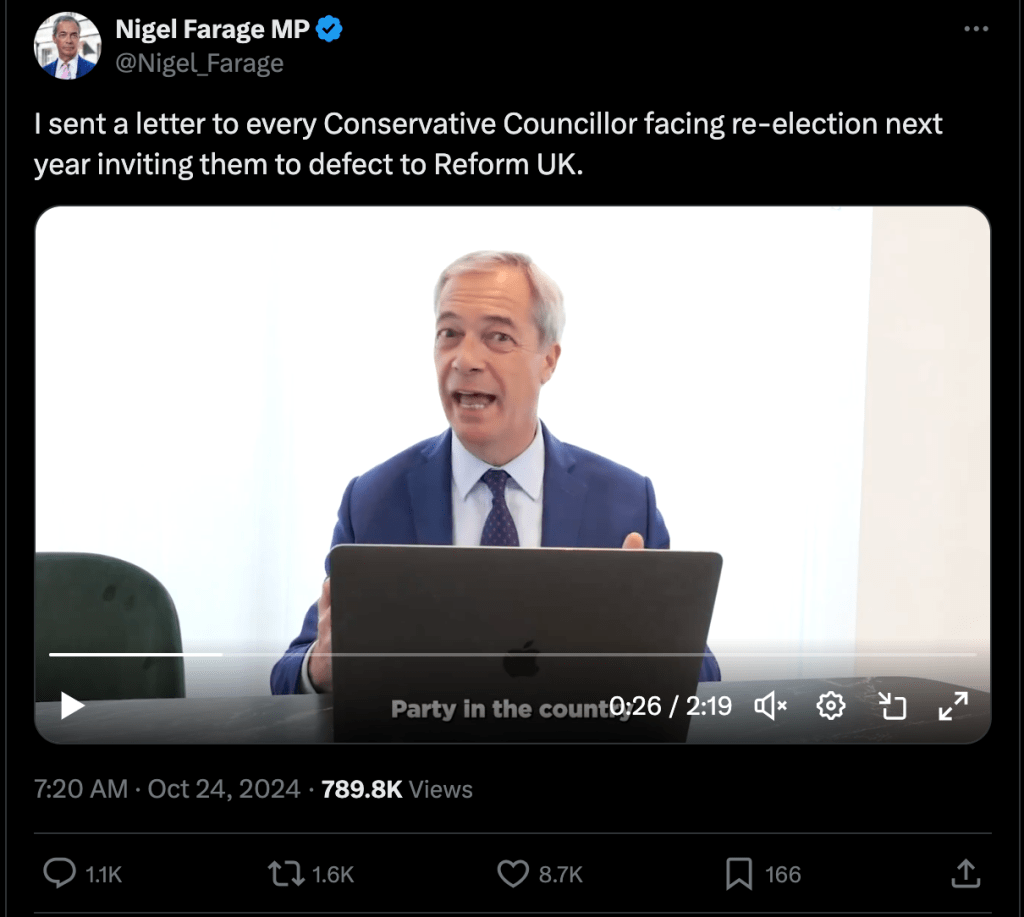
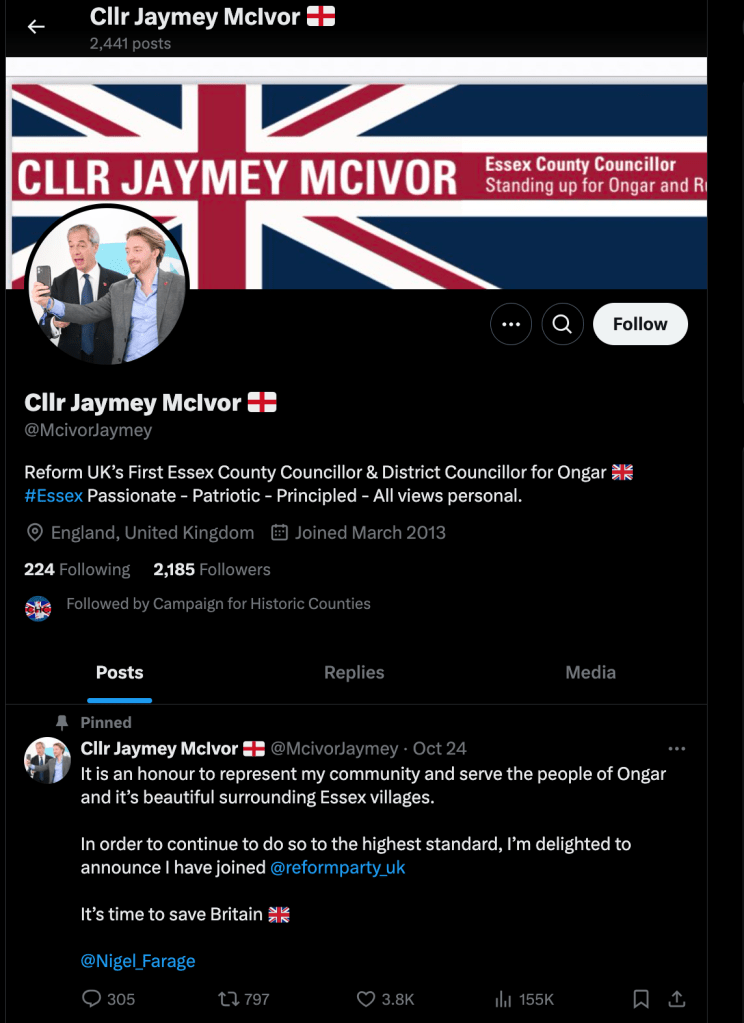
With two of the five Reform MPs sitting in Essex, the county is clearly in the party’s sights. Two Southend councillors defected to Reform in September. In October, Farage announced that he had sent a letter to every Conservative Councillor facing re-election next year inviting them to defect to Reform UK, giving them until 6 November to do so or face a Reform candidate standing against them. Jaymey McIvor, councillor for Ongar & Rural promptly jumped ship.
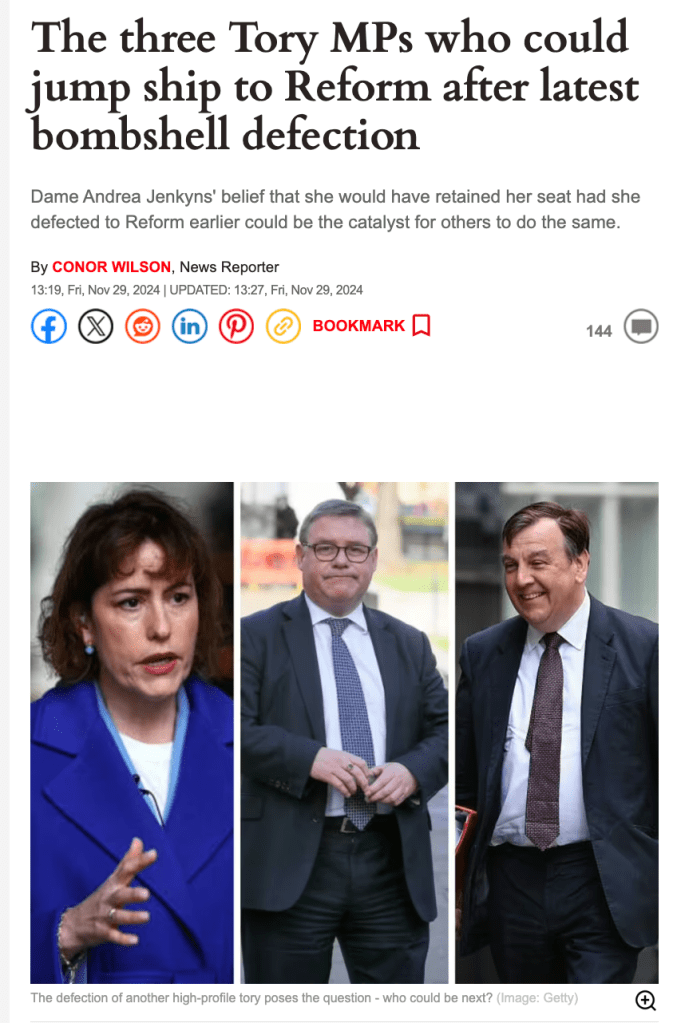
With a bunch of other middle-ranking Tories making the switch (from former MP Dame Andrea ‘give the public the finger’ Jenkyns, to the husband of former Home Secretary Suella ‘Cruella’ Bravermann), The Daily Express published ‘The three Tory MPs who could jump ship to Reform after latest bombshell defection’. The lead photograph of three Tory MPs included Maldon’s member John Whittingdale alongside Mark Francois, the member for Rayleigh and Wickford – but the article didn’t actually mention Sir John.
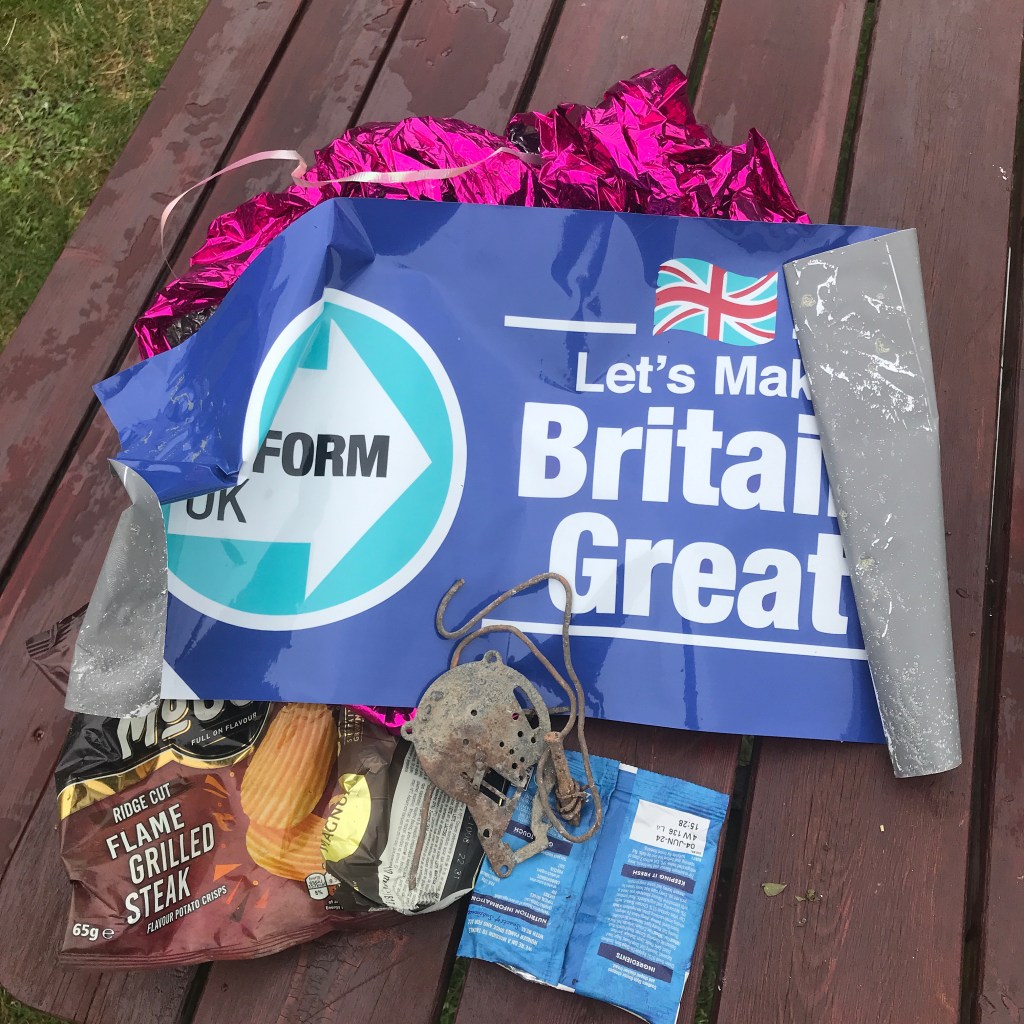
In the general election, Whittingdale held his seat but Reform came from nowhere to second place; his share of the vote was nearly halved [election report] The ‘Vote Reform’ sticker bombing campaign on the Dengie was extensive and despite my own and others’ efforts to remove their graffiti, many are still evident in hard-to-reach positions. The much heralded Musk $100 million war chest could supply the funds for an even larger campaign. That said, the first opportunity for Reform to actually contest an Essex County Council seat came with the Stock by-election last week and they didn’t fielded a candidate there. Perhaps they’re holding out for the better publicity opportunities afforded in May and the new Danbury & The Hanningfields division.
This week saw the publication of a government white paper on regional devolution that proposes a much larger reorganisation of political geographies. It’s being heralded as a re-localisation of sovereignty, with powers moving from Whitehall to new regional authorities. Squint a bit and it looks like the unfinished regional devolution in England that was supposed to follow the formation of the Scottish Parliament and Welsh Assembly. Squint harder and it’s the modern manifestation of the long Labour tradition of devolutionary thought and the Fabian nod to a ‘new heptarchy’ in England(see some discussion of this here.)
The proposed shape of this new political geography is not yet fully revealed but the demise of two-tier local government (county and district councils here) in favour of combined authorities is writ large. This would involve a centralisation of powers rather than subsidiarity. Will there be Mayoralties? Assemblies? What form of representation will the electorate be offered by this restructuring? Jim McMahon, the local government minister speaking in the House attempted to reassure before publication saying that the ‘white paper will also announce measures that will give local places and communities greater control over shaping their area’. As District, Town and Parish councils are currently working on the Local and Neighbourhood Development Plans that will cover the period up until 2050 – by which time the UK is legally committed to total decarbonisation – the local shaping of our places has never before been so important.
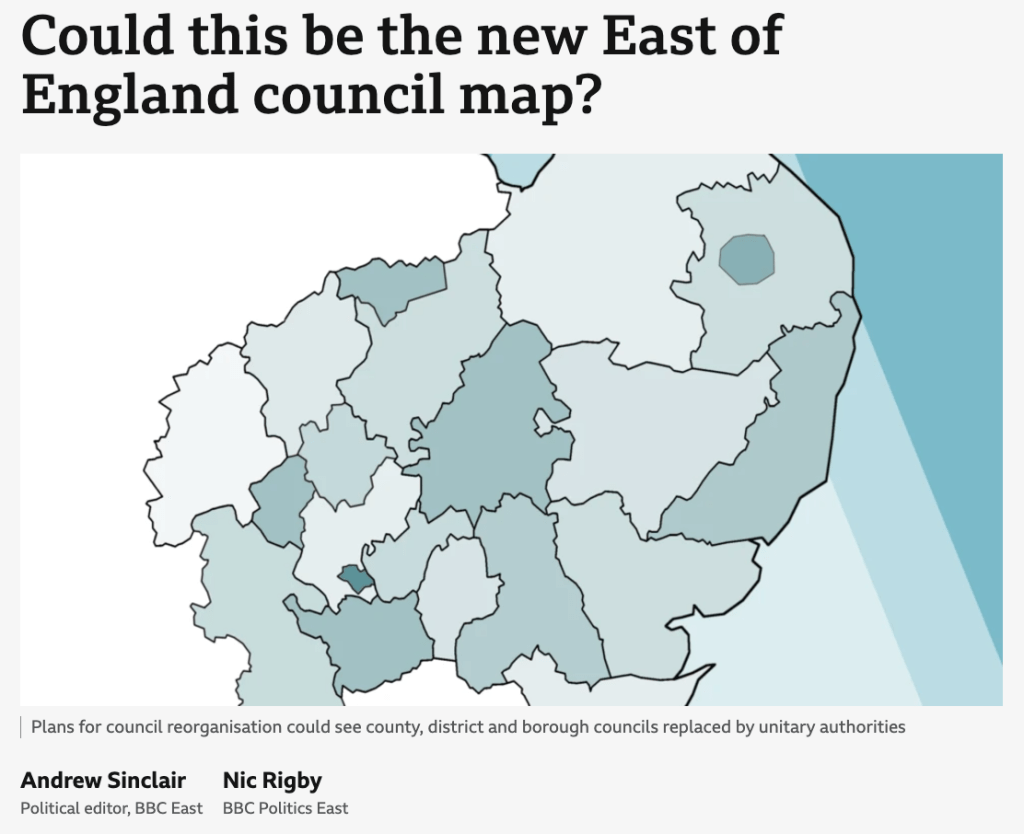
The Times reports that ‘Ministers are believed to have identified ten areas of the country that are open to reform and will form the first wave of reorganisation.’ Among those ten is Essex.
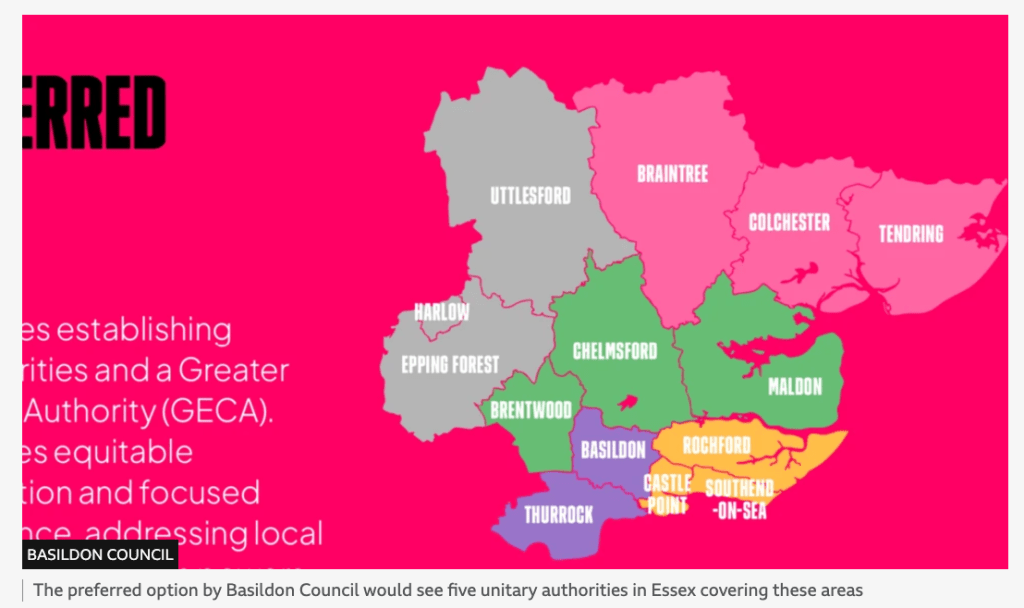
Gavin Callaghan, Labour leader of Basildon council, is keen on the idea and has a map dividing Essex into five unitary authorities. ‘Callaghan said he had spoken to ministers in Westminster who were “receptive” to the idea that “Essex is broken and that there is a better way”.’
In Maldon District, the council leader was more circumspect:
‘Cllr Richard Siddall, Leader of Maldon District Council, who is a Maldon District Independent Group member, said: “I would echo the comments of the District Councils’ Network, in that any reorganisation of local government would need to be part of a holistic public service reform. Local government needs to be kept local so that residents and businesses can relate to it. We need to ensure that we strengthen local democracy and reflect local circumstances. Councils need to have a sense of place, otherwise they lose the connection to those they represent. I await to see the Government’s White Paper.”
In The Guardian, Simon Jenkins writes about the distinct but related proposals to ‘reform’ planning laws by making planning ‘centralised – or “regionalised”’ with ‘local planning offices and committees… be[ing] disempowered’. It’s not the ‘greater control over shaping their area’ heralded by Jim McMahon. Jenkins notes that ‘[t]oday “regional” is merely code for central direction’ and that it ‘is anti-democratic – and will do little more than aid Reform’.
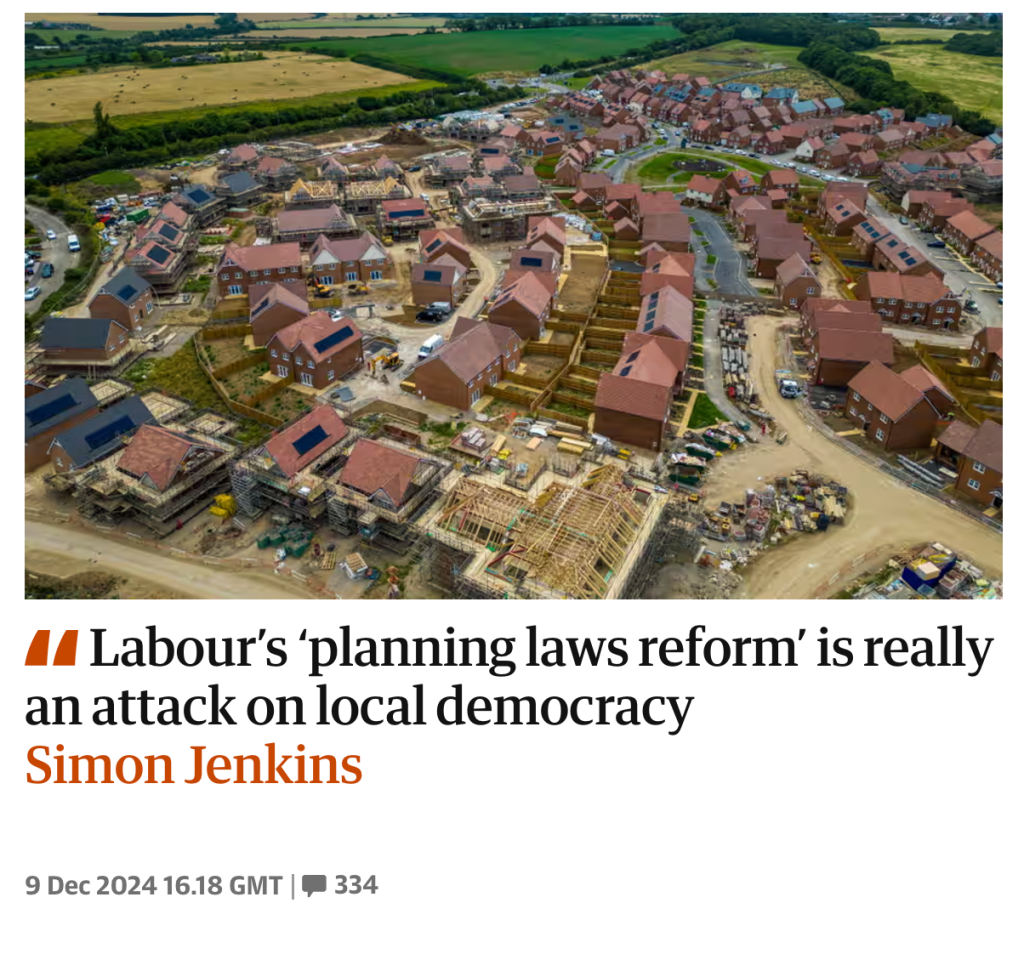
The Reform he mentions here is not the reform of the article title but the party Reform UK. He doesn’t elaborate but one assumes from the article’s content that he means: if Labour push through the building of loads of new houses, ‘Algorithmic housing targets are to be imposed on rural communities and any proper control over a development’s location, scale and appearance removed’ then an electorate eager to Take Back Control will vote for Reform UK.
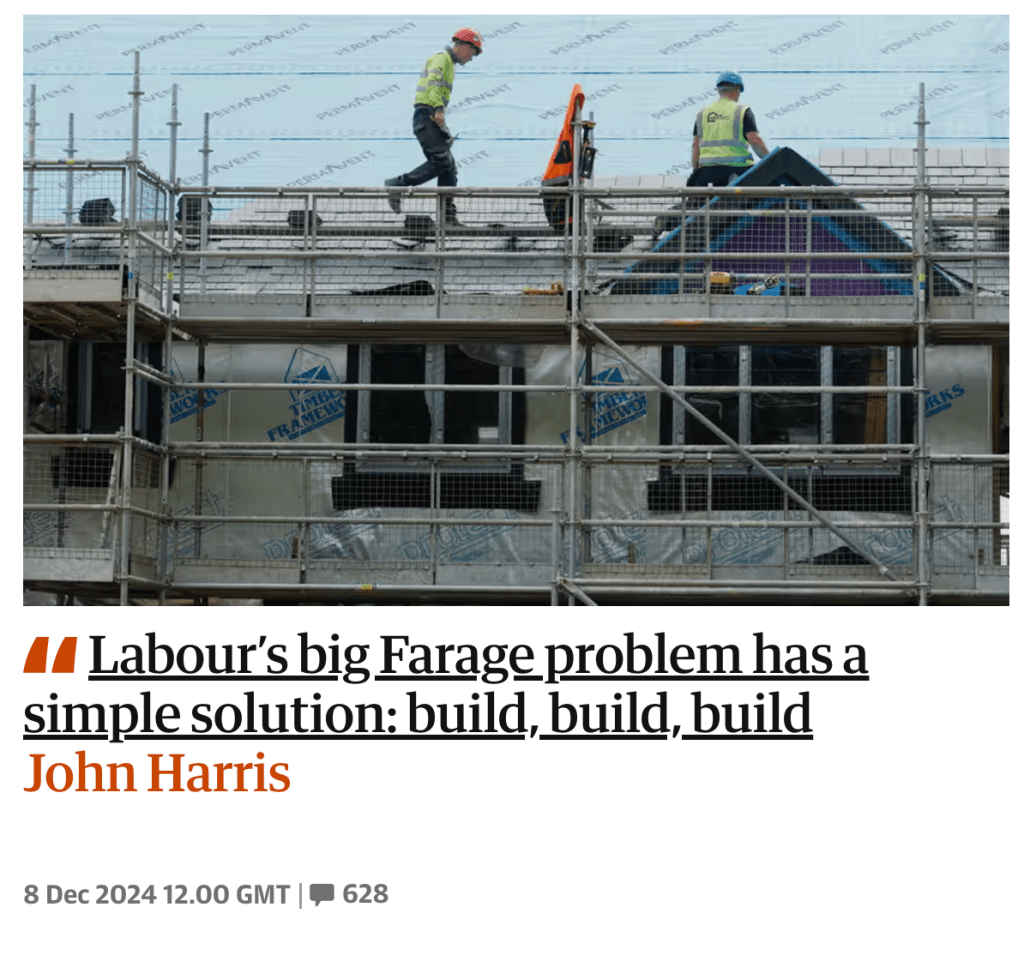
It’s interesting to contrast Jenkin’s article with one by his colleague John Harris published a day earlier: ‘Labour’s big Farage problem has a simple solution: build, build, build’. Harris states that ‘while reporting from so many of the places now leaning Reform’s way: coastal towns, the parts of outer-east London that blur into Essex…’ that ‘once conversations have got through immigration and the threadbare state of local public services, people have concentrated on one inescapable subject: housing, and how its scarcity compares with a past of relative plenty, which is exactly the kind of contrast that Reform trades on.’
Damned if you build, damned if you don’t.
Andrew Schrader, a Conservative councillor for Basildon, speaking about the proposed reorganisation of Essex expressed some wariness but noted that ‘local government was crying out for reform’ – the naming of Reform UK increasingly reveals its utility. Barry Aspinell, the Liberal Democrat leader of Brentwood Borough Council was equally wary of reorganisation, warning ‘with the county council now dominated by the Tories – a unitary authority with even more powers could also likely be ruled by the Conservatives – despite district variations.’ The threat of Reform UK is somehow both clear and obscure.
Looking ahead to next May’s local elections, and also to the possible political geographies ahead, the tribulations of a town council can appear trivial. But my thoughts return to the words of Graham Shackleton writing for Common Ground about the parish as being the ‘scale at which people feel a sense of familiarity and ownership in their place’. The existing larger authorities and the proposed new ones are human geographies based on the quantification of human populations and their mathematical division. They are bounded neither by human familiarity nor by any more-than-human sense of territory. They are queer to a bioregional eye. A more serious devolution, a more devout commitment to subsidiarity would have found itself grounded in these smaller polities. And so, I think they matter. I care about what happens to them. In the bureaucratic formalism of a Neighbourhood Development Plan, I see the potential for holistic context. On the narrow, uneven path to a decent future, I am anxious about the boorish forces that would push us aside and off course. Everything feels fragile now, every discontinuity or disturbance a kind of defeat. There’s a delicate piece of place-making to do here and a tapestry of world-building to weave from those pieces, a patchwork if you will.

 Dengie Bioregion